
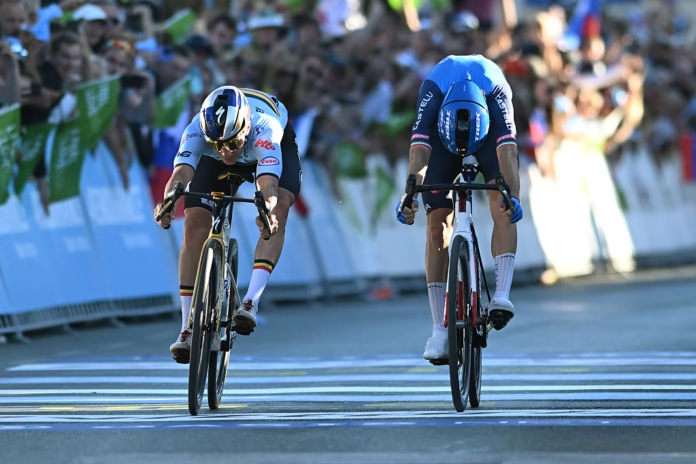
Remco Evenepoel won the 2026 European Championships men’s elite road race in 4:16:37, finishing on the same time as Giulio Ciccone. Christian Scaroni took third, 59 seconds behind, while Toms Skujiņš led the next group across the line at 1:13. The result separated the race into a two-rider fight for the title, a clear chase for bronze and a tightly compressed contest behind.
The decisive move came with 37 kilometres remaining, when Evenepoel and Ciccone attacked together. Evenepoel then crashed 15 seconds after the attack was recorded, adding uncertainty to the closing phase, but the final result confirms that he recovered and completed the race ahead of Ciccone on the same time. Scaroni’s late activity in the first chase group secured the final podium place.
That late selection was prepared by a long sequence of attacks and reductions. The opening moves repeatedly changed the shape of the peloton without producing a confirmed winning break, while the middle phase saw several riders dropped from the groups ahead. By the time the eventual winners moved clear, the field had already been narrowed through sustained pressure rather than one early action.
A restless opening leaves the race unresolved
Kristinn Jónsson made the first recorded attack with 196 kilometres remaining, and Alex Molenaar accelerated five kilometres later. Nelson Oliveira and Domen Novak then tried to alter the race, before Molenaar attacked again with 183 kilometres left. The succession established an aggressive opening, but none of these events identifies a rider or group gaining lasting control.
Jochem Kerckhaert continued the sequence at 179 kilometres to go. A four-rider counter-attack followed one kilometre later, then a separate five-rider move named Tiago Antunes, Luka Mezgec, Fabian Weiss, Josef Černý and Jakob Söderqvist. This was the first clearly defined group in the narrative, but the event record does not establish that it stayed away or became the race-winning break.
Emiliano Vila countered at 175 kilometres, followed by another acceleration from Jardi Christiaan van der Lee at 168 kilometres and an attack by Mikkel Bjerg three kilometres later. The effect was cumulative: the race kept forcing reactions, while the lack of a confirmed decisive escape left the main contenders facing a broad and unsettled contest.
Van der Lee’s second acceleration came with 102 kilometres still to race, showing that the earlier activity had not exhausted the attacking phase. A further counter-attack was recorded at 84 kilometres, but again the next clear changes came through riders being dropped rather than through a named group establishing an unassailable advantage.
Pressure turns movement into selection
The first major losses came at 104 kilometres to go. John Degenkolb, Sander De Pestel and Māris Bogdanovičs were dropped from the peloton, while Černý was dropped from the first group. Luka Mezgec and Jakob Söderqvist followed one kilometre later. Their exits materially changed the composition of the group that had included several of the earlier attackers.
The sequence was important without yet deciding the title. Černý, Mezgec and Söderqvist had all been named in the five-rider counter-attack, but the later drops show that the move had not translated into a stable winning unit. The race was being decided progressively, with each reduction removing another possible bridge to the front.
At 82 kilometres remaining, Sjoerd Bax and Gal Glivar were dropped from the peloton. Juan Ayuso, Julien Bernard and Gijs Leemreize then lost contact one kilometre later, while Jan Christen attacked. The combination of attacks and losses made the first groups increasingly significant, because fewer riders remained capable of influencing the final selection.
The next phase included a further attack by Christen and another change in the chase structure. The events do not establish a single rider controlling the race at this point, but they do show a field being thinned before the strongest late moves. That distinction matters: the decisive attack had not yet happened, but the conditions for it were being created by repeated selection.
The climb sharpens the contest
With 60 kilometres remaining, the peloton was on the Možjanca climb, described in the event sequence as 2.1 kilometres at 10.3 per cent. Ramses Debruyne was recorded pulling in the peloton two kilometres later, before Anthon Charmig was dropped with 58 kilometres left. The climb therefore coincided with another clear loss from the main group.
Pavel Sivakov accelerated at 56 kilometres to go, extending the run of attacks into the part of the race where every move had greater potential to reshape the front. The event record does not say that Sivakov’s acceleration created the winning break, but it marked another attempt to force separation after the earlier groups had already been reduced.
There had also been an earlier incident, at 151 kilometres remaining, when Heorhii Antonenko and Joel Nicolau crashed in the peloton. The event identifies the two riders involved but provides no evidence linking the crash to either the eventual result or the later selection. It is therefore part of the race chronology, not an explanation for the podium.
After the Možjanca phase, the race moved towards a more concentrated battle. The attacks had not produced a result by themselves, but they had removed riders from the groups and left the strongest contenders closer to the front. The next major change would involve the two riders who ultimately finished first and second.
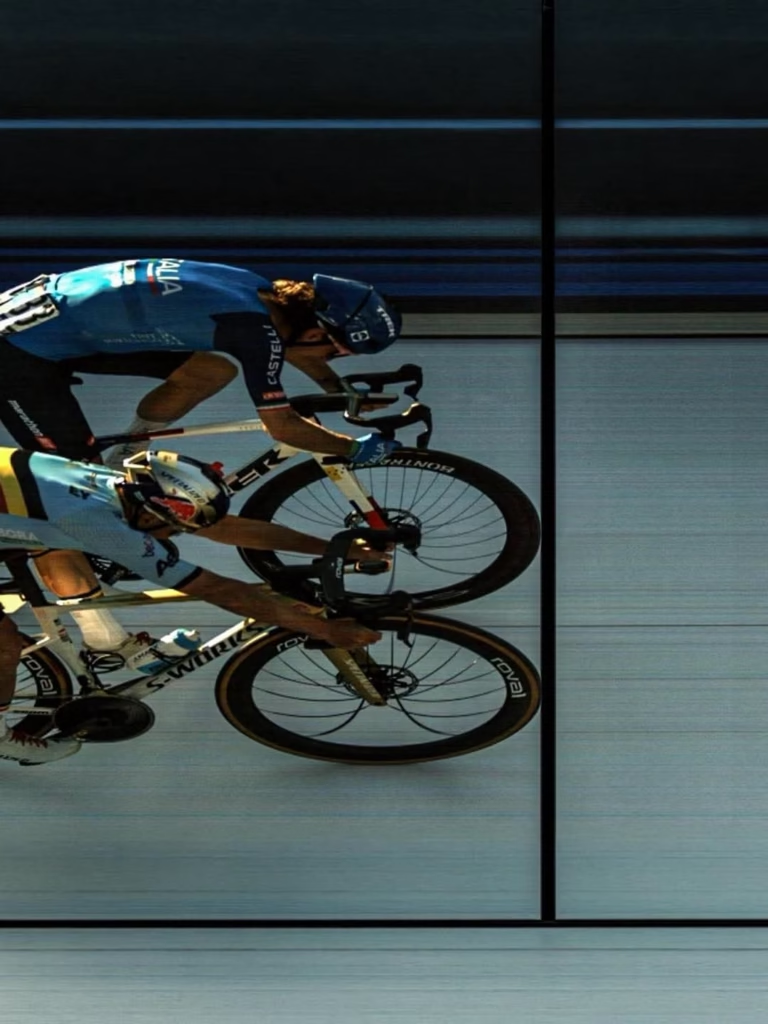
Evenepoel and Ciccone break the race open
Evenepoel and Ciccone attacked together with 37 kilometres remaining. Unlike the earlier individual moves and counters, this event directly identified the eventual winner and runner-up in the same move. It transformed the race from a broad selection into a contest centred on whether the chase could bring the pair back.
Evenepoel crashed 15 seconds after the two-rider attack was recorded. The incident involved Evenepoel alone and occurred at the same point of the race, but the packet does not establish whether it changed the time gap or the organisation behind him. The safe conclusion is that the crash interrupted the decisive move without overturning the final order.
Ciccone’s presence in the move gave him the clearest route to second place. He was not merely the closest rider in the final classification, but the rider identified alongside Evenepoel in the attack that split the race. The official result then confirmed that both finished on the same time, underlining how closely the pair remained matched at the finish.
Scaroni was already part of the contest behind the leading pair, but the gap between the two-rider move and the first chase group became the central divide. When Scaroni eventually finished 59 seconds behind, it showed that the chase had not closed the race sufficiently to challenge for the title, even though it remained important for the final podium places.
Scaroni wins the chase for bronze
The first chase group was still unsettled with 20 kilometres remaining, when Iván Romeo Abad accelerated from it. That move kept the battle for the lower podium positions active after Evenepoel and Ciccone had gone clear. It also showed that the chase was not simply riding towards a predetermined sprint or fixed order.
Scaroni then accelerated with 14 kilometres to go and attacked again one kilometre later from the first chase group. Two recorded moves in the closing phase provide the clearest narrative link to his third place. He finished 59 seconds behind Evenepoel and Ciccone, but far enough ahead of the next finishing group to secure the final podium position.
Skujiņš was fourth at 1:13, 14 seconds behind Scaroni. That gap separated the podium from the riders immediately behind, although the fight for fourth and the remaining top-10 places was much tighter. Skujiņš therefore occupied a distinct position in the result, leading a compressed group rather than joining the bronze-medal contest.
Romeo Abad, Ramses Debruyne, Emil Herzog and Maxim Van Gils all finished at 1:16. Léo Bisiaux was next at 1:18, with Primož Roglič at 1:19. The three-second spread from fourth to tenth demonstrates how little separated much of the chase at the finish, even though Scaroni had already created a clear gap to that group.
Why the winning margin held
Evenepoel’s title was won through the late move with Ciccone, not through any one of the many early attacks. Jónsson, Molenaar, Oliveira, Novak, Kerckhaert, Van der Lee, Bjerg and others kept the race moving, while the counter-attacks and successive drops reduced the number of riders able to influence the finale. That long selection was the foundation, but the two-rider attack was the decisive event.
The evidence also separates the winner’s position from the size of his margin. Evenepoel retained first place after the crash, but Ciccone finished on the same time, so the result does not support a claim that the winning gap grew late. Instead, the decisive advantage was the pair’s separation from the chase, with Scaroni ending 59 seconds behind and Skujiņš a further 14 seconds back.
-
 Photo Credit: Getty

Ciccone was the closest rival because he made the decisive move with Evenepoel and stayed level with him on the official result. Scaroni reached the podium through a different route, using two late accelerations from the first chase group to finish clear of the tightly packed riders behind. Their final positions therefore came from two distinct late-race contests.
The race finished with Evenepoel first in 4:16:37 and Ciccone on the same time. Scaroni completed the podium at 59 seconds, followed by Skujiņš at 1:13. Romeo Abad, Debruyne, Herzog and Van Gils shared 1:16, Bisiaux finished at 1:18 and Roglič at 1:19. The final classification captured a race decided by one late move, with the remaining places settled in a much narrower chase.
European Championships Men Elite Road Race 2026 Result
| Pos. | Rider | Team / nation | Time / gap |
|---|---|---|---|
| 1 | Remco Evenepoel | Belgium | 4:16:37 |
| 2 | Giulio Ciccone | Italy | Same time |
| 3 | Christian Scaroni | Italy | +00:59 |
| 4 | Toms Skujiņš | Latvia | +01:13 |
| 5 | Iván Romeo Abad | Spain | +01:16 |
| 6 | Ramses Debruyne | Belgium | +01:16 |
| 7 | Emil Herzog | Germany | +01:16 |
| 8 | Maxim Van Gils | Belgium | +01:16 |
| 9 | Léo Bisiaux | France | +01:18 |
| 10 | Primož Roglič | Slovenia | +01:19 |

