
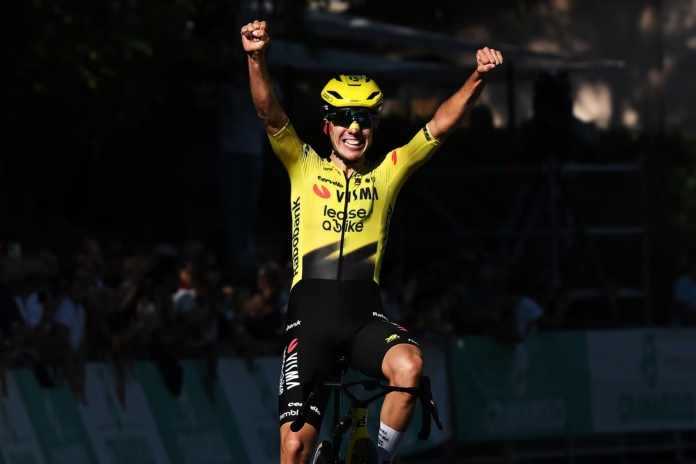
Davide Piganzoli won the 2026 Giro dell’Emilia for Team Visma | Lease a Bike, finishing in 4:33:19 after making the decisive move with 4.8 kilometres remaining. Tom Pidcock and Oscar Onley crossed two seconds later, with Pidcock taking second and Onley third on the same time.
The race was shaped by a long reduction in the breakaway’s advantage, followed by an increasingly selective contest among the favourites. Piganzoli first appeared in the late attacking sequence at 20 kilometres to go, then separated himself from the group with his move inside five kilometres. The gap grew before the chasers brought it back towards the finish, but not enough to deny him the win.
Behind him, Pidcock produced the strongest late response among the pursuers, while Onley attacked in the final 500 metres to secure third. Ben Tulett completed a strong result for Visma in fourth at five seconds, and Matteo Jorgenson finished fifth at 12 seconds after also featuring in the decisive phase.
How it unfolded
The breakaway still held a 1.63-kilometre advantage over the peloton with 158 kilometres remaining, a margin that placed the early race in a state of balance rather than immediate crisis. By 83 kilometres to go, that gap was decreasing, signalling the first sustained change in the race without yet determining which riders would control the finish.
The situation briefly moved the other way at 49 kilometres, when the gap between the break and peloton was increasing. That shift did not last. Seven kilometres later, the escape had only 470 metres in hand, and an acceleration in the peloton at 40 kilometres to go marked the transition from a long chase into the more consequential part of the race.
Kevin Pezzo Rosola was dropped from the break at 38 kilometres, reducing the escape just as the main field began to apply more pressure. Luke Plapp accelerated one kilometre later, followed by an attack from Pello Bilbao. A four-rider counter-attack at 34 kilometres added another layer to the selection, but none of these moves yet produced the winning gap.
The breakaway loses its protection
The sequence around 40 to 34 kilometres mattered because the breakaway’s advantage had already been reduced to a narrow margin before the attacks began. Pezzo Rosola’s drop showed that the escape was no longer holding together, while Plapp and Bilbao’s moves shifted attention towards the riders trying to bridge or force the next selection from behind.
Quentin Pacher accelerated at 28 kilometres, extending a run of separate attacks rather than a single uninterrupted move. The repeated changes made the race increasingly selective, but the decisive rider had not yet emerged. The important consequence was that the field was being filtered before the final confrontation, leaving fewer riders to respond when the principal attacks arrived.
At 20 kilometres, Piganzoli joined that attacking pattern with an acceleration of his own. Jorgenson followed one kilometre later, while Brandon McNulty attacked at the same point and briefly opened a small gap. McNulty was caught almost immediately, and Ben Healy then accelerated before Pidcock made his own move.
That cluster of attacks gave the race its decisive structure. Piganzoli was active at the front of the selection, Jorgenson was also trying to move clear, and Pidcock was among the riders capable of answering the changes. McNulty’s short-lived move showed how difficult it was to stay away at that point, but the continued pressure was steadily reducing the group of favourites.
A shrinking group of favourites
Jhonatan Narváez accelerated with 14 kilometres remaining, keeping the pressure on after the attacks at 20 and 19 kilometres. Pello Bilbao attacked again at 11 kilometres, while Adam Yates was recorded pulling in the group of favourites. The chase was therefore being shaped by both attacks and an active pursuit from within the reduced group.
Narváez and Lenny Martinez were dropped from the favourites’ group at 11 kilometres. That was a clear change in the race’s composition: riders who had still been part of the principal selection were no longer able to follow, while Bilbao’s second acceleration also failed to keep him in the front group.
Jorgenson opened a small gap at 10 kilometres, but Bilbao was dropped one kilometre later. Jorgenson’s move created another brief separation, yet the race remained unsettled rather than resolved. Piganzoli was still positioned to make the move that would decide the win, while Pidcock and Onley remained close enough to contest the podium.
The late selection also explains the final distribution of the result. Tulett stayed within five seconds of Piganzoli, Jorgenson remained within 12, and Healy finished 22 seconds behind. Bilbao, despite his repeated attacks, ended 1:51 down, while Narváez finished 5:33 back. Their earlier presence in the action did not translate into the final leading group.
Piganzoli creates the winning gap
Piganzoli attacked with 4.8 kilometres remaining, turning his earlier activity into the move that mattered. Thirty seconds later he had opened a small gap, and with 2.1 kilometres left the distance to the group of favourites was increasing. The sequence established the difference between an acceleration within the selection and a move capable of producing a race-winning advantage.
The gap began to decrease at 700 metres to go, so Piganzoli did not arrive at the finish with an unchallenged lead. The late reduction made the final kilometres a genuine chase, but the earlier increase had given him enough margin to remain ahead. At 4:33:19, he completed the race two seconds clear of Pidcock and Onley.
Pidcock was recorded pulling in the group at 1.9 kilometres to go, an effort that helped shape the pursuit and ultimately placed him second. His response was not enough to close the distance to Piganzoli, but it was sufficient to finish ahead of the rest of the chasers.
The chase also had to absorb a final sequence of attacks. Onley accelerated with 500 metres remaining, and Pidcock attacked again at 400 metres. Those moves decided the order behind Piganzoli rather than the winner’s identity. Pidcock took second, Onley third, and both finished two seconds behind the winner.
The podium fight goes to the line
The fight for the remaining podium places was much closer than the contest for the win once Piganzoli’s gap had begun to grow. Pidcock’s work at 1.9 kilometres and his attack inside the final 400 metres helped him finish second, while Onley’s move at 500 metres secured third. The two riders were separated on the official result despite finishing on the same time.
Tulett was the next rider home, five seconds behind Piganzoli. His fourth place placed another Visma rider immediately behind the podium, while Jorgenson’s fifth at 12 seconds confirmed that the team had multiple riders in the decisive selection.
Healy finished sixth at 22 seconds, followed by Lorenzo Fortunato at 29 seconds and Michael Storer at 37 seconds. Adam Yates and Brandon McNulty completed the top 10, both 45 seconds behind Piganzoli. McNulty’s presence in that group came after his brief attack at 19 kilometres, which was caught before the later selection was completed.
Why Piganzoli won
Piganzoli’s victory came from the combination of sustained late involvement and the one attack that produced a lasting separation. He was part of the attacking phase at 20 kilometres, remained in the reduced contest as Narváez, Martinez and Bilbao were dropped, and then moved clear at 4.8 kilometres.
The timing of the final move was decisive. The gap first increased through the section from 4.8 kilometres to 2.1 kilometres remaining, establishing the foundation for victory. Although the favourites reduced it inside the final kilometre, the recovery came too late to change the winner.
Pidcock’s second place was built in the closing chase, where he helped pursue Piganzoli and then attacked in the final 400 metres. Onley waited until the final 500 metres to make his move and finished alongside Pidcock on time. Tulett and Jorgenson completed Visma’s broader presence at the front, but neither could match Piganzoli’s separation.
The remaining top 10 reflected the strength of the final selection: Healy was 22 seconds down, Fortunato 29, Storer 37, and Yates and McNulty 45. Behind them, Lorenzo Mark Finn also finished on 45 seconds, while Thymen Arensman was 1:22 behind and Clément Berthet 1:34 down.
Piganzoli therefore converted the final attack into a two-second win, with Pidcock and Onley completing the podium. The race was not decided by the first breakaway advantage or the earlier exchanges alone, but by Piganzoli’s ability to turn the late sequence of accelerations into the only decisive gap.
Giro dell’Emilia Men 2026 Result
| Pos. | Rider | Team / nation | Time / gap |
|---|---|---|---|
| 1 | Davide Piganzoli | Team Visma | Lease a Bike | 4:33:19 |
| 2 | Tom Pidcock | Pinarello Q36.5 Pro Cycling Team | +00:02 |
| 3 | Oscar Onley | Netcompany INEOS | +00:02 |
| 4 | Ben Tulett | Team Visma | Lease a Bike | +00:05 |
| 5 | Matteo Jorgenson | Team Visma | Lease a Bike | +00:12 |
| 6 | Ben Healy | EF Education – EasyPost | +00:22 |
| 7 | Lorenzo Fortunato | XDS Astana Team | +00:29 |
| 8 | Michael Storer | UAE Team Emirates – XRG | +00:37 |
| 9 | Adam Yates | Tudor Pro Cycling Team | +00:45 |
| 10 | Brandon Mcnulty | UAE Team Emirates – XRG | +00:45 |

