Johan van der Velde’s career is difficult to reduce to a conventional list of wins. At his best, the Dutchman could climb with the strongest riders of his generation, win from distance, collect points across a Grand Tour and work inside one of the most organised teams professional cycling had yet seen. He finished third in the Tour de France, won major one-day races and became a three-time winner of the Giro d’Italia points classification.
Yet the results tell only part of it. Van der Velde’s career moved from the highly controlled world of TI-Raleigh to Italian teams, spectacular Giro performances and, eventually, a difficult life away from racing. The contradictions are important because they explain why he remains such a distinctive figure in Dutch cycling history. He was a rider capable of riding for a leader one week and looking like a Grand Tour contender himself the next.
From Rijsbergen to TI-Raleigh
Born in Rijsbergen in the Netherlands on 12 December 1956, Van der Velde emerged at a time when Dutch professional cycling had considerable depth. His route into the top level led to TI-Raleigh, the team managed by Peter Post and built around discipline, collective strength and an ability to control races through numbers. It was an environment that could be demanding, but it suited a rider whose range extended well beyond one speciality.
Van der Velde became an important part of the team during its most successful period. The wider history of TI-Raleigh is full of riders who could win individually while still being expected to fit a tightly defined team plan. Van der Velde was one of the clearest examples. He had the engine for hard stage races, could survive serious climbing and had enough speed to turn good positions into victories.
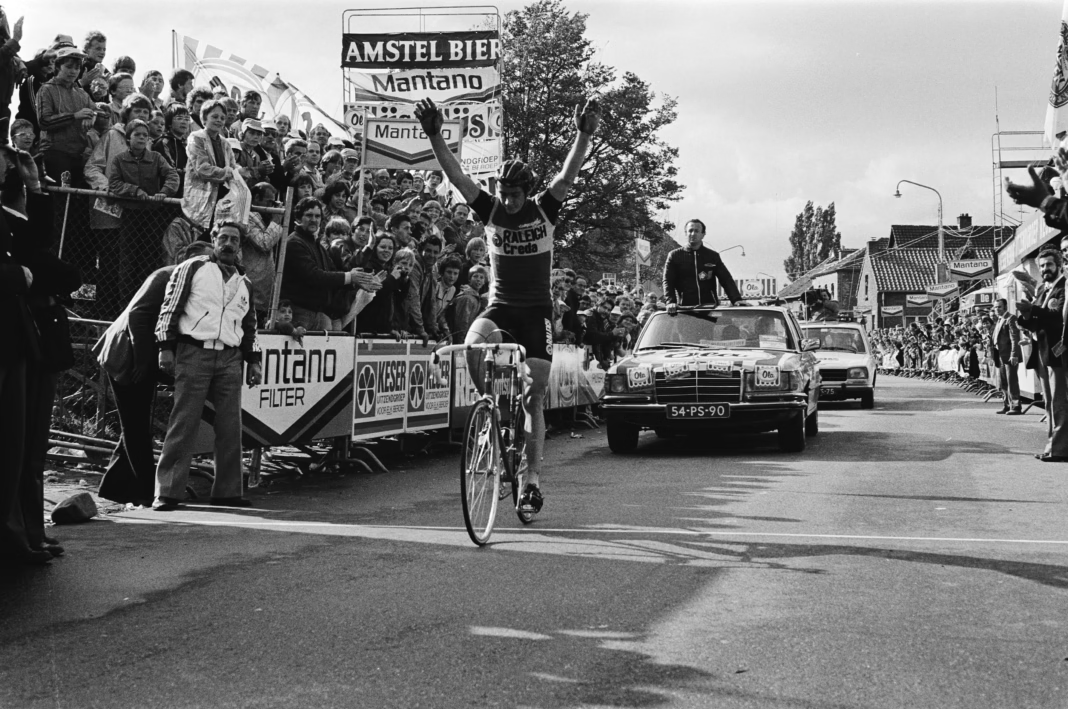
His first professional seasons quickly established that he was not simply another domestique. He won the Tour of Britain in 1978 and the Dutch road title in 1980. That national championship came during a season in which TI-Raleigh’s strength was becoming almost overwhelming in stage racing, especially at the Tour de France.
The 1980 Tour and a place among the best
The 1980 Tour de France was the clearest demonstration of Van der Velde’s potential as a general classification rider. Joop Zoetemelk won the Tour for TI-Raleigh, finally converting years of near misses into overall victory, while the team accumulated stage wins throughout the race. Van der Velde finished 12th overall and won the young rider classification, evidence that he could already carry his own ambitions through three weeks while contributing to a dominant team.
Two years later he went considerably further. In the 1982 Tour de France, Bernard Hinault took his fourth overall victory, but Van der Velde finished third. Only Hinault and Zoetemelk were ahead of him in Paris. A Tour podium put him into a different category: not merely a versatile winner, but a rider who had proved he could remain near the front of the general classification across the mountains and time trials of the biggest race in cycling.
That result also helps explain the sense that his career could have developed in several directions. A rider with a Tour podium might ordinarily have been pushed towards increasingly narrow general classification preparation. Van der Velde instead continued to race with a much broader brief. He won Liège-Bastogne-Liège in 1981, took the Championship of Zurich in 1982 and remained dangerous in races where positioning, climbing and endurance mattered in different proportions.
A rider who never fitted one category
Van der Velde was neither a pure climber nor a conventional sprinter. That ambiguity was an advantage in an era when stage racing rewarded riders who could repeatedly place near the front across very different terrain. His climbing was good enough for a Tour podium, but his ability to score highly on flatter and rolling stages later made him unusually effective in the Giro’s points competition.
He also possessed the attacking instinct expected of leading riders in the period. Long stages and less specialised team roles created opportunities for riders who could judge a break, cope with poor weather and still have enough left to race at the finish. Van der Velde’s strongest performances often came when a race became difficult to classify neatly. That quality made him valuable to strong teams but also meant his palmarès developed in a less linear way than those of riders built around one Grand Tour or one set of Classics.
His move away from TI-Raleigh changed the context around him. The Dutch team’s structure had provided one of the strongest support systems in the peloton. Racing for Italian squads placed him in a different culture and eventually brought out another side of his abilities, particularly at the Giro d’Italia.
The Giro years and three points classifications
Van der Velde’s relationship with the Giro became one of the defining strands of his career. He won the points classification in 1985 with Vini Ricordi, then again in 1987 and 1988 with Gis Gelati. Three victories in four editions were unusual for a rider whose earlier reputation rested partly on climbing and Tour general classification results.
The 1987 Giro showed how effective he could be. Stephen Roche eventually won the overall race after the famous internal conflict at Carrera with defending champion Roberto Visentini. Van der Velde won stages 15 and 16 on consecutive days and finished fourth overall. He also won the points classification with 175 points, four ahead of Paolo Rosola. It was perhaps the most complete Giro of his career, combining stage-winning speed with a general classification performance close to the podium.
He retained the points title in 1988, the Giro won by Andy Hampsten. That edition also produced the image most closely associated with Van der Velde decades later: the stage over the Passo di Gavia. Snow, freezing temperatures and appalling visibility turned the mountain into one of the most famous days in Grand Tour history. Van der Velde was first over the Gavia summit after attacking on the climb, but the descent and cold transformed the race.
His ride is sometimes remembered only through the drama that followed, which misses the sporting point. Reaching the summit first in those conditions required an enormous effort. The problem was that the stage did not finish there. Hampsten’s better management of the conditions helped put him into the pink jersey, while Van der Velde lost substantial time before reaching Bormio. He still completed the Giro and still won the points classification, a reminder of how consistently he had scored throughout the race.
Success, instability and the end of the first career
The late 1980s also exposed the less stable side of Van der Velde’s life. Professional cycling of the period was physically harsh and its culture around medication and stimulants was very different from the modern peloton. Van der Velde later spoke publicly about amphetamine use and addiction. Those problems continued beyond his racing career and cannot sensibly be separated from the way his life developed after he stopped competing at the top level.
He left professional cycling in 1990, still only in his early thirties. The transition was difficult. Financial and personal problems followed, and his drug addiction became part of a period in which the status he had held as one of the Netherlands’ leading riders disappeared quickly. He was later convicted of offences connected to theft and spent time in prison.
There is a temptation with riders from this era either to romanticise the chaos or to allow it to erase the racing. Neither approach gives a useful picture. Van der Velde’s problems were serious, but so were his results. A Tour podium, Liège-Bastogne-Liège, major stage-race performances and three Giro points classifications amount to a career that would stand out in any generation.
A return to cycling
Cycling eventually became part of Van der Velde’s life again. After the most difficult years following retirement, he returned to the sport in public-facing roles and remained a recognisable figure in Dutch cycling. His son Ricardo also became a professional rider, extending the family’s connection with the peloton into another generation.
Van der Velde’s later visibility changed the way his story could be viewed. Instead of ending with the collapse that followed his professional career, it became possible to see a longer arc: elite success, addiction and criminality, then a degree of stability and reconnection with the sport that had defined his early adult life.
That does not make the difficult parts incidental. They are central to understanding the man and the period. Cycling in the late 1970s and 1980s could create famous riders without providing much preparation for life when the contracts, structure and daily racing stopped. Van der Velde’s experience was an extreme case, but it was not completely detached from the culture around him.
How Johan van der Velde should be remembered
In purely sporting terms, Van der Velde belongs among the strongest Dutch stage racers of his generation. Third in the 1982 Tour de France and fourth in the 1987 Giro are results of genuine Grand Tour quality. Add a Liège-Bastogne-Liège victory, the Dutch national title, major one-day wins and three Giro points jerseys, and the breadth becomes more striking than any single result.
His racing also resists modern labels. A rider capable of a Tour podium would now be protected as a specialist general classification leader. Van der Velde could instead move between supporting a Tour winner, contesting Classics, winning stages and accumulating points over three weeks. The sport asked different things of riders, and he was unusually well equipped to answer several of them.
The Gavia remains the easiest image to summon: Van der Velde alone at the top of a snow-covered mountain before the race turned against him on the descent. His career had the same uneven shape. There were periods when he seemed capable of almost anything, followed by losses that were far more serious than minutes on a classification. The complete record is compelling precisely because both sides are there.