The women’s elite time trial at the 2026 European Championships should be a much closer contest than Marlen Reusser’s 40-second World Championships victory in Montréal suggested. Reusser remains the clear reference point, but the 22.1km Šenčur course is shorter, steeper and more irregular than the flat 39.2km Worlds test.
Demi Vollering, Franziska Koch, Elisa Longo Borghini and Cédrine Kerbaol are the most obvious challengers. Vollering comes into Wednesday’s race after winning the European road title on the same finishing circuit, while Koch, Longo Borghini and Kerbaol all finished inside the top five of the World Championships time trial.
The route gives the strongest climbers a genuine opportunity to take time out of the pure specialists. Možjanca averages just over 10% for roughly two kilometres, with steeper ramps near the top, before a rolling section and faster descent return the riders to the flatter roads around Šenčur.
Reusser still starts as favourite because she has been the best elite time triallist in the world across two very different championship courses in the last year. The question is whether the extra climbing brings Vollering and Longo Borghini close enough to turn the title into a much tighter race.
Previous winners
2025 – Marlen Reusser
2024 – Lotte Kopecky
2023 – Marlen Reusser
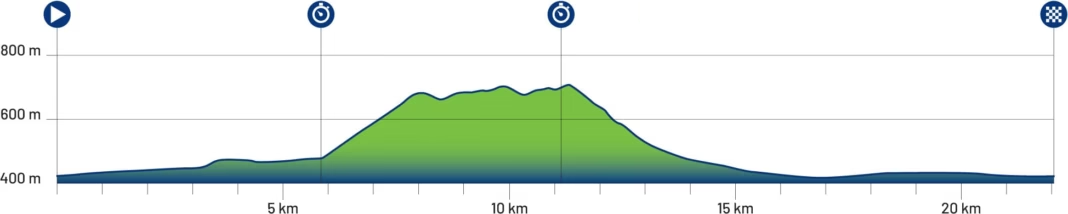
Women’s European Championships time trial route
The women race one lap of the 22.1km Šenčur circuit, with 367 metres of climbing packed into a course that is far more selective than its distance suggests. The opening kilometres are relatively flat, allowing the more powerful riders to settle into a high speed before the route turns towards Možjanca.
The climb is the key section. Možjanca is around 2.1km at 10.2%, with the steepest ramps pushing towards 16%. It comes early enough that riders cannot simply empty themselves on the ascent and hold on to the finish. The best efforts will balance a fast opening against the need to arrive at the foot of the climb with enough left to keep the cadence high.
The road continues to rise and roll after the summit before the descent back towards the valley. There is one tighter hairpin where bike handling matters, but this is not a relentlessly technical course. The final kilometres are flatter again, giving Reusser, Koch and the stronger aerodynamic specialists a chance to recover time lost on the climb.
That makes pacing more complicated than Montréal. A rider can lead at the first checkpoint and still lose the race badly on Možjanca, while a climber who starts too conservatively may not have enough road after the descent to recover the deficit. Our 2026 European Championships route guide covers the Šenčur circuit in more detail.
Marlen Reusser remains the rider to beat
Marlen Reusser arrives as both defending European champion and double world champion. She won the 2025 European title by 49 seconds and then retained the rainbow jersey in Montréal two weeks ago, beating Zoe Bäckstedt by 40 seconds after producing the fastest second half of the race.
The important detail is that those two wins came on very different courses. Kigali in 2025 rewarded climbing and pacing over an undulating route, while Montréal was a much flatter power test. Reusser was best on both.
Šenčur is shorter and steeper than either, which narrows her margin for error. The climb favours lighter riders and the 22.1km distance leaves less time for Reusser to use sustained power to recover any deficit. Even so, her ability to climb at a high tempo without losing aerodynamic efficiency makes her difficult to oppose.
She is also racing for a fifth European time-trial title. Another win would move her clear at the top of the all-time list.
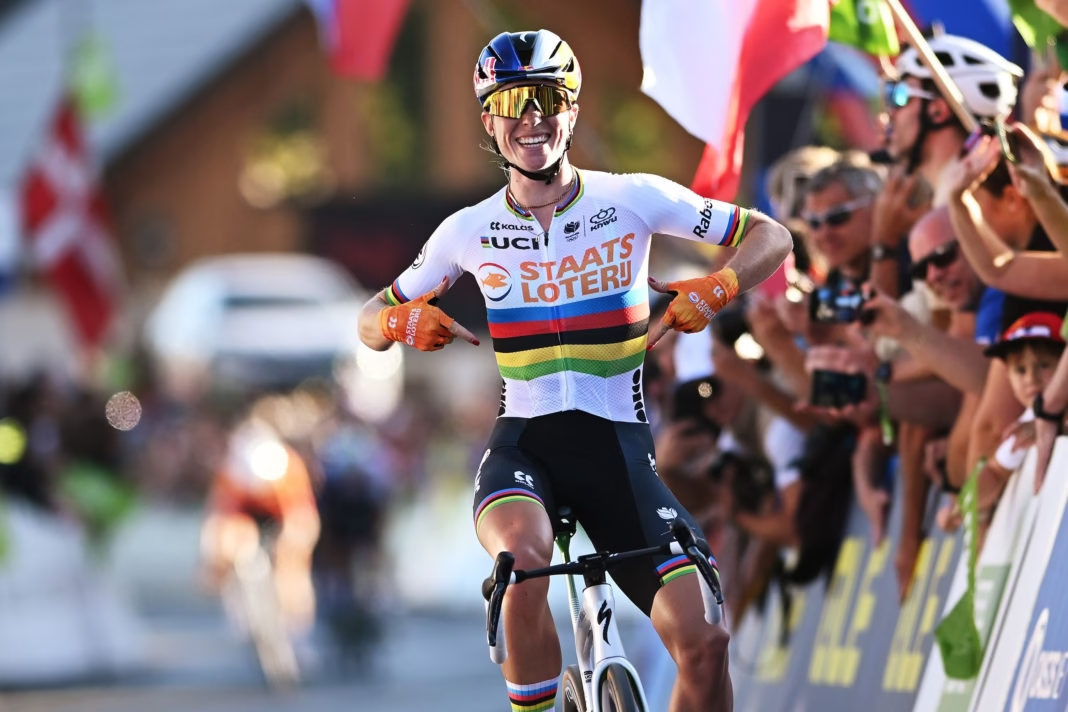
Demi Vollering has the course that Montréal did not give her
Demi Vollering finished eighth in the World Championships time trial, almost 1:50 behind Reusser, but the raw gap is less useful than the course context. Montréal was largely flat and rewarded riders who could hold a very high aerodynamic speed for close to 40km.
Šenčur gives Vollering much more to work with. She has already shown exactly how well Možjanca suits her by attacking on the final ascent of Saturday’s road race and riding clear to defend her European title. The time trial uses the same climb once, and there is enough gradient for her to take meaningful time out of heavier specialists.
The challenge is what happens either side of it. Vollering still has to limit her losses through the faster opening kilometres and then produce enough speed after the descent to stop Reusser taking the time back. She does not need to match the Swiss rider everywhere. She needs to make the climb important enough that the rest of the course cannot cancel it out.
Her road-race victory also confirms the form is there. Four days between the two elite events should be enough recovery for the race itself not to be the concern.
Franziska Koch arrives from a World Championships podium
Franziska Koch was one of the biggest performers in Montréal, finishing third and spending a long spell in the hot seat before Bäckstedt and Reusser came through.
Koch finished only five seconds behind Bäckstedt and less than five seconds ahead of Longo Borghini. That performance makes her impossible to leave out of the medal discussion, particularly because the European course is short enough to reward her ability to start hard and maintain speed.
The climb is the obvious question. Koch is not as naturally suited to a 10% ascent as Vollering or Longo Borghini, so she needs to build time before Možjanca and then avoid giving too much of it back. If she reaches the summit within a handful of seconds of the best climbers, the final flat section works in her favour.
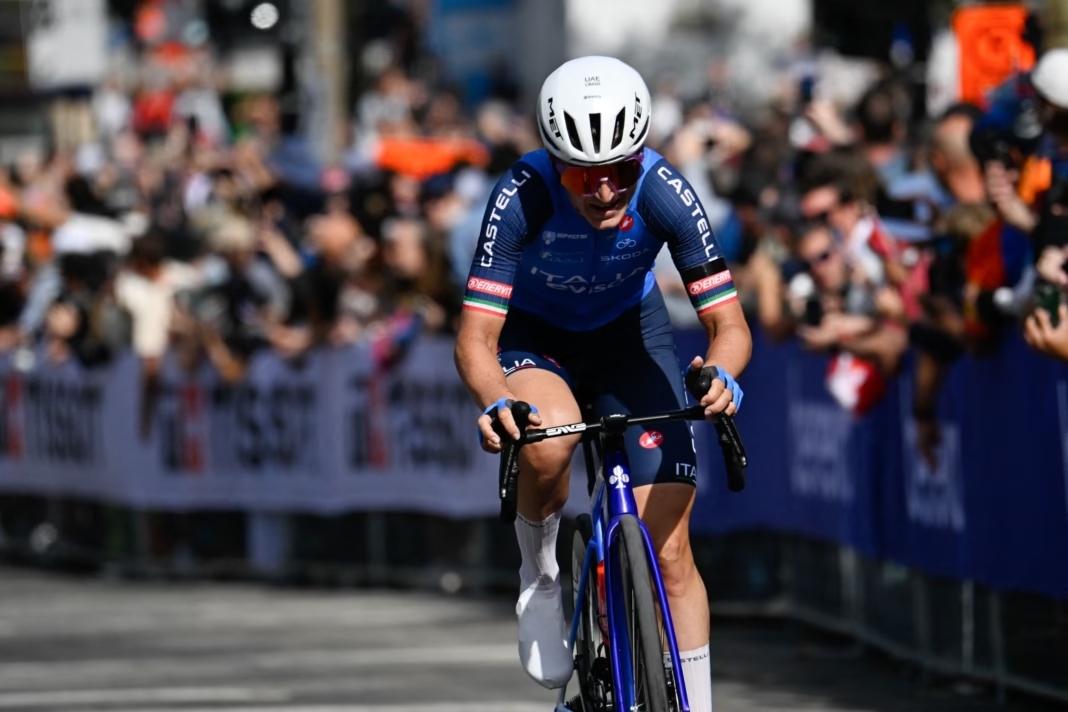
Elisa Longo Borghini could turn the climb into her advantage
Elisa Longo Borghini missed the World Championships time-trial podium by less than five seconds, finishing fourth behind Koch. She then took fourth again in Saturday’s European road race after losing contact with Vollering on the final Možjanca climb before recovering into the chase.
That road-race result shows both sides of her chances. Vollering was stronger on the steepest section, but Longo Borghini still climbed well enough to remain in medal contention and has considerably stronger sustained time-trial speed than most of the pure climbers in this field.
She does not need to beat Vollering on Možjanca if she can start faster and lose only a small amount on the climb. The Italian’s best route to gold is a balanced ride rather than trying to turn the ascent into an all-out climbing test.
Cédrine Kerbaol is well suited to the mixed demands
Cédrine Kerbaol was fifth at the World Championships time trial, 20 seconds behind Longo Borghini and just over a minute behind Reusser. She did that on a course that leaned more towards the pure specialists than Wednesday’s route does.
Kerbaol’s climbing and descending ability make her particularly interesting in Šenčur. She should lose less than Koch or some of the heavier riders on Možjanca and is strong enough against the clock to avoid surrendering everything on the flatter sections.
A medal is realistic. Winning probably requires Reusser to have an imperfect day and Vollering to give away too much time before the climb, but this is one of the better championship time-trial courses Kerbaol could ask for.
Dominika Włodarczyk and Steffi Häberlin can threaten the top five
Dominika Włodarczyk finished ninth in Montréal and brings another combination of climbing ability and solid time-trial form. The shorter European course should reduce the penalty she pays to the strongest specialists on the flat, while Možjanca gives her somewhere to gain it back.
Steffi Häberlin is harder to place but has enjoyed a strong season and comes into the event as Swiss road champion. She will not have the same pressure as Reusser and can ride her own pacing plan, which makes a top-five challenge plausible if she handles the climb well.
Monica Trinca Colonel and Lieke Nooijen are also capable of strong rides, while Juliette Berthet should benefit from a course where climbing matters more than it did at the World Championships.
Lauren Dickson carries the British interest
Lauren Dickson is Great Britain’s only starter and begins at 14:40 CEST, 13:40 BST. Her immediate form is strong after finishing third at Giro dell’Emilia Donne on Saturday, where she was one of the best riders on the double ascent of San Luca.
This is a very different test, and Dickson does not arrive with the same elite time-trial record as Reusser, Koch or Longo Borghini. The climbing nevertheless gives her a better opportunity than a flat championship course would. A solid first half followed by a strong Možjanca could put her into the top half of the result and potentially higher if the specialists misjudge the pacing.
What will decide the women’s European time trial?
The race should be decided by the trade-off between the first six kilometres and Možjanca. Reusser and Koch can afford to take time early, but neither wants to reach the climb already close to the limit. Vollering and Longo Borghini can gain more uphill, but they cannot allow the gap to become too large before the road tilts up.
The section after the summit may be just as important. Riders need to recover quickly from a two-kilometre effort at around 10% and then return to a high aerodynamic speed through the descent and final flat kilometres. Anyone who takes too long to settle back into position will lose seconds quickly.
Reusser remains the safest pick because she has fewer weaknesses than anyone else in the field. Vollering has the clearest route-based challenge, while Koch and Longo Borghini have the recent time-trial results to punish either favourite if they get the pacing wrong.
How to watch the women’s European Championships time trial
The first rider starts at 14:30 CEST on Wednesday 7 October, which is 13:30 BST. Reusser is the final rider away at 14:54 CEST, 13:54 BST.
UK coverage is available through TNT Sports and HBO Max. Our European Championships TV guide has the full broadcast schedule, while the women’s time trial start list has every rider’s local and UK start time.
Top 3 prediction
1. Marlen Reusser
2. Demi Vollering
3. Elisa Longo Borghini