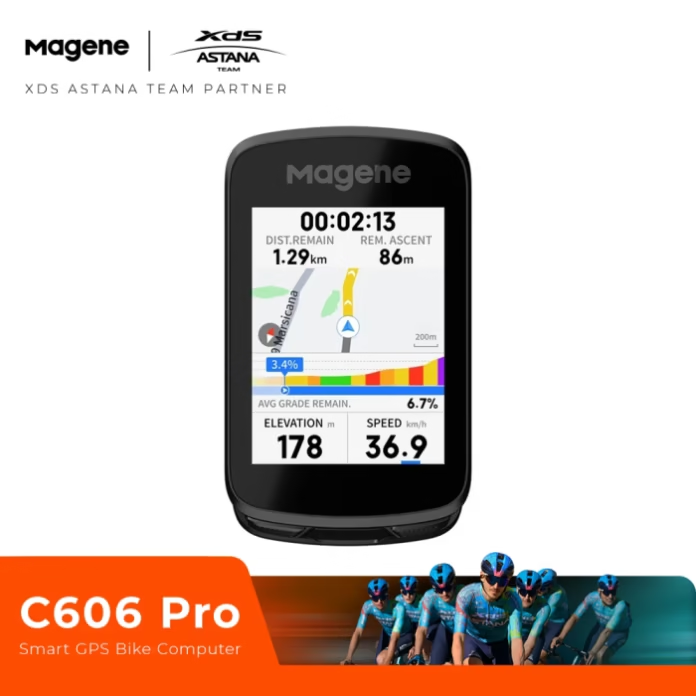
Magene has two GPS bike computers competing for riders who want mapping, training data and modern connectivity without paying Garmin or Wahoo flagship prices. The C606 Pro costs £209 at UK list price, while the larger C706 is £239. That £30 difference looks small, but the two units take noticeably different approaches to navigation, satellite reception and on-bike controls.
The Magene C606 Pro at Tredz has a 2.8-inch transflective touchscreen, a claimed 25-hour battery life and a compact 105g body. The Magene C706 at Tredz moves to a 3.3-inch screen, dual-band satellite reception, voice instructions and five physical buttons. Those are useful upgrades, although recent independent reviews of both devices raise concerns about the reliability of mapping and rerouting.
This comparison uses Magene’s official specifications and independent testing rather than claiming that ProCyclingUK has ridden with either computer. The October road.cc assessment of the C606 Pro and Cycling Weekly’s review of the C706 are particularly relevant because they test how the hardware behaves away from a specification sheet. Both make it clear that a generous feature list is only half the story.
This article contains affiliate links where available. ProCyclingUK may earn a commission on qualifying purchases without changing the price you pay. The most important buying decision here is not which device has the longer list of features, but how much you rely on the computer to find its way through unfamiliar roads.
Magene C606 Pro vs C706: the differences
At UK list prices the C606 Pro is £209 and the C706 £239. Magene claims the C606 Pro weighs 105g, against 111g for the C706. The smaller model uses a 2.8-inch transflective colour touchscreen, designed to remain legible in sunlight without drawing as much power from its backlight. The C706 has a larger 3.3-inch TFT colour touchscreen and more space for mapping and data.
Both support ANT+, Bluetooth and Wi-Fi, with 8GB of storage, USB-C charging, Strava Segments, route-based climbing information, compatible power meters and smart trainers. The C606 Pro has three buttons; the C706 has five. Magene quotes up to 25 hours for the C606 Pro and 17 to 25 hours for the C706, depending on settings and use.
The C706 has dual-band satellite positioning rather than the C606 Pro’s single-band system. It also adds spoken navigation prompts, an electronic bell, a configurable ambient alert ring and freeride ClimbPro, which can identify climbs outside a preloaded route. These are practical differences, especially for riders who explore unfamiliar roads or want navigation without constantly looking at the display.
The C606 Pro counters with lower weight, a smaller footprint and its transflective screen. Its interchangeable mount orientation may also help with different cockpit layouts. Riders whose main requirement is to see speed, power, heart rate and an occasional breadcrumb or map may find the smaller unit easier to justify.
Navigation: the issue that matters most

The C606 Pro promises turn-by-turn mapping, imported routes, offline navigation and automatic rerouting. The feature list sounds competitive with much more expensive units. In his road.cc test published on 7 October, however, Paul Grele found that the actual mapping was much less convincing than route creation in the companion app.
The reviewer found the app intuitive and route plotting straightforward, but said rerouting on the computer was unreliable. The screen could also be difficult to read in bright reflections or rain, and touch responses sometimes needed several attempts. His overall verdict was five out of ten, describing the C606 Pro as nicely made but let down by navigation.
Those shortcomings matter more on an unfamiliar ride than on a familiar training loop. When a junction arrives quickly, a computer needs to show an unambiguous instruction and react promptly if a turn is missed. A device that demands repeated touches or sends the rider through confusing rerouting steps can become distracting, even if it records speed and power accurately.
The C706 is not an automatic cure. Cycling Weekly’s recent review praised its hardware value but also reported unreliable onboard route calculation and rerouting. Its reviewer found that radar integration needed improvement. In other words, spending another £30 buys better navigation hardware and more useful prompts, but it does not guarantee Garmin-level software reliability.
For a rider who regularly explores complex city streets, remote lanes or unfamiliar junctions, that distinction is important. Dual-band GNSS can help positioning in difficult environments, but positioning accuracy and route-planning logic are different problems. Better satellite reception cannot repair an awkward rerouting algorithm.
Screen, controls and visibility
Magene’s C606 Pro screen uses transflective technology. This is intended to improve visibility in strong sunlight and reduce battery demand, but the road.cc test reported reflections that obscured the display. The same reviewer found raindrops and glove wiping could cause accidental screen changes, while some touches were not recognised first time.
The C706 offers more screen area and five physical buttons. Those extra controls should be useful in wet weather or with gloves, although their real-world convenience depends on the software behind them. The bigger display also provides room for more detailed maps and multiple data fields, which may suit riders following unfamiliar routes.
Neither computer should be judged purely by screen dimensions. Legibility in low winter sun, readability in rain and the number of actions needed to change a page all matter. A smaller display with clear information can be better than a large one with poorly organised menus. The independent tests suggest buyers should pay close attention to interface behaviour.
Battery, training and sensor support
The C606 Pro’s claimed 25-hour battery life is a selling point, particularly for long club rides, sportives and all-day routes. road.cc listed battery endurance among its positives. The C706’s published range of 17 to 25 hours is also competitive, although the larger display, navigation activity and chosen settings will influence real-world results.
Both computers support power meters, heart-rate straps, cadence and speed sensors, electronic shifting information and smart-trainer functions. Magene also supports structured workouts and advanced cycling dynamics with compatible power meters. That makes either unit capable of handling a serious training setup without requiring an expensive flagship computer.
ClimbPro information is available on both, but the C706 extends the feature to freeride climbs without a preloaded course. This is a meaningful distinction for riders who frequently change routes or ride by feel. The C606 Pro’s route-based climbing information is sufficient if you generally follow a planned GPX file.

Magene’s OnelapFit app is an important part of the experience. road.cc liked the C606 Pro’s straightforward route planning, and the company’s wider ecosystem allows synchronisation with services such as Strava and TrainingPeaks. It is worth checking which functions require a phone connection and which operate entirely on the head unit.
C706 extras: useful or unnecessary?
The C706 adds a speaker for spoken navigation and ride alerts, an electronic bell and an illuminated ring for configurable notifications. Its dual-band positioning is another hardware improvement. These features may sound like extras, but audible turn instructions can be genuinely useful when approaching a junction at speed or riding with a group.
The C606 Pro lacks voice prompts and an electronic bell, according to Magene’s comparison table. It also lacks the C706’s freeride ClimbPro and dual-band GNSS. For only £30 more at list price, the larger unit therefore makes a strong case on specifications alone, especially if navigation is a priority.
There are reasons not to choose the C706. It is slightly heavier, takes more space on the handlebars and its bigger screen may be unnecessary for riders who mostly use power and speed data. Its TFT display is also a different technology from the C606 Pro’s transflective panel. Neither specification automatically determines how readable it will be in a particular rider’s conditions.

Our existing Magene C706 review looks at the flagship’s broader strengths and compromises. It is worth reading alongside this comparison because the C706’s premium hardware is not the same thing as consistently polished navigation software.
The cheaper C606 V2 complicates the choice
Magene also sells the C606 V2, which should not be confused with the C606 Pro. The V2 uses a 2.8-inch TFT screen rather than the Pro’s transflective display and has a published battery range of 15 to 25 hours. It also gives up some of the Pro’s offline saved-location and return-navigation functions.
The UK distributor announced a £169 recommended price for the C606 V2 in March 2026. That makes it relevant to anyone considering the C606 Pro primarily for recording rides and displaying training metrics. If sophisticated navigation is not essential, the V2 may be the more logical budget option, subject to current pricing.
However, comparing the C606 V2 with the C706 shows why Magene’s naming needs attention. The newer and cheaper V2 is not necessarily the higher-spec device. The C606 Pro remains the smaller, transflective-screen option with more offline functions, while the C706 is the full-featured model with the larger display and dual-band satellite reception.
Price and value against established brands
At £209, the C606 Pro cannot rely on price alone to excuse unreliable navigation. road.cc compared it with the Garmin Edge Explore 2 and argued that the relatively small list-price gap made Garmin’s more dependable mapping a serious consideration. A discounted C606 Pro might change the equation, but the reviewer’s core criticism concerns the software experience rather than the number on the price tag.
The C706’s £239 list price is notably lower than many premium Garmin and Wahoo computers, and its hardware specification is ambitious. Cycling Weekly acknowledged the value while identifying software problems that need attention. Firmware updates may improve either Magene model, but a purchase should be based on functions that work now rather than improvements that might arrive later.
Tredz lists both computers on their own product pages, allowing readers to compare live offers rather than relying on a historical recommended price. Check the current C606 Pro price and check the C706 price at Tredz. Prices and availability can change, and discounts may alter the £30 gap between their recommended prices.
Which Magene computer should you buy?
Check the C606 Pro at Tredz if you prioritise a compact unit, long battery life, a transflective screen and training data, and you normally ride routes you already know. Its route-building app and sensor compatibility are genuine strengths. The weaker mapping experience becomes less damaging when navigation is only an occasional requirement.
Check the C706 at Tredz if you want the larger display, dual-band positioning, spoken instructions and freeride climbing information. At only £30 more than the C606 Pro at UK list price, its additional hardware is compelling. But its own navigation and radar-integration criticisms mean it should not be presented as a flawless upgrade.
If dependable rerouting on unfamiliar roads is the overriding requirement, neither model has yet made an unqualified case against established alternatives. Independent reviews of both Magene computers found software shortcomings that matter in actual use. It would be sensible to compare a Garmin Edge Explore 2 or another proven navigation-focused computer before committing.
Verdict
The C606 Pro is a capable training computer with a useful battery specification and an appealing compact design, but its mapping problems make £209 difficult to justify for navigation-led riding. The C706 adds genuinely useful hardware for a relatively modest premium, and is the more persuasive of the two on paper.
That does not settle the buying decision. The C706 has its own routing weaknesses, so the best choice depends on what the rider expects the computer to do. For familiar routes and structured training, the C606 Pro can make sense at the right price. For more ambitious navigation, the C706 offers better equipment, but neither should be bought on specification alone.