A budget of £100 is enough to buy a genuinely useful winter bike light, but only if the money goes towards the right part of the specification. A powerful front light is important on unlit country roads, where the beam needs to reveal potholes and gravel before a rider reaches them. On street-lit commutes, side visibility, straightforward charging and a mount that does not slip may be more valuable than an extra few hundred lumens. Rear lights pose a different problem again: they need to be conspicuous without becoming uncomfortable for cyclists directly behind.
This guide keeps each individual light below £100 rather than pretending a high-output front light and premium rear light will necessarily fit within a £100 total. It considers five current models, with practical recommendations for how they fit into a complete setup. The selection is based on manufacturer specifications, published independent testing and UK retail listings. ProCyclingUK has not conducted its own comparative beam or battery tests for this article, and prices should be checked again before purchase.
An important distinction is that this is a price-led shortlist, not a replacement for our broader guide to the best bike lights for UK commuting and dark lanes. Riders who want advice without a strict spending ceiling should start there. Here the question is narrower: which products give the most useful combination of illumination, durability and features for less than £100 each?
The shortlist
| Light | Role | Maximum quoted output | Main advantage | Principal limitation |
|---|---|---|---|---|
| Cateye AMPP900 | General-purpose front | 900 lumens | Familiar controls, wide beam and strong side visibility | High mode is best treated as a limited-duration setting |
| Magicshine ALLTY 1200 | Front for darker roads | 1,200 lumens | Useful anti-glare optics and USB-C | Strap mount and battery indicator drew criticism in testing |
| Lezyne Macro Drive 1400+ | Front for unlit lanes | 1,400 lumens | Powerful central beam, robust construction and USB-C | More weight and fewer smart functions |
| Cateye VIZ300 | Straightforward rear | 300 lumens | High-visibility conventional rear-light approach | No radar or complex smart features |
| Magicshine SEEMEE 300 | Smart rear | 300 lumens | Side visibility, OptiTracing and long low-power runtimes | Independent testers found mode selection and sensor behaviour imperfect |
For current product listings, see the ALLTY 1200 at Magicshine UK, Lezyne Macro Drive 1400+ at Tredz, and SEEMEE 300 at Magicshine UK. These are direct, non-affiliate links, and prices can change.
There are three front lights and two rear lights because the relevant comparison is not simply a ranking by lumen output. The front-light models serve different types of road, while the rear-light options divide into conventional conspicuity and additional automated lighting functions. Products described here should not be confused with similarly named versions. In particular, Magicshine’s ALLTY 1200 and its ALLTY 1200U underneath-mounted version share an output rating but have different mounting packages.
Cateye AMPP900: the sensible front-light starting point
The AMPP900 is the straightforward choice for someone who wants more than a tiny urban light without paying for a complicated electronic ecosystem. Cateye specifies a 900-lumen maximum, an aluminium body, an OptiCube lens, USB-C charging and a three-colour battery indicator. The lens and side visibility matter because road riding is rarely a matter of illuminating the exact centre of the lane. Approaching junctions and the road margin also need to remain readable.
Cyclingnews has identified the AMPP900 as a strong budget choice in its 2026 lighting recommendations, and UK retail listings have placed it around the £50 mark. A buyer should still check the current exact listing rather than assume a previous promotional price remains available. The AMPP900’s familiar design is an advantage for riders who remove and charge their light frequently: there is little benefit in a complex app if the primary need is dependable illumination for a forty-minute commute.
The main compromise is endurance when using its maximum output. For mixed riding, many cyclists will achieve a better balance by using a middle setting under streetlights and saving the brightest mode for unlit sections. The advertised maximum is useful reserve power, but leaving it engaged for every metre is rarely the best use of a battery. Riders regularly covering fast, totally unlit descents may want the extra output of the two alternatives below.
Magicshine ALLTY 1200: more light and a controlled beam
Magicshine’s ALLTY 1200 moves the budget towards riders who regularly leave the streetlights behind. The manufacturer’s specification includes a 1,200-lumen maximum, 300-, 600- and 1,200-lumen steady modes, a 4,200mAh battery, USB-C, IPX7 water resistance and an anti-glare lens. It claims around two hours at full output and just under five hours at 600 lumens. That middle mode is likely to be much more relevant for normal winter training than the brightest setting.
An independent Cyclingnews test praised the ALLTY 1200’s effective illumination and value but raised practical issues with the battery indicator, the way modes are changed and the security of the strap on thicker bars. These concerns are worth retaining in the recommendation. A light can have good optics and still be annoying if the mount is awkward on a particular cockpit. The casing also became hot during use in the independent test, a reminder that heat management is part of a compact high-output design.
Magicshine UK has listed the normal ALLTY 1200 at £69.99, within the guide’s ceiling. Buyers should not accidentally order the ALLTY 1200U because they recognise the name and lumen figure. The 1200U is intended to mount underneath an out-front bracket, and its included fittings differ. The conventional ALLTY 1200 is more suitable if you simply need a light mounted on top of the bars. It is also worth checking clearance around cables, cycling computers and bar bags before making either choice.
Lezyne Macro Drive 1400+: for repeated rides on unlit roads
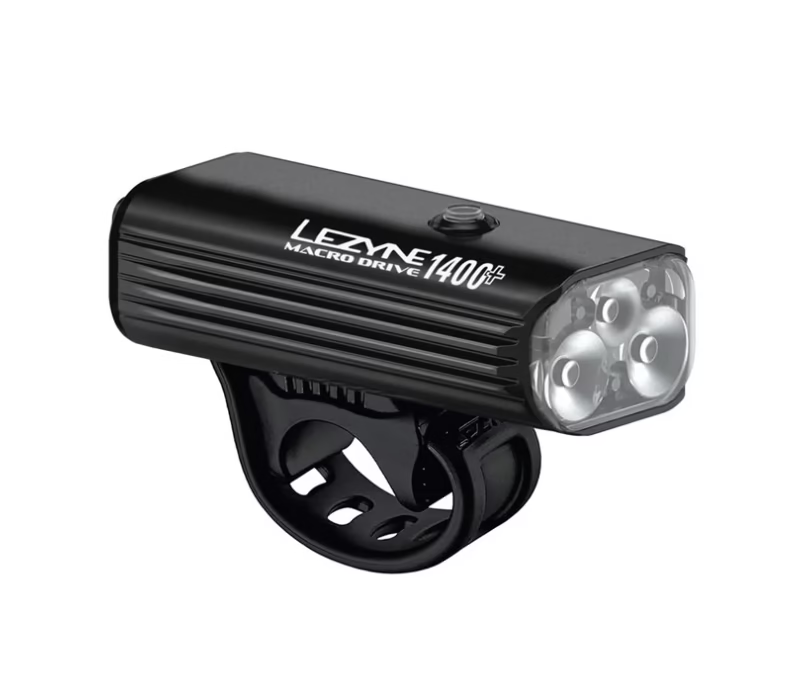
The Macro Drive 1400+ is the strongest output option in this shortlist, but its case rests on more than the 1,400-lumen number. Lezyne specifies a 5,200mAh battery, USB-C charging, an aluminium case, IPX7 water resistance and optics that concentrate much of the beam ahead while retaining illumination around its edges. It is a more substantial unit than a compact city light, weighing around 230g according to the manufacturer.
BikeRadar’s independent testing described useful central illumination with a gradual reduction of light towards the periphery and good runtimes, including more than an hour at maximum output without triggering the red battery indicator in its test. The review also noted a relatively simple feature set. That is not automatically a weakness: riders who want to see the road rather than change settings from a phone may prefer a well-developed optical system over smart controls they will rarely touch.
This is the choice that makes the most sense for frequent evening road training, dark gravel connectors or longer journeys where the route changes from lit streets to unlit lanes. It is less attractive for someone who carries a light only as a backup or spends most of the journey under streetlights. At the time of research, UK retail promotions had brought the Macro Drive 1400+ below £100; it should only be retained in this guide if a current UK listing still meets the price ceiling on publication day.
Cateye VIZ300: the uncomplicated rear-light choice
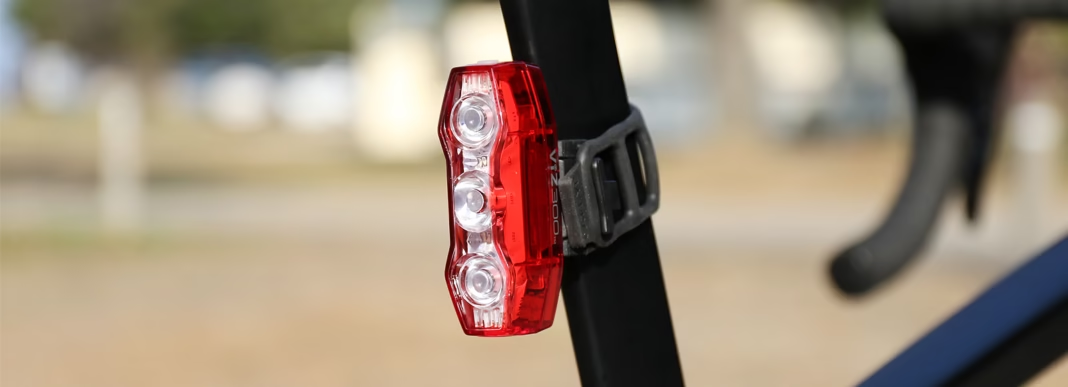
A rear light should make the rider recognisable from behind and from an angle, particularly at junctions, on roundabouts and through wet spray. Cateye’s VIZ300 follows a conventional approach, concentrating on a bright light and visibility rather than vehicle-detection technology. For riders who already have a clear understanding of approaching traffic through normal observation and prefer fewer devices to configure, that simplicity has value.
With a quoted 300-lumen maximum, the VIZ300 has more potential daytime conspicuity than many older compact rear lights. That figure needs sensible use, however. The highest flash mode is not the correct setting for every group ride or dark shared-use path, and maximum-output advertising tells us little about battery endurance at the setting a rider will actually use. Choosing a lower steady or pulse mode after sunset can make the light more comfortable for those following.
Previous UK listings placed the VIZ300 around £30 to £40, although a current retailer price and model match are still needed before an affiliate destination is inserted. It is an attractive pairing for the AMPP900 or ALLTY 1200 because it leaves most of the budget with the front beam. Its main limitation is equally clear: there is no radar, no approaching-vehicle information on a cycling computer and no reason to pay for it expecting such functionality.
Magicshine SEEMEE 300: rear-light features without a radar premium
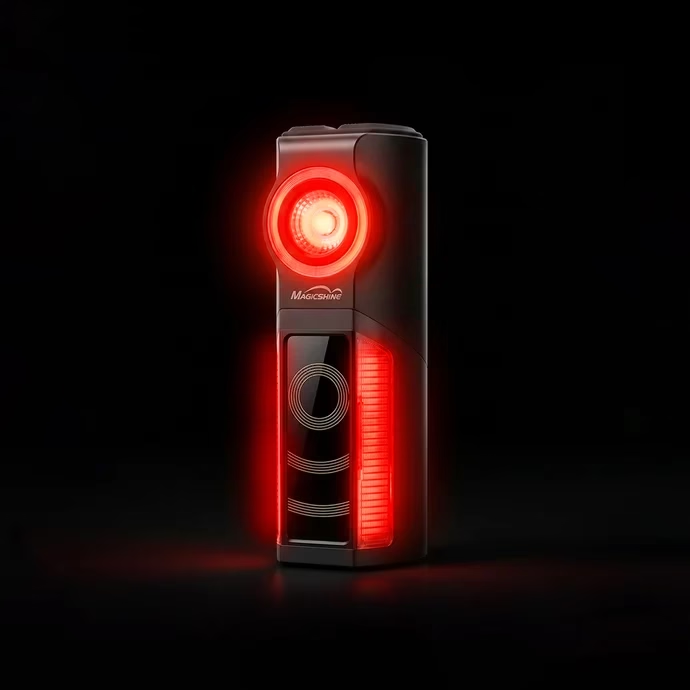
Magicshine’s SEEMEE 300 is a more feature-rich rear-light alternative. It combines a 300-lumen maximum claim with a downward-facing OptiTracing system intended to illuminate the area around the back of the bike. The manufacturer also specifies a 1,600mAh battery, USB-C charging, an IPX6 rating and modes that respond to braking or ambient light. These functions should not be confused with the SEEMEE R300 radar product: the SEEMEE 300 does not detect approaching vehicles and will not display traffic warnings on a head unit.
The underlying light has a substantial independent test record. Cyclingnews praised its battery endurance and useful rearward/downward illumination. BikeRadar liked the punchy output and smart functions but considered the braking response over-sensitive and found battery life difficult to predict. Road.cc also reviewed it positively while highlighting a slow-reacting light sensor and the need to select modes carefully. Taken together, those reviews suggest a capable rear light with a few compromises, not an entirely automatic device that always selects the best setting for every road.
Magicshine UK’s listing showed the SEEMEE 300 at £49.99 when researched. That puts it above the simplest rear options but still leaves room for a sensible front-light pairing within an overall £100 budget in some retailer combinations. Riders commuting on busy urban routes, where visibility from different angles matters, have a stronger reason to consider the additional illumination features than riders who simply need a conventional red rear light.
How to choose a front and rear light without wasting the budget
For a mostly street-lit commute, the front light needs to reveal nearby surface hazards and give traffic a clear indication of your presence. Side visibility at junctions, secure mounting and enough battery for the return journey are at least as important as headline lumens. A front light around the Cateye AMPP900’s level, combined with a practical rear light, will cover many commutes without obliging the rider to run maximum output continuously.
On completely unlit rural roads, the need changes. A brighter front lamp with a usable medium mode allows more time to identify potholes, broken tarmac and road-edge debris. The ALLTY 1200 and Macro Drive 1400+ are more appropriate here, with the decision partly depending on beam preference, weight and mounting arrangements. A second front light is useful on some long rides, but it should be regarded as an extra layer of resilience rather than an excuse to buy a poorly performing primary unit.
Do not spend everything on the front and then neglect the rear. British winter conditions produce low sun, spray, dark clothing and reduced contrast, and a modest but effective rear light addresses a different visibility problem from the headlight. Equally, there is little merit in a rear light so bright and badly aimed that it dazzles a rider travelling directly behind. Aim it correctly, use suitable modes and check that a saddle bag or mudguard does not block its beam.
Power and charging also deserve practical attention. USB-C is convenient, but a familiar connector will not compensate for a short run-time or an unreliable mount. Manufacturers normally state battery life separately for each output mode; the most flattering maximum-hours figure often belongs to the dimmest mode. For a winter commute, match the claimed battery time to the mode you expect to ride in, then allow extra margin for cold weather and battery ageing.
Which combination makes most sense?
For general commuting, the Cateye AMPP900 and VIZ300 make a straightforward pair if current UK prices keep the combined cost under £100. Both are oriented around basic lighting rather than extra app features. Their different roles are complementary: the AMPP900 handles forward illumination and the VIZ300 provides a conspicuous rearward signal.
For faster rides that include dark roads, Magicshine ALLTY 1200 with a simpler rear light can make more sense than spending heavily on a smart rear unit. The front beam earns its extra cost each time the road becomes genuinely unlit. Riders choosing the Lezyne Macro Drive 1400+ may need to budget separately for the rear light depending on the current sale price. That can still be good value if the priority is regular winter training rather than an inexpensive complete pair.
Those who already own a sound front light may be better served by putting £50 towards the SEEMEE 300 than replacing equipment that works. Its side and downward illumination and the manufacturer-stated smart functions are distinctive, though the independent review concerns should guide expectations. Those specifically looking for approaching-vehicle warnings should read the radar rear light versus normal rear light comparison instead of confusing the SEEMEE 300 with a radar unit.
Finally, do not assume that the biggest number in the comparison table represents the best purchase. Consider where the road is actually dark, how long a typical ride lasts, whether the mount fits the bike and how the rear light behaves in traffic or a group. Those questions are more useful than treating five very different lights as a simple brightness contest.
-
 Photo Credit: Olly Hassell/SWPix.com
-
 Photo Credit: Getty