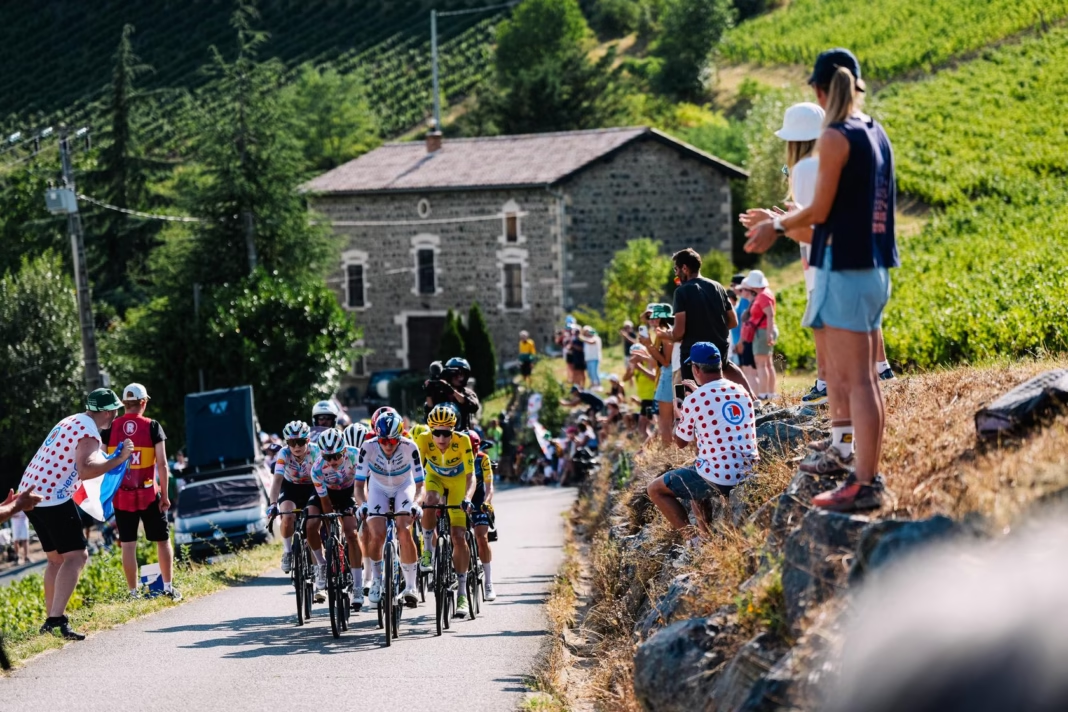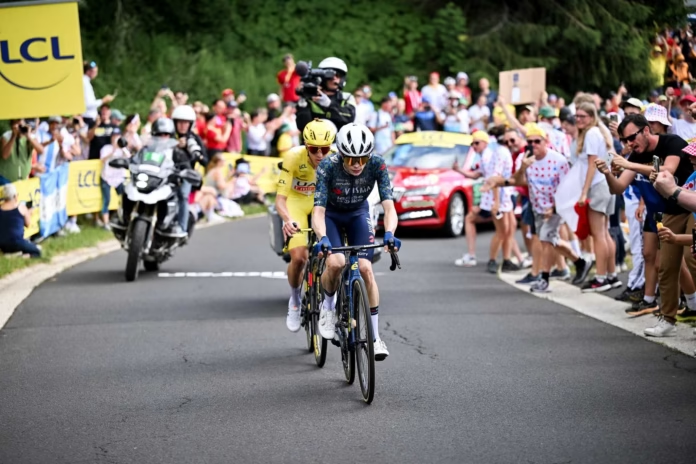
The 2027 Tour de France has been built around a tension that will shape the entire general classification battle: 71 kilometres of individual time trials give the strongest riders against the clock a genuine advantage, but the mountain stages provide several chances to take it back. The decisive moment may not be the final climb of the Col du Portet. It could come when one team runs out of riders on the roads to Les Saisies, or when a contender reaches the Pyrenees already needing to recover time.
The newly announced route covers 3,479 kilometres from Edinburgh to Paris, with 53,450 metres of climbing. Six stages are classified as mountainous, but only three end on a mountain summit: the Grand Colombier, Les Saisies and the Col du Portet. The others encourage a different kind of racing, with repeated ascents, descents and stretches where a team-mate ahead of the race could become decisive.
Two time trials, 38km between Blois and Chambord on stage 7 and 33km around Toulouse on stage 16, add up to the largest amount of individual time trialling in the Tour since 2012. The first comes before the high mountains; the second immediately before the final Pyrenean block. Their placement matters as much as their distance.
This is a closer look at the days that could decide the yellow jersey, rather than another list of all 21 stages. The complete 2027 Tour de France route guide covers every start, finish and stage profile. Here, the question is where a contender can actually force a rival to lose time, and what that might mean for the race as a whole.
The seven stages most likely to shape the general classification
| Stage | Key terrain | Why it matters |
|---|---|---|
| 7, 9 July | 38km ITT, Blois–Chambord | First substantial time gaps before the mountains |
| 9, 11 July | Grand Colombier summit finish | First true climbing hierarchy |
| 11, 14 July | Five major Alpine climbs to Les Saisies | Best early opportunity to isolate leaders |
| 14, 17 July | Cévennes and Mende | Attrition and tactical attacks rather than altitude |
| 16, 20 July | 33km Toulouse ITT | Resets the gaps before the decisive mountain days |
| 18, 22 July | Tourmalet and Col du Portet | Largest sustained climbing test |
| 19, 23 July | Basque climbs and descent to Laruns | Last realistic opportunity for a major comeback |
These are the seven most obvious pressure points, not a prediction that every one will see an attack by the favourites. Wind, crashes and unexpected alliances can overturn the best plans. Stage 3 to Cardiff, the long stage 8 into Le Creusot and the exposed Rhône Valley stage 12 are particularly capable of producing gaps outside the mountains.
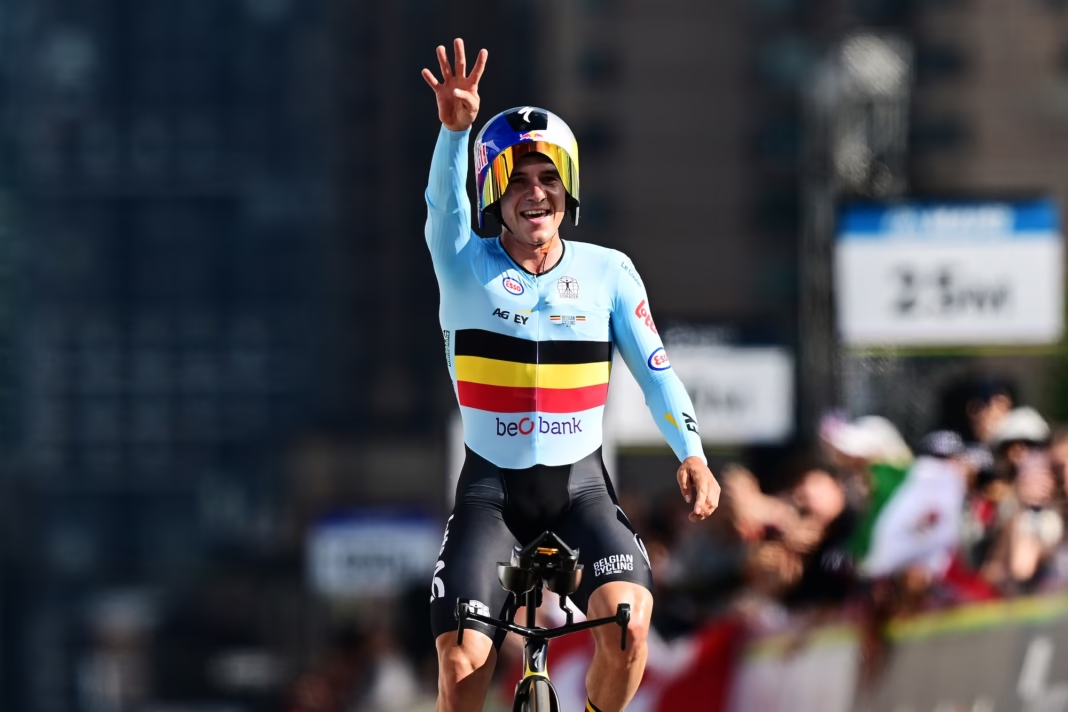
Stages 7 and 16: the two time trials dictate who has to attack
Stage 7 is the first substantial sorting point. The 38km course from Blois to Chambord runs over rolling rather than mountainous roads, with long sections where maintaining an aerodynamic position and a controlled effort will matter more than repeated bursts of acceleration. It should suit dedicated time triallists, but it is long enough for every general classification candidate to be affected.
A pure climber can survive a short, technical time trial without suffering a heavy defeat. Over 38km, small differences in speed accumulate. A rider who concedes significant time in Chambord cannot simply wait behind the strongest rival in the mountains. The Grand Colombier follows two days later, making the first test against the clock a direct influence on how aggressively the race is contested that weekend.
Toulouse then gives the same riders a second, different examination. Stage 16 is 33km, but the Côte de Pech-David interrupts the predominantly fast course with 800 metres averaging 12.4%, including much steeper pitches. A perfectly even pacing strategy may be harder to execute there, and riders must decide how much to conserve for the climb without giving away time on the faster sections.
The timing is almost designed to provoke a reaction. The third rest day comes before Toulouse; after the time trial there is one likely sprint stage into Pau, then the Col du Portet and Laruns on consecutive days. A rider who gains time in Toulouse can race defensively in the Pyrenees. Someone who loses a further minute will have little option but to attack, perhaps from much farther out than they would prefer.
That makes this route particularly interesting for Remco Evenepoel, who won his fourth world time trial title in 2026. His participation in the 2027 Tour is not yet confirmed. He has the credentials to profit from both tests, but a strong position after Toulouse would still have to survive two unusually hard days in the Pyrenees. A time trial advantage is useful only if the rider can defend it after thousands of metres of climbing.
Stage 9: the Grand Colombier could turn an early time gap into a crisis
The 162km route from Villars-les-Dombes to the Grand Colombier is the first genuine high-mountain examination. There are around 3,750 metres of climbing, including the Col du Berthiand and Col de Richemond before the final ascent. It is more demanding than a single uphill sprint after an otherwise gentle day.
The position of the stage is important. The riders will have completed the 38km time trial on Friday and the 224km stage to Le Creusot on Saturday, including the steep ramps of the Signal d’Uchon. That is a testing combination even before the race heads towards the Grand Colombier, with the second rest day following immediately afterwards.
For a contender already behind after Chambord, the Grand Colombier is a tempting place to respond. But an early attack carries a risk: failing to dislodge the leader may simply reveal who has spent energy and who is comfortable. A strong team might instead keep its leader protected, increase the pace progressively and force the first meaningful selection on the final climb.
This is where the overall standings should begin to reflect climbing form rather than positioning and time trial strength alone. The summit may not decide the winner, but a rider who struggles badly here will have difficulty presenting that performance as a one-off when the Alpine stages begin after the rest day.
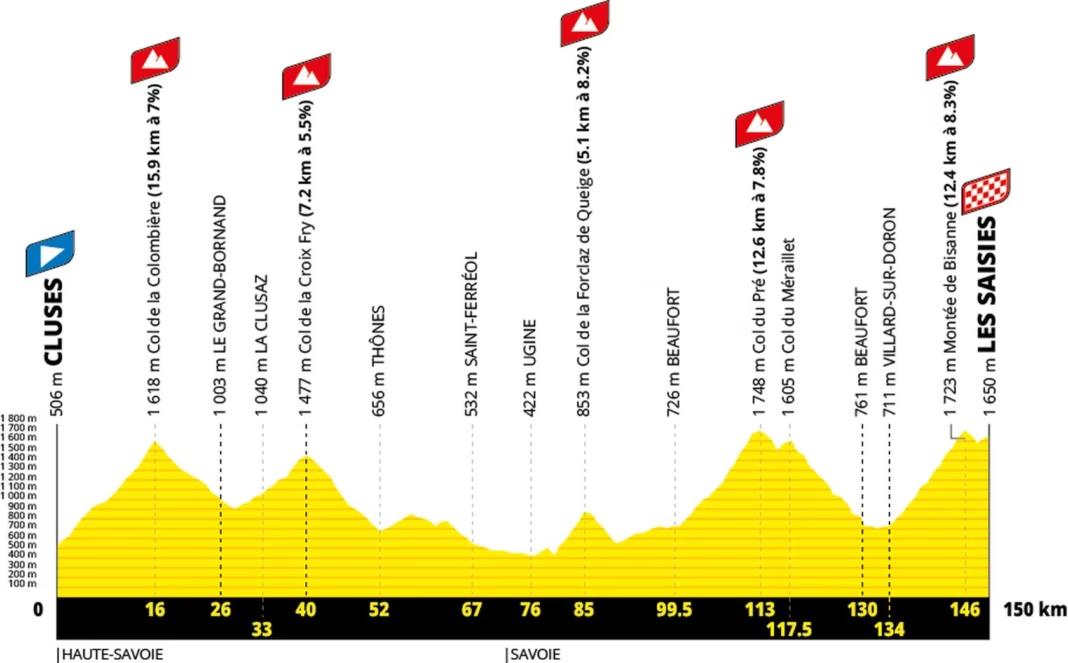
Stage 11: Les Saisies looks the best day to break an opposing team
The 150km Bastille Day stage from Cluses to Les Saisies is arguably the most tactically interesting route of the first two weeks. It packs approximately 4,750 metres of climbing into a relatively short distance, with the Col de la Colombière, Col de la Croix Fry and Col de la Forclaz de Queige before the final combination of the Col du Pré and the Montée de Bisanne.
The Bisanne is 12.4km at 8.3%, but the damage can begin well before its foot. Repeated long climbs make it difficult for mountain domestiques to recover after each effort. A team with two or three strong climbers could increase the pace on the Col du Pré, then send a rider up the road to help its leader after the final big ascent. That is a more complicated problem for a yellow jersey team than simply responding to one acceleration near the finish.
The final approach also changes the calculation. The riders have to negotiate the descent after Bisanne before reaching the short rise to Les Saisies. An attacker who crests the final major climb with a small advantage could carry it towards the finish, while a leader who has lost team support must make decisions about chasing and descending without the usual protection.
Stage 10 to Sallanches helps create the conditions for this. Its repeated ascents of the Côte de Domancy, 2.5km at 9.4%, provide a sharp introduction to the Alps. If leaders spend their support riders heavily around Sallanches, there may be a price to pay only 24 hours later on the Colombière, Pré and Bisanne.
This is the sort of terrain where Jonas Vingegaard and Visma | Lease a Bike have historically sought to make a race hard through collective pressure, although a 2027 start list and team selection are not yet confirmed. Tadej Pogačar has also demonstrated that he can win both from long-range attacks and from a reduced group on summit finishes. The tactical question is whether the strongest challenger can force the defending contender to respond to more than one rider at once.
Stage 14: Mende is a dangerous day because it does not look like the queen stage
At 199km with approximately 4,300 metres of ascent, the ride from Montpellier to Mende is more demanding than a casual glance at its altitude profile might suggest. The route crosses the Cévennes, including the Col du Vent, Cirque de Navacelles and Col de la Lusette, before finishing on the steep Côte de la Croix Neuve above Mende.
There is no long Alpine summit to focus all the attention, which makes the day’s racing harder to predict. A large breakaway could take riders up the road before the main favourites begin attacking. Repeated climbs allow teams to wear down opponents through attrition, and the pace may become difficult to control long before the finish.
The appeal of Mende for an ambitious contender is that the leader’s team may be less certain when to commit its resources. Chase too early and the domestiques disappear before the final climb; allow a dangerous group too much room and a rider who was previously considered a distant general classification threat can become relevant again.
It is not necessarily a stage that will produce several minutes between the top favourites, especially if they arrive together for the final ramp. But it is exactly the type of stage on which somebody could arrive at the finish unexpectedly isolated, exhausted or behind after a difficult day in the wind. The next day’s rolling route towards Albi gives little guarantee of an easy recovery before the final rest day.
The British stages and exposed roads offer quieter threats
Stage 3 from Welshpool to Cardiff is the first early opportunity to take small but meaningful amounts of time. Eight categorised climbs, around 3,000 metres of elevation gain and the Côte de Caerphilly, 2km at 8.2%, near the finish make it too difficult to treat as a guaranteed sprint. A punchy leader could take a few seconds or bonus seconds, and a poorly positioned rival could lose more if the group splits.
Stage 8 to Le Creusot should also be watched. It is the longest day at 224km, with the Signal d’Uchon, 5.7km at 5.7%, close enough to the finish to invite late attacks. Even if the principal contenders stay together, the energy needed to respond will be carried into the Grand Colombier stage the next day.
Wind may play an even less glamorous role. On stage 12 from Chambéry to Valence, the last 25km of the Rhône Valley are exposed and a significant change of direction comes around 10km from the finish. Stage 13 towards Montpellier faces possible Mistral or Tramontane winds. None of these features guarantees echelons, but a contender caught behind a split can lose time just as effectively as on a mountain. The teams that ignore those days may discover the cost later.
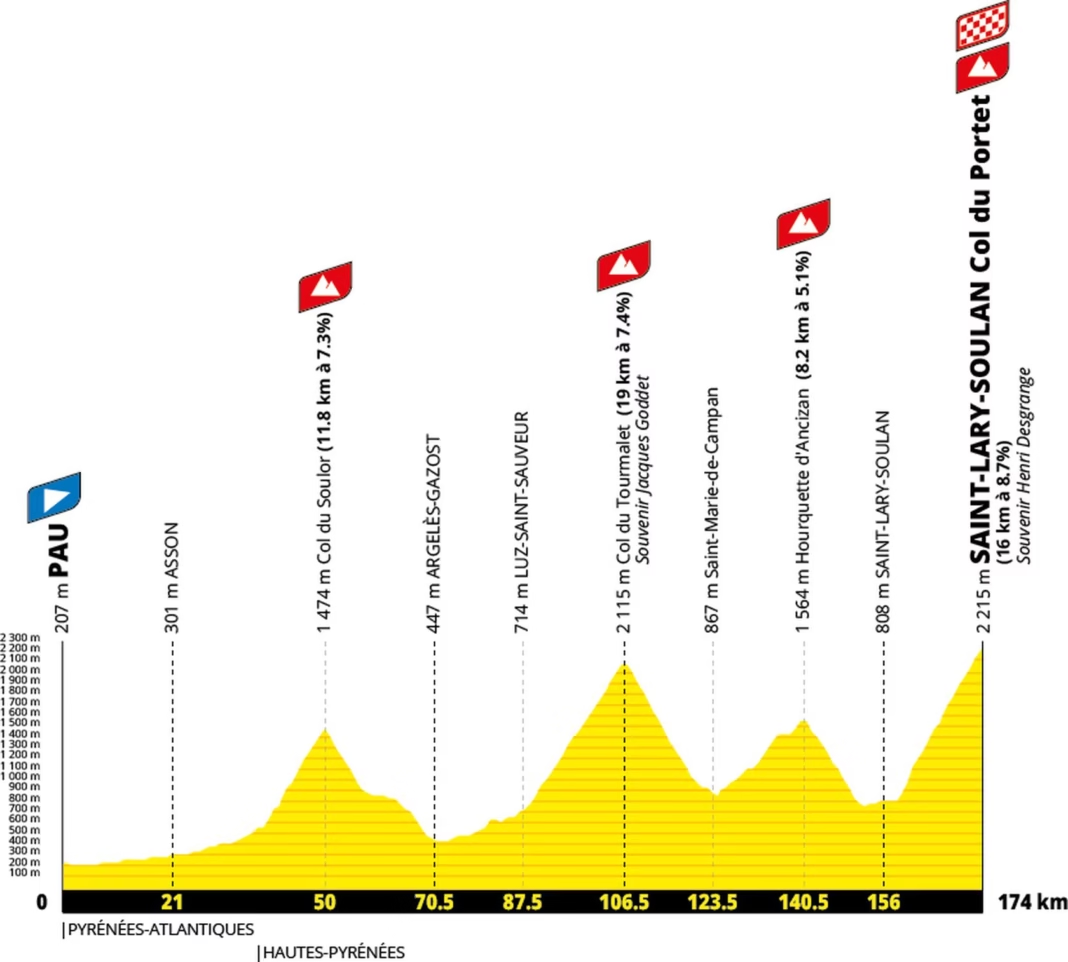
Stage 18: the Col du Portet is the hardest single test of the Tour
If one stage deserves the title of queen stage, it is the 174km ride from Pau to the Col du Portet. The organisers have placed around 5,400 metres of climbing across four major ascents: the Col du Soulor, Col du Tourmalet, Hourquette d’Ancizan and the final 16km up the Col du Portet at 8.7%. The finish is at 2,215 metres, the highest point of the race.
The challenge is not simply the gradient of the final ascent. The Tourmalet alone climbs for 19km at 7.4%, and arrives with two big ascents still to come. A hard pace there may seem unnecessary to riders planning to attack on the Portet, but it can strip away support riders and leave rivals exposed for the remainder of a very long mountain stage.
The Hourquette d’Ancizan creates another chance to make the race uncomfortable. A climber who is struggling may get back onto a group over a descent, but the effort required to do so can become decisive once the Portet begins. By the time the race reaches its final 16km, teams will have had to make repeated decisions about whether to protect their leader or spend riders setting the pace.
At altitude, the Portet is a climb on which pacing matters. A rider who responds too aggressively to an early move could pay for it farther up the mountain. Equally, waiting until the last two kilometres may not be enough for somebody who reaches the stage significantly behind on general classification. The contender who needs to take time has to balance the size of the required gain against the risk of attacking too far from the finish.
Pogačar won at the Col du Portet in 2021, but that result says nothing certain about what will happen six years later. His climbing, attacking range and time trial ability make him a natural reference point for analysing the course, yet the 2027 race will depend on form, recovery, team selection and the gaps established before the Pyrenees. The route itself offers opportunities to take back a deficit, not a guarantee that a big attack succeeds.
Stage 19: Laruns gives the rider behind one final chance to turn the Tour
A common mistake in reading the route is to assume that the overall race ends on the Col du Portet. Stage 19 to Laruns follows immediately, with another 160km and approximately 4,300 metres of climbing. It does not finish uphill, but the succession of steep Basque climbs could be more awkward to control than a mountain summit finish.
The Col de Burdincurutcheta rises for 8.7km at 9.3%, including sections at 15%, before the Col de Bagargui, Soudet and Marie Blanque. Attacking on the first of those climbs would require a considerable commitment, yet an isolated yellow jersey rider could find it hard to answer repeated attacks across the entire route. The finish after the descent towards Laruns gives an escapee another way to preserve an advantage.
The stage favours a challenger prepared to race tactically. A team could place a rider in the early break, then use that support after the leader attacks from the main group. A rival chasing alone may have to close gaps on each ascent and then make further decisions over the descents. With only a flatter stage to Libourne and the Paris finale remaining, there is no reason to expect a defeated challenger to save their effort for later.
There is an important counterpoint. If the leader emerges from the Portet with a comfortable advantage and a strong mountain squad intact, even these climbs may not produce a reversal. Laruns is potentially the most dramatic stage, but its importance depends entirely on how close the general classification remains after the previous day’s finish.
Which riders does the 2027 Tour de France route suit?
Pogačar offers the most complete reference point because there is little terrain on which he is obviously vulnerable: he can time trial well, sprint from selective groups and win high in the mountains. The route’s mix of hard one-day-style finishes and long climbing stages could suit that range of abilities. But it also contains more than one place where a disciplined team could attempt to stretch and isolate him.
For Evenepoel, the arithmetic is clearer. Seventy-one kilometres against the clock provide chances to build a useful margin over riders who climb better than they time trial. The obvious danger is defending that margin on back-to-back high-mountain stages, especially Les Saisies and the Pyrenean double-header. If he is in the race and in form, his rivals will want to avoid allowing him a comfortable lead after Toulouse.
For Vingegaard, the attraction would be the accumulation of difficult climbs rather than any one summit in isolation. A strong collective effort on stage 11 or a multi-climb attack on stage 19 could create conditions in which his endurance and climbing are especially valuable. He would still need to limit any losses in the two individual time trials, while his recovery and racing level after the injuries that disrupted 2026 will remain important questions heading into next season.
Other contenders may benefit from particular stages, but it is too early to treat the 2027 start list as settled. The route analysis is about the types of riders and teams that could make the most of it; confirmed leadership and selections will only become clear much closer to July.
Verdict: the decisive day might come before the final summit
The Col du Portet is the hardest single climb and stage 18 should make for the clearest mountain confrontation. Yet Les Saisies is the stage with the most intriguing tactical possibilities, because the climbs come in succession and a strong team can create an advantage well before the finish. Stage 19 is the final opportunity for a rider who is prepared to take much bigger risks.
The real key, though, may be the sequence rather than one day: establish a time gap in Chambord, test rivals on the Grand Colombier, force them to work in the Alps, then reset the picture in Toulouse before the two Pyrenean stages. Those moves can be connected across the three weeks. The rider who wins the 2027 Tour may not need one extraordinary attack if they consistently make rivals spend energy and defend time gaps that began much earlier.
That is the quality of this route. The organisers have not simply stacked their hardest mountain passes at the end. They have placed long time trials around major climbing blocks and left enough awkward terrain between them to reward proactive racing. The winner will probably have to be good against the clock, climb exceptionally well and, perhaps most importantly, choose when to make opponents do the chasing.