The 2027 Tour de France Femmes ends on the Puy de Dôme, but the yellow jersey could be won or lost long before the final ascent. A difficult opening weekend in England, the race’s first team time trial in London and three consecutive days of climbing in the Massif Central make this a route that rewards far more than one outstanding performance on a mountain.
The nine stages between Leeds and the Puy de Dôme cover 1,156km with 17,665 metres of climbing. The final day alone brings 3,840 metres of ascent, ending with 11.3km at 7.8% on the volcanic climb above Clermont-Ferrand. Yet the road to that final showdown starts with the short, steep ascents of the Peak District on stage 2 and the very different demands of 18km of team time trialling on stage 3.
The most interesting feature is how closely the decisive days follow each other. There are no rest days. The climbing begins in earnest on stage 7 at La Loge des Gardes, continues across 3,000 metres of ascent towards Clermont-Ferrand on stage 8, then culminates in the longest and hardest stage on the final Saturday. A rider who spends too much energy defending a small lead might pay for it before reaching the Puy de Dôme.
This is the tactical companion to ProCyclingUK’s complete 2027 Tour de France Femmes route guide, which includes the full timetable and profiles for all nine stages. The question here is which days can create meaningful gaps, where teams could lose control and which riders are best equipped to take advantage.
The six stages most likely to decide the 2027 Tour de France Femmes
| Stage | Decisive feature | Likely impact on yellow |
|---|---|---|
| 2, 31 July | Peak District, Winnats Pass and Jenkin Road | Early splits, bonus seconds and positioning |
| 3, 1 August | London team time trial, 18km | Differences created by collective strength |
| 5, 3 August | Six late climbs towards Magnanville | Chance to isolate or surprise a contender |
| 7, 5 August | La Loge des Gardes, 6.7km at 7.1% | First sustained climbing test |
| 8, 6 August | Massif Central, around 3,000m ascent | Repeated attacks and reduced team support |
| 9, 7 August | Puy de Dôme, 11.3km at 7.8% | Final and hardest general classification test |
These are the main opportunities rather than a prediction that each stage will produce major time gaps. Stages 1 and 4 have exposed roads where wind could decide far more than the profile suggests, while bonus seconds of 10, six and four are available to the first three finishers on every road stage. Small gains in the opening days could become important if the strongest climbers reach the finale closely matched.
Stage 2: Manchester to Sheffield could cause trouble before the race settles
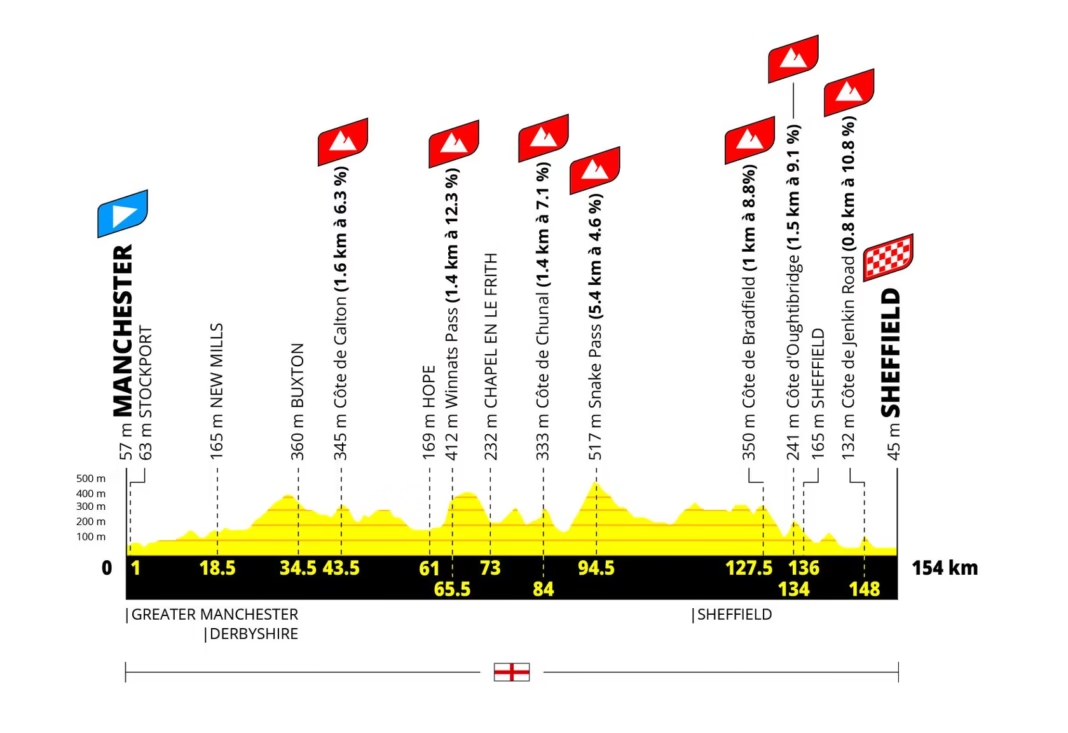
With around 2,800 metres of climbing over 154km, stage 2 is closer to a difficult one-day Classic than a conventional Grand Tour opening weekend. The steep slopes of Winnats Pass, 1.4km at 12.3%, are followed by more hard terrain before the final series of climbs towards Sheffield, including the Côte d’Oughtibridge, 1.5km at 9.1%, and Jenkin Road, 800 metres at 10.8%.
These are short climbs, but their gradients make positioning essential. A rider at the back of a reduced peloton on Oughtibridge may already be struggling to remain in contact when the next attack comes. The final ascent of Jenkin Road could favour a Classics specialist able to accelerate out of the saddle, particularly with the finish close enough that an organised chase might not have time to recover.
The significant risk for general classification contenders is not necessarily losing minutes to an outright mountain climber. It is being caught on the wrong side of a split behind riders who have the power to respond to repeated attacks. A team with a strong group of Classics riders can control the approach and force rivals to use energy repeatedly. Those without similar support must either stay near the front throughout or risk arriving in Sheffield behind a small leading group.
The route echoes the last three climbs of the 2014 men’s Tour stage into Sheffield, where Vincenzo Nibali attacked to win. That precedent illustrates the opportunities on the roads, but the nature of the 2027 women’s race will depend on who is willing to commit early. An aggressive opening weekend could put a prospective winner under pressure before the first time trial.
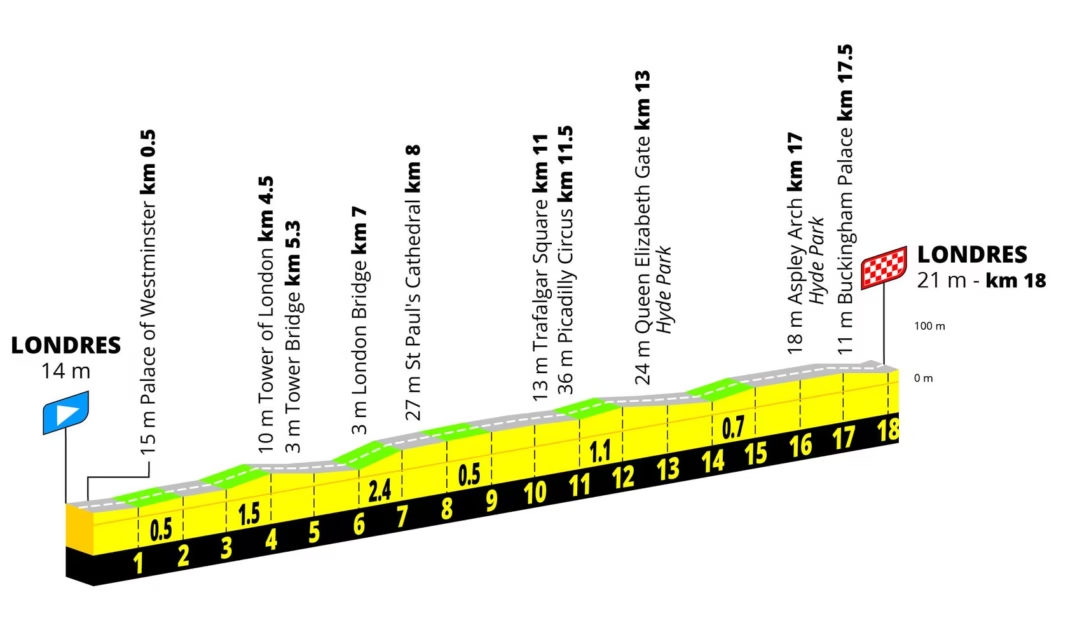
Stage 3: London’s team time trial could change the entire general classification
There has never been a team time trial at the modern Tour de France Femmes, making the 18km London stage the biggest unknown of the route. The course links landmarks including Westminster, Tower Bridge, St Paul’s Cathedral, Hyde Park and Buckingham Palace, finishing on The Mall. It is almost flat, but the repeated changes of direction mean the winning squad will need more than several individually strong time triallists.
Smooth cornering, communication and the ability to accelerate back to speed together will be critical. A strong rider who pushes too hard out of every turn can damage the formation as easily as a weaker team-mate who struggles to stay attached. Teams with time to practise their pacing and formation could have a real advantage over line-ups assembled chiefly for the final mountain stages.
That is where the implications extend beyond a single 18km result. A general classification rider may climb better than a rival but still reach France behind because her team has conceded time in London. The gap may be only seconds, but it could change the choices her squad makes over the next six stages. Equally, an advantage created by team performance could allow a climbing leader to ride more defensively at La Loge des Gardes.
The exact application of individual times and any special team time trial timing provisions should be confirmed from the final regulations rather than assumed from other events. Whatever the details, the stage places the spotlight on depth and collective preparation. Movistar, Canyon SRAM and FDJ United–SUEZ will each face difficult selections if they want to balance a powerful time trial unit with the climbers needed for the finale.
Stages 4 and 5: the days when the strongest teams could be caught out
Stage 4 from Le Touquet-Paris-Plage to Calais appears relatively straightforward at 123km, but the Opal Coast has a habit of exposing riders to crosswinds. The Côte du Cap Blanc-Nez, 900 metres at 7.7%, sits around 12km from the finish and creates another opportunity for a late attack. If the wind is favourable for echelons, a small positioning error might prove much more costly than an acceleration on the climb.
Stage 5 to Magnanville is more obviously dangerous. Over 161km, the route includes six successive short climbs inside the last 50km and a finishing kilometre averaging around 5%. The terrain encourages repeated attacks from riders who may not be overall contenders but have enough strength to trouble a tired group. A sprint is possible, though this is not a day for a team leader to drift towards the back of the peloton.
The important tactical question is how much work the general classification teams are prepared to do before the Massif Central. A rider who gains time in London may not wish to use her climbing domestiques chasing every attack through the Yvelines. Conversely, an ambitious rival could place team-mates in an escape and force the defending team to take responsibility. Even a day without substantial time gaps can become expensive when riders are racing hard for a second or third consecutive day.
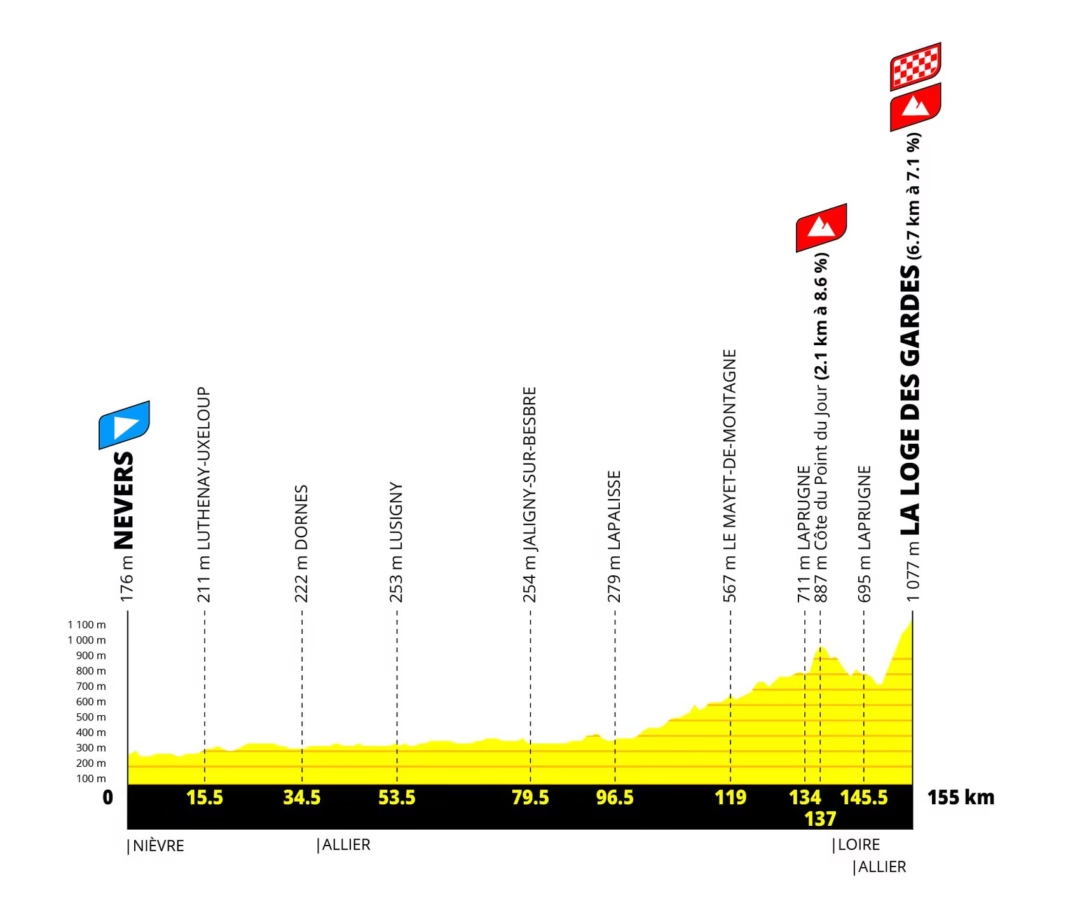
Stage 7: La Loge des Gardes establishes the first genuine climbing order
The first major summit finish arrives relatively late, on stage 7 from Nevers. The 155km route becomes more selective after the Côte du Point du Jour, 2.1km at 8.6%, with a descent of roughly 12km before La Loge des Gardes, 6.7km at 7.1%. The final ascent should favour riders able to maintain a high pace on sustained gradients while still responding to attacks in the final kilometres.
The Point du Jour climb matters because teams can increase the pressure before the final ascent. A leader whose support riders are dropped there may be left with few options if rivals begin attacking on La Loge des Gardes. For the rider in yellow, controlling the tempo would be easier with several team-mates still present. For the challengers, the objective may be to make that control disappear before the decisive climb begins.
But this is not the final opportunity to win the race, and it would be risky to treat it as such. A climber who attacks repeatedly to gain 20 seconds here could pay for the effort on the following two days. A rider who loses a smaller amount of time may still be well placed if she can recover better and has support for the next day’s irregular terrain.
The ascent featured in Paris-Nice when Tadej Pogačar won in 2023 and João Almeida in 2025, although those men’s results offer little direct evidence about which woman will be quickest in 2027. The useful point is the profile: a sustained climb that should reveal which contenders have arrived at the final weekend in strong condition.
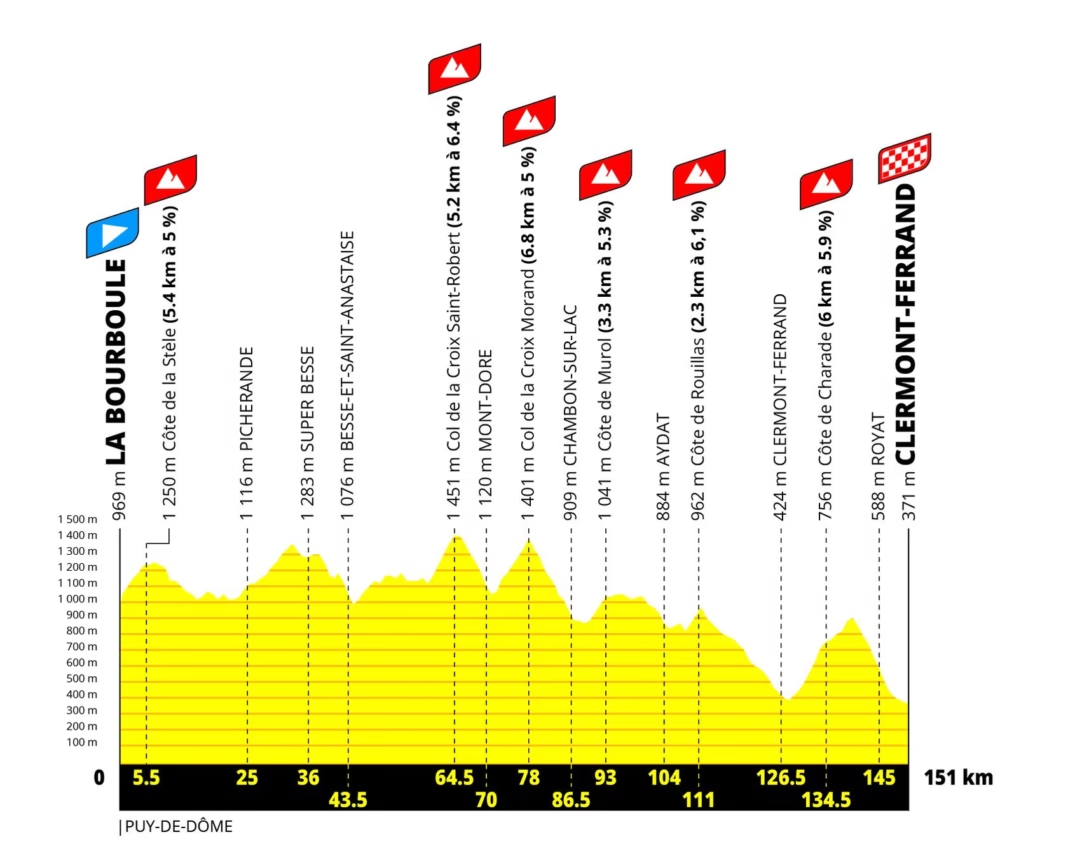
Stage 8: the rolling terrain to Clermont-Ferrand may be the best place to isolate yellow
The penultimate stage from La Bourboule to Clermont-Ferrand contains approximately 3,000 metres of climbing, with the Côte de la Stèle, the Col de la Croix Saint-Robert and the Côte de Charade among the main difficulties. Charade measures 6km at 5.9%, followed by a short, sharp rise towards the finish. This is a very different task from simply following the best climber up one long mountain.
The repeated climbs offer opportunities to wear down a strong team. A contender with several climbing team-mates could put one up the road, then ask another to increase the pace behind. The yellow jersey holder would have to decide whether to respond personally or trust the remaining support riders to bring the move back. After seven days of racing without a rest day, the difference between a squad with three fresh riders and one with none could be decisive.
The race has another tactical complication: there is still an even harder day to come. The strongest climber might prefer to conserve energy for the Puy de Dôme, but leaving a dangerous rival too much room could turn the final stage into a defensive exercise. A rider who is less suited to a long, steep final ascent may view stage 8 as her last realistic chance to gain time on more variable terrain.
It is also a stage where a breakaway could become a useful asset for the general classification teams. A rider in the early escape can later help a leader after an attack, allowing her to maintain speed over flatter sections between climbs. Those stretches are precisely where an isolated contender has the hardest time preserving a small advantage against an organised chase.
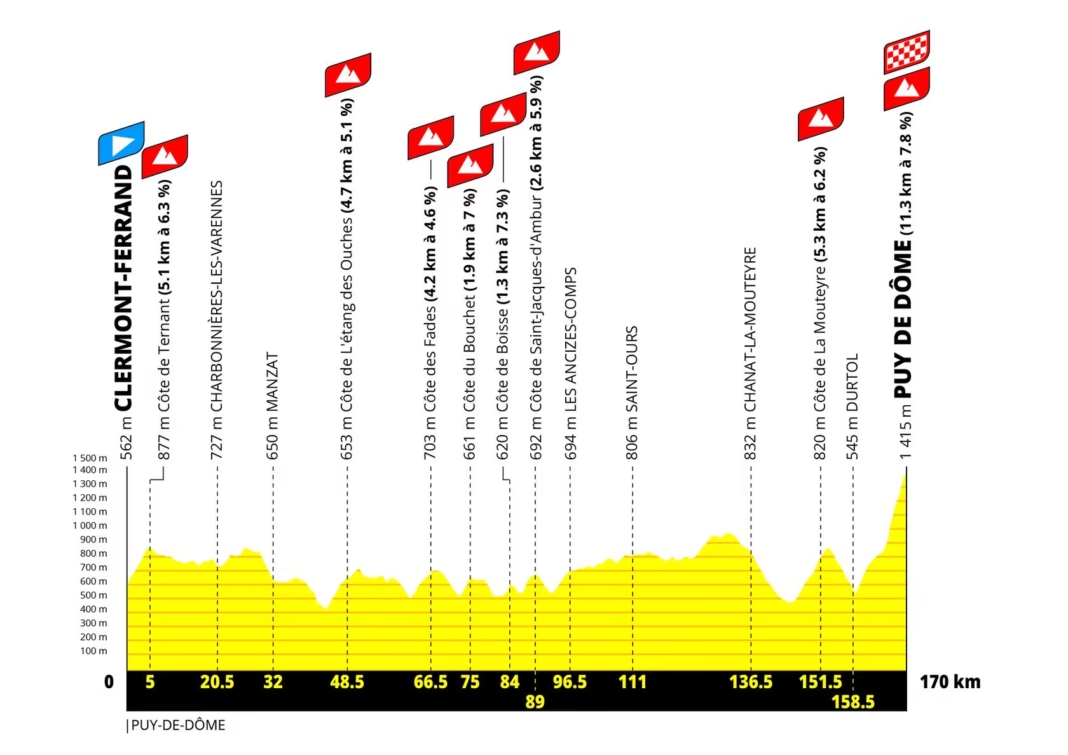
Stage 9: the Puy de Dôme is the hardest test, but the damage may start earlier
The final stage is the longest of the race at 170km and contains 3,840 metres of climbing, far more than a straightforward procession to one iconic summit. The Côte de Ternant, 5.1km at 6.3%, begins a sequence of climbs through the Sioule gorges, and the Côte de la Mouteyre is a particularly important obstacle before the final ascent.
The Mouteyre is 5.3km at 6.2%, but the narrow, rough roads can make it more selective than those figures suggest. If a strong team pushes the pace there, riders who are already struggling may lose contact and have little chance to regain their position before the climb to the Puy de Dôme. A leader isolated at that point will face a very different final ascent from one who still has team-mates to regulate the pace.
The final 11.3km at 7.8% provide a proper climber’s finish. The gradient is sustained, the road keeps rising and there is little opportunity to conceal a bad day. A rider defending a small lead may be tempted to match an early acceleration, but that carries an obvious risk on a climb of this length. Losing control halfway up could mean conceding far more time than by accepting a steady gap and pacing the ascent correctly.
Equally, a contender who reaches the final stage needing to take a minute cannot automatically wait for the last few kilometres. She may need her team to make the earlier climbs hard enough to reduce the group, then attack where the fatigue of the previous eight days is most evident. The 3,840 metres of climbing before and including the Puy de Dôme make that strategy possible, though hardly easy.
The Puy de Dôme has a long Tour history, from the Anquetil–Poulidor duel in 1964 to Michael Woods’s stage victory in 2023. It also appeared in the earlier women’s Tour de France races of 1986 and 1987, when Maria Canins won on both occasions. The 2027 Tour de France Femmes will give the climb another place in women’s racing history, but its importance will be determined by the general classification gaps after eight stages.
Which riders and teams could benefit from this route?
Demi Vollering enters the conversation as the reigning champion after winning the 2026 Tour de France Femmes by 1 minute 18 seconds from Kasia Niewiadoma-Phinney. The FDJ United–SUEZ rider won the final two stages around Nice last August, demonstrating how quickly a close race can be turned around in the mountains. Her ability to sustain a high pace on long climbs makes the Puy de Dôme an obvious opportunity, provided she reaches it close enough to her rivals.
Niewiadoma-Phinney’s strength is a different kind of consistency. The Canyon SRAM leader is capable of navigating difficult one-day-style terrain and has spent several years competing at the front of the Tour. Stage 2 into Sheffield and the rolling approaches to Clermont-Ferrand could suit her attacking instincts, while the team’s depth and performance in London’s time trial will be important if she is to defend a position near the top of the overall classification.
Marlen Reusser is an especially interesting name because the course includes a team time trial rather than an individual test. She retained the elite women’s world time trial title in Montréal in 2026 and rides for Movistar, which have also signed Paula Blasi for 2027. Blasi finished fifth overall at the 2026 Tour, has already won La Vuelta Femenina and brings climbing strength that could complement Reusser. On paper that offers tactical depth, although team time trials reward the entire selected squad and not simply the strongest individual rider.
Elisa Longo Borghini, third in the 2026 classification, and Antonia Niedermaier, fourth, are further reminders that the race cannot be reduced to three favourites. Niedermaier’s time-trial ability and climbing could be valuable across nine demanding days, while Longo Borghini has the experience to exploit days when strong teams hesitate to chase. Pauline Ferrand-Prévot, the 2025 winner, remains another rider capable of affecting the race if she is selected and arrives fit after her difficult 2026 Tour.
These are assessments of how the route might suit the riders, not a confirmed 2027 start list. Team selections, injuries, preparation and the balance of climbing support against time-trial specialists could alter those calculations considerably before the Grand Départ in Leeds.
Verdict: recovery and team depth could matter as much as the final climb
The Puy de Dôme is clearly the hardest individual finishing climb, but La Loge des Gardes should establish the hierarchy among the climbers before the race reaches its final two days. The more complicated tactical opportunity comes on stage 8: repeated climbs, uneven gradients and short sections between the ascents create scope to weaken the yellow jersey’s support rather than simply attack the leader herself.
The British opening also matters more than it first appears. The Peak District can create early differences on stage 2, while the London team time trial may turn a rider’s collective strength into an individual advantage in the general classification. If the time gaps remain small, the 10, six and four-second road-stage bonuses could be worth pursuing as well.
With no rest day across the nine stages, the rider who begins the final weekend with the strongest team and the best recovery may hold an advantage that is invisible in the standings. Winning the 2027 Tour de France Femmes is likely to require more than the ability to climb the Puy de Dôme quickly. It will demand good positioning in England, a well-executed time trial in London and the judgement to spend energy at the right moments over the final three days.