The Garmin Varia Vue and Cateye AMPP2200 can both sit on the front of a road bike, but they are not trying to solve the same problem. The Garmin combines a road-facing camera with a comparatively modest headlight, while the Cateye spends its entire design budget on throwing light down the road. For a UK rider heading home on dark lanes, that distinction matters more than the fact that both are sold as premium front cycling lights.
The Varia Vue records video, automatically protects footage when an incident is detected and integrates with compatible Garmin Edge computers. The AMPP2200 has no camera, app or incident-recording function. Instead, it offers a 2,200-lumen peak mode and several sustained outputs for riding after dark. Buying the Garmin because it is more expensive would be a mistake if the actual need is to see potholes at speed; buying the Cateye would be equally misguided if continuous video evidence is the priority.
This comparison draws on official specifications, current UK retailer listings and independent hands-on reviews of the exact products. It is not presented as a new ProCyclingUK side-by-side road test. We have previously covered the Garmin Varia Vue and Cateye AMPP2200 individually. Here the question is what the extra money actually buys, and which compromises matter when British winter riding puts lighting and video quality under pressure.
Garmin Varia Vue vs Cateye AMPP2200 specifications
| Specification | Garmin Varia Vue | Cateye AMPP2200 |
|---|---|---|
| Main purpose | Front camera and smart headlight | High-output front headlight |
| Peak advertised output | 600 lumens in day flash | 2,200 lumens in Ultra Boost |
| Highest continuous output | 550 lumens | 1,500 lumens High |
| Camera | 4K recording, incident detection | None |
| Weight claimed | 200g | 213.5g |
| Water resistance | IPX7 | IPX4 |
| High output runtime | 4K video + 550lm: 1.25 hours | 1,500lm: 1.5 hours |
| Lower power mode | 4K + 140lm: 3.5 hours | 200lm Enduro: 12 hours |
| Charging | USB-C; can run while charging | USB-C; cannot run while charging |
| Mount | Garmin out-front integrated arrangement | Cateye FlexTight bar mount |
| UK example checked | £409, Sigma Sports | £139.95, Biketart |
The prices were checked on 28 October 2026 and are retailer examples, not permanent offers. Both listings showed UK delivery stock at the time. The Garmin also needs a suitable microSD card for recording, which is not included, while Garmin Vault cloud storage is optional and subscription-based. That makes the actual cost of the camera arrangement higher than the headline price if the rider wants online footage backup.
On an unlit road, beam quality beats the headline lumen figure
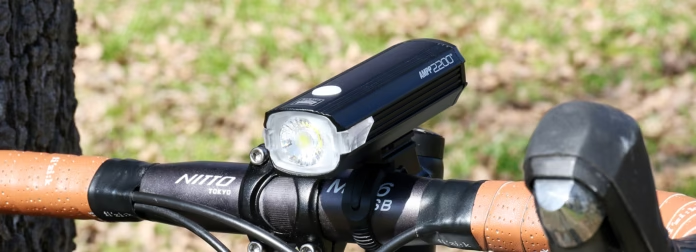
Cateye’s 2,200-lumen setting is called Ultra Boost for a reason. The manufacturer quotes just one hour at that output, so it is better understood as an occasional maximum than a normal all-evening setting. The 1,500-lumen High mode is rated for 90 minutes, while 800 lumens gives a claimed two and a half hours. For a fast road ride on unlit lanes, that middle setting is often the more useful reference point: enough output to illuminate the next bend without exhausting the battery before the journey home.
Road.cc’s independent review praised the AMPP2200’s secure mount, simple one-button operation and useful spread of light, but noted that the highest setting drains the battery quickly. MBR was less enthusiastic about its output and beam for the money, describing a relatively focused pattern and weaker endurance than some competitors. Those are different test impressions, not proof that the lamp cannot illuminate a dark road. The sensible conclusion is to choose on the beam and sustainable output, not to treat 2,200 lumens as available indefinitely.
The Garmin has a different ceiling. Its highest continuous setting is 550 lumens, with the 600-lumen figure reserved for daytime flash. A shaped cutoff beam is intended to direct light onto the road without dazzling oncoming traffic. Road.cc found the light usable for normal road riding, but its output is much closer to a competent commuter lamp than to a dedicated high-power night-riding unit. On a technical descent or unfamiliar unlit lane, the Cateye’s sustained 800-lumen setting has a clearer purpose than the Garmin’s camera-led design.
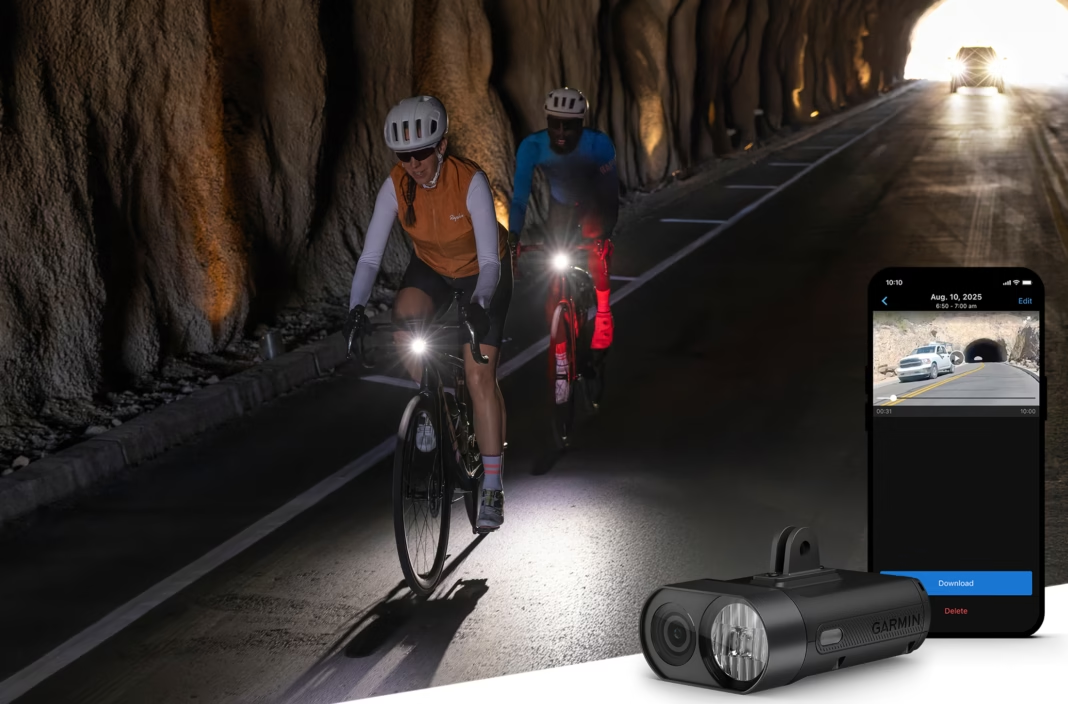 Photo Credit: Garmin
The Garmin’s camera is valuable, but its footage has limits
The Varia Vue’s main advantage is that it records the view ahead without requiring a separate action camera, second handlebar mount or extra battery. It can capture video at 4K, record audio and preserve clips around a detected incident. With a compatible Garmin Edge, riders can control functions from the computer, while the Varia app handles settings and footage. This is a credible convenience benefit for someone who rides through busy traffic every day and wants a continuous record rather than a camera they must remember to start.
The difficult question is whether the footage is good enough when it matters. Road.cc’s independent review found registration plates readable in daylight but struggled to identify vehicles in dusk and darkness, particularly with glare from lights and reflective plates. Cyclingnews also reported disappointing image quality, mounting movement and frustrating app transfers. Those findings are a reason to treat the camera as a potential source of evidence, not a guarantee of readable number plates in every incident. Resolution alone cannot overcome poor exposure, vibration or a fast-moving vehicle.
The Garmin’s incident-saving function is useful because a rider may be unable to press a button after a crash. But an incident detector cannot guarantee that every near miss is preserved, and a saved clip does not automatically establish responsibility. Riders who want video specifically for winter commuting should assess example low-light footage rather than assume that a 4K label settles the question. They should also check the mounting arrangement on their particular bike, especially where an out-front computer, bag or front rack already occupies the available space.
Battery life depends on whether the Garmin is filming
The two products’ battery figures are not directly comparable without specifying how they are used. Cateye rates the AMPP2200 for 12 hours in its 200-lumen Enduro mode, five hours at 400 lumens and two and a half hours at 800 lumens. That gives riders a clear choice between endurance and the light needed for speed. The manufacturer also quotes four hours for a full USB-C recharge, and the light cannot operate while charging. That is a limitation for very long night rides using an external power bank.
Garmin quotes one hour and fifteen minutes for 4K recording with the continuous 550-lumen light, rising to three and a half hours at 140 lumens. Using 1080p rather than 4K extends the corresponding runtimes. Camera-only operation can last longer, and the Vue can run while connected to external power. Road.cc’s test exceeded Garmin’s quoted high-output runtime, which is encouraging, but a longer ride with camera and bright light together still requires planning. You cannot compare the Garmin’s nine-hour camera-only figure with Cateye’s high-beam runtime and draw a useful conclusion.
For a one-hour urban commute, both can cover the trip if charged. For three hours of winter training on unlit roads, the Cateye has a more natural set of sustained light modes, while the Garmin may need reduced output, reduced recording resolution or external power. Riders who want video evidence for the whole ride should regard camera settings and storage capacity as part of their battery plan. A light that remains bright after the camera has been disabled may not meet the reason they bought the Garmin in the first place.
Mounting, weather resistance and everyday ownership
The Cateye uses the familiar FlexTight bracket, which road.cc found secure and straightforward to move between handlebars. Its aluminium body and physical button keep operation simple, although the button and battery indicator are not a substitute for knowing how much charge remains before a long ride. The AMPP2200 is rated IPX4 for water resistance. That covers splashing but is a lower rating than the Garmin’s IPX7, so riders who routinely leave a light exposed in prolonged heavy weather should consider the difference without treating either number as a lifetime waterproof guarantee.
Garmin’s mounting system places the Vue under a compatible out-front arrangement and can leave the top position available for an Edge computer. That is neat on a road bike with a suitable cockpit, but less flexible on bikes with bulky handlebar bags, unusual bar shapes or front racks. Cyclingnews reported movement at the camera mount during testing, which is particularly relevant because vibration affects footage. The Vue’s IPX7 rating is reassuring for wet commuting, and its ability to operate while charging is genuinely useful, but its app, memory card and camera settings introduce more ownership work.
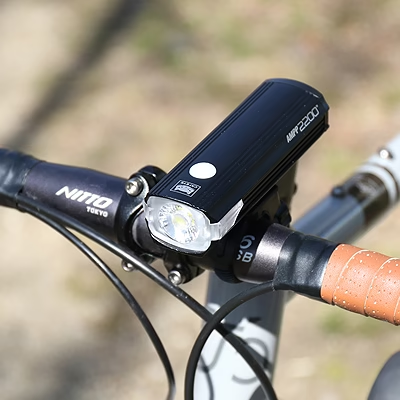 Photo Credit: Cateye
Is the Varia Vue worth roughly £270 more?
At the checked prices, Sigma Sports listed the Garmin Varia Vue at £409, while Biketart listed the Cateye AMPP2200 at £139.95. That is a difference of £269.05 before adding the Garmin’s memory card or optional cloud service. The extra money is not buying more light. It is buying video capture, incident handling, a smart mounting ecosystem and the convenience of combining two devices in one body.
If video is important, compare the Garmin with the cost and inconvenience of a separate front camera plus a conventional light, rather than expecting the Cateye to do a job it was never designed for. A separate camera can be positioned independently and may give more flexibility, but it also requires another mount, battery and charging routine. Conversely, if video is not needed, the Garmin is a poor way to spend more than £400 on illumination alone. Even a discounted Vue cannot compete with the AMPP2200’s high-output beam on simple pounds-per-lumen terms.
Neither product removes the need for a suitable rear light or for sensible road positioning. A camera records events rather than preventing them, while a powerful front light does not automatically make a cyclist conspicuous from behind. Riders choosing a complete lighting setup can also use our guide to lights for commuting and dark lanes to match output and mounting to their usual route.
Which should you buy for UK winter riding?
Buy the Cateye AMPP2200 if your first priority is seeing the road. Its sustained 800-lumen mode, dependable mounting and straightforward controls make sense for dark country lanes, evening club rides and gravel routes where an unlit corner arrives quickly. The weaknesses are real: maximum output lasts only an hour, pass-through charging is absent and IPX4 is modest for a premium lamp. Yet at about £140 it is considerably less expensive than the Garmin and spends its budget on the part of the product most night riders will actually use.
Buy the Garmin Varia Vue if continuous forward-facing recording is the reason you are shopping, you already use a compatible Garmin computer and you are willing to accept its camera limitations. The integration, incident capture and ability to run while charging are attractive, particularly for urban commuting. But the night-time registration-plate criticism is too substantial to ignore, and the 550-lumen continuous light is not a substitute for a dedicated high-output lamp on fast unlit roads. Check that the mount fits your cockpit and budget for a memory card.
For riders whose journeys combine fast unlit lanes with heavy traffic, the difficult answer is that neither device alone covers every requirement perfectly. The Cateye provides stronger illumination but no video, while the Garmin records but cannot promise useful night-time evidence. The decision should begin with the problem you need solved: seeing the road, recording the ride, or both. That is a more reliable buying test than treating the Varia Vue as a premium version of the AMPP2200.