Ten seconds can change a stage race without anybody riding ten seconds faster. A time bonus is a deduction from a rider’s general classification total, awarded for finishing in a particular position at a designated point. It is one of the reasons a bunch sprint can affect the yellow jersey even when every contender is given the same stage time.
The system is easy to understand once the clock and the classification are treated separately. What is less obvious is when bonuses apply, how they differ between races and why teams sometimes spend a remarkable amount of energy chasing only a handful of seconds.
What time bonuses do to the overall standings
A rider’s recorded stage time is not always the same figure that determines their place in the overall standings. Stage races start with cumulative elapsed time, then subtract eligible bonuses from individual riders. That is how two contenders who finish in one timed bunch can leave the stage with a different gap between them.
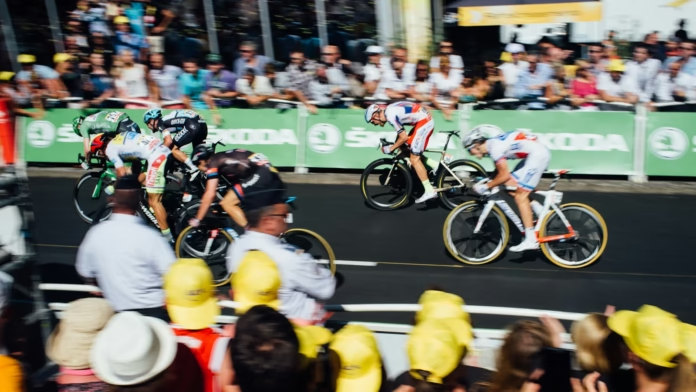
Suppose two contenders start the day level on time. They finish in the same bunch and receive identical recorded stage times. Rider A takes second place and earns a six-second bonus, while Rider B is fourth and receives nothing. Rider A moves six seconds ahead overall without having ridden the stage six seconds faster. It is a legitimate classification advantage, not a timing error.
The same principle applies when a breakaway stays clear. A rider who reaches the line eight seconds before a rival and earns a larger bonus has two distinct advantages: the recorded gap and the difference between their bonuses. The official classification combines both, and the result can be considerably larger than the road gap alone.
Bonuses belong to the individual general classification on time. They should not be confused with sprint points, mountains points, prize money or a team’s aggregate classification. A rider can collect several different awards at one location, but each operates under a different rule.
Why the familiar finish bonuses are 10, 6 and 4 seconds
The Tour de France’s official 2026 route information specified ten seconds for a road-stage winner, six for second place and four for third. The UCI’s stage-race regulations provide this familiar scale for full stages, with other provisions for particular formats. It is the most useful starting point when explaining bonus seconds, but it should not be treated as a promise that every event uses precisely the same arrangements.
A first-place bonus of ten seconds is four more than the six seconds awarded for second and six more than the four seconds awarded for third. Fourth place earns no standard finish bonus. The differences are small, but in the opening days of a stage race they can be enough to change who wears the leader’s jersey.
On a mountain stage, the calculation can be more dramatic. Imagine a winner crossing the line eight seconds ahead of the runner-up. The winner’s ten-second bonus is four seconds larger than the runner-up’s six. Assuming the recorded road gap is eight seconds, the winner gains twelve seconds in the overall standings. The physical gap and the bonus differential must both be counted.
Not every stage awards the same bonus. Race regulations and the event’s technical guide determine the applicable scale and eligible locations. An editor should check those documents rather than carrying a figure from one Grand Tour to another without verification.
How intermediate bonus sprints differ from points sprints
Some races place additional opportunities along the route. These intermediate sprints can reward the first riders through a designated location with general classification seconds. Others award points towards a separate points jersey but no time deductions. It is possible for an event to have both types, which is why the label ‘intermediate sprint’ alone is not enough to establish the reward.
The Giro d’Italia’s 2026 Red Bull KM illustrates the difference. At the designated sprint, the first three riders could collect six, four and two seconds for the overall classification. Those seconds were a distinct reward from ordinary points-jersey scoring, and their position along the route could bring general classification teams into a contest well before the finish.
The UCI framework regulates the permitted intermediate bonus arrangements and requires the details to appear in the technical guide. It also connects intermediate bonuses to the prescribed finish-bonus structure. Those requirements matter because a stage profile may show several sprint symbols without revealing which ones, if any, offer general classification time.
An intermediate bonus can change a team’s priorities. A rider six seconds behind the leader may chase a mid-stage sprint rather than wait for a finish that suits a pure sprinter. The leader’s team might respond by riding on the front, or it might allow a non-threatening breakaway to collect the available seconds.
Why a finish gap and a bonus gain are different
Television pictures can be deceptive when riders cross the line in a tight group. The official stage classification, not the apparent distance between bicycles, establishes the recorded time gap. Bunch-time and incident rules can also affect the time credited to riders. Only after that stage time is settled should bonuses be applied to calculate the general classification.
If two contenders are credited with the same stage time, a bonus can be the only reason one gains seconds. If one finishes alone, the winner may benefit from both a measured advantage and a time deduction. A commentator saying a rider ‘gained ten seconds’ might be describing the bonus rather than a solo attack, so the distinction is worth checking.
Consider a challenger twelve seconds behind at the start. The challenger and leader finish in the same timed group, but the challenger earns a ten-second finish bonus and the leader receives none. The gap becomes two seconds. If the challenger had also earned a six-second intermediate bonus under the event’s rules, the overall lead would change hands by four seconds.
That arithmetic is simple, but it depends on accurate inputs. Use the official race results to check the credited stage times, the specific bonus awards and the existing general classification. Adding the television’s estimated road gap to a bonus graphic can produce the wrong answer.
The tactical argument over a few seconds
A bonus sprint can be worth pursuing because early stage-race standings are often separated by very little. The leader’s jersey brings attention, podium appearances and responsibilities for the team defending it. Securing a handful of seconds on a manageable stage can provide protection against a small loss later in the race.
Chasing is not free. Teammates must work to bring a breakaway back, often at the expense of energy needed for a climb or difficult finale. A squad might decide that a six-second opportunity is too expensive if the route contains crosswinds, a steep finishing ascent or another obvious chance for its leader.
A breakaway can protect a leader’s advantage without the leader’s team chasing it. If the escapees are far behind overall, allowing them to occupy the first finishing positions denies bonus seconds to the closest rivals. It is a counterintuitive tactic: letting somebody else win the stage can be the safest way to defend the race lead.
The same calculation changes with the profile. A punchy uphill finish favours a rider who can accelerate sharply after several hours, while a flat sprint may deliver the bonuses to specialists with no interest in the overall standings. Bonus seconds influence tactics, but they do not override the physical demands of the course.
Why time trials are different
The normal UCI stage-race bonus provisions do not award time bonuses in individual or team time trials. Those events are decided by the recorded time on the course under their applicable rules. A rider who finishes third in an individual time trial cannot assume the standard four-second road-stage bonus will be deducted from their overall total.
A time trial rewards the fastest elapsed performance under its rules, not an additional finishing-position deduction. That changes the value of different skills. A powerful time-trialist can build a measured advantage, while a rider with a sharp sprint may collect several small bonuses across road stages without ever finishing clear of the group.
A ten-second loss in a time trial can later be offset by a ten-second bonus for winning a road stage, but the two gains arise through different mechanisms. The first is an elapsed-time deficit, the second a classification deduction. They can cancel in the overall table without being equivalent performances.
Team time trials also have their own rules for which riders’ times count and how the result is assigned. Those should be checked independently. The presence of a team time trial on a Grand Tour route is not evidence that finish bonuses will apply to it.
How to check a bonus in the official results
Begin with the general classification and look for a bonus column, often marked B. This may show the total bonuses accumulated by each rider, not just the seconds collected that day. Then compare the stage classification, which identifies the riders’ recorded times and positions, with any intermediate sprint results.
Use the official stage times rather than an estimated gap from a television picture. Subtract the bonus awarded to each rider from their credited stage time and combine that with the previous cumulative total. Where a race uses an intermediate bonus as well, include it separately. The arithmetic only works when the organiser’s actual rules and results are the inputs.
The event’s technical guide remains essential when the award system is unusual. The 2026 Giro’s Red Bull KM and the Tour’s conventional finish bonuses show why it is unwise to assume every sprint works identically. A television graphic may summarise the result, but the race regulations explain the calculation.
For more on how the biggest races differ, see our comparison of the Giro d’Italia, Tour de France and Vuelta a España. Our history of the closest Tour de France finishes also shows why a handful of seconds can carry an importance far beyond their size.