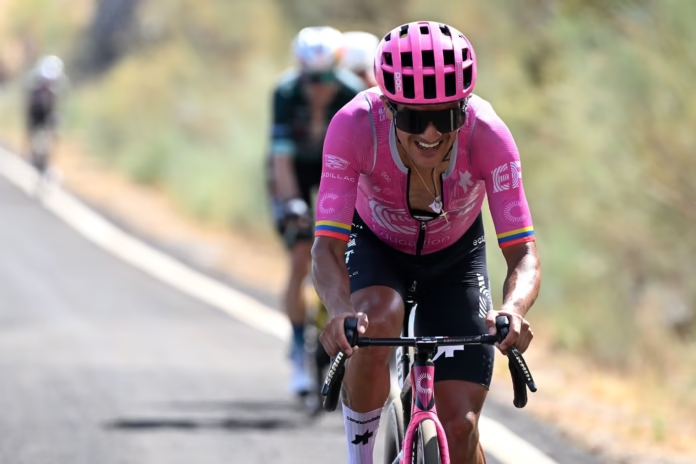
A King of the Mountains title is not awarded to the cyclist who sets the fastest climbing time. It goes to the rider who collects the most points at categorised summits across a stage race. A rider can finish twenty minutes behind the overall leader yet lead the mountains classification by winning a succession of climbs from breakaways.
At the Tour de France the mountains leader wears the white jersey with red polka dots. The equivalent at the Giro d’Italia is the blue maglia azzurra, while the Vuelta a España uses a white jersey with blue dots. The calculation changes by race and sometimes by year, but the essential tactical question is the same: which riders can collect the most points across the mountain summits before the final stage?
What does King of the Mountains actually mean?
Mountain points are awarded at designated scoring lines, usually on the summits of categorised climbs. The first rider across takes the biggest score for that climb, with smaller awards to the next riders according to its category. Where a rider finishes the stage or sits on general classification is a separate matter.
A rider who is first over a climb can then be caught, dropped or even finish far behind the stage winner without losing the points already awarded. Equally, winning a stage with a summit finish is not automatically enough to become King of the Mountains if another rider has accumulated more points during previous days.
The general classification, usually shortened to GC, is entirely separate. GC adds together each rider’s stage times and associated time adjustments, while the mountain contest adds up scoring results from designated climbs. That distinction explains why a rider can be twenty minutes down in the overall classification yet still be the most successful mountain-points collector.
Teams often assign a rider to pursue this target once their main general classification ambitions have faded, but that is a choice rather than a rule. Our guide to how cycling teams select their leaders explains why individual race objectives can change as a Grand Tour develops.
How climbs are categorised and scored
Organisers classify climbs using a combination of length, gradient, altitude and how the ascent fits the race. A short but very steep hill can be difficult, while a long pass at moderate gradients tests endurance differently. The categories are not a universal mathematical formula, and a mountain’s label can differ between races.
At the Tour de France, the categories usually run from fourth category for the smallest scoring climbs through third, second and first to hors catégorie, often abbreviated HC. The French term means ‘beyond category’ and denotes the climbs given the highest scoring scale. Lower-category climbs tend to reward only the rider or small group at the front.
The weighting is substantial. The first rider over an HC climb in the 2026 Tour de France collects 20 points. A first-category climb awards 10 to its winner, second category five, third category two and fourth category just one. It is therefore possible to overturn several days of low-category scoring on a single mountainous stage.
An ascent does not need to be a stage finish to count. Points can be available on several climbs during a single mountain stage. A breakaway rider may collect a succession of intermediate summit points, then lose contact before the final climb and still have secured a substantial increase in their classification total.
2026 Tour de France mountains points by climb category
The 2026 Tour rules award points to several riders on the hardest climbs and fewer riders as the difficulty decreases. The table below shows the scoring places for each category. It is a specific 2026 Tour schedule, not a set of UCI points that automatically applies to the Giro, Vuelta or women’s races.
| Place at summit | HC | Cat 1 | Cat 2 | Cat 3 | Cat 4 |
|---|---|---|---|---|---|
| 1st | 20 | 10 | 5 | 2 | 1 |
| 2nd | 15 | 8 | 3 | 1 | – |
| 3rd | 12 | 6 | 2 | – | – |
| 4th | 10 | 4 | 1 | – | – |
| 5th | 8 | 2 | – | – | – |
| 6th | 6 | 1 | – | – | – |
| 7th | 4 | – | – | – | – |
| 8th | 2 | – | – | – | – |
For example, a rider reaching the top of one HC climb first collects 20 points. If the same rider wins two first-category climbs on another day, they gain another 20. A competitor taking ten fourth-category summits would collect only ten points in total, illustrating how the largest mountain stages can change the contest rapidly.
Points are credited as riders pass the official scoring line, which often makes the breakaway’s progress relevant long before the finish. Television viewers may see one rider sprint for the mountain line then let others move ahead again. That is rational if the jersey classification, rather than the stage victory, is their immediate priority.
Double points at mountain-top finishes should not be assumed. Although some earlier Tour editions used special doubling provisions, the 2026 rules do not automatically add such a bonus. The standard category schedule applied even on the biggest climbs, including the Col du Galibier on stage 20.
Why breakaways are so important to the polka-dot jersey
A successful mountains-classification strategy often begins with getting into the right breakaway. If a group rides clear on a stage containing several classified climbs, its strongest climber can collect the first-place points at each intermediate summit. The general classification contenders may not be concerned because the breakaway is not threatening the overall lead.
An unexpected advantage of being far down on general classification is freedom. A GC leader’s rivals may chase an attack immediately, but the same teams can allow a rider twenty minutes behind to ride away. That is how a specialist can gain access to several mountain scoring lines before the yellow-jersey group arrives.
Teams also plan around where the largest points are available. A route with multiple first-category climbs on successive days rewards a different approach from one dominated by a single huge finish. The rider targeting mountain points may conserve energy on a flatter stage, then spend everything attempting to reach the next day’s breakaway.
The trade-off becomes delicate when a team also has a GC leader. A strong climber might be needed as a domestique to pace their leader on a decisive mountain, rather than ride away to collect the points themselves. Pursuing an individual jersey can therefore conflict with the tactics required to protect a teammate.
Can a rider win the mountains jersey without winning a mountain stage?
Yes. The King of the Mountains title depends on the total points awarded across the race, not how many stage wins a rider has. Someone could finish second on several high-scoring climbs and beat a rider who takes one major summit victory but scores almost nothing elsewhere.
The reverse is equally possible. A rider can win a dramatic summit finish yet be too far behind in mountain points to claim the jersey. GC riders are particularly likely to pick up mountain points as a by-product of attacking for time, but a specialist climber may build a larger total by repeatedly reaching early climbs in breakaways.
Richard Carapaz provided a recent illustration by winning the 2026 Tour de France mountain classification with 156 points. Tadej Pogačar, winner of the overall race, had 100, while Valentin Paret-Peintre had 99. The mountain competition had its own winner and logic, even during the stages on which GC contenders were strongest.
Time bonuses should not be confused with mountains points. A rider can earn a few seconds off their GC time at a stage finish or intermediate sprint in races that offer them, but those seconds do not automatically count towards the climbing competition. See our explainer on stage-race time bonuses for the distinction.
How the Tour, Giro, Vuelta and women’s races differ
At the Giro the mountains leader wears blue, the maglia azzurra, and the year’s highest designated climb can carry a special Cima Coppi points scale. At the Vuelta the jersey is white with blue dots. The principle remains collecting points at climbs, but neither event must use the men’s Tour de France points table.
The Vuelta a España has its own categorisation and points distribution, with a white jersey covered in blue polka dots for the classification leader. The 2026 Vuelta jerseys explainer covers the colour scheme and how the contest fits alongside the red and green jerseys.
The Tour de France Femmes avec Zwift also runs a mountains contest, commonly described as the Queen of the Mountains classification. Its leader wears a polka-dot jersey, but the race’s shorter programme and its published rules must be checked separately rather than importing the men’s Tour scoring table wholesale.
These differences are a useful reminder to check the regulations for the edition being discussed. Our comparison of the Giro, Tour and Vuelta sets out the wider contrasts between the three Grand Tours, while the 2027 Giro route guide identifies the high mountains where a future maglia azzurra battle could develop.
The history behind the polka dots
The Tour de France introduced a formal mountains classification in 1933, and Vicente Trueba is recognised as its first winner. The distinctive red polka-dot jersey was introduced in 1975, decades after the competition itself began. Both details matter: the classification and the jersey are not the same age.
The red dots first appeared as the Tour’s mountains leader’s jersey in 1975, even though the classification began in 1933. Richard Virenque later won the title a record seven times; Federico Bahamontes and Lucien Van Impe collected six each. These were separate sporting achievements from the event’s overall winner’s record.
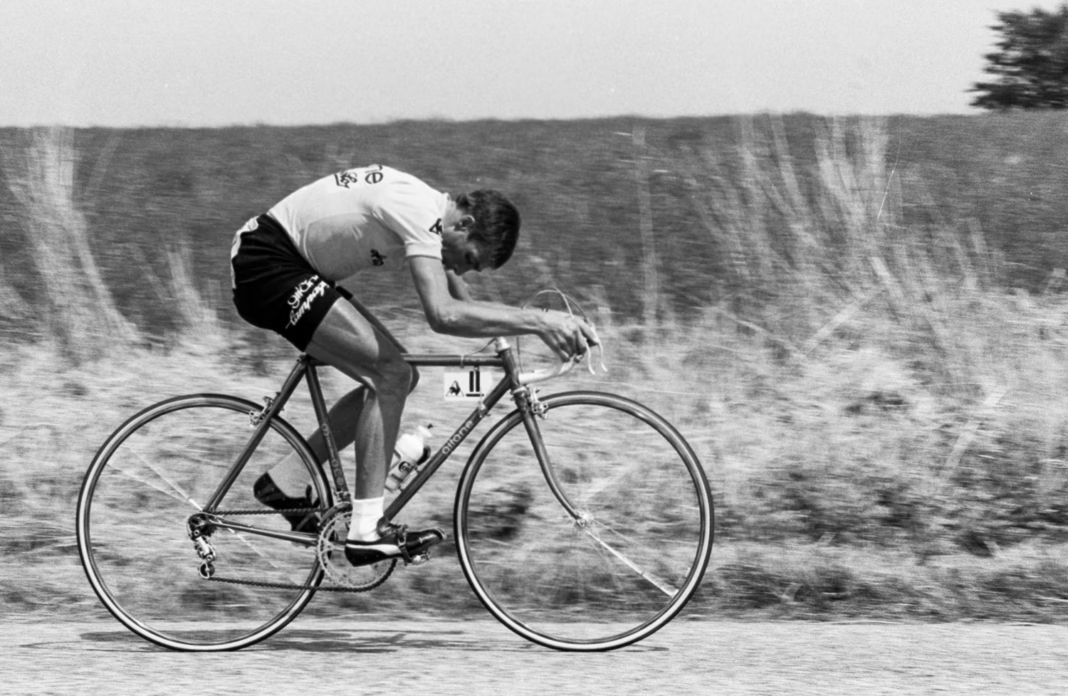 Photo Credit: B. Milanese
Van Impe was one of the great examples of a rider who combined pure climbing ability with Grand Tour ambitions. He won the Tour outright in 1976 but also repeatedly targeted the mountains classification across his career. Our profile of Lucien Van Impe explores why his style proved so successful in that era.
The polka-dot jersey’s visual appeal can obscure the considerable tactical calculation beneath it. Even riders without realistic ambitions for yellow may become the focus of a mountain stage when a string of classified summits makes their points total relevant.
How to follow the mountains competition during a stage
The first step is to check the stage profile and identify which climbs have an official classification. The kilometres and gradients tell you how hard the road may be, but the category tells you how many mountain points are on offer. A steep uncategorised section might decide the stage without awarding a single mountains point.
Next, look for the breakaway and the existing mountain classification standings. If a rider is close to the jersey and is in the day’s leading group, each summit may produce an attack or a short sprint for points. The time gap to the peloton becomes relevant because the leading riders must reach the scoring line before the race favourites.
After the stage, compare the updated mountains table with the general classification. They may have different leaders, and the jersey wearer can sometimes be a rider occupying a lower-priority classification because the same cyclist leads two competitions. The race’s published jersey-priority rules determine who wears which garment.
Ties in mountain points are resolved through the race’s published regulations, with priority commonly given to the number of first places on the most difficult categorised climbs. Do not guess the winner from the order shown during a live stage: the final official table includes the exact classification and tie-break provisions.
-
 Photo Credit: David Pintens / Belga / AFP via Getty Images
-
Photo Credit: David Pintens / Belga / AFP via Getty Images