
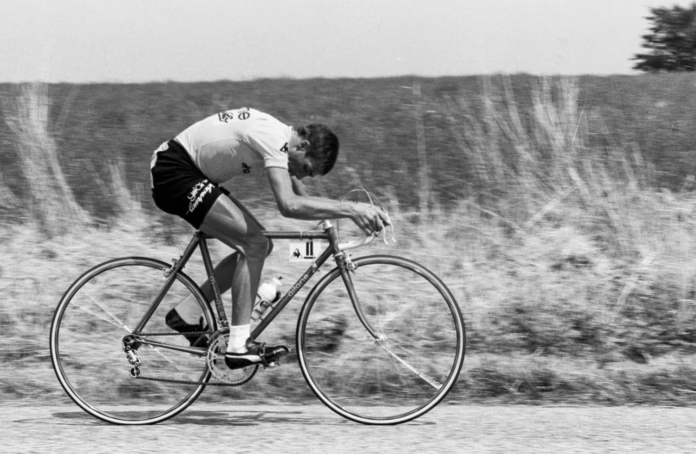
Lucien Van Impe belongs to a particular line of Tour de France champions: small, light climbers whose authority came from the mountains rather than from dominating every type of terrain. He won the 1976 Tour, took the race’s mountains classification six times and collected nine Tour stage victories across a professional career that stretched from 1969 to 1987.
Those numbers make him easy to categorise as a specialist, but they can also flatten the story. Van Impe did not win the Tour simply because the 1976 route contained enough climbing. He had to beat Joop Zoetemelk across a four-week race of more than 4,000 kilometres, survive time trials that favoured heavier riders and choose the moment when his climbing superiority could create a gap large enough to defend.
He remains the last Belgian man to win the Tour de France. In a country whose cycling identity is so often built around the Classics, Van Impe’s place is different: the Belgian who became the outstanding pure Grand Tour climber of his generation and turned one decisive day in the Pyrenees into yellow in Paris.
From Mere to the high mountains
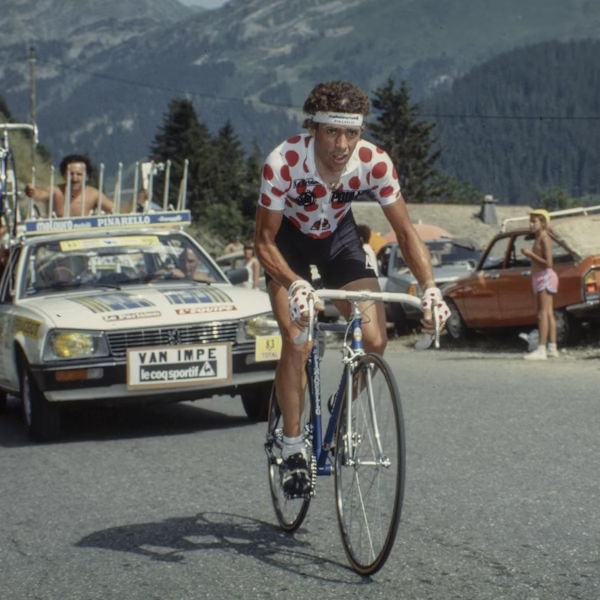
Van Impe was born in Mere, East Flanders, on 20 October 1946. His build suited climbing from the beginning. At roughly 59kg during his racing career, he did not have the physical profile of a rider expected to dominate flat time trials or bully a peloton through crosswinds. His route to the top depended on extracting time where gradient reduced the value of raw power and rewarded repeated climbing acceleration.
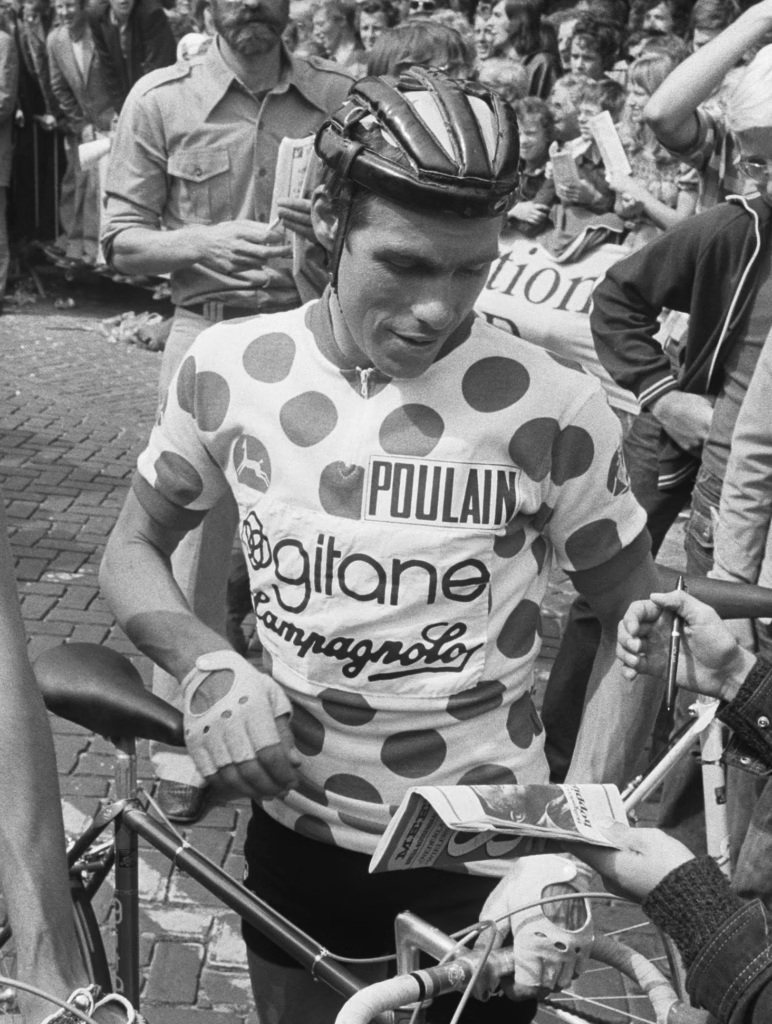
He turned professional in 1969 and quickly established the pattern that would define his career. By 1971 he had won his first Tour mountains classification. He repeated it in 1972, when he also took his first Tour stage victory, and became a fixture in the upper reaches of the race whenever the route reached the Alps or Pyrenees.
The early 1970s were not an easy period in which to build a Tour palmarès. Eddy Merckx still dominated the sport, and the riders trying to win around him included Luis Ocaña, Bernard Thévenet, Raymond Poulidor and Zoetemelk. Van Impe’s climbing results therefore accumulated inside one of the deepest Grand Tour eras. He was not waiting for the field to weaken. He was learning how to turn one exceptional attribute into overall relevance.
A mountain specialist who kept returning to the Tour podium fight
By the middle of the decade, Van Impe was much more than a jersey hunter. He finished third in the 1971 Tour, fourth in 1972, fifth in 1975 and repeatedly showed that his climbing could carry him through the parts of the race that did not suit him. The mountains classification remained a natural target, but general classification became realistic because his bad days were increasingly controlled.
His rivalry with Zoetemelk is central to understanding this period. The Dutchman was the more rounded stage racer and would eventually win the 1980 Tour, but Van Impe could put him under severe pressure on the steepest climbs. ProCyclingUK’s Joop Zoetemelk rider history shows how often Zoetemelk’s career placed him close to the dominant rider of the moment. In 1976, that dominant opponent became Van Impe.
The pair had already traded mountain blows before the decisive Tour. Zoetemelk beat Van Impe on Alpe d’Huez in 1976 and again the following day, gradually tightening the overall race. Van Impe needed something larger than a few seconds at a summit finish. His response came in the Pyrenees.
Pla d’Adet and the day Van Impe won the 1976 Tour
The defining stage finished at Pla d’Adet above Saint-Lary-Soulan. Raymond Delisle began the day in yellow, while Van Impe and Zoetemelk were the two riders with the clearest route to overall victory. Van Impe attacked from distance, bridged towards the riders ahead and then separated himself on the final climb.
Zoetemelk chased largely alone. He was strong enough to pass other leading riders on the climb, but he could not close the decisive gap. Van Impe won the stage and put more than three minutes into his principal rival. The exact tactical folklore has become part of Tour history: directeur sportif Cyrille Guimard later claimed he had effectively ordered Van Impe to attack, while Van Impe disputed the more theatrical versions of that story. The result is less debatable. It was the move that broke open the race.
Van Impe then did something essential for a climber trying to win the Tour: he defended the advantage away from the mountains. He finished strongly enough in the final individual time trial to preserve his lead and reached Paris 4:14 ahead of Zoetemelk, with Poulidor third. He had won the Tour without winning the mountains classification, missing that competition by a point to Giancarlo Bellini.
The irony suited his career. The year in which Van Impe achieved his greatest climbing performance was also one of the rare Tours in which he did not take the polka-dot prize. Overall victory mattered more. His name sits permanently on ProCyclingUK’s list of Tour de France winners, and no Belgian man has joined him there since.
Why a second Tour never arrived
Winning in 1976 did not turn Van Impe into an all-terrain patron. His strengths remained sharply defined, and the Tour changed around him. He entered 1977 as a favourite but could not reproduce the same decisive advantage. Thévenet returned to win, while Van Impe’s campaign became another reminder that a climber needed the route, form and tactical opening to align.
He nevertheless remained a Tour force for years. Van Impe won the mountains classification again in 1977, 1981 and 1983, bringing his total to six. He finished second overall in 1981, behind Bernard Hinault, and returned to Pla d’Adet that year to win there again. The climb that had delivered his yellow jersey in 1976 remained one of the clearest expressions of his racing identity.
Longevity became part of the record. Van Impe started 15 Tours and finished all 15. In an era of longer stages, fewer protections for riders and much less specialised recovery, simply carrying Grand Tour competitiveness across that span was significant. His results were not confined to a brief peak around 1976.
The Giro, Vuelta and a career beyond France
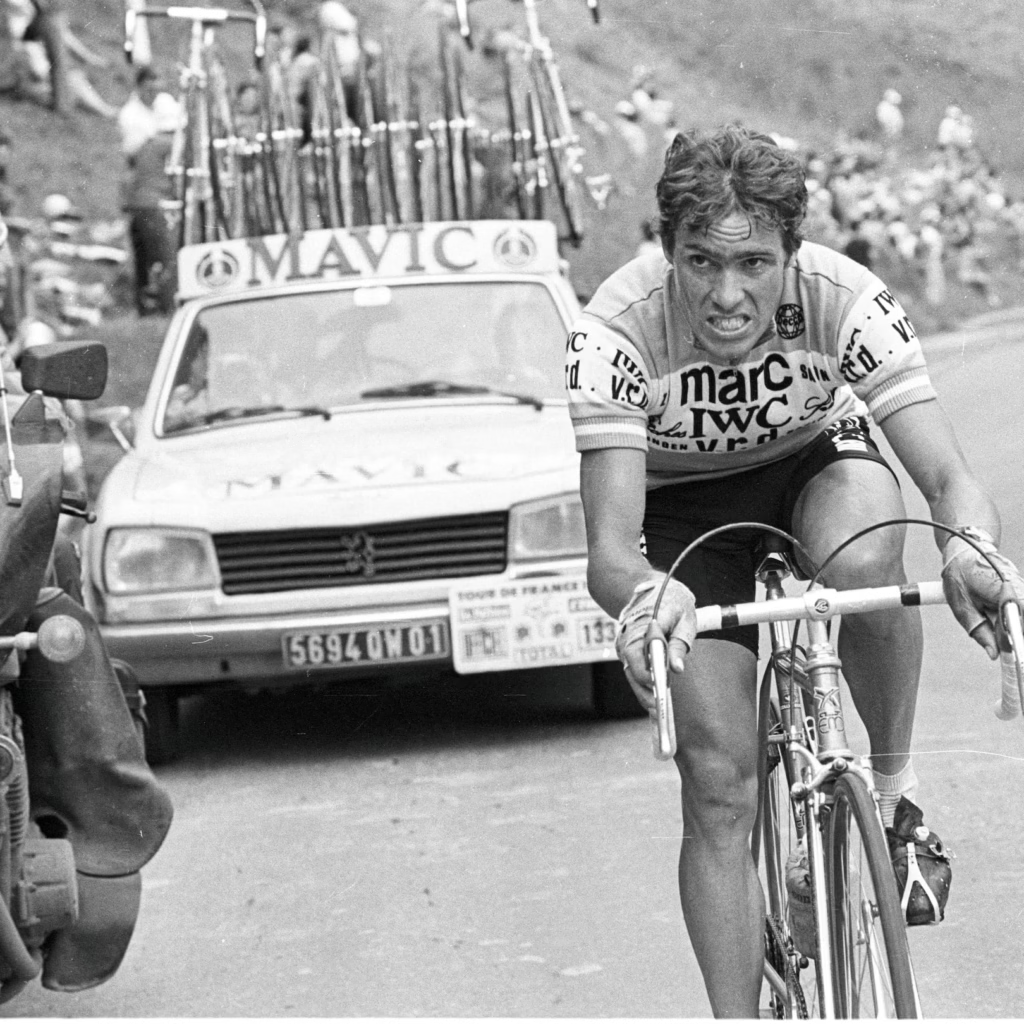
The Tour understandably dominates Van Impe’s reputation, but his climbing travelled. He won a stage of the Vuelta a España in 1979 and later became a major figure at the Giro d’Italia, winning the mountains classification in both 1982 and 1983. He also took a Giro stage in 1983.
Those Italian results came when he was already in his mid-30s. They matter because they show that Van Impe’s late career was not ceremonial. He could still shape Grand Tour mountain competitions long after the generation around his Tour victory had begun to disappear.
In 1983 he also won the Belgian national road title, an unusual but valuable addition for a rider so strongly associated with stage-race climbing. It did not transform him into a Classics rider, but it broadened a palmarès that is sometimes reduced too aggressively to one Tour and six mountains jerseys.
A climber from before the age of climbing specialists
Modern Grand Tour climbing is highly specialised: pacing is measured, nutrition is continuous, equipment is optimised for every gradient and teams arrive with detailed power models. Van Impe raced in a period when the basic physical requirement was less forgiving. A climber still had to absorb huge distances, repeated long transfers, rudimentary recovery and time trials that could be disproportionately damaging.
That context is why his 1976 win should not be treated as a route-assisted curiosity. Van Impe had to build a gap large enough in the mountains to cover his relative weaknesses elsewhere, and he had to do it against Zoetemelk, one of the most durable stage racers in Tour history. His attack at Pla d’Adet was spectacular because it was also mathematically necessary.
He also represents the closing stretch of Belgium’s extraordinary Tour-winning tradition. Before him came riders such as Eddy Merckx, whose dominance reshaped the race and whose rare moments of vulnerability remain part of Tour folklore, including the 1971 day at Orcières-Merlette. Van Impe was a very different champion. He did not control the sport. He waited for the mountains to give him leverage.


The last Belgian Tour winner
Van Impe retired after the 1987 season. By then his professional career had lasted nearly two decades and bridged the Merckx era, the rise of Hinault and the beginnings of another generation. His six Tour mountains titles stood as one of the defining climbing records of the race, while his 1976 yellow jersey remained unmatched by later Belgian riders.
The label of ‘last Belgian Tour winner’ can obscure as much as it explains. It frames Van Impe through what his country has not done since rather than through what he actually achieved. He was a 15-time Tour finisher, a multiple Grand Tour mountain champion, a stage winner in all three Grand Tours and a rider capable of finishing second at the Tour five years after his victory.
His career makes most sense when viewed through that consistency. Pla d’Adet was the decisive masterpiece, but it worked because Van Impe had spent years learning how to stay close enough to the best riders for one mountain attack to matter. In 1976, he finally created the gap that no one could take back.

