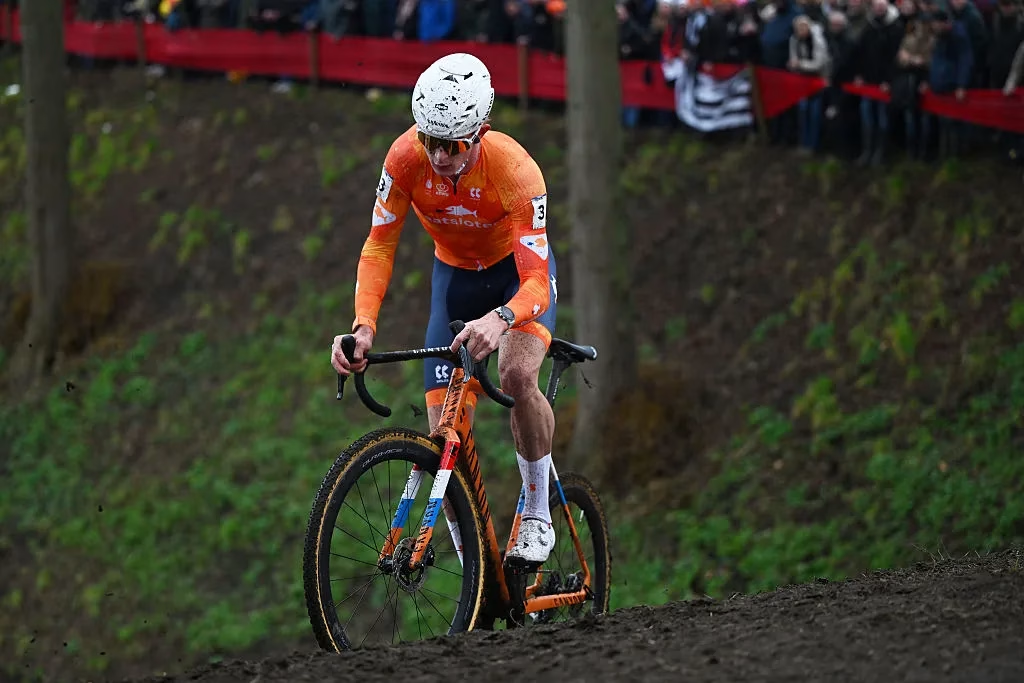
Marianne Vos and Mathieu van der Poel have won eight elite cyclocross world titles apiece, yet their achievements on the road are just as important to the way modern cycling is understood. Vos has won Olympic and road world titles, while Van der Poel has become a road world champion and one of the outstanding one-day specialists of his generation. Neither treated success on grass and mud as the limit of what a cyclocross rider could achieve.
The crossover runs much deeper than those two names. Wout van Aert, Pauline Ferrand-Prévot, Tom Pidcock, Zdeněk Štybar, Hanka Kupfernagel and Puck Pieterse offer very different examples of riders transferring an off-road foundation into road racing. Their careers also show the limitations of the comparison: the skills overlap, but an explosive hour-long cross and a mountainous three-week road race are not the same contest.
Marianne Vos set the standard across disciplines
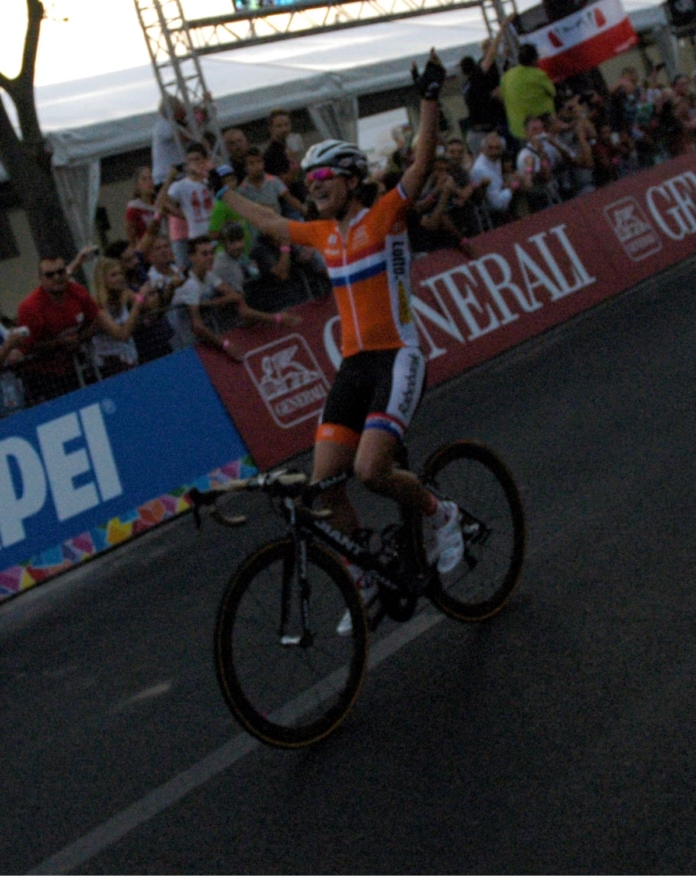
Vos won her first elite cyclocross world title in 2006 and her eighth in 2022, a sixteen-year span that is almost impossible to comprehend as a period of continuous relevance at the highest level. The Dutch rider had already become a world champion on the road in 2006, then added road world titles in 2012 and 2013. Her Olympic road race victory at London 2012 and three overall victories at the Giro Rosa illustrate how far beyond winter racing her influence extended.
Vos’s success came from more than simply entering several disciplines. Cyclocross taught Vos to make decisions when traction was poor and to accelerate repeatedly after corners. On the road, those abilities fitted the demands of selective one-day races, technical finishes and attacks launched over short climbs. She could also contest bunch sprints and endure stage races, so her road palmarès cannot be explained solely by the one-hour intensity of cyclocross.
She remained a relevant road winner even as the women’s calendar became deeper and more specialised. The range of her achievements has forced comparisons with other leading road champions, explored in our Marianne Vos and Annemiek van Vleuten career comparison. Their strengths differed markedly, but Vos’s cyclocross record is a reminder that the road’s most complete riders have often developed skills outside a conventional road-only programme.
Her longevity reveals another part of the story. After years competing in both disciplines, Vos learned to manage health, recovery and programme selection rather than assuming every winter needed a full cyclocross calendar. That matters because multi-discipline success over one or two seasons is difficult enough; remaining competitive over more than a decade requires constant decisions about when not to race.
Mathieu van der Poel made a cyclocross skill set decisive on the road
Van der Poel’s eighth elite cyclocross world title came at Hulst in February 2026, taking him beyond Eric De Vlaeminck’s long-standing men’s record of seven. He had already won the elite road race world championship in Glasgow in 2023, after a race in which his ability to handle an unforgiving technical circuit helped him create a decisive gap. The road title belonged to the same rider who could dominate in mud, but it was achieved through hours of sustained racing rather than an isolated explosive effort.
Victories in the Tour of Flanders and Paris-Roubaix reveal the overlap between the disciplines. Cobbles, sharp changes of pace, narrow approaches to obstacles and repeated accelerations demand both power and confidence in the bike. In cyclocross, a missed line might mean losing two seconds through a turn. On the roads of Flanders and northern France, losing position before a sector can put a rider on the wrong side of the decisive selection.
Van der Poel also became a stage winner at the Tour de France, demonstrating that he could convert his strengths to a Grand Tour setting without becoming a general-classification contender. His road programme has required periods when cyclocross racing was deliberately limited or shifted around training camps and bigger spring targets. Treating his schedule as uninterrupted full-intensity racing misses the precision behind his preparation.
At the Tábor cyclocross World Championships, Van der Poel won his first elite cross rainbow jersey in 2015 and returned to take another in 2024. Those two victories bookend much of his rise on the road. The same technical confidence remained, but his ability to sustain power in long Classics and survive highly organised team tactics grew substantially.
Wout van Aert used cyclocross as a foundation, not a ceiling
Van Aert won three consecutive elite cyclocross world titles from 2016 to 2018, originally building his reputation as a rival to Van der Poel before establishing a major road career. He has won stages of the Tour de France in very different circumstances: in bunch sprints, against the clock and from demanding attacks. Winning the green points jersey in 2022 demonstrated the breadth of that ability across a three-week race.
His most obvious link with cyclocross is his capacity to recover after hard surges. He can accelerate on a climb, ride strongly across an exposed section and still have enough speed to compete at the finish. Yet his value as a road rider also includes sustained time-trial power, positioning within a larger team and sacrificing individual opportunities to help a general-classification leader. None of those tasks is simply an extended cyclocross lap.
The rivalry with Van der Poel has made their dual success unusually visible, but their road careers are not mirror images. Van der Poel has concentrated much of his winning record on the biggest one-day races; Van Aert has become especially notable for the variety of roles and terrain in which he can influence a race. Their shared off-road background produced two distinct ways of being successful on the road.
Pauline Ferrand-Prévot achieved something no one had done before
Ferrand-Prévot holds a remarkable place in cycling history. She won the elite road race world title in 2014, the cyclocross world title at Tábor in February 2015 and the mountain bike cross-country world title later that year. For a period, she simultaneously held elite world titles in three different cycling disciplines. The achievement goes much further than being a rider who occasionally starts races on different kinds of bicycle.
Her road achievements have extended well beyond those early rainbow jerseys, including her overall victory at the 2025 Tour de France Femmes avec Zwift. The shift in emphasis required for that success matters. An athlete prepared to win an hour-long cyclocross race or an Olympic mountain bike event still has to develop the ability to pace long climbs, recover between stages and handle the strategic pressures of defending a general-classification position.
Ferrand-Prévot’s programme also demonstrates the costs of versatility. Her programmes have involved deliberate switches in focus, injury and health challenges, and periods when one discipline took precedence over another. Calling her simply a cyclocross rider who succeeded on the road would understate the wider significance: she became one of cycling’s most accomplished athletes by mastering several disciplines and making hard choices about when to specialise.
Tom Pidcock and Puck Pieterse represent a newer generation
Pidcock won the elite men’s cyclocross world championship in 2022, then took a memorable Tour de France stage victory on Alpe d’Huez that summer. He added Strade Bianche in 2023 and the Amstel Gold Race in 2024, while also winning Olympic mountain bike cross-country gold medals in Tokyo and Paris. His record spans very different formats, from technical off-road racing to the tactical demands of the spring Classics.
Those victories show why cyclocross has become a useful training ground for versatile young riders. Pidcock’s handling allows him to carry speed where others hesitate, but the stage on Alpe d’Huez required endurance and efficient climbing after several hours of racing. The road victories were not achieved through technique alone; they depended on the aerobic base and tactical judgment needed to operate at WorldTour level.
Pieterse offers a similarly revealing example in women’s cycling. She was already established in cyclocross and mountain biking when she won stage four of the 2024 Tour de France Femmes in Liège, beating Demi Vollering and Kasia Niewiadoma in a three-rider finish. That required her to survive the hard climbing and then sprint against some of the strongest road racers in the world, despite relatively limited road-racing experience.
Our report on Pieterse’s Tour de France Femmes stage victory captures the breakthrough. Not every junior cyclocross champion will win a WorldTour stage. It is that the sport can develop a combination of bike handling, high-intensity endurance and racing instinct that becomes particularly valuable when the road route is selective and technical.
Zdeněk Štybar and Hanka Kupfernagel proved the crossover was not new
Long before the current interest in multi-discipline calendars, Štybar had shown how a cyclocross champion could become a winner of leading men’s road races. The Czech rider won elite cross world titles in 2010, 2011 and 2014. On the road he claimed Strade Bianche in 2015, took a stage of that year’s Tour de France and won Omloop Het Nieuwsblad and E3 in 2019.
The transition demanded more than carrying his cyclocross fitness onto the road. His cyclocross background gave him confidence through technical sectors, but he also learned to manage longer races and team tactics in the Classics. His record is particularly revealing in the type of road races he won: demanding one-day contests where repeated efforts and accurate decisions could separate a small leading group.
Kupfernagel represents an even earlier example of sustained excellence across disciplines. The German won four elite women’s cyclocross world titles between 2000 and 2008, while also becoming road time-trial world champion in Stuttgart in 2007. Her career showed that cyclocross strength could sit alongside the very different discipline of an individual road time trial, where controlled pacing and aerodynamics matter far more than repeated dismounts.
Our detailed Hanka Kupfernagel career profile examines the achievements that can be overlooked when multi-discipline cycling is discussed only through current stars. Her success also makes clear that women were demonstrating this kind of versatility well before it became a popular feature of modern men’s WorldTour coverage.
Which cyclocross skills actually transfer to road racing?
Bike handling is the clearest shared skill. Riders accustomed to loose surfaces and changing traction often have an advantage when a road race involves cobbles, gravel, wet corners or complicated positioning before a climb. Cyclocross also rewards repeated short accelerations. A rider who can produce power after every corner may be exceptionally difficult to follow on a punchy Classic course where the pace repeatedly breaks and reforms.
There are clear limits to that physical crossover. Most elite cyclocross races last roughly an hour; a road Monument or Grand Tour stage can last several times longer. Road racing demands sustained fuelling, longer-term fatigue resistance, team cooperation and a different management of effort. There is no reason to assume a champion in one discipline will automatically become a general-classification specialist or a dominant sprinter.
Scheduling has become crucial to making the crossover work. A full winter of hard racing may improve competitive sharpness but reduce the opportunity for a traditional preparation block ahead of the spring Classics. Conversely, an extended road season can make it difficult to arrive ready for early cyclocross rounds. The best riders choose their most important competitive peaks rather than treating every race as equally important.
The 2026–27 cyclocross calendar illustrates the crowded winter programme against which these choices are made. For Vos, Van der Poel, Van Aert, Ferrand-Prévot and their successors, the defining skill may ultimately be the ability to choose when cyclocross develops their road ambitions and when a change of focus is necessary.
-
 Photo Credit: ProCyclingUK archive (original photographer unverified)
-
 Photo Credit: NSN Cycling Team (official 2027 kit launch)
-
 Photo Credit: Beeline