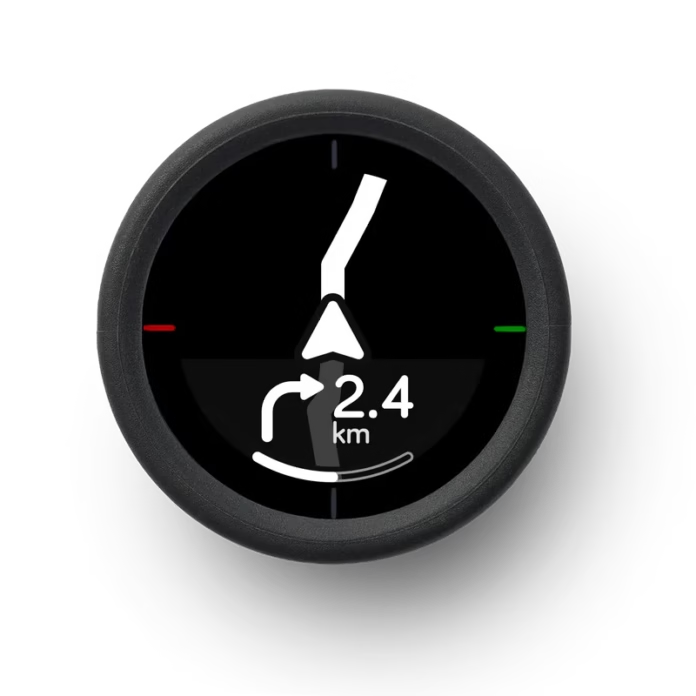
A cycling computer can be useful without doing everything. The Beeline Velo 2 takes that principle to its logical conclusion: it shows straightforward navigation and basic ride information while your smartphone calculates the route. The Magene C606 Pro is a conventional full-featured head unit, with its own GPS receiver, colour maps, training tools and support for cycling sensors. Which is better depends much more on the type of rider than on headline specifications.
Both can guide a cyclist on unfamiliar roads, but they are not interchangeable products. Beeline is about removing distraction from everyday riding. Magene is aimed at riders who want training information and detailed navigation in one place. This is an independently researched comparison, not a hands-on test by ProCyclingUK. It draws on current manufacturer documentation and independent reviews from road.cc, Cycling UK, BikeRadar, Cycling Weekly and Cyclingnews.
Magene C606 Pro vs Beeline Velo 2 at a glance
| Specification | Magene C606 Pro | Beeline Velo 2 |
|---|---|---|
| UK manufacturer’s listed price | £209 | £99.99 |
| GPS positioning | Integrated, standalone satellite receiver | Provided by paired smartphone |
| Display | 2.8-inch transflective colour touchscreen | Compact circular navigation display |
| Battery claim | Up to 25 hours | Up to 11 hours |
| Weight | 105g | 25g |
| Navigation | Detailed on-device maps and turn-by-turn route guidance | Simplified directions through Beeline app |
| External cycling sensors | ANT+, Bluetooth, including compatible power meters | No comparable full power-meter and trainer ecosystem |
| Core buyer | Training-focused road or gravel rider | Commuter, leisure rider or simplicity-first navigator |
These are UK manufacturer prices checked in November 2026, before any temporary offers. Magene’s UK website lists the C606 Pro at £209 with an indicated dispatch window of one to three business days. Beeline lists its Velo 2 at £99.99 with an active purchasing option. Both can appear at different prices through retailers, so any buying decision should start with the current exact-model listing. Magene’s older C606 is a separate product, as is the higher-tier C706.
Why the smartphone question matters
The Velo 2 does not contain the same independent navigation hardware as a typical Garmin, Wahoo or Magene computer. The Beeline application uses the paired phone’s GPS and routing engine, then sends turn guidance and essential information to the small handlebar device. The phone can be kept in a pocket with the screen off, which makes the arrangement much less distracting than riding with the phone’s display exposed to rain and road spray.
The trade-off is dependence on that phone. A flat handset battery, disconnected Bluetooth connection or incorrectly configured background-app settings can interrupt navigation. It is therefore important to distinguish the Velo 2’s quoted device battery life from the total life of the phone-and-device combination. A cyclist setting off for a ten-hour ride cannot assume the Beeline will guide them for eleven hours if the phone itself runs out first.
The Magene C606 Pro has its own satellite receiver and route storage. It can display surrounding roads on the device, import GPX routes and present turn instructions without borrowing the smartphone’s position every second of the ride. This makes it the more self-contained choice for long days away, particularly when the phone is needed for emergencies or photos rather than constant navigation.
There is still a companion app with Magene, called OnelapFit, and some setup and route functions use it. Self-contained navigation does not mean the computer never needs software updates or a phone to prepare a ride. But its core riding functions are more independent once a route and maps are loaded.
Simple turn instructions versus a proper map
Beeline’s appeal is how little information it places between the rider and the road. It shows concise directions rather than trying to recreate a full smartphone map on a tiny screen. The app offers fast, quiet and balanced routing options, as well as a community road-rating system. You can import a GPX route, follow prompts and review distance, speed, time, ETA and basic climb information. For short city rides or unfamiliar lanes, that can be all a rider wants.
Cycling UK’s October 2026 review found the Velo 2 approachable for route following, while Cycling Weekly liked its simple interaction. Cyclingnews was also positive about the uncluttered idea, though its reviewer found the experience less persuasive on gravel and smaller paths. These are useful distinctions: a system that is excellent on ordinary roads may still be less satisfying where paths, tracks and junctions are poorly represented.
Magene’s C606 Pro gives much more visual context. The 2.8-inch colour touchscreen offers on-device map views, heading-up or north-up orientation, route import, turn prompts and several rerouting options. Magene also advertises a route limit of up to 1,000km, which is substantial for a single cycling outing. The map is better suited to someone who wants to see adjoining streets or assess a junction for themselves.
However, more mapping does not guarantee better route choices. Road.cc’s independent October 2026 review praised the C606 Pro’s build and app, but was less impressed with aspects of its navigation and off-route behaviour. That is particularly relevant to cyclists taking unfamiliar shortcuts or deliberately deviating from a programmed route. Magene’s specifications are ambitious; the software experience deserves testing against your own needs before you buy.
 Photo Credit: Magene
Do you need power, heart rate and training screens?
This is the least ambiguous part of the comparison. The Magene is intended to work as a training computer. Its ANT+ and Bluetooth protocols support compatible power meters, speed and cadence sensors, heart-rate monitors and smart trainers. There are structured-training functions, configurable screens, climb-related information and Strava segment support. Magene also lists compatibility with some radar lights and electronic shifting systems, although individual accessories may need specific firmware and setup.
Those functions change how a serious rider uses the head unit. For threshold intervals, displaying three-second power, cadence, heart rate and lap time simultaneously can be useful. On a long climb, the gradient profile and distance remaining may help pace the effort. A cyclist returning from a hard club ride can use the data as part of a training analysis workflow.
The Beeline Velo 2 intentionally avoids that complexity. It will show simple ride statistics, can export and synchronise ride data through its phone-based ecosystem, and includes enough for everyday navigation. It is not designed to replace a head unit that displays detailed power-meter metrics or controls a smart trainer. That does not make it a poor product. It means riders who care about training numbers should probably take it off their shortlist.
For someone who already wears a watch to record exercise, a Beeline may provide the missing navigation without duplicating the rest of their equipment. For somebody using a Garmin-style training setup or planning to add a power meter, Magene’s more complete sensor support has genuine value.
Battery life and the difference between two riding days
Magene claims up to 25 hours for the C606 Pro. Battery performance changes with display brightness, use of maps, connected sensors, wireless syncing and temperature, so it is not a guaranteed twenty-five-hour result on every winter ride. Even allowing for a practical margin, it offers attractive endurance for a sportive, a long club ride or a multi-day tour.
Beeline claims up to 11 hours for the Velo 2 itself, with extended standby time. For a commuter or rider out for a few hours, that is more than adequate. The complication is again the paired phone. If the smartphone starts at half charge, or its GPS and networking consume unusually high power, it may determine how long the navigation arrangement remains useful. A small power bank can reduce the risk, but it adds another item to carry.
Weight and bulk strongly favour Beeline. Its quoted 25g device is about a quarter of the Magene’s 105g weight, and its circular form looks particularly discreet on a road-bike stem. The C606 Pro is hardly a heavy flagship at 105g, however, and its broader display gives room for maps and multiple data fields. Choose based on how much information you want on the handlebars, not whether eighty grams is theoretically significant to the bike.
Setup, controls and software maturity
Beeline has had years to develop a limited, intuitive product. The user connects a phone, plans a route and follows the directions. The road-rating concept also gives frequent riders a way to influence future routing suggestions. But the simplicity is only as robust as the smartphone connection and the routing information available in the area.
Magene offers multiple sport profiles and considerably more configuration. You can adapt the screens to your power meter and preferred data, change mapping views and use its training functions. The price for that flexibility is a longer setup process and more ways for the interface to become confusing. The October 2026 road.cc review’s mapping criticisms are a useful warning that a long feature list does not automatically mean mature software.
It is also important not to conflate independent tests of Magene’s original C606 with the C606 Pro. The names are similar, but the Pro has its own product specification and software updates. We give greatest weight to reviews that identify the exact 2026 Pro version. Likewise, commentary on Beeline’s original Velo should not be treated as a direct test of the current Velo 2.
 Photo Credit: Magene
Which is better value for UK cyclists?
The £99.99 Velo 2 costs £109.01 less than the C606 Pro’s £209 manufacturer price. It is a good purchase when a rider already owns a reliable smartphone and wants clear directions without a cumbersome or expensive computer. Adding a larger GPS head unit would be unnecessary for someone who never uses power, cadence or detailed maps.
The Magene begins to justify the difference as soon as the rider wants self-contained GPS recording and more than directions. Power-meter compatibility, climb tools, full route maps, a longer claimed battery and better integration with training software can each have real value. Its available retail discounts may reduce the price difference substantially, although the exact stock and discounted amount should be confirmed at purchase.
Someone buying a Christmas gift for a casual cyclist might favour the Beeline because the idea is easy to explain and the device is visually discreet. A regular sportive cyclist who enjoys performance data may outgrow the Beeline quickly. These products solve different problems, which is more important than trying to decide which specification sheet is objectively superior.
Our recommendation
Choose the Beeline Velo 2 for commuting, relaxed riding and simple navigation. It is small, reasonably priced and avoids a screen crowded with training data. The phone dependence and shorter standalone device battery claim are the limitations to understand before buying. It is best when the rider is happy to plan and navigate through an app.
Choose the Magene C606 Pro when cycling is also training. Its standalone GPS, detailed maps, sensor integration and generous battery specification make it a much more complete cycling computer. Independent reviewers have raised legitimate questions about its navigation software, so it should not be bought solely on the promise of faultless rerouting. But for a rider with a power meter or regular long routes, it offers significantly greater scope.
Our Beeline Velo 2 review, Magene C606 Pro versus C706 comparison and GPS computers under £250 guide provide further context. For exact products and live UK prices, see Beeline and Magene. These are direct non-affiliate links.
-
 Photo Credit: Litelok
-
 Photo Credit: MFonzatti / Wikimedia Commons (CC BY-SA 4.0)