
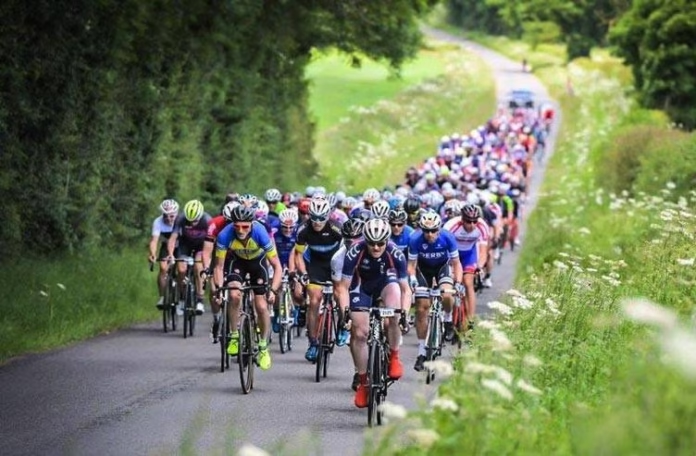
A sportive is an organised cycling event designed for riders who want the challenge and atmosphere of a race without actually having to race.
You sign up in advance, turn up with your bike, follow a marked route and ride at your own pace. There are usually feed stations, mechanical support, timing chips and hundreds or sometimes thousands of other cyclists on the road at the same time.
For experienced riders, a sportive can be a chance to chase a fast time or tackle famous climbs. For beginners, it is often the first step from ordinary weekend riding into a bigger cycling challenge.
The important thing is that a sportive is not the same as a road race. There is usually no mass sprint for the finish, no expectation that everyone rides together and no requirement to be particularly fast. If you can complete the distance safely and within any published time limits, you belong there.
For riders looking beyond the basic definition and towards an actual event, our guide to choosing your first sportive or charity ride is a useful next step.
 Photo Credit: Getty
What does sportive mean in cycling?
A sportive is a mass-participation road cycling event, usually ridden over a set course with signposted directions and organised support.
The word is most commonly used in Britain and Europe. Similar events may be called gran fondos, cyclosportives, challenge rides or century rides depending on the country.
Most sportives offer several distances. A short route might be 40-60km, a medium route 80-120km and longer options can exceed 160km, particularly events built around the traditional 100-mile century distance.
The biggest difference from an ordinary ride is the organisation around it. You normally have a start area, registration, route signs, checkpoints or feed stations and an official finish.
That structure makes a sportive feel like an event rather than simply another Sunday ride.
Is a sportive a race?
Usually, no.
Some riders will absolutely treat it like one. They will start near the front, ride hard and compare finishing times afterwards, particularly at larger events where fast groups naturally form.
That does not mean you have to.
Most sportives are designed so riders of very different abilities can take part on the same day. You can ride with friends, stop at feed stations, take photographs, wait for someone after a climb or simply focus on finishing.
Timing is often included, but it is mainly there to give riders a record of their day rather than create an official race result.
That makes sportives much more accessible than road racing. You generally do not need a racing licence, a team or experience riding in a competitive peloton. You need an appropriate bike, enough fitness for the route and the confidence to ride safely around other cyclists.
 Photo Credit: Thomas Lovelock for Prudential Ride London
What happens at a sportive?
Most events follow a fairly similar format.
You register online before the event and choose a route distance. Some sportives sell out months in advance, while smaller events may allow entries much closer to the day. Before riding, you may need to collect a rider number, timing chip or handlebar plate.
Large events often use start waves, where riders leave in smaller groups over a period of time rather than everyone setting off together. This reduces congestion and makes the opening kilometres less chaotic.
Once you cross the start line, you follow route signs around the course. Feed stations usually appear at intervals, offering water and a mixture of sweet and savoury food, with several stops on longer routes.
At the finish, your timing chip records the ride and you may receive a medal, food or event merchandise depending on the organiser.
That is basically it. The challenge comes from everything between the start and finish.
Our first sportive checklist goes into more detail about registration, equipment, feed stops and what the day normally feels like.
How long is a sportive?
There is no fixed distance.
Sportives range from short beginner rides to events that are harder than anything most recreational cyclists will attempt during normal training.
A useful rough guide is:
| Distance | Typical level |
|---|---|
| 30-50km | Beginner-friendly |
| 50-80km | Beginner to intermediate |
| 80-120km | Intermediate |
| 120-160km | Experienced recreational riders |
| 160km+ | Endurance challenge |
Distance alone does not tell the full story.
A flat 100km sportive can be easier than a 70km event containing several major climbs. Elevation gain, road surface, weather and route profile matter just as much as mileage.
This is especially important in the Lake District, Wales or Peak District, where relatively short routes can still include thousands of metres of climbing. Our guide to the toughest sportives in the UK shows how much harder events become once steep gradients, weather and remoteness are added to the distance.
What is the difference between a sportive and a gran fondo?
The terms overlap.
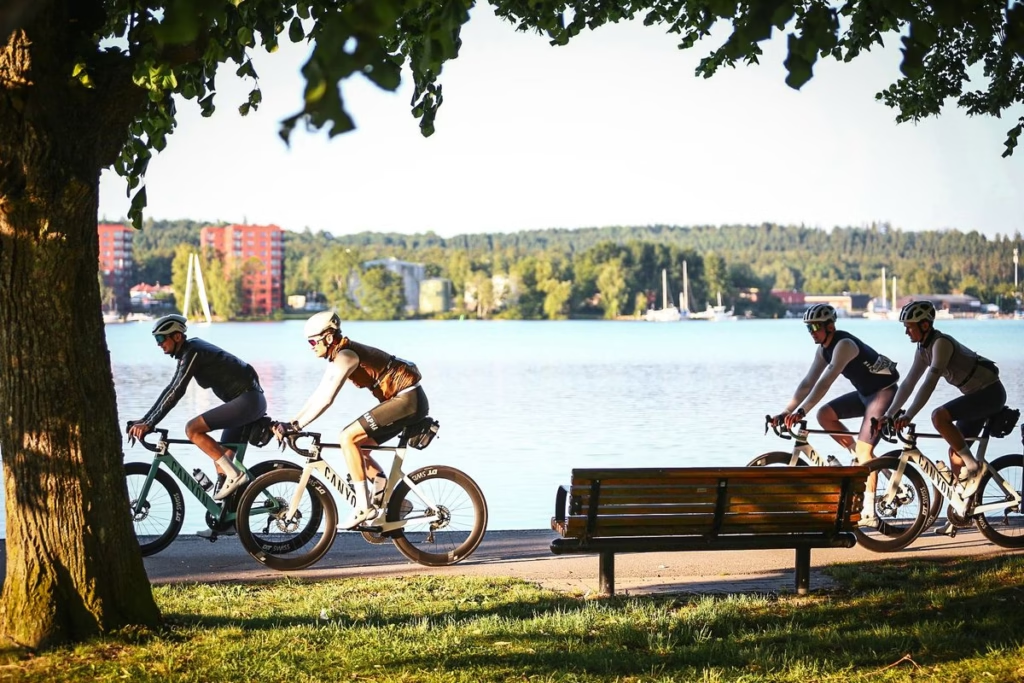
In Italy, gran fondo generally refers to a long-distance mass-participation cycling event. Some gran fondos are highly competitive, with front groups racing seriously and official classifications awarded.
In Britain, sportive usually carries a slightly less competitive meaning. You still get riders chasing times, but the event is generally marketed as a challenge rather than a race.
The practical experience can be very similar: timing chips, feed stations, multiple route options and large numbers of riders.
For a beginner, the distinction matters less than checking the rules of the specific event.
Some gran fondos are effectively amateur races.
Most British sportives are not.
Do sportives use closed roads?
Sometimes, but most do not.
A small number of major events use fully closed roads, which means cyclists have the route to themselves. These are particularly popular because riders do not have to deal with normal traffic and can enjoy the atmosphere of a major event without vehicles passing.
Our guide to the best closed-road sportives in the UK covers events such as Etape Caledonia and Etape Loch Ness where traffic-free roads are a major part of the appeal.
Most sportives, however, take place on open roads. That means normal traffic laws still apply. You must stop at red lights, give way where required and ride on the correct side of the road. Marshals may help at difficult junctions, but they do not automatically give cyclists priority.
This is one of the most important things for beginners to understand. A sportive can feel like a race because there are hundreds of riders around you, but unless the road is officially closed, you are still riding on a public highway.
Do I need a road bike?
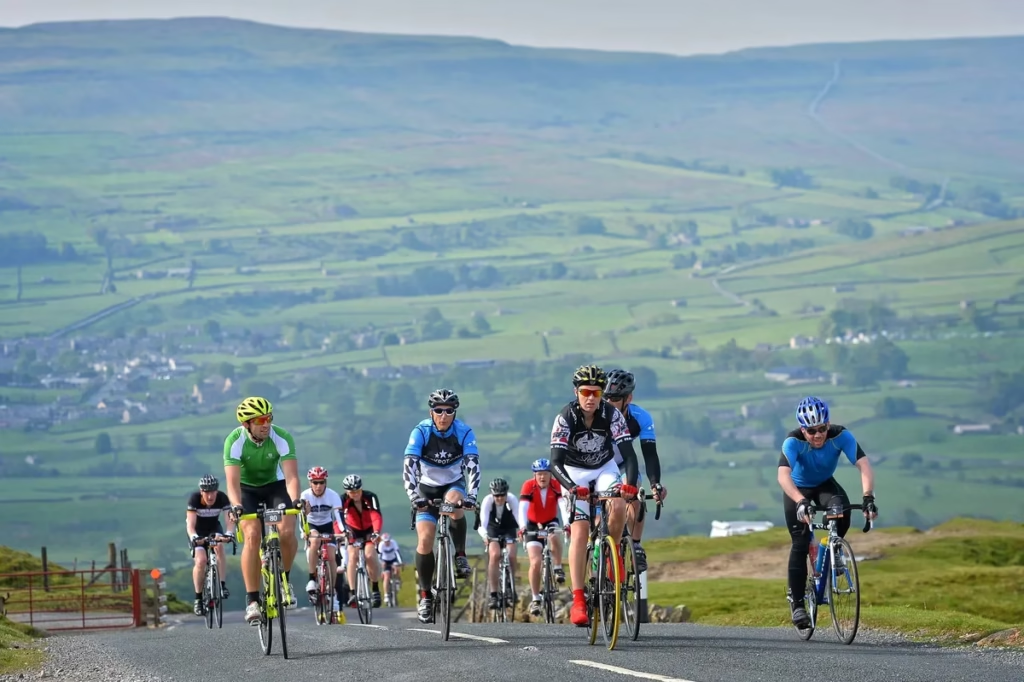
No, although a road bike is usually the easiest option.
You can ride many sportives on a hybrid, gravel bike or even a mountain bike provided it is in good condition and suitable for the route.
The main issue is efficiency. A relatively light road bike with suitable tyres will generally be easier to ride over 100km than a heavy mountain bike with wide knobbly tyres.
That does not mean you need an expensive bike.
A basic road bike with working brakes, reliable gears and sensible tyres is perfectly good enough for most sportives.
Comfort matters more than weight. If your bike fits properly and you can ride it for several hours without pain, you are already in a good position.
Do I need clipless pedals?
No.
There is no requirement to use clipless pedals for a sportive.
Plenty of riders use them because they are comfortable and familiar with the system, but flat pedals are completely acceptable.
If you are new to clipless pedals, a sportive is not the ideal place to learn.
Use whatever setup you already trust.
The same applies to other equipment. Do not fit a completely new saddle, change shoes or make major bike-position adjustments the night before the event.
A sportive rewards familiarity far more than last-minute upgrades.
What should I wear?
Normal cycling kit is fine.
For most riders that means padded shorts, a jersey or suitable top, a helmet and cycling shoes or trainers.
Weather determines everything else.
A summer sportive may require little more than shorts, jersey and sun cream. A spring event in Britain might need arm warmers, a gilet, waterproof jacket and gloves.
The most useful approach is to prepare for conditions changing during the ride. You may start cold, climb while overheating and then become cold again on a long descent.
A lightweight layer that can be removed and stored in a jersey pocket is often more useful than dressing heavily from the beginning.
Do sportives have feed stations?
Most medium and long events do.
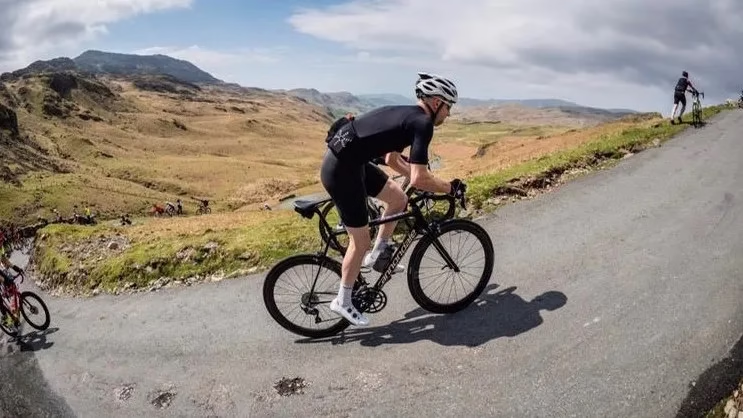
Feed stations are one of the main advantages of riding an organised sportive. They normally provide water and some combination of bananas, flapjacks, cakes, sandwiches, energy products or other snacks.
Do not rely entirely on them.
Bring food you know works for you.
A sportive is not the ideal day to discover that your stomach dislikes a particular energy gel after three hours of riding. Eat regularly from the beginning rather than waiting until you feel hungry.
Our guide to how to fuel your rides covers the basics of food and hydration for longer cycling without making it unnecessarily complicated.
How much should I eat?
For a beginner, consistency matters more than chasing a perfect nutritional number.
Try to eat something every 30-45 minutes once the ride is properly underway. That might be half a bar, banana, small sandwich or gel.
Longer and harder rides require more carbohydrate, but the basic principle remains the same: keep topping up rather than trying to rescue yourself after running out of energy.
The same applies to drinking. Take regular small drinks rather than waiting until you feel very thirsty, and use feed stations to refill bottles before they are empty.
On hot days, you may need significantly more fluid than on a cool spring sportive.
What does bonking mean?
Bonking is cycling slang for running seriously low on available energy.
It usually feels much worse than ordinary tiredness. Your legs suddenly have very little power, concentration drops and a pace that felt comfortable earlier becomes difficult to maintain.
It can happen when riders start too hard, forget to eat or simply underestimate how much energy a long ride requires.
The best solution is prevention.
Start eating early, keep doing it consistently and do not assume a large breakfast means you can ignore nutrition for the next four hours.
The longer the sportive, the more important this becomes.
How fast do you need to ride?
There is no single minimum speed for all sportives.
Some events have cut-off times, particularly longer rides where organisers need riders to reach checkpoints before roads, feed stations or support services close.
These should be published before the event.
A beginner riding a shorter sportive may average somewhere around 20-25km/h on relatively flat terrain, but there is no reason to obsess over that number. Climbing can reduce average speed dramatically, and stops matter too.
A rider averaging 25km/h while moving may finish much later once feed station stops, mechanical problems and rest breaks are included.
The important question is whether your expected pace fits comfortably within the event’s cut-off.
Do I have to ride in a group?
No.
You can ride an entire sportive alone if you prefer.
In practice, riders naturally form groups because people settle into similar speeds. Riding behind other cyclists reduces aerodynamic drag and can make flat sections easier, but group riding requires awareness.
Do not overlap wheels, avoid sudden braking and hold a predictable line. If you are nervous, stay towards the back or side of a group rather than placing yourself in the middle of a tight bunch.
There is no obligation to sit on someone’s wheel simply because they pass you.
The quickest riders may treat a sportive like a fast club run. You do not need to join them.
What if I get dropped?
Nothing happens.
This is one of the biggest differences between a sportive and racing.
If the group you are riding with accelerates on a climb and leaves you behind, let them go. Another group will probably appear later.
Trying to follow riders who are significantly stronger than you is one of the easiest ways to ruin a long sportive.
The same applies at the beginning. The first 20 minutes often feel extremely easy because everyone is fresh and excited.
That is precisely when you should avoid riding much harder than planned.
How should I pace my first sportive?
Start slower than you think you need to.
The opening hour should feel controlled. If you are riding 100km, you do not want to feel impressive after 20km. You want to feel good after 80km.
On climbs, use low gears and avoid trying to match stronger riders. On flat roads, settle into a sustainable rhythm.
If you reach the final third with plenty of energy left, then you can start riding harder.
That approach is much more enjoyable than spending the final hour paying for an unnecessary attack on the first climb.
How much training do I need?
That depends on the distance and terrain.
You do not necessarily need to ride the full sportive distance in training before the event. For a 100km sportive, being comfortable with regular 60-80km rides gives you a reasonable foundation if the route is not particularly mountainous.
For riders targeting that distance for the first time, our training plan for your first 100km ride provides a simple eight-week progression.
Longer events require more time in the saddle, while climbing sportives require actual climbing practice. There is little point preparing for a route with 2,500 metres of ascent by riding exclusively on flat roads.
You do not need identical climbs near home, but you do need enough repeated efforts to understand how your legs respond after several hours.
What should I carry?
Even if the event provides mechanical support, you should be able to deal with basic problems yourself.
At minimum, carry:
- One or two spare inner tubes, or appropriate tubeless repair equipment
- Tyre levers
- A pump or CO2 inflator
- A multitool
- Food
- Water bottles
- Phone
- Bank card or emergency money
- Identification
- Lightweight waterproof if conditions justify it
A small saddle bag makes most of this easy to carry.
Mechanical support may be available, but it could take time to reach you. Knowing how to fix a puncture is one of the most useful skills you can bring to any sportive.
The first sportive checklist gives a fuller packing list for the night before and the morning of the event.
What happens if my bike breaks?
Try to move somewhere safe first.
Do not stop in the middle of the road or directly after a blind corner.
If you can fix the problem yourself, do so. If not, contact the event’s mechanical or emergency number, usually printed on your rider number, route card or event information.
Some events have support vehicles patrolling the course. Others may only provide mechanical help at feed stations.
Check before you start so you know what is available.
Support is useful, but it should not replace basic self-sufficiency.
What happens if I cannot finish?
Again, nothing terrible happens.
Riders abandon sportives because of mechanical problems, illness, weather or simply having a bad day.
If you cannot continue, inform the organiser rather than disappearing from the course. They need to know you are safe.
Some events have broom wagons or support vehicles capable of returning riders to the finish. Others may require you to organise your own transport.
The event information should explain the procedure.
Not finishing does not mean you failed at cycling. It means you attempted a challenge and something stopped you completing it.
There will be another one.
Are sportives safe for beginners?
Yes, provided you choose the right event.
A beginner should probably not make the Fred Whitton Challenge their first organised ride. Events like that are brilliant, but they combine distance, steep gradients and accumulated climbing in ways that require experience.
A 50-80km route is often an ideal starting point for someone who already rides recreationally. It is long enough to feel like an achievement without turning the entire day into an endurance test.
Our guide to the best beginner-friendly sportives in the UK includes events with shorter routes, good support and less intimidating terrain.
The goal of your first sportive should be to finish feeling as though you would like to do another one.
What are sportive medals?
Many events give finishers a medal.
Some also provide certificates, T-shirts or other souvenirs.
The medal has no competitive meaning. You receive it for completing the route rather than finishing in a particular position.
For many riders, that is exactly the point.
A sportive is built around personal challenge rather than beating everyone else.
The rider completing 50km for the first time may have achieved something far more significant personally than the rider flying through a 160km route in four hours.
Are electric bikes allowed?
Often, yes, but rules vary.
Some events allow road-legal e-bikes on selected routes, while others separate them from timed classifications or restrict certain categories.
Check the event regulations before entering.
If e-bikes are allowed, normal etiquette still applies. Be especially careful when passing riders uphill because the speed difference can be much larger than expected.
The fact that a sportive is timed does not necessarily mean every participant is competing under identical equipment rules.
Can I stop during a sportive?
Of course.
You can stop at feed stations, cafés, viewpoints or simply at the side of the road somewhere safe.
Your official finishing time will normally continue running. That only matters if you care about your time or need to meet a cut-off.
For a first sportive, stopping for a few minutes at a feed station can be useful. Eat, refill bottles and check how you feel before continuing.
Turning every stop into a 30-minute café visit is different, particularly if the event has cut-offs, but nobody expects a beginner to ride continuously from start to finish.
Sportives are ideal stepping stones to bigger challenges
One of the best things about sportives is how naturally they create progression.
Your first event might be 60km.
The next could be 100km.
Then perhaps you target your first century.
After that, climbing sportives, closed-road events or something as difficult as the Fred Whitton may begin to look realistic.
The structure gives training a purpose. Instead of riding vaguely because you want to get fitter, you have a date, distance and route to prepare for.
For riders wanting to see where that progression can eventually lead, our best UK sportives to ride in 2026 covers everything from approachable first events to much harder endurance challenges.
-
 Photo Credit: Canyon SRAM (supplied media release)
 -
 Photo Credit: Park Tool
How to choose your first sportive
Ignore prestige initially.
Choose the event that suits your current riding.
Look at distance, climbing, road closures, start location, cut-off times and likely weather. An event 40 minutes from home with a 70km route may be a much better first experience than a famous 160km sportive requiring a hotel, 5am alarm and several mountain passes.
Our full guide to choosing your first sportive or charity ride goes into the factors worth checking before entering, particularly terrain, support and logistics.
The biggest mistake is choosing by reputation rather than suitability.
You can always enter the harder one next year.
Why sportives are so popular
Sportives offer something road cycling normally struggles to provide: a shared challenge without requiring competition.
Everyone starts from roughly the same place and follows the same roads, but each rider can have a completely different objective. One person is chasing four hours, another wants to ride 100 miles for the first time and someone else simply wants to get around without walking on the climb they walked the previous year.
They can all ride the same event.
That mixture is what gives a good sportive its atmosphere. There is enough structure to make the day feel important, enough support to make a difficult route manageable and enough freedom that the challenge remains yours.
For anyone who has spent months riding the same weekend loops and wondering what comes next, a sportive is one of the easiest answers.

