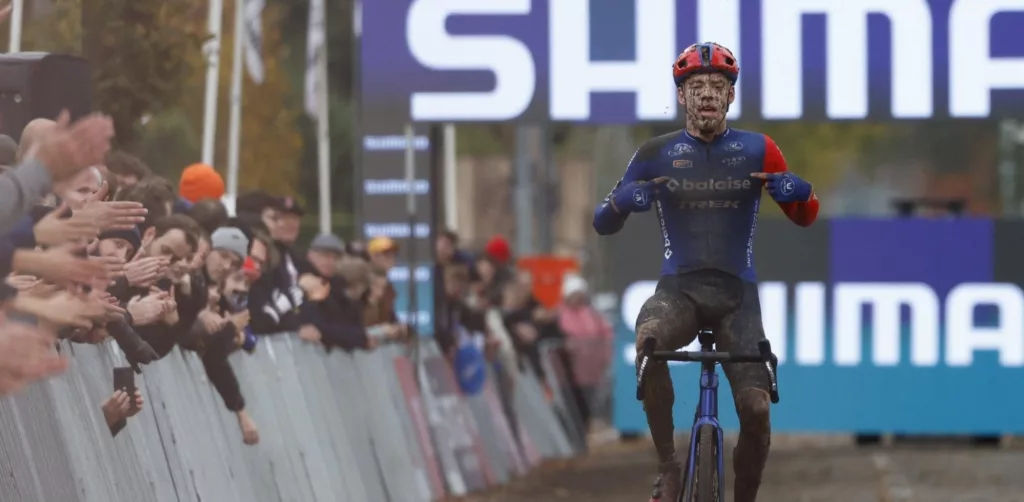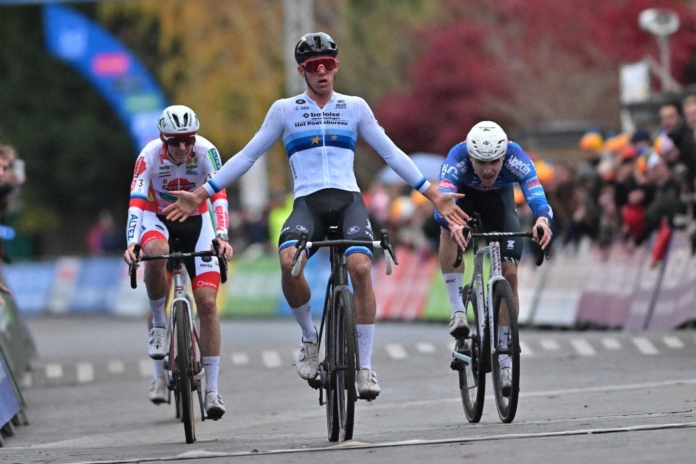
Thibau Nys is the rider the field must find a way to beat when the X²O Badkamers Trofee reaches Beringen on Sunday, 22 November. The European champion has won both opening rounds, at Koppenberg and Hamme-Zogge, and now returns to the steep be-MINE terrain where he has already shown his national-championship quality. The former coal mine presents a different physical problem from the fast final-lap contest that settled Hamme.
Michael Vanthourenhout, Joris Nieuwenhuis, Joran Wyseure, Cameron Mason and several other established contenders are named on the official elite men’s startlist. Their presence makes the third round significant for both the day’s result and the accumulated-time Trophy standings. A single badly judged climb or descent can cost more than a sprint placing when the overall classification is measured in seconds.
Nys has the form and the history
Nys’s favourite status is supported by recent results. He defeated Vanthourenhout at Koppenbergcross to take the series lead, then won the Hamme-Zogge race after a tight late battle involving several riders. His European title at Zeddam adds another important result to a remarkable opening block of cyclocross, and the variety of those successes suggests he is not dependent on one particular type of circuit.
His history at Beringen extends beyond than a routine calendar visit. The be-MINE site hosted the Belgian national championships earlier in 2026, where Nys secured another elite national title ahead of Emiel Verstrynge. He knows what a long series of difficult accelerations feels like on these slopes and has already dealt with the pressure of being expected to win on this terrain.
Familiarity brings confidence, not certainty. A national championship raced in different weather and against a different field cannot provide a reliable lap-by-lap script for Sunday. What it does offer is confidence about line choice, where to recover and which climbs are worth attacking. Those details may become decisive if the race remains close after the first major ascent.
Nys also has to consider the time-based standings. The X²O Badkamers Trophy explainer sets out how cumulative time shapes the competition. A clean victory accompanied by a meaningful time gap would strengthen his position, but a risky move that ends in a crash or long mechanical stop could change the championship in the opposite direction.
2026 X²O Trophy Beringen men’s startlist
The organiser’s official 22 November list opens with Nys, Vanthourenhout, Nieuwenhuis and Wyseure, followed by Mees Hendrikx, Gerben Kuypers, Ryan Kamp, Jente Michels and Cameron Mason. Toon Vandebosch, Witse Meeussen, Danny van Lierop, Andrew Strohmeyer and Victor Van de Putte are also among the entrants. The compact field still has considerable depth, with enough depth to punish a favourite who starts too slowly.
Vanthourenhout is one of the main threats to Nys based on the early Trophy contests. He has been able to match the European champion for long spells and possesses the experience to judge when a climb should be ridden rather than attacked. His challenge is to convert that proximity into an actual gap, particularly on a circuit where the rider in front can make the strongest competitor behind work awkwardly.
Nieuwenhuis is another rider with the strength to impose a sustained tempo. He has been targeting the overall Trophy and will recognise that every second he gains in Beringen is useful beyond Sunday’s finishing order. His problem may be Nys’s ability to respond explosively after a short recovery, making it important not to telegraph every acceleration on the most obvious climbs.
Wyseure and Mason add different threats. Wyseure has already demonstrated winning form this autumn and can use a demanding lap to keep the favourite under pressure. Mason’s victory at Niel gave him the kind of high-level result he had been pursuing, and he has the engine to climb effectively if he enters the key sections in a good position. Both would profit if Nys and Vanthourenhout become overly concerned with one another.
The climbing character of be-MINE
Beringen’s be-MINE Cross takes place among the buildings and slopes of a former coal-mining complex in Limburg. The terril, a spoil heap formed by the mining operation, provides the course with steep gradients and an industrial setting unlike the parkland races elsewhere in the calendar. The setting is distinctive, but the sporting significance lies in the repeated effort of gaining height and then negotiating a technical way back down.
The difficulty cannot be measured solely by the length of any one climb. A steep section can force riders to accelerate far above their sustainable pace, sometimes immediately after a turn or run-up. Even if the gradient is short, its effect accumulates because the legs have only a limited opportunity to recover before another technical challenge arrives.
Descending may be as consequential as climbing. A rider who reaches the top with a small advantage can lose it by braking too hard or taking a poor line on the way down. In damp conditions, the correct tyre selection and the timing of a dismount become major variables. Running a climb cleanly can be faster than stalling while trying to ride an increasingly slippery line.
The pit introduces another decision under fatigue. Fresh equipment may help on a heavy lap, but switching bikes costs time at a point when the leaders are already spread out. The Beringen cyclocross history and course guide gives further background on the former mine and its place in Belgian racing.
A rivalry shaped by seconds rather than places
Nys has two victories from two Trophy rounds, but the men’s competition is not settled by the order of names on the results sheet. It is based on accumulated time under the series rules. A second place only a few seconds behind the winner can preserve a contender’s overall chances, while a poor technical lap can create a much more difficult deficit.
At Hamme-Zogge, Nys won a tactical contest in which the lead changed hands and several riders still had a chance late on. The Hamme-Zogge men’s race preview described the situation before that second round. Sunday’s slopes demand a different approach, with fewer opportunities to sit in a compact group and wait for a finishing sprint.
Vanthourenhout is well equipped to resist sustained pressure, and he has the motivation of a general classification that remains within reach. It would be misleading, however, to turn every tactical question into a private duel between him and Nys. Nieuwenhuis can benefit from their hesitation and may be more prepared to sacrifice a small amount of immediate efficiency for a potentially larger overall time gain.
For contenders further down the standings, the same principle applies. Closing a gap to the next rider on the course can improve the accumulated position even if the victory is out of reach. Those incentives often produce a race in which attacks continue behind the leading pair, giving spectators more than one contest to follow.
How a decisive move might emerge
A steep ascent looks like the natural place to attack at Beringen is an exposed ascent, but an acceleration there is not always the most effective way to win. A rider who climbs flat out can be vulnerable on the descent if his handling becomes ragged or if he has no power left to accelerate out of the next turn. The most damaging move may instead begin with a technically perfect exit from an earlier corner.
Nys is likely to use his ability to change speed decisively, but there is value in making rivals commit before he does. If Vanthourenhout or Nieuwenhuis chooses an aggressive pace, Nys can test whether the effort is sustainable without immediately taking responsibility for the race. That strategy becomes less comfortable if an outsider such as Wyseure reaches the front and forces the favourites to chase.
Mason’s interests could be served by a race of consistent hard lap times rather than repeated tactical interruptions. His recent victory demonstrates that he has the speed to finish a demanding contest, but he will want to avoid becoming trapped behind slower riders entering the major climbs. The difference between riding in clear air and having to pass competitors on narrow technical lines could be worth several seconds each lap.
Weather can change all these calculations. On a dry circuit, some gradients may remain rideable enough for powerful riders to use a long acceleration. A wetter surface can shift the advantage towards those who mount and dismount efficiently, select the best footwear grip and make fewer mistakes on the descents. Technical decisions could matter more than by one overwhelming burst of strength.
Beringen’s place in the recent cyclocross story
The mining site has established itself as a recognisable fixture and hosted the Belgian championships in January 2026, confirming its capacity for a high-stakes event. Nys’s national title there gives this year’s return a clear sporting thread, but the competition is broader than a replay of that championship. Different teams, incentives and race-day conditions all affect which sections become decisive.
The venue has also seen other winners during its recent history. Lars van der Haar won the men’s 2024 Exact Cross Beringen, while the women’s event was taken by Fem van Empel. The results underline that successful riders have used different combinations of sustained power and precise technical execution. They should not be interpreted as an automatic hierarchy for the 2026 Trophy field.
Sunday will come after Saturday’s Rapencross in Lokeren, where several of the Beringen entrants are also expected. Consecutive races can change both preparation and performance, especially when the second is as demanding as this one. A rider who spends unnecessary energy defending a small gap on Saturday might discover its cost on the longer climbing efforts in Beringen.
Start time and the moments to follow
The elite men’s race is scheduled for Sunday, 22 November at 15:00 Belgian time, corresponding to 14:00 GMT in the UK. The elite women’s race starts at 13:45 locally, or 12:45 GMT. See the 2026–27 cyclocross calendar for the surrounding fixtures and the X²O Trophy dates.
The first extended climb should indicate whether Nys wants to make the race selective immediately or whether Vanthourenhout and Nieuwenhuis try to set the tempo. The middle laps could be more important than the opening if the course remains heavy enough to make every acceleration costly. At that stage, a clean descent may be worth as much as a strong ascent.
If the favourites reach the final lap together, their route through the steepest sections will be the key tactical contest. Nys has the finishing speed to threaten in a close race, while Vanthourenhout and Nieuwenhuis have reasons to make it difficult before the final straight. With Mason and Wyseure also capable of influencing the pace, Beringen has the ingredients for a fight in which the gaps in the overall classification change as quickly as those on the course.
-
 Photo Credit: Cor Vos
-
 Photo Credit: Cor Vos
-
 Photo Credit: la__pics / CANYON//SRAM (official team announcement)