

The Beeline Velo 2 is not trying to become the control centre of your bike. It does not cover the handlebars with detailed maps, fill the screen with training metrics or assume that every cyclist wants to analyse power zones while riding to work.
Instead, it provides clear turn instructions, basic ride information and a compact display that remains unobtrusive on the bike. That restraint is the entire point.
The Velo 2 is best understood as a navigation device rather than a direct replacement for a Garmin Edge, Wahoo ELEMNT or Hammerhead Karoo. It works particularly well for commuting, exploring unfamiliar towns and following relatively straightforward road routes without leaving a phone exposed on the handlebars.
Its reliance on a connected smartphone and limited performance data prevent it from becoming a complete cycling computer. Riders focused on structured training, detailed mapping or long-distance reliability will quickly find its boundaries. For urban cyclists and recreational riders who want uncomplicated directions, however, the Beeline Velo 2 remains one of the most appealing minimalist devices available.
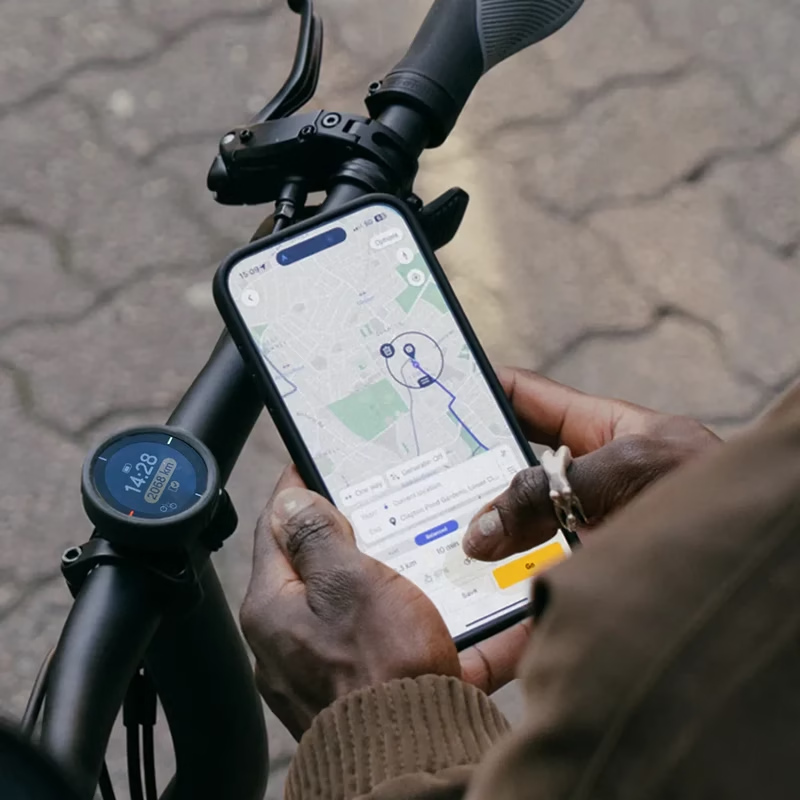
Beeline Velo 2 specifications
Price: £99.99
Weight: 25g
Dimensions: 46.4mm diameter and 17.3mm deep
Display: 32.4mm circular screen
Resolution: 240 x 240 pixels
Battery life: Up to 11 hours in daytime use and 20 hours at night
Charging: USB-C
Water resistance: IP67
Connectivity: Bluetooth 4.0 or later
Phone compatibility: iPhone running iOS 16 or later and Android 8.0 or later
Route integrations: Komoot and Strava
Sensors: Accelerometer, gyroscope, magnetometer and ambient-light sensor
Quick verdict
The Beeline Velo 2 is a compact and unusually likeable navigation device for riders who want directions without turning their bicycle into a rolling data centre.
Its display is clear, the controls are simple and the entire device weighs only 25g. Route planning through the Beeline app is straightforward, while Komoot and Strava integration make it possible to use courses created elsewhere.
The compromise is that the Velo 2 depends heavily on a connected smartphone. It does not provide full onboard mapping, extensive sensor support or the training analysis available from a conventional GPS computer. Its rerouting and off-road guidance can also feel less assured on complicated routes.
Best for: Commuters, leisure cyclists, urban riders and anyone wanting simple navigation with minimal handlebar clutter.
Not ideal for: Structured training, detailed performance analysis, gravel exploration, bikepacking or riders who want a completely independent GPS computer.
Rating: 4/5
Reasons to buy
- Small, light and unobtrusive
- Clear turn-by-turn navigation
- Simple companion app
- Komoot and Strava route integration
- Up to 11 hours of daytime battery life
- USB-C charging
- IP67 weather protection
- Keeps a smartphone safely in a pocket or bag
- Costs considerably less than most premium GPS computers
Reasons to avoid
- Relies on a connected smartphone
- No conventional full-map display
- Limited training and performance data
- No broad ANT+ sensor ecosystem
- Proprietary mounting system
- Rerouting can be less polished on complex roads
- Not the strongest choice for gravel or remote exploration
Design and first impressions
The first thing you notice about the Velo 2 is how little space it occupies.
Its circular casing measures just 46.4mm across and weighs 25g, making it scarcely larger than a modern stem cap. It looks neat on a commuter, road bike or stripped-back winter setup and does not dominate the cockpit in the way that some larger colour-screen computers can.
That matters on a practical urban bike already carrying lights, a bell and perhaps an e-bike controller. The Velo 2 adds navigation without making the handlebar feel like a dashboard.
The compact casing also makes the device easy to remove and place in a pocket when leaving the bike outside. A quarter-turn interface secures it to Beeline’s mount, although the proprietary design means riders cannot simply attach it to the collection of Garmin-compatible mounts they may already own.
Build quality feels appropriate for regular outdoor use. The Velo 2 has an IP67 rating, meaning it is protected against dust and temporary water immersion. It should therefore handle British rain, road spray and normal commuting conditions without difficulty, although the charging-port cover still needs to be fitted properly.
The screen keeps information deliberately simple
The Velo 2 uses a 32.4mm circular display with a resolution of 240 x 240 pixels.
That sounds modest beside the large colour touchscreens found on premium cycling computers, but Beeline is not attempting to show a conventional map. The screen displays large directional cues, junction information and a limited collection of ride statistics.
The simplified presentation is its greatest strength. Instructions are readable at a glance, and the automatic brightness adjustment helps the display respond to changing light conditions without requiring manual intervention.
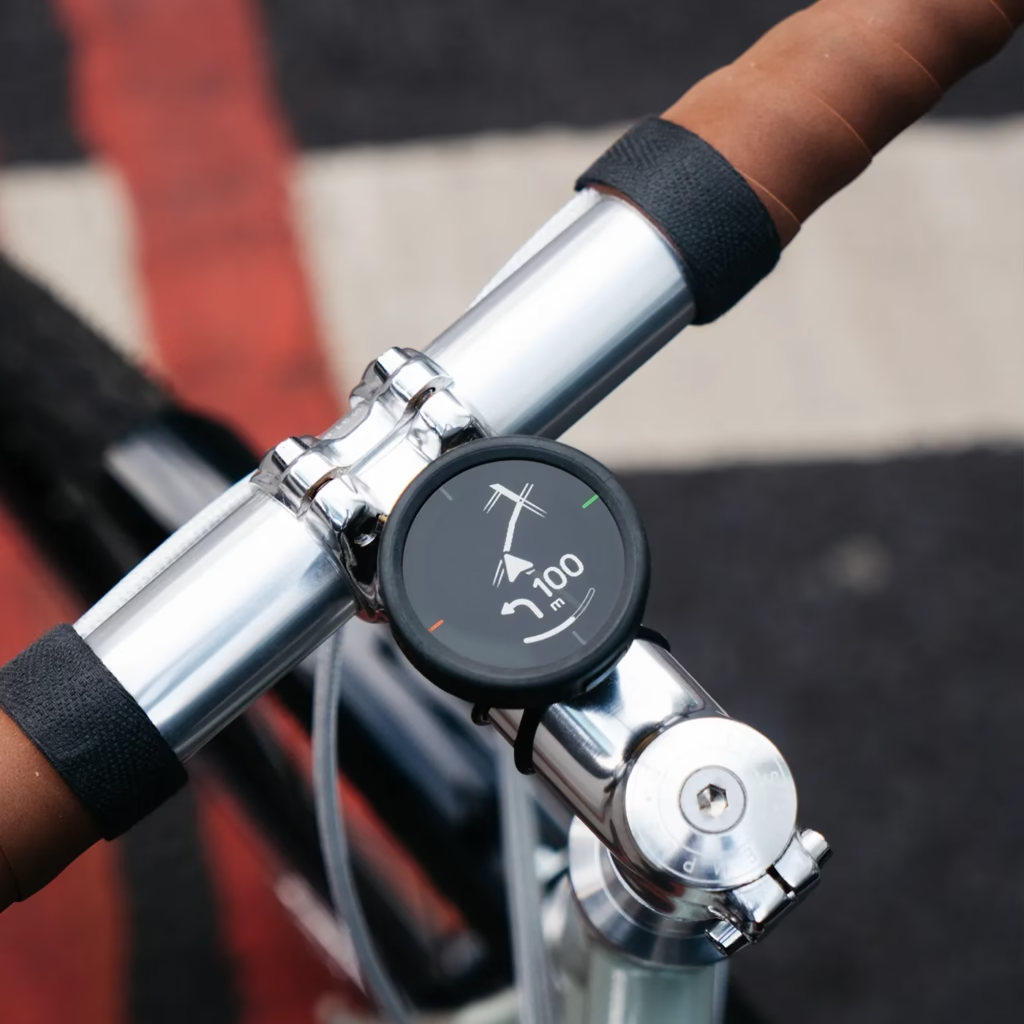
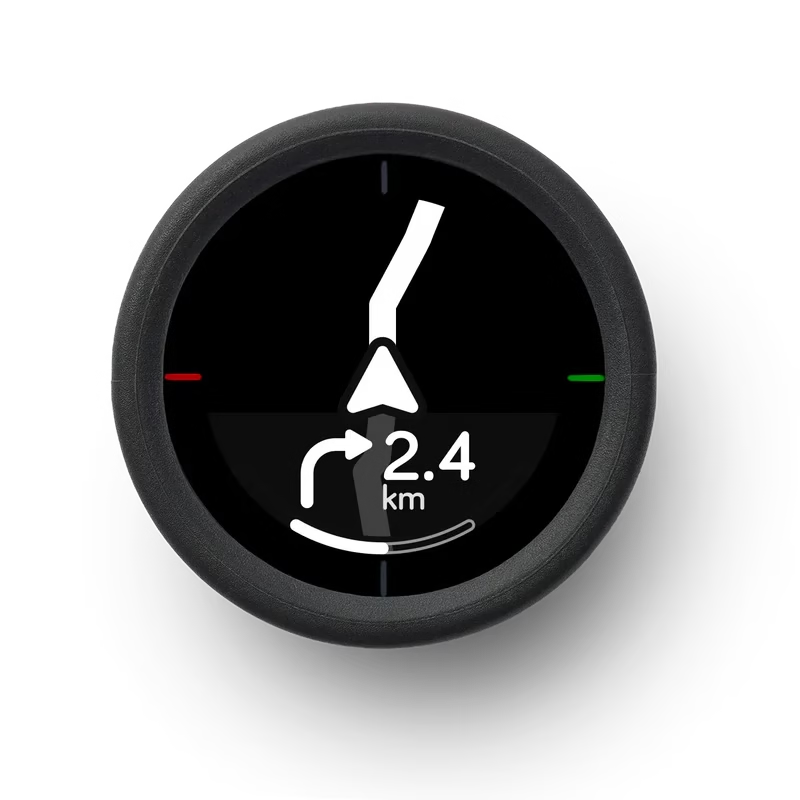
Rather than studying street names or trying to identify a tiny line across a detailed map, the rider normally sees the direction of the next turn and the distance remaining until it. Roundabouts, junctions and other changes are presented in a way that requires little interpretation.
It is not as informative as a proper map when several roads meet in quick succession or the route passes through an unusually complicated junction. The small screen simply cannot provide the same geographical context as a Garmin Edge or Hammerhead Karoo.
For normal urban navigation, however, the lack of detail can make the information easier to use rather than harder.
How the Beeline Velo 2 works
The Velo 2 is closely tied to the Beeline smartphone app.
Routes are planned or imported through the app before being sent to the device. The phone provides the main location and navigation processing, while the Velo 2 acts as a simplified display on the handlebars.
That distinction is important. This is not a completely independent GPS computer that allows the phone to be left at home. The rider still needs to carry a compatible smartphone with Bluetooth enabled.
Once a route has been prepared, the phone can remain in a pocket or bag. That avoids exposing an expensive handset to rain, vibration and the increased battery use associated with keeping its screen illuminated throughout a ride.
Beeline offers two broad approaches to navigation. Turn-by-turn routing provides conventional instructions along a planned course, while compass mode points towards the destination and leaves the rider to choose how to reach it.
Compass mode is useful when wandering through familiar territory or exploring a city without following a rigid line. It encourages improvisation while still preventing the ride from drifting completely away from the intended destination.
Turn-by-turn mode is better when arrival time matters or the route contains roads that need to be followed precisely.
Route planning through the Beeline app
The companion app is central to the experience and is one of the stronger parts of the Velo 2 package.
A destination can be entered directly, after which Beeline generates route choices based on cycling suitability. Riders can also import or synchronise routes from Komoot and Strava, which is useful for anyone who already maintains a route library elsewhere.
Beeline’s routing system uses community feedback as part of its planning. Riders can rate roads positively or negatively after using them, helping the platform distinguish between theoretically rideable roads and those that cyclists actually enjoy.
That approach has particular value in cities. The fastest route between two locations is not always the most pleasant, and a minor variation can mean the difference between a protected cycle lane and a congested multi-lane road.
The app is less convincing when a ride moves into remote gravel terrain or follows a complicated network of unsurfaced tracks. The Velo 2 is fundamentally strongest as a road and urban navigation device rather than a backcountry exploration tool.
For cyclists comparing different approaches to on-bike navigation, our guide to whether cycling computers are worth buying explains the wider differences between simple head units and full training computers.
Navigation is clear when the route is straightforward
On a normal commute or road ride, the Velo 2’s guidance is easy to understand.
A large arrow shows the direction of the next turn, while the surrounding information indicates how far away it is. The display changes as the junction approaches, reducing the need to stare at the screen for an extended period.
This is where Beeline’s minimalist approach works best. The rider receives enough information to make the next decision without being distracted by details that have no immediate relevance.
It is particularly effective in built-up areas where repeatedly removing a phone to check a map becomes irritating. The Velo 2 allows the phone to remain protected while still providing visible guidance through turns, junctions and roundabouts.
The system becomes less assured when several possible turns sit close together. Without a detailed map, it can be difficult to distinguish between two parallel roads or understand why a route has selected an unusual diversion.
Riders who prefer to verify their exact position against the surrounding street layout may find the directional interface restrictive. Those happy to follow the prompt and continue riding are more likely to appreciate it.
Rerouting exposes the limitations
Missing a turn is where the distinction between the Velo 2 and a more advanced computer becomes clearer.
The device can redirect the rider, but the experience is not always as quick or visually reassuring as the automatic rerouting provided by leading Garmin, Wahoo and Hammerhead units. Complex urban layouts can produce moments where the directional cue changes while the rider is still trying to understand which road caused the mistake.
A full-map computer can show the original route, current position and revised course at the same time. The Velo 2 has to communicate the same situation through arrows and distances.
That does not make it unusable. In most cases, continuing along the new instruction returns the rider to the route without much difficulty. It does mean that the minimalist design is least convincing precisely when more context would be useful.
For regular commutes and relatively simple road routes, this is an occasional inconvenience. For long rides across unfamiliar countryside, it becomes a more meaningful limitation.
The Velo 2 now shows more than directions
The Velo 2 remains navigation-led, but it is not limited to displaying arrows.
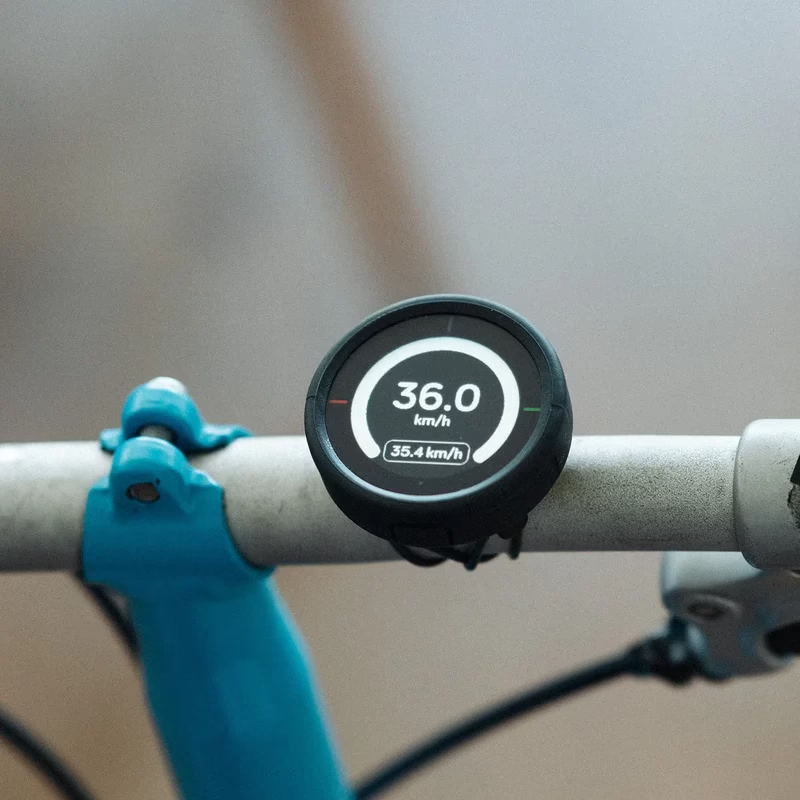
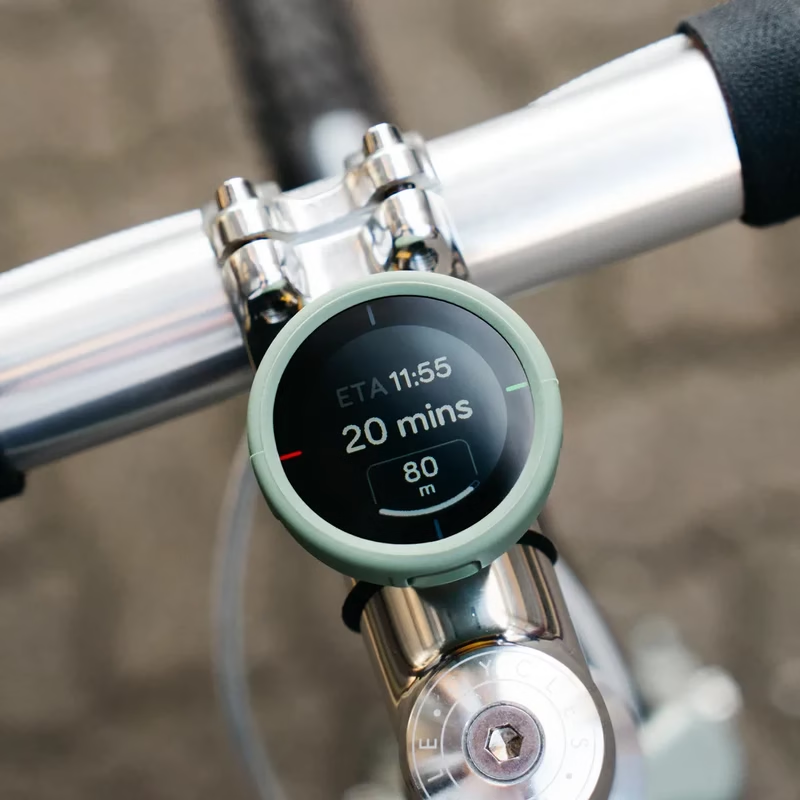
Riders can see basic information including speed, distance, elapsed time and estimated arrival time. Elevation information can also warn of upcoming climbs and indicate the remaining profile.
These features make the device more useful on longer leisure rides without undermining its simple presentation. The emphasis remains on information that helps during the ride rather than data intended for detailed analysis afterwards.
What is missing is equally important.
The Velo 2 is not designed around power meters, heart-rate straps, structured workouts, training load, interval targets or extensive customisable data pages. Riders using those tools will receive much more from a conventional GPS computer.
That limitation is deliberate rather than accidental. Beeline has chosen not to compete directly with devices designed for training and racing.
The result is calmer, but also considerably less capable.
Battery life is sufficient for commuting and most day rides
Beeline claims up to 11 hours of daytime use and as much as 20 hours at night, when the screen requires less power.
Actual runtime will vary according to screen brightness, temperature, route complexity and the condition of the battery. The connected phone must also have enough charge to provide location and navigation throughout the ride.
For commuting and ordinary weekend riding, 11 hours is more than adequate. Most users should be able to complete several shorter journeys before charging the device.
USB-C is a welcome improvement over the micro-USB ports still found on some older cycling accessories. It allows the Velo 2 to share cables with many current phones, lights and computers.
Long-distance riders need to consider the combined battery demands of both the Beeline and smartphone. A conventional computer with independent satellite reception may be more dependable for an all-day event, audax or multi-day tour because navigation does not depend on two separate devices remaining charged.
The mount is secure but keeps the Velo 2 in its own ecosystem
The standard mount uses elastic straps to attach to the handlebar or stem, making installation simple and allowing it to move between bikes without tools.
The Velo 2 then twists into place. Once fitted, the unit feels secure enough for commuting and ordinary road riding.
Beeline also sells additional mounting options for riders who want a more permanent or neater arrangement.
The disadvantage is that the interface is proprietary. Many cyclists already own several Garmin quarter-turn mounts across different bikes, and the Velo 2 does not fit them directly without an appropriate adaptor.
That slightly undermines the otherwise excellent portability. Moving the device itself is effortless, but sharing it between bikes may require moving the Beeline mount or purchasing additional ones.
What the Beeline Velo 2 does well
Clutter-free navigation
This is where the Velo 2 stands apart.
It removes much of the visual and mental noise associated with larger computers. The rider glances down, identifies the next instruction and continues. There is little incentive to scroll through pages or become preoccupied with constantly changing figures.
For riders who find performance data distracting, that is a genuine advantage.
Everyday practicality
The unit is small enough to move between bikes and subtle enough to leave a commuter cockpit looking tidy. Its 25g weight is effectively irrelevant, while the compact shape makes it easy to carry after parking.
USB-C charging, weather protection and simple controls all support regular use rather than occasional novelty.
Strong urban navigation
Built-up areas are where the Velo 2 makes its most convincing case.
It removes the need to mount a phone or stop repeatedly to check directions. Turn prompts are clear, while the community-informed routing can help identify roads that are more pleasant to cycle than the most direct option.
Low learning curve
The limited feature set makes the device easy to understand.
A rider does not need to configure several activity profiles, choose from dozens of data fields or understand a complicated training ecosystem. Plan the route, begin navigation and follow the prompts.
That makes the Velo 2 particularly approachable for newer cyclists who want guidance but do not yet need a full cycling computer.
-
 Photo Credit: A.S.O./Billy Ceusters


What the Velo 2 gets wrong
It is dependent on a smartphone
The Velo 2 may look like a standalone computer, but the phone remains central to its operation.
That creates two battery levels to manage and means a phone connection problem can affect navigation. Riders expecting an independent GPS unit should understand this before buying.
There is no full map
The arrow-led interface is elegant when the instructions are straightforward and frustrating when additional context is needed.
A full map makes it easier to understand complicated junctions, inspect alternative roads and identify exactly where a wrong turn occurred. The Velo 2 deliberately removes that capability.
Training features are limited
Basic speed, distance and ride information are available, but serious training tools are not.
There is no comparable alternative to the performance analysis, sensor connectivity and structured workout support found on devices from Garmin, Wahoo and Hammerhead.
It is less suited to remote riding
The combination of phone reliance, basic rerouting and limited geographical detail makes the Velo 2 a weaker choice for bikepacking, remote gravel riding or complex off-road routes.
It can still follow imported courses, but that does not mean it offers the same confidence as a detailed standalone mapping computer.
Beeline Velo 2 versus Garmin Edge
The comparison with Garmin depends on which problem the rider wants to solve.
A Garmin Edge is a complete cycling platform. Current models offer onboard maps, satellite navigation, sensor pairing, structured workouts, performance metrics, radar integration and extensive post-ride analysis.
The Velo 2 offers a fraction of those capabilities.
It is also considerably smaller, cheaper and easier to configure. A commuter who only wants reliable directions may gain little from the additional features of a premium Edge.
The Garmin Edge 840 Solar demonstrates the difference clearly. It is a compact device by premium-computer standards, yet still provides detailed mapping, ANT+ and Bluetooth sensor support, Wi-Fi, training analysis and independent navigation.
The Garmin is the better cycling computer. The Beeline may still be the better product for someone who does not want all of that.
Beeline Velo 2 versus Wahoo ELEMNT
Wahoo computers tend to offer a cleaner interface than Garmin while retaining proper maps, sensor support and performance features.
That places the ELEMNT range between Beeline’s minimalism and Garmin’s broad ecosystem. A Wahoo remains more suitable for club rides, structured training, sportives and long road routes, while generally being easier to configure than some full-featured rivals.
The Velo 2 is smaller and more approachable, but the gap in capability remains considerable.
A rider who expects to add a heart-rate monitor, power meter or rear radar later should normally choose the Wahoo. Someone who only wants clear directions around a city may prefer the Beeline.
Beeline Velo 2 versus phone navigation
The Velo 2 makes its strongest argument against mounting a smartphone directly to the bike.
A phone provides a larger and more detailed map, but it is also expensive, power-hungry and vulnerable to rain, vibration and impact. Bright sunlight can make the screen difficult to read, while leaving it illuminated for several hours can drain the battery quickly.
The Beeline allows the phone to remain protected in a pocket or bag while placing only the essential information on the handlebars.
That does not remove phone dependency, but it changes how the phone is used. The handset performs the background work without being exposed throughout the ride.
A good phone mount can still be the more versatile option for riders who need detailed mapping, delivery apps or frequent destination changes. Our SP Connect bike mount review examines the advantages and compromises of keeping the full phone on the bars.
Price and value
At £99.99, the Velo 2 sits below most mainstream mapping computers but well above basic speed-and-distance units.
Its value therefore depends almost entirely on how closely the rider matches its intended audience.
For someone who wants straightforward navigation, an elegant display and freedom from a bar-mounted phone, the price is reasonable. The device is well made, weather resistant and sufficiently distinctive to justify paying more than a basic computer.
For a rider expecting the features normally associated with a GPS head unit, £99.99 may feel expensive. Budget Garmin, Wahoo and Bryton devices can provide greater independence and wider functionality, even if they lack the Velo 2’s visual charm.
This is not a bargain created by offering most premium features for less. It is a specialist product that charges for simplicity, design and ease of use.
Who should buy the Beeline Velo 2?
The Velo 2 makes the most sense for commuters, urban cyclists and recreational riders who want help following routes without becoming immersed in data.
It is also well suited to cyclists who dislike mounting a smartphone but do not need the training functions of a conventional computer. Newer riders may appreciate its low learning curve, while experienced cyclists may enjoy using it on relaxed days when speed and power are not the point.
It is less suitable for racers, serious training riders and anyone regularly completing long routes through remote areas. Those riders benefit from independent navigation, detailed maps, broad sensor support and longer standalone battery life.
Beeline Velo 2 verdict
The Beeline Velo 2 succeeds because it understands what it does not need to be.
It is not a miniature Garmin, a training platform or an adventure computer. It is a clean, compact display that helps a rider follow a route while keeping the phone protected and the handlebars uncluttered.
Its strengths are simplicity, portability and low-stress navigation. Its weaknesses are the natural consequences of that approach: no conventional maps, limited data and continued dependence on a smartphone.
Those limitations are substantial enough to rule it out for some riders. They are also why the Velo 2 feels so refreshingly different from the devices surrounding it.
For commuting, urban exploration and uncomplicated leisure riding, it is one of the easiest cycling navigation products to enjoy using. Riders wanting a calm guide rather than an overbearing control panel will find the Beeline Velo 2 a persuasive alternative.
Rating: 4/5

