
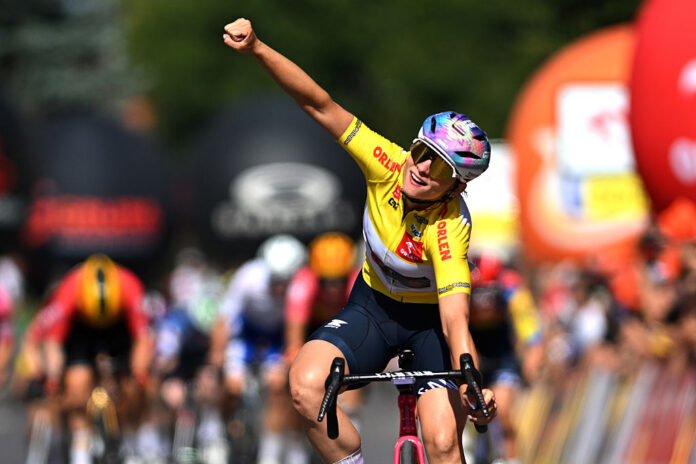
The Tour de Pologne Women has one of the more unusual histories in women’s cycling. It is not a simple case of a long, uninterrupted national tour growing steadily year after year. Instead, it has moved through different phases: an early run in the late 1990s and 2000s, a later revival linked to the Tour de Pologne name, a long absence from the calendar, and then a modern relaunch that has quickly pushed the race back into international relevance.
That makes it a race with both history and unfinished business. Poland has produced major women’s cycling talent, from Bogumiła Matusiak to Katarzyna Niewiadoma, Marta Lach, Daria Pikulik and Agnieszka Skalniak-Sójka, but its women’s stage race has not always had the same continuity or profile as the country’s place in the sport deserved.
The modern Tour de Pologne Women is now trying to change that. After returning in 2024, growing again in 2025 and stepping up to UCI Women’s ProSeries level for 2026, it has become one of the most important short stage races in Central Europe.
For a current race overview, our beginner’s guide to Tour de Pologne Women 2026 explains the latest route, dates, teams and format.
Tour de Pologne Women at a glance
| Detail | Summary |
|---|---|
| Race | Tour de Pologne Women |
| Country | Poland |
| Format | Women’s road stage race |
| Organiser | Lang Team |
| Early history | Editions recorded from the late 1990s and 2000s |
| Notable early winner | Hanka Kupfernagel |
| Most successful rider | Bogumiła Matusiak, with back-to-back wins in 2005 and 2006 |
| Last pre-hiatus winner | Jolanda Neff in 2016 |
| Modern revival | Returned in 2024 |
| 2024 winner | Laura Molenaar |
| 2025 winner | Chiara Consonni |
| 2026 status | UCI Women’s ProSeries |
| 2026 dates | Friday, 24th July to Sunday, 26th July |
A race with a complicated lineage
The history of Tour de Pologne Women can be confusing because different sources count its editions in different ways. Some databases include the earlier women’s race history from the late 1990s and 2000s, while the modern Lang Team revival has been discussed in terms of its newer edition count after the race returned to the calendar.
That is why the race can feel both old and new at the same time. It has historical roots, but the current version is still building its identity.
The early editions gave Poland a place on the women’s stage-race calendar at a time when many national tours had uneven support. Those races brought together Polish talent and international names, giving the event credibility even if it did not have the constant profile of races in western Europe.
The modern version, relaunched in the 2020s, is a different project. It is shorter, more tightly packaged and connected to the wider Tour de Pologne structure. Its aim is not only to honour the old race, but to create a stable, visible event that can grow alongside the professionalisation of women’s cycling.
That difference matters. The modern Tour de Pologne Women is not just a continuation on paper. It is a reboot with higher ambitions.
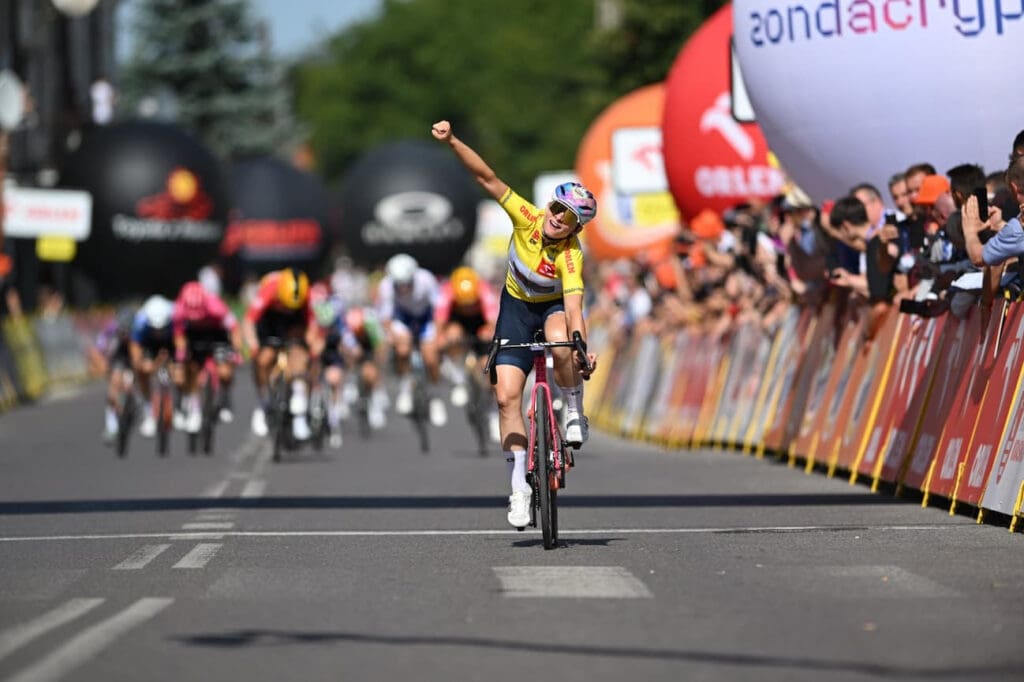 Photo Credit: Tour de Pologne
The early years: Poland on the women’s stage-race map
The early Tour de Pologne Women period belongs to a different era of women’s cycling. Race calendars were less stable, media coverage was thinner, and many events depended heavily on local organisers, national structures and limited sponsorship.
Even so, the race attracted strong riders. Hanka Kupfernagel, one of the most versatile riders of her generation, was among its earliest winners. That immediately gave the event international weight. Kupfernagel was not simply a road rider, but a multi-discipline force with major results across road, cyclocross and time-trialling.
The early history also has a strong Polish thread. Bogumiła Matusiak became the race’s most successful overall winner, taking back-to-back titles in 2005 and 2006. That matters because she was a central figure in Polish women’s cycling, racing across an era when riders often had to build international careers with far fewer resources and less visibility than today’s professionals.
The list of winners from that period also includes international names such as Tatiana Guderzo and Kirsten Wild, which shows that the race was never only a domestic event. It had enough status to attract riders who would go on to become major figures in women’s cycling.
Bogumiła Matusiak and the Polish core
No short history of Tour de Pologne Women should skip Bogumiła Matusiak. Her back-to-back wins in 2005 and 2006 remain central to the race’s identity.
Matusiak’s importance goes beyond the results sheet. She represented a generation of Polish riders who helped keep the country visible in the women’s peloton before the later breakthrough of riders such as Katarzyna Niewiadoma. Her success in the national tour gave the race a home winner with real depth, and her double remains the clearest example of Polish dominance in the event’s early history.
That home connection has always been important. The Tour de Pologne Women is not just a race held in Poland. It is part of the country’s wider cycling story, and its strongest editions have been those where local interest, Polish riders and international competition have overlapped.
Modern Polish women’s cycling now has more prominent names, more professional structures and more visibility than in the 2000s. That makes the race’s revival feel timely. It gives those riders, teams and fans a home event with growing international relevance.
2016: a return under the Tour de Pologne spotlight
The 2016 edition is an important marker because it brought the women’s race back under the broader Tour de Pologne spotlight. Run as a three-stage event, it came at a time when women’s cycling was beginning to push harder for visibility, better race structures and stronger links with established men’s events.
Jolanda Neff won the overall that year. Her victory gave the race another striking name because Neff was best known as a mountain bike star, but also had the engine and attacking range to make an impact on the road. That result underlined the variety that has often defined the race. Tour de Pologne Women has not always been a pure climber’s race or a simple sprinters’ race. Its winners have often reflected route design, form, opportunism and cross-discipline strength.
But 2016 did not immediately lead to continuity. The race disappeared again, leaving a gap where a regular Polish women’s stage race might have developed.
That absence is part of the story. It shows how fragile women’s events could be, even when they had recognisable branding and credible winners.
The long gap and why it mattered
The absence of Tour de Pologne Women after 2016 mattered because the women’s calendar was changing quickly. The Tour de France Femmes was launched, the Giro d’Italia Women retained Grand Tour status, La Vuelta Femenina grew, and more established men’s race organisers began adding or expanding women’s events.
In that context, Poland not having a regular high-profile women’s stage race felt like a missed opportunity. The country had cycling culture, a major men’s WorldTour event, strong women riders and a growing audience. The ingredients were there.
The gap also meant that the race could not build year-on-year identity. Stage races rely on memory: familiar roads, returning winners, repeat teams, rivalries and a sense of calendar position. When an event disappears, that continuity has to be rebuilt from almost nothing.
That is why the 2024 revival was significant. It was not simply another race returning to the calendar. It was Poland re-entering a part of women’s cycling where it had clear historical and sporting reasons to belong.
2024: the modern revival
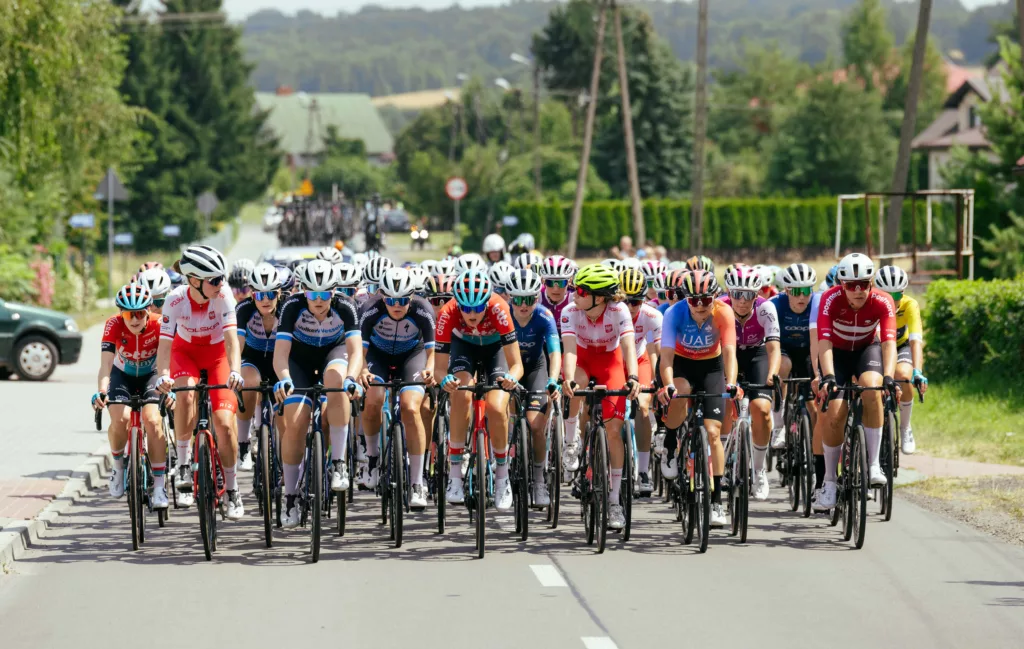
The Tour de Pologne Women returned in 2024 as a three-day UCI race in the Lubelskie region. That revival gave the event a fresh foundation: compact, accessible, and built around terrain that could produce aggressive racing rather than simply relying on the prestige of the Tour de Pologne name.
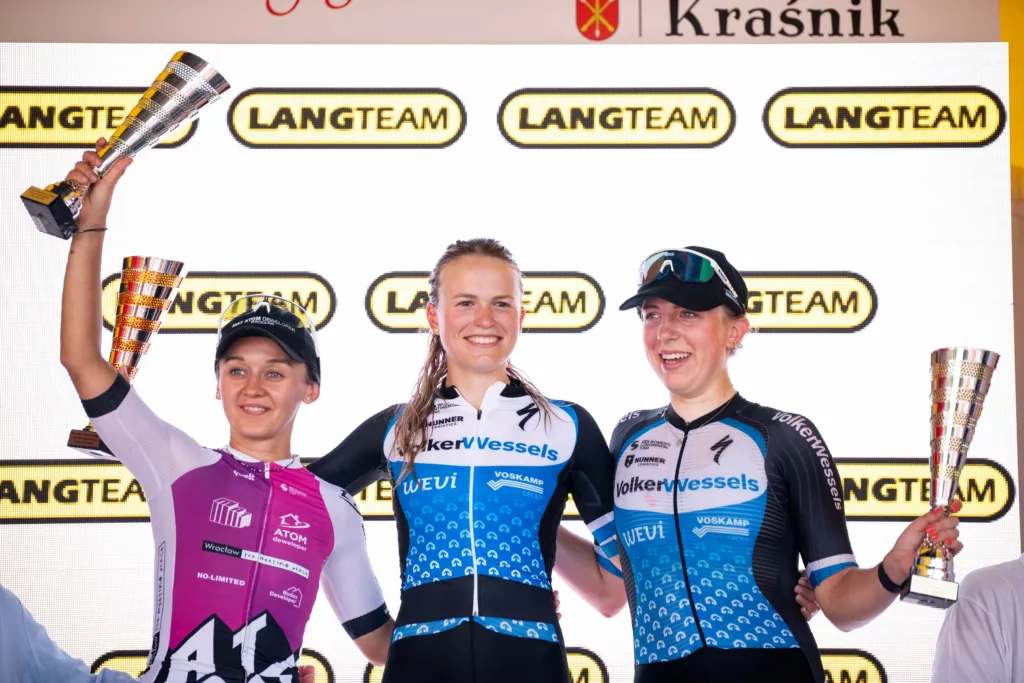
Laura Molenaar won the overall after a decisive stage 2 solo move, with VolkerWessels dominating the race. Scarlett Souren won the final stage in Kazimierz Dolny, while Molenaar defended the yellow jersey to secure the general classification.
The 2024 edition mattered because it proved the race could work again. It delivered a clear sporting storyline, strong team identity, a home podium presence through Katarzyna Wilkos, and a route that showed what the Lubelskie region could offer.
The revived race also opened with a short time-trial in Lublin, where Stina Kagevi won the opening stage of the 2024 Tour de Pologne Women, giving the event an immediate competitive shape before Molenaar’s decisive move.
For a relaunched event, that is important. A race does not need to be perfect in its first modern edition. It needs to feel viable. Tour de Pologne Women 2024 did that.
Our report on Laura Molenaar’s stage 2 win at Tour de Pologne Women 2024 covers the move that set up her overall victory, while the final stage report from Kazimierz Dolny explains how VolkerWessels closed out the race.
2025: Consonni and a stronger international field
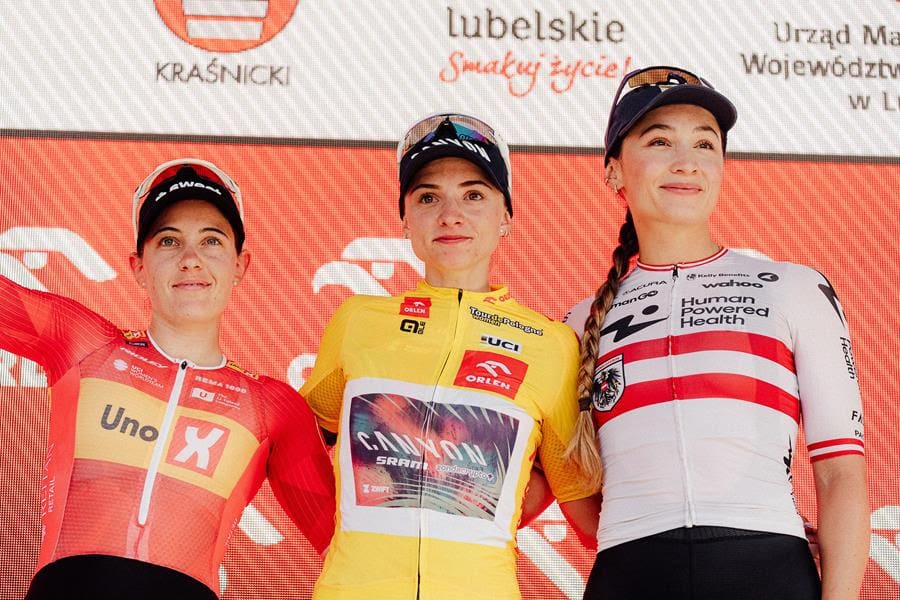
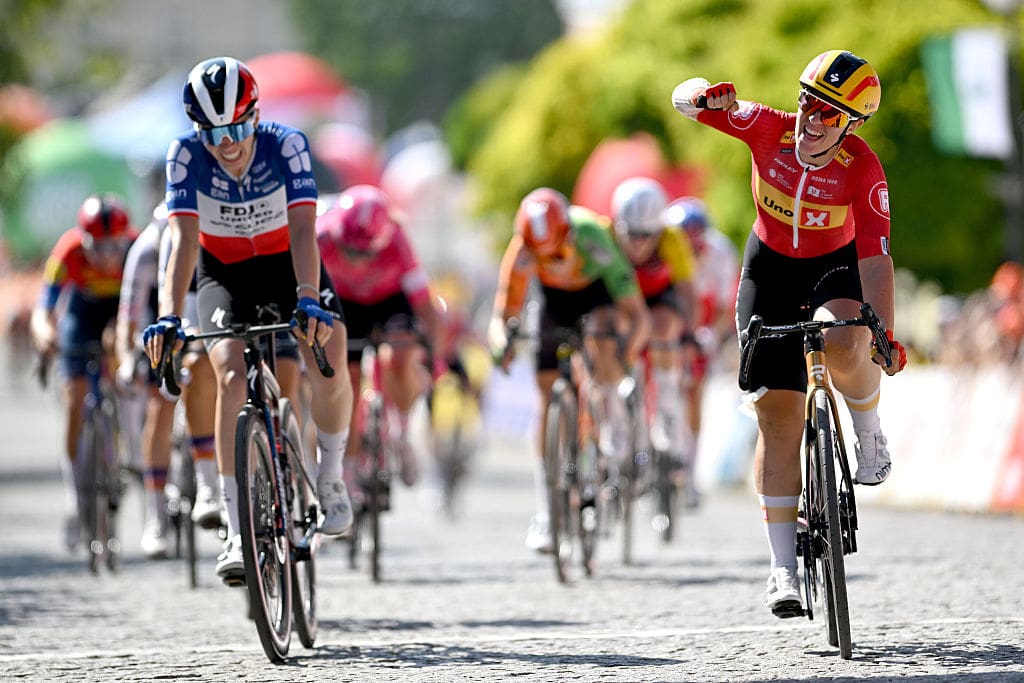
The 2025 edition gave the modern race another step forward. Chiara Consonni won the overall after taking two stages, including the final day in Kraśnik. Linda Zanetti won stage 2 in Chełm, and the race again showed how short stage-race formats can reward riders who combine sprint speed, positioning and repeatability.
Consonni’s victory was important because it brought a recognisable top-level winner to the modern roll of honour. She arrived with WorldTour quality, track pedigree and a fast finish, and she converted that into both stage wins and the general classification. Her wider career background is covered in our Chiara Consonni rider profile.
The race itself also felt more established. The 2025 edition drew stronger teams, clearer storylines and a sense that the revived Tour de Pologne Women was not just a one-off experiment. It was becoming a proper calendar fixture.
That matters in women’s cycling, where race growth is often judged not only by category status, but by whether teams want to return, whether routes produce meaningful racing and whether the event gives riders something distinctive.
Our reports on Chiara Consonni’s stage 1 win in Zamość, Linda Zanetti’s stage 2 victory in Chełm and Consonni sealing the 2025 GC in Kraśnik show how the race built its modern identity through fast, tactical finishes.
2026: the ProSeries step
The next major step is 2026, with Tour de Pologne Women moving up to UCI Women’s ProSeries level. That is a major statement for a race still rebuilding its modern place on the calendar.
The 2026 edition runs from Friday, 24th July to Sunday, 26th July, again over three stages in the Lubelskie region. The route begins in Tomaszów Lubelski and finishes stage 1 in Zamość, stage 2 runs from Włodawa to Lubartów, and stage 3 takes the race from Janowiec to Lublin.
That structure keeps the race compact, but the category upgrade changes the field and expectations. A ProSeries race can attract a stronger mix of Women’s WorldTour teams, ProTeams, national selections and ambitious Continental squads. It also gives the event a clearer position between smaller international races and the biggest Women’s WorldTour stage races.
The key question now is whether the race can turn that status into long-term stability. A three-day format can be a strength if the stages are distinctive and the racing stays open. It can give sprinters, classics riders and aggressive all-rounders a real target without needing the scale of a week-long stage race.
Our coverage of the Tour de Pologne Women 2026 team list looks at how the race’s upgraded status has strengthened the start list.
Why Lubelskie has become central to the modern race
The modern Tour de Pologne Women has built its revival around the Lubelskie region. That gives it a different feel from the men’s Tour de Pologne, which often uses a wider range of terrain across the country.
Lubelskie has suited the modern women’s race because it offers rolling roads, fast finishes, enough variation to create splits, and towns that give the event a clear regional identity. It is not a high-mountain race, but it does not need to be. Its recent editions have shown that short Polish stages can still create selective racing through positioning, punchy finishes, cobbles, circuits and tactical pressure.
That identity is important. Not every women’s stage race needs to copy the Grand Tour model. A three-day race can have its own purpose if it gives riders a clear challenge and viewers an easy story to follow.
The Tour de Pologne Women’s modern strength may be exactly that: short, sharp, readable racing in a country with a strong cycling tradition and growing women’s road depth.

How Tour de Pologne Women fits into Polish cycling
The race matters because Polish women’s cycling has outgrown the idea that it should only be represented abroad. Katarzyna Niewiadoma has become one of the defining riders of her generation, while riders such as Marta Lach, Daria Pikulik, Agnieszka Skalniak-Sójka and others have kept Poland visible across road and track racing.
A national stage race gives that talent a home stage. It gives Polish teams exposure, gives national riders a chance to race in front of home crowds, and gives the country a clearer place on the international women’s road calendar.
It also matters symbolically. The men’s Tour de Pologne has long been part of the WorldTour structure. The women’s race does not yet sit at that level, but its ProSeries status gives it a stronger platform. That is how race development often works: first continuity, then field strength, then profile, then broader ambition.
The wider strength of Polish women’s cycling is also visible through WorldTour team structures. Canyon SRAM zondacrypto, home to Niewiadoma and Skalniak-Sójka, referenced Tour de Pologne Women success as part of a broader 2025 season that also fed into its 2026 Women’s WorldTour team guide.
For Poland, the Tour de Pologne Women is not only about three days of racing. It is about giving women’s cycling a recurring national showcase.
Key winners in Tour de Pologne Women history
| Year | Winner | Why it matters |
|---|---|---|
| 1998 | Hanka Kupfernagel | Early international prestige for the race |
| 2004 | Tatiana Guderzo | Added another major international name to the roll of honour |
| 2005 | Bogumiła Matusiak | Home victory by one of Poland’s key women’s riders |
| 2006 | Bogumiła Matusiak | Back-to-back win, making her the race’s standout repeat champion |
| 2007 | Kirsten Wild | A major sprint name on the winners’ list |
| 2016 | Jolanda Neff | Revival-era winner with major cross-discipline status |
| 2024 | Laura Molenaar | Winner of the modern relaunch |
| 2025 | Chiara Consonni | First modern winner after the race strengthened its international field |
The winners list shows the race’s mixed identity. It has never belonged to only one type of rider. Time-triallists, sprinters, all-rounders, Polish road leaders and cross-discipline stars have all shaped its story.
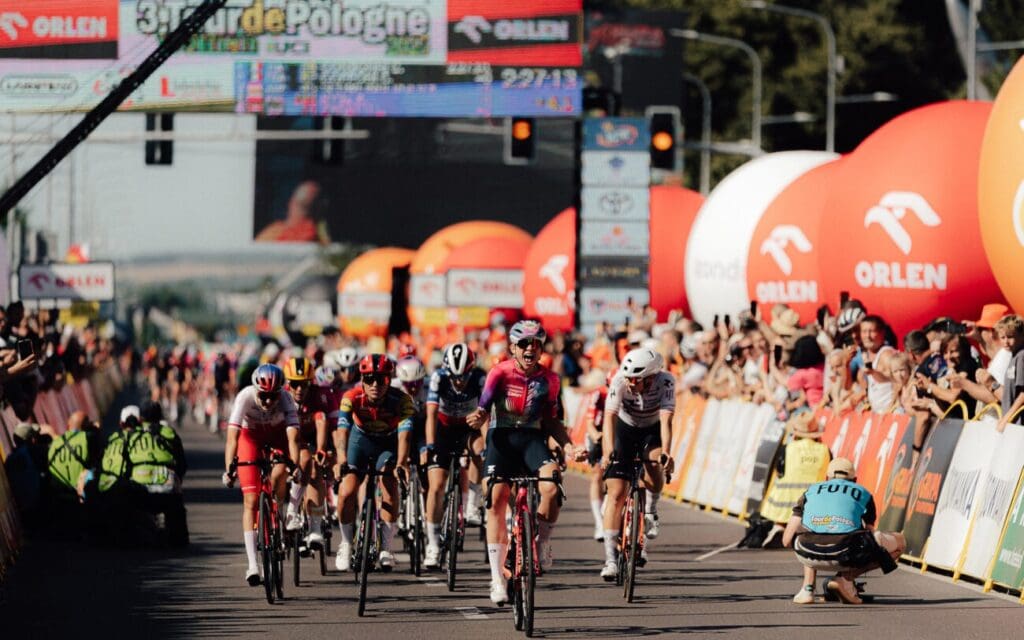 Photo Credit: Thomas Maheux
Why the race disappeared and returned
Many women’s races have had broken histories, and Tour de Pologne Women is part of that pattern. The reasons are rarely only sporting. Women’s races have often depended on sponsorship, organiser priorities, calendar space, local authority backing, media interest and the broader health of the women’s professional scene.
The difference now is that women’s cycling has more structure. The Women’s WorldTour is stronger than it was, ProSeries races have a clearer place, and national federations, sponsors and organisers have stronger reasons to support women’s events. That does not make growth automatic, but it gives revived races a better environment.
Tour de Pologne Women returned at a good moment. The women’s calendar needs more strong stage races outside the three Grand Tours. Central and Eastern Europe need more visible events. Poland has the cycling culture and rider base to support one.
That combination gives the modern race a stronger chance than earlier stop-start versions had.
What makes the race distinctive
Tour de Pologne Women is distinctive because it sits between categories in the best way. It is not a Grand Tour, and it should not be judged like one. It is not a one-day race either. Its three-day format gives teams enough time to build a GC story, but keeps every stage important.
That makes time bonuses, positioning, stage finishes and small gaps matter. A rider can win the race through a single decisive move, as Molenaar did in 2024, or through repeat sprint strength and bonus seconds, as Consonni did in 2025. The format rewards riders who can stay alert every day.
It also gives teams tactical choices. Do they bring a sprinter and chase stages? Do they race for GC with an all-rounder? Do they attack early because the race is too short to wait? Do they use national riders aggressively on home roads?
That is the appeal. Tour de Pologne Women is compact, but not simple.
Where the race can go next
The next stage in the race’s development is continuity. The ProSeries upgrade is important, but status only matters if it leads to stronger fields, better coverage, good routes and repeated calendar presence.
The race does not necessarily need to become a week-long event. A strong three-day race can be valuable if it knows what it is. The priority should be to keep improving route identity, team quality, broadcast visibility and Polish rider presence.
Longer term, a Women’s WorldTour place may become part of the conversation if the race continues to grow. But that should not be rushed. The modern race is still young, even if the broader event name has history behind it.
For now, the task is simpler: keep the race stable, make each edition distinctive, and let Tour de Pologne Women become a regular part of the women’s summer calendar.
-
 Photo Credit: Getty

Tour de Pologne Women FAQ
When did Tour de Pologne Women start?
The race’s wider history reaches back to the late 1990s, with Hanka Kupfernagel winning an early edition in 1998. The modern revived version returned in 2024 after a long gap.
Who has won Tour de Pologne Women the most times?
Bogumiła Matusiak is the standout repeat winner, taking back-to-back overall victories in 2005 and 2006.
Who won Tour de Pologne Women in 2024?
Laura Molenaar won the 2024 Tour de Pologne Women after a decisive stage 2 solo victory and then defended the overall lead on the final day.
Who won Tour de Pologne Women in 2025?
Chiara Consonni won the 2025 Tour de Pologne Women, taking two stages and sealing the general classification on the final day in Kraśnik.
What level is Tour de Pologne Women in 2026?
Tour de Pologne Women is a UCI Women’s ProSeries event in 2026, running from Friday, 24th July to Sunday, 26th July.
Is Tour de Pologne Women part of the Women’s WorldTour?
No. Tour de Pologne Women is not part of the Women’s WorldTour in 2026. It sits one level below as a UCI Women’s ProSeries stage race.
Why Tour de Pologne Women matters
Tour de Pologne Women matters because it gives Poland a serious women’s stage race at a time when the sport needs more strong events outside the biggest countries and established Grand Tours.
Its history is not perfectly smooth, but that is part of the point. The race reflects the stop-start development of women’s cycling itself: early ambition, uneven continuity, revival, and now a push towards stronger structures. Its early winners gave it credibility. Its Polish champions gave it identity. Its modern revival gives it purpose.
The 2026 ProSeries step is therefore more than an administrative upgrade. It is a sign that Tour de Pologne Women is being rebuilt as something that can last. In a calendar where short stage races can play an increasingly important role, that makes it a race worth watching.
For more on the current edition, see our beginner’s guide to Tour de Pologne Women 2026 and our latest women’s cycling race coverage.

