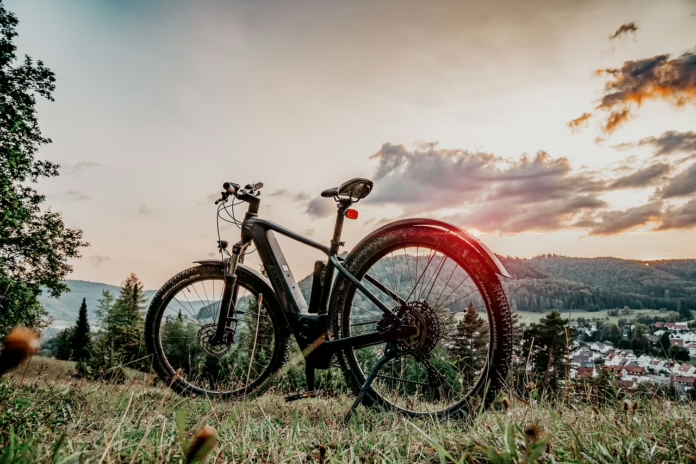
Yes, an e-bike can be excellent off-road, but the important distinction is between a road-legal electric bike and an electric motorbike. A proper electric mountain bike, or e-MTB, combines a mountain-bike frame, wide tyres, strong brakes and suspension with pedal assistance. It is designed for exactly the kind of steep climbs, forest tracks and technical trails that would expose the limits of a normal commuter e-bike.
In the UK, a legal electrically assisted pedal cycle must meet the EAPC rules: the motor’s continuous rated output must not exceed 250W and assistance must cut out at 15.5mph. If it meets those requirements, it is treated as a pedal cycle and can be used anywhere ordinary bicycles are permitted.
That does not mean every path is open to e-bikes. Access rights still matter, and a high-powered or modified bike may no longer be legally classed as a bicycle at all.
Can e-bikes be used off-road?
Legal e-MTBs are welcome on many purpose-built mountain-bike trails, forest roads, bridleways and other routes where cycling is permitted. Forestry England, for example, explicitly allows compliant EAPCs and e-MTBs on its waymarked cycle trails, suitable public rights of way and many stone tracks and forest roads.
The motor does not turn the bike into a motorcycle. It assists while you pedal, making steep climbs and repeated elevation easier without removing the need to ride, balance and control the bike yourself.
What makes an e-MTB different from a normal e-bike?
| Feature | E-MTB | Typical commuter e-bike |
|---|---|---|
| Tyres | Wide, high-volume and heavily treaded | Narrower and faster rolling |
| Suspension | Front suspension or full suspension | Often rigid or short-travel |
| Brakes | Powerful hydraulic discs, often larger rotors | Designed mainly for road speeds |
| Geometry | Stable on steep, rough terrain | Optimised for roads and cycle paths |
| Motor tune | Strong climbing assistance and trail response | Smoother urban assistance |
| Weight | Usually heavier but built for rough use | Varies, often lighter-duty |
Where can you legally ride an e-bike off-road in England and Wales?
If the bike is a legal EAPC, the access rules are broadly the same as for a conventional bicycle. Cyclists can use public bridleways, restricted byways and byways open to all traffic. Public footpaths are for walkers, so a bicycle does not gain access simply because it has an electric motor.
Open-access land creates another common misunderstanding. The right to roam does not automatically include cycling away from a permitted route. You can ride where a bridleway or byway crosses that land, or where the landowner specifically allows cycling, but the general right of access is primarily for walking and related activities.
Trail centres and managed forests can have their own signed networks, so check the local rules before riding. Closures for forestry work, trail maintenance or weather can also change what is available from one visit to the next.
Be careful with ‘off-road mode’ and derestricted e-bikes
The phrase “off-road mode” can be misleading. Some electric bikes can be altered so the motor continues assisting above 15.5mph, or can be fitted with more powerful motors and throttles.
UK government guidance is clear that an electric cycle with a mode allowing motor assistance above the normal EAPC speed limit is not considered compliant with the EAPC regulations. Once a bike falls outside those rules it can be treated as a motor vehicle, bringing registration, insurance and licensing requirements with it.
Forestry England also bars chipped, overpowered and non-compliant electric bikes from its cycle trails. A derestricted e-bike is therefore not a clever way to get more performance on a trail centre: it can change both the bike’s legal status and where you are allowed to use it.
Why e-MTBs work so well on climbs
Climbing is where electric assistance changes mountain biking most. A motor lets riders cover more elevation in the same amount of time and can make repeated technical climbs realistic rather than something saved for the freshest part of the day.
That also changes how routes can be linked together. Instead of relying on an uplift service or avoiding long transitions, an e-MTB can turn the climb back to the trailhead into part of the ride.
The motor does not remove technique. Loose climbs still require weight distribution, traction and careful power delivery. Selecting maximum assistance and stamping on the pedals can simply spin the rear tyre if the surface is poor.
The extra weight changes descending
E-MTBs are heavier than equivalent non-electric mountain bikes because of the motor and battery. Modern bikes hide that mass well, but it still affects braking, direction changes and how much effort is needed to lift the bike over obstacles.
The extra stability can feel reassuring on rough descents, while the downside appears in tight turns and when the bike has to be moved manually. If you regularly lift a bike over gates, onto a roof rack or up stairs, weight deserves as much attention as motor power when buying.
Hardtail or full-suspension e-MTB?
A hardtail e-MTB uses front suspension only. It is simpler, usually cheaper and works well for forest roads, easier trails and riders who want electric assistance without buying a heavy enduro-style machine.
A full-suspension e-MTB adds rear suspension and is the better choice for repeated technical descents, rough trail-centre riding and more demanding terrain. The extra complexity costs more and adds weight, but control and comfort improve substantially when the ground gets rough.
Battery range off-road is highly variable
There is no dependable single range figure for an e-MTB. Rider weight, gradient, surface, temperature, tyre choice and assistance mode all matter. A battery that lasts for a long road ride can disappear much faster when repeated steep climbs are ridden in the highest support setting.
Plan conservatively on unfamiliar terrain. Finishing an e-MTB ride with a flat battery is not impossible, but pedalling a heavy mountain bike without assistance is much less enjoyable than riding it with the system working as intended.
What to look for when buying an e-bike for off-road riding
Start with the terrain rather than the motor specification. For towpaths, forest roads and smoother bridleways, a rigid or hardtail electric bike with reasonably wide tyres may be enough. For technical trail centres, a purpose-built e-MTB with proper suspension, strong hydraulic brakes and suitable tyres is a much safer purchase.
Also check battery capacity, charging arrangements, replacement-battery availability and the manufacturer’s dealer network. Motors and batteries make e-bikes more complicated to own than conventional bikes, so long-term support matters.
If you are still working out the wider legal and buying questions, ProCyclingUK’s guide to buying an electric bicycle in the UK covers EAPC rules, everyday use and what to check before purchasing.
Can a hybrid e-bike handle off-road trails?
Light gravel, towpaths and smooth forest tracks are within reach of many electric hybrids, especially with tyres around 40mm or wider. The limit arrives when roots, rocks, drops and steep descents become regular features.
A hybrid’s more upright geometry and road-biased components do not magically become trail-ready because a motor has been added. Our hybrid bike guide explains where that category works and where a mountain bike becomes the better tool.
Trail etiquette matters more with an e-MTB
Electric assistance can close gaps between riders with different fitness levels, but it can also mean reaching other trail users faster than expected. Slow down around walkers and horse riders, give way where required and avoid damaging soft trails in poor conditions.
On shared routes, assistance should make the ride easier rather than provide an excuse to treat every climb as a race. The same countryside and trail etiquette applies whether the bike has a motor or not.
Are e-bikes good for off-road riding?
Purpose-built e-MTBs are exceptionally capable off-road and can make mountain biking accessible to riders who want more range, more climbing or help keeping a mixed-ability group together. They also open up route combinations that would demand significantly more fitness on a conventional bike.
The key is using the right bike on a route where cycling is permitted. A legal EAPC remains a bicycle in UK law; a chipped or overpowered machine may not. Match the suspension, tyres and brakes to the terrain, respect access rules and an e-MTB can be one of the most versatile ways to explore off-road.