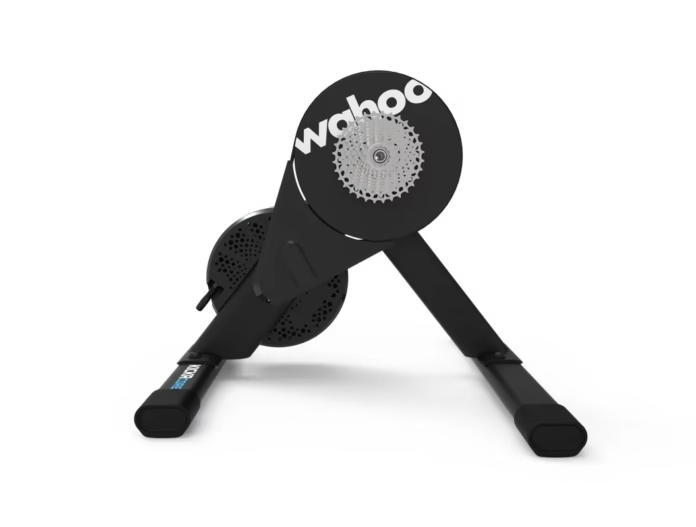
The first cold week of autumn is usually enough to expose the weaknesses of an indoor training setup. A trainer that takes ten minutes to connect, struggles with short intervals or needs a cassette change every time another bike goes on it soon becomes an expensive obstacle to riding. The good news is that direct-drive smart trainers now offer useful resistance control and credible power data at prices well below the traditional premium models.
This guide compares six specific trainers available through UK product listings in October 2026. The selection runs from the Van Rysel D100 with Zwift Cog and Click to the Tacx NEO 3M, with two particularly close mid-priced rivals in the JetBlack Victory and Wahoo KICKR CORE 2. It also covers the Wahoo KICKR V6 and Elite Justo 2 for riders who want more accuracy, connectivity or room for hard efforts.
This is a research-led buying guide, not a hands-on group test by ProCyclingUK. The assessments draw on published manufacturer specifications, UK retail listings and independent practical testing. Prices below are reference UK prices checked on 26 October 2026, not guaranteed checkout prices; short promotions, delivery charges and stock can change. The important question is not which trainer has the largest specification, but which one solves the problems you will actually encounter.
Best smart trainers for 2026: UK price and specification comparison
| Model | UK reference price | Max power | Max gradient | Claimed accuracy | Best suited to |
|---|---|---|---|---|---|
| Van Rysel D100 with Zwift Cog and Click | £279.99 | 600W | 6% | ±5% | Budget, steady training |
| JetBlack Victory V2 with Zwift Cog and Click | £399 | 1,800W | 16% | ±2% | Best-value Zwift racing |
| Wahoo KICKR CORE 2 with Zwift Cog and Click | £499.99 regular | 1,800W | 16% | ±2% | Balanced all-rounder |
| Wahoo KICKR V6 with 11-speed cassette | £774.99 | 2,200W | 20% | ±1% | Racing and multiple apps |
| Elite Justo 2 with 12-speed cassette | £1,099.99 | 2,300W | 24% | <1% | Structured training, precision |
| Tacx NEO 3M with 11-speed cassette | £1,599.99 | 2,200W | 25% | within 1% | Premium road feel |
The claimed accuracy figures are manufacturer tolerances, not measurements made for this article. They do not describe every sprint or every power transition, and the quoted maximum wattages are well beyond what most riders need. Prices also refer to the exact configurations named in the table. A cassette-equipped trainer and a Zwift Cog version are not automatically interchangeable purchases.
Van Rysel D100: the least expensive sensible entry point
At £279.99 from Decathlon, the D100 with Zwift Cog and Click offers direct drive without a large initial outlay. The Cog simplifies fitting different bikes, while the Click controller handles virtual gear changes in Zwift. The unit weighs about 10.5kg, and the folding support makes it easier to move out of a shared room than some heavier rivals.
There is a firm performance ceiling. Decathlon specifies 600W, a simulated gradient of 6% and accuracy of ±5%, with no built-in cadence measurement. Those figures are workable for easier endurance sessions, steady intervals and someone exploring indoor riding. They are much less convincing for powerful sprints, steep virtual climbs or close-fought racing. Independent testing has also highlighted that the modest resistance ceiling is a limitation rather than a detail to ignore.
The Zwift Cog version is particularly attractive if several bikes use different drivetrains, but virtual shifting is tied to the supported Zwift setup. Other training applications may require a conventional cassette and the appropriate compatible connection. Check the axle adapters, the bike’s drivetrain and the intended app before treating the Cog as a universal solution.
JetBlack Victory V2: the price that puts pressure on Wahoo
The JetBlack Victory V2 with Zwift Cog and Click is listed at £399 in the UK. Its headline figures are strikingly close to the KICKR CORE 2: 1,800W maximum resistance, a 16% gradient ceiling, claimed ±2% power accuracy and Wi-Fi connectivity. The supplied Cog and Click make it straightforward to get into Zwift without choosing a cassette at checkout.
Independent BikeRadar and road.cc tests reported convincing power data and a good ride feel, particularly for the money. BikeRadar found ERG-mode response smooth but noted that power smoothing is enabled by default and cannot be disabled, which makes the displayed line appear cleaner than the actual pedalling effort. That matters to riders who like to examine every interval rather than just complete a workout.
The Victory is the obvious value challenger if the current UK listing is available for dispatch. It is not automatically a better purchase for every rider: local support, warranty handling, ease of moving the unit and the preference for Zwift virtual shifting all deserve consideration. Riders who routinely switch to other training apps should factor in the cost and inconvenience of replacing the Cog with a cassette.
Wahoo KICKR CORE 2: the safer all-round choice
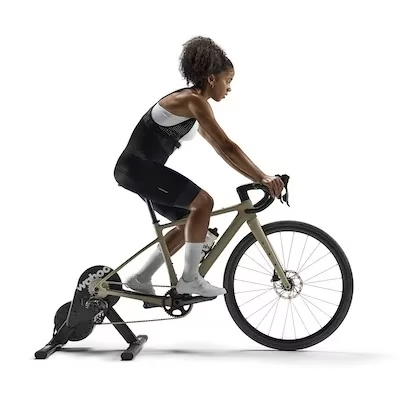 Photo Credit: Wahoo
The Wahoo KICKR CORE 2 has a regular UK price of £499.99 in the Zwift Cog and Click configuration. It matches the Victory’s claimed 1,800W and 16% limits, and adds Wi-Fi, automatic calibration and Race Mode to a well-established trainer platform. Wahoo’s specifications give a 5.4kg flywheel and ±2% claimed power accuracy.
Independent Cyclingnews and BikeRadar testing both found the power data credible and the ride feel polished. Cyclingnews noted that it does not have the easiest folding or carrying arrangement, while BikeRadar found a small improvement in measured power accuracy over the previous CORE. Those are more useful distinctions than another 200W of resistance most cyclists will never reach.
It is a sensible option for riders who want to fit a trainer once and use it throughout winter, particularly where multiple training apps or an established accessories ecosystem matter. The premium over the Victory buys familiarity and support rather than a large improvement in the headline performance figures. ProCyclingUK’s separate KICKR CORE 2 review looks more closely at that value calculation.
Zwift sometimes runs short discounts that change the comparison considerably. The table uses the verified regular UK price rather than assuming that a promotional checkout offer or tracked link is available to every buyer. Check the live price and shipping charge before ordering.
Wahoo KICKR V6: more control without moving into four figures
Wahoo’s cassette-equipped KICKR smart trainer, commonly referred to as the V6, is currently listed at £774.99. The upgrade over the CORE 2 is not simply its 2,200W output and 20% gradient simulation. Claimed power accuracy tightens to ±1%, while its connectivity options include Wi-Fi and Wahoo’s racing-oriented data transmission.
It also brings side-to-side movement through its feet, automatic calibration and useful refinements for ERG workouts. For a rider doing regular virtual races or structured threshold intervals, the improved measurement tolerance and faster reporting are more defensible reasons to spend extra than the ability to simulate a gradient they may never select.
The decision is less obvious for occasional indoor riding. A CORE 2 or Victory can already run hard workouts, and a better fan, mat or reliable display may improve the experience more than the trainer upgrade. Buyers should check whether they want the cassette version or a separate Zwift Cog and Click configuration; the purchase price and shifting behaviour are not identical.
Elite Justo 2: premium data and serious training features
The standard Elite Justo 2 with pre-installed Shimano 12-speed cassette is listed at £1,099.99 by Tredz, which currently describes it as available with its supplier rather than immediate warehouse stock. Elite claims better than 1% power accuracy, up to 2,300W resistance and gradients of 24%, alongside built-in Wi-Fi and automatic calibration.
There is a more tangible benefit in the details. The Justo 2 includes alternative Flex Feet to adjust the amount of movement, supports Ethernet as well as wireless protocols, and can operate in certain stand-alone modes. Cyclingnews praised the smooth ride and consistent power readings in its independent test, while raising reservations about the balance of the carrying handle and some cadence behaviour encountered during testing.
This is a specialist purchase for someone who trains indoors frequently and wants high-quality data without a separate power meter. It is harder to justify for a rider who mostly joins easy social rides. Also distinguish this cassette-equipped model from the separate Justo 2 with Zwift Cog and Click, because the supplied transmission hardware changes how it is used.
Tacx NEO 3M: excellent resistance control, very expensive entry
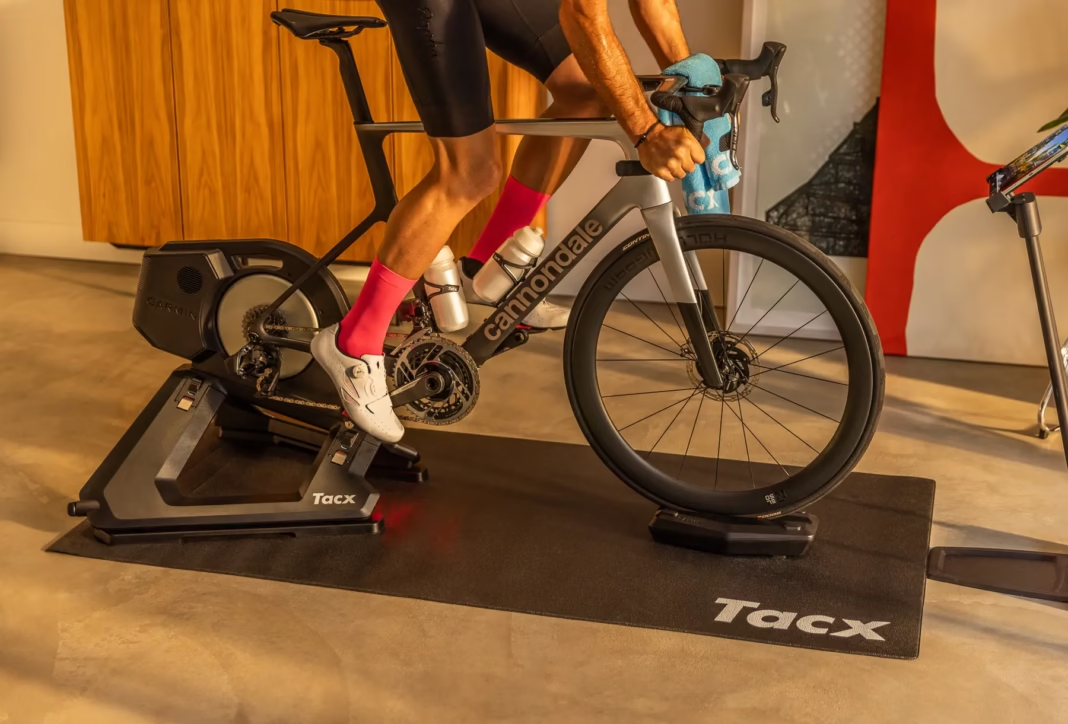 Photo Credit: Garmin
The Tacx NEO 3M is listed by Garmin at £1,599.99 with an 11-speed cassette fitted. It simulates gradients up to 25%, measures power to within 1% according to Garmin and includes built-in multidirectional movement. Its electronically simulated road surfaces and highly controlled resistance distinguish it from conventional flywheel trainers.
BikeRadar’s independent review praised the accuracy, ERG-mode behaviour and convincing resistance, but was much less enthusiastic about the price and several missing convenience features. The movement was not universally better during sprints, and derailleur clearance and cassette choice were legitimate concerns. A higher price therefore does not mean a universally better training experience.
For riders already using Garmin and Tacx software, or those who particularly value the road-surface simulation and premium resistance behaviour, the NEO 3M has a coherent case. For most cyclists the extra cost is better spent elsewhere. Our Tacx NEO 3M review examines that balance in more detail.
What actually matters when choosing a smart trainer?
Compatibility comes before accuracy
Check your frame’s axle standard, cassette and freehub requirements, brake clearance and the manufacturer’s compatibility list. A direct-drive trainer replaces the rear wheel, so a quick-release road bike, a 12mm thru-axle gravel bike and a mountain bike with Boost spacing can require different fittings. Buying the wrong adapter is an immediate obstacle, whatever the claimed power accuracy.
Zwift Cog and Click can simplify multi-bike use, but its virtual gears work in the supported Zwift environment. If you also ride on Rouvy, MyWhoosh or TrainerRoad, check exactly how the trainer behaves with that app. A conventional cassette can be more flexible across platforms, though it needs to match the bike and be kept clean and correctly adjusted.
Connectivity and ERG behaviour matter more than extreme gradients
Bluetooth and ANT+ are still useful, but Wi-Fi can make a permanent indoor setup more reliable, particularly where several sensors and controllers compete for connections. ERG mode is equally important: it holds a prescribed target power for intervals, and a trainer that responds smoothly to changes makes structured sessions easier to complete. Independent testing is more informative here than a manufacturer’s maximum wattage claim.
A quoted ±1% or ±2% accuracy figure should not be confused with a guarantee that two separate power meters will display identical numbers. The trainer measures downstream of the crank or pedals, drivetrain losses affect comparisons, and the measurement conditions differ. If you use the same trainer consistently for workouts, repeatability and stable calibration often matter more than a tiny specification advantage.
Noise, heat and storage can decide whether you keep riding
A direct-drive trainer is generally quieter than a wheel-on unit, but the chain, fan and room acoustics remain audible. The cheapest route to a more comfortable session is often proper airflow rather than a more expensive trainer. Use a stable floor surface, protect it from sweat and allow room around the bike. Our indoor trainer setup advice covers the practical side.
Think about who else uses the room. A 10kg trainer with a folding foot is different to moving a large premium unit every evening. If the bike has to be removed after each session, factor in cassette alignment, storage space and how easily the legs fold. A setup that can remain ready to ride is more likely to be used than one that has to be assembled from scratch.
Which smart trainer should you buy in the UK?
For a new rider whose sessions will be steady and relatively short, the Van Rysel D100 is a reasonable starting point, provided its 600W limit and modest gradient simulation will not become restrictive. The JetBlack Victory is the more compelling value proposition for riders who already know they want racing and structured intervals. At its regular price the KICKR CORE 2 costs more, but its established platform and broad connectivity make it the least complicated recommendation for many cyclists.
The KICKR V6 is worth the jump when the extra accuracy, stability and connection options will be used regularly. The Elite Justo 2 is a credible choice for demanding training and a more involved setup, while the Tacx NEO 3M is a specialised premium purchase rather than a sensible default. Start with your bike, your training app and the space you have, then spend on the trainer that meets those needs. A higher price cannot compensate for a setup that is awkward to use.
-
 Photo Credit: Brecht Steenhouwer
-
 Photo Credit: Telenet Superprestige