
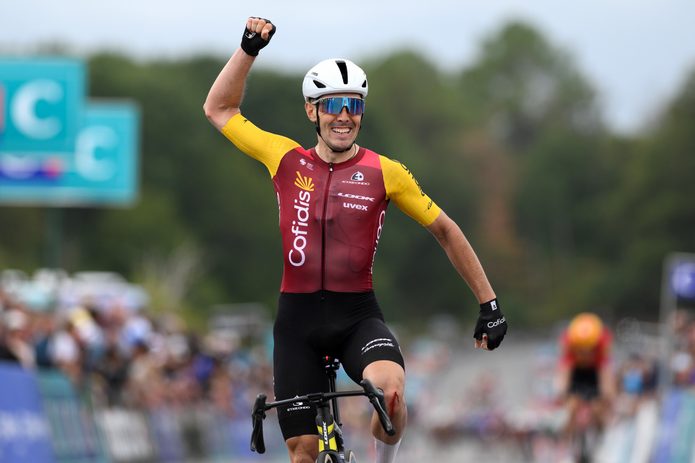
Alex Aranburu won the 2026 Bretagne Classic in Plouay, attacking from the front group inside the final 1.5 kilometres to take a major WorldTour one-day victory for Cofidis.
The Spanish rider made his move just before the flamme rouge, opening a gap as the reduced lead group hesitated behind. Alexander Kamp was the closest to reacting for Uno-X Mobility, but he could not bring Aranburu back and had to settle for second place, 4 seconds down.
Alessandro Borgo finished third for Bahrain Victorious at 10 seconds, ahead of Emil Herzog of Red Bull-Bora-Hansgrohe and Jenno Berckmoes of Lotto-Intermarché. Paul Lapeira, Romain Grégoire, Alexandre Delettre, Rick Pluimers and Andrea Vendrame completed the top 10.
It was a victory built on timing, strength and hesitation behind. The final ascent of Ty Marrec created the decisive selection, but Aranburu did not wait for the sprint. He attacked at exactly the moment when the group was still looking at each other, then held the gap all the way to the line.
A shorter Plouay route but no easy race
The 2026 Bretagne Classic covered 228.3 kilometres around Plouay, making it shorter than some recent editions but still a full WorldTour one-day test.
The route carried more than 3,600 metres of climbing and placed the decisive difficulty in the final circuits. The return of Ty Marrec gave the race a more traditional Plouay feel, with the last lap offering a platform for puncheurs rather than a straightforward run-in for the fastest sprinters.
Each finishing circuit forced the bunch over short Breton climbs, with Lezot, Kerscoulic and Ty Marrec all giving the race points of pressure. None of them were long enough to decide the race alone, but together they created the kind of finish where positioning, repeated accelerations and late decision-making mattered as much as pure speed.
That was always the question before the start. Could the durable sprinters survive and organise a reduced bunch finish, or would the climbs invite a late attack that the group could not close?
Aranburu gave the answer in the final kilometres.
Early breakaway gives the race shape
The day’s breakaway included Liam Slock, Emil Herzog, Markus Hoelgaard, Quinten Hermans and Benjamin Thomas.
It was not a token move. On a route like this, with so much rolling terrain and a hard final circuit, a strong early group can force the peloton into a long chase and then still leave riders with enough energy to influence the end. Herzog’s eventual fourth place showed that the early aggression did not automatically remove him from the finale.
Cofidis were also well placed. Thomas gave them representation up the road, which meant they did not need to take responsibility too early behind. With Aranburu and Dylan Teuns still in the peloton, the French team had more than one route into the race.
The break resisted several counter-attacks and kept the peloton working through the middle phase. Behind, the bunch never allowed the move to gain total control, but it also could not simply coast towards the final laps.
That set up exactly the kind of race Plouay often produces: a long breakaway, repeated pressure behind, then a final circuit where the strongest riders from both halves of the race still had something to say.
Magnier crash changes the sprint picture
The race was shaken up around 50 kilometres from the finish when Paul Magnier crashed in the peloton.
The Soudal Quick-Step rider had been one of the leading favourites for the day, especially if the race came down to a reduced sprint. He tried to continue after the fall, but soon stopped and abandoned before being taken away by ambulance.
That changed the tactical picture immediately. Without Magnier, one of the clearest fast-finishing options was removed from the race. It also reduced the likelihood of a fully controlled sprint finish, because one of the teams with the strongest reason to chase had lost its main card.
The crash also reinforced how tense the final hour had become. The Bretagne Classic is often defined by its hills, but the stress of fighting for position before those climbs can be just as decisive. With the finishing circuit approaching and teams trying to keep leaders near the front, the peloton became increasingly stretched and nervous.
From that point, the race felt more likely to be decided by a reduced attacking group than by a clean sprint.
The break is finally caught on Ty Marrec
The decisive phase came on the last ascent of Ty Marrec.
The early breakaway had survived deep into the race, but the final climb finally brought it back. Ty Marrec was not long, but it was placed perfectly. At around 6 kilometres from the finish, it came late enough that any split over the top could go all the way.
The catch immediately created a new selection. Instead of the full peloton reforming, the strongest riders moved clear and opened a small gap. It was not a huge advantage, around 15 seconds at first, but with only a few kilometres remaining and the peloton fractured behind, it was enough.
That front group contained the riders who would decide the race. Aranburu was there for Cofidis, Kamp for Uno-X Mobility, Borgo for Bahrain Victorious, Herzog after surviving from the break, Berckmoes, Lapeira, Grégoire, Delettre, Pluimers, Vendrame, Teuns, Benoît Cosnefroy and Lewis Askey.
It was a dangerous group because it contained both fast finishers and attackers. That also made it hard to organise. Every rider knew the sprint would be difficult to control. Every rider also knew that waiting too long could allow someone else to steal the race.
Aranburu understood that better than anyone.
Cofidis enter the finale with numbers
Cofidis had two riders in the decisive group, with Aranburu and Teuns both present.
That mattered. In a finale where the group was small and the chase behind was no longer fully organised, numbers gave Cofidis options. Teuns could follow moves, discourage a chase or simply force others to take responsibility. Aranburu could wait for the right moment.
The presence of Kamp, Borgo, Berckmoes, Lapeira, Grégoire and Vendrame meant there was no obvious favourite strong enough to command the whole group. Several riders had a fast finish. Several had an attack. That created the hesitation Aranburu needed.
The final kilometres into Plouay were not about a full team lead-out. They were about reading fatigue. After 228 kilometres and repeated climbs, the winning move was always likely to come from a rider with just enough explosiveness left to open a gap before the sprint structure formed.
Aranburu has made a career from exactly that kind of moment.
Aranburu attacks before the flamme rouge
Aranburu launched his winning attack a little before the final kilometre.
It was not a long-range move, but it was far enough out to avoid the sprint and close enough to the finish that the group behind had no time to organise properly. He accelerated from the front group, immediately opened daylight, and forced everyone else into a choice: chase straight away or gamble that someone else would.
That hesitation was decisive.
Kamp was the rider who reacted most clearly. The Dane gave chase and briefly looked like he might get close enough to make it a duel, but Aranburu had already created the gap he needed. The Cofidis rider kept his effort smooth into the final kilometre, using the delay behind to hold his advantage.
By the time the others committed, the race had gone.
It was a classic Aranburu victory: not a pure sprint, not a mountain attack, but a sharp, perfectly timed acceleration at the point where the group was least able to respond.
Kamp closest but not close enough
Kamp’s second place was a strong ride, but also a frustrating one.
The Uno-X Mobility rider was the only rider to really threaten Aranburu after the attack. He chased alone, kept the gap small and crossed the line 4 seconds behind. In another version of the finale, with a slightly quicker response behind or a moment of hesitation from Aranburu, Kamp might have been able to bring it back.
But he was left with too much to do.
Once Aranburu had the gap, Kamp had to chase without giving the riders behind an easy tow. That is the difficulty of a late attack from a group like this. Everyone wants the move closed, but nobody wants to spend the final kilometre dragging faster riders back into contention.
Kamp made the right decision by going after Aranburu, but the Spaniard had timed the attack too well.
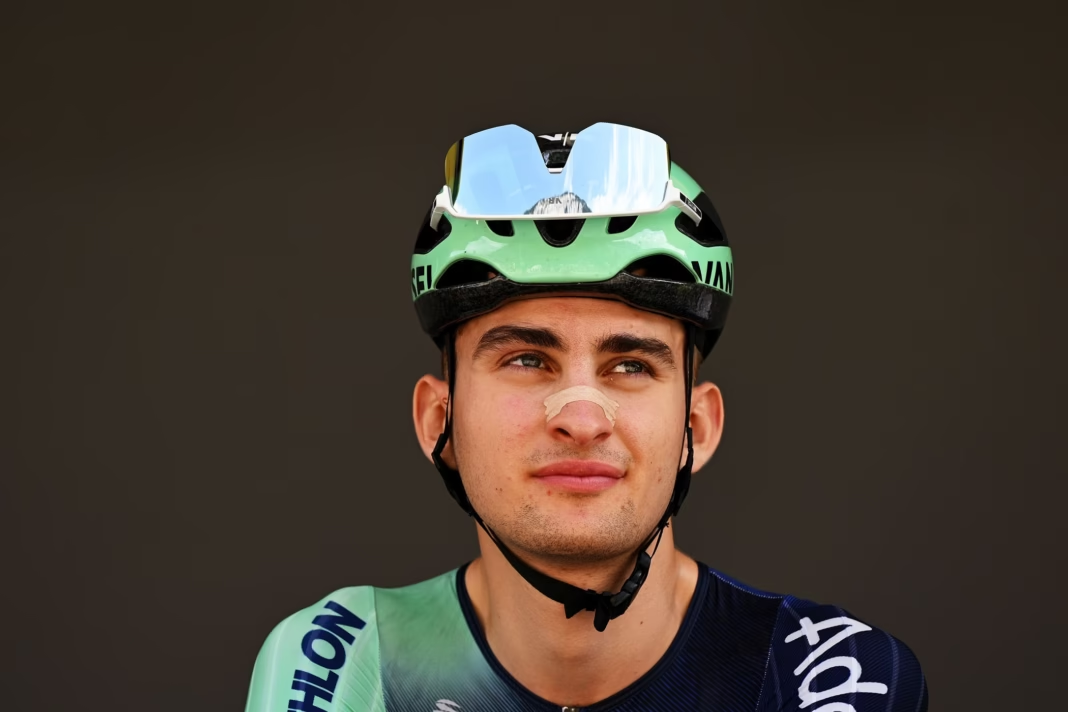
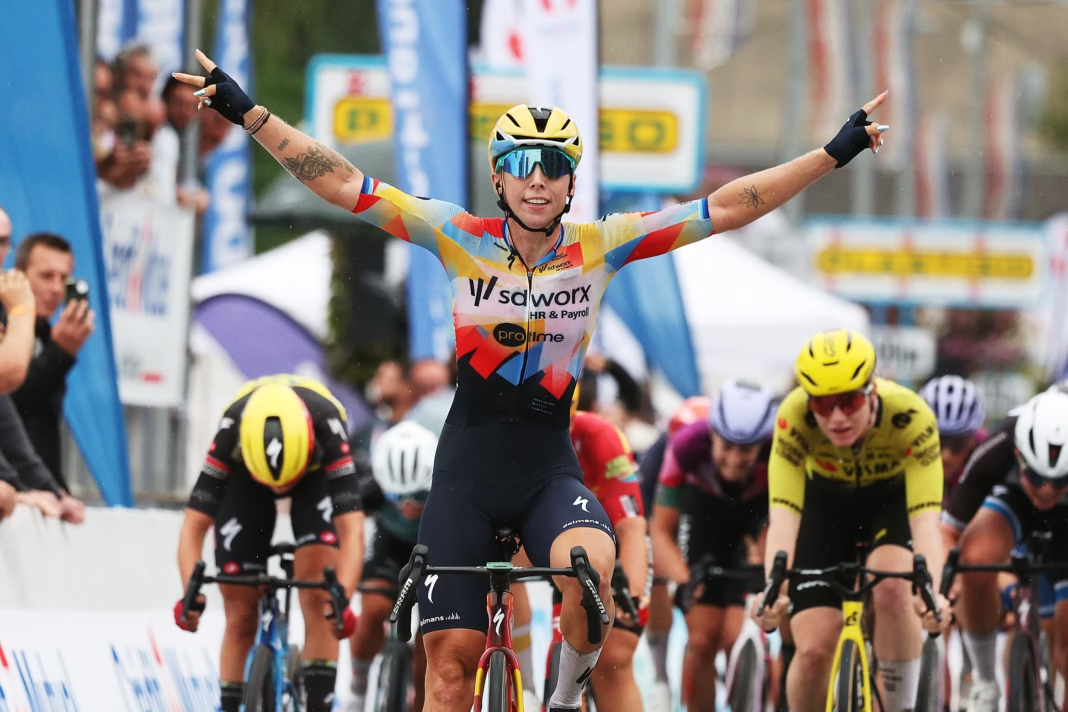
Borgo takes another Bahrain podium
Borgo completed the podium for Bahrain Victorious.
The Italian finished third at 10 seconds, winning the sprint from the reduced chase after Aranburu and Kamp had gone clear. It was another sign of his growing reliability in hard one-day races, where surviving the selection is only half the job.
Borgo had to come through a race that had been difficult all day: the early climbs, the fast run through the final circuits, the late Ty Marrec selection and the stop-start tactical finale. Third place was a strong return from a race that rewarded riders with both resilience and speed.
Herzog’s fourth place was also notable, given his presence in the day’s breakaway. He had spent a long time up the road, survived being caught on the final climb and still had enough left to finish near the front. Berckmoes took fifth, with Lapeira, Grégoire, Delettre, Pluimers and Vendrame following.
It was a result sheet that reflected the nature of the race: puncheurs, reduced-sprint specialists and riders who could absorb repeated late accelerations.
French teams close but not winning
The French teams were visible throughout the finale, but could not keep the win at home through a French rider.
Cofidis got the victory through Aranburu, and Teuns finished just behind the main top-10 group at 13 seconds, giving the team a strong collective finish. Decathlon CMA CGM placed Lapeira sixth, while Groupama-FDJ United had Grégoire seventh. Tudor Pro Cycling Team placed Delettre eighth, and TotalEnergies had Pluimers ninth.
There were options everywhere, but no French rider was able to turn the race into a home victory. Grégoire had the punch for a course like this, Lapeira had the speed for a reduced group, and Cosnefroy was still close enough to matter in the final selection, but Aranburu’s timing removed the need to beat them all in a sprint.
That is what made the move so effective. It did not require Cofidis to control every rival. It required Aranburu to attack before those rivals could use their own strengths.
Magnier’s abandon leaves Soudal Quick-Step frustrated
Soudal Quick-Step’s race was defined by Magnier’s crash.
Magnier had already shown in 2026 that he could handle tough one-day finishes and fast reduced sprints. On a shorter, punchier Bretagne Classic route, he looked like one of the riders most likely to benefit if the race came back together after Ty Marrec.
Instead, his race ended before the final selection had even formed.
That had consequences beyond one rider’s result. Without Magnier, the final chase lacked one of its most obvious sprint focal points. It also changed the pressure on other teams, because Soudal Quick-Step no longer had the same reason to commit riders to a full chase behind the late attacks.
The result was a finale with more freedom for opportunists. Aranburu took advantage.
Aranburu gives Cofidis a major WorldTour win
For Cofidis, this was a major result.
The team had ridden the race with options, first through Thomas in the breakaway and then through Aranburu and Teuns in the decisive group. Aranburu’s win gave them a WorldTour Classic victory in France, in one of the country’s most established one-day races.
It also suited the profile of the rider. Aranburu is not a pure sprinter and not a climber in the traditional sense. His best wins often come from awkward finales, small groups and moments where he can use a punchy acceleration before others have fully committed.
Plouay was ideal for that. The climbs removed the pure sprinters, the final selection created hesitation, and the run-in gave him just enough road to make the attack count.
He did not need a large gap. He needed the first 100 metres of separation, then the strength to hold it.
Ty Marrec proves decisive on return
The return of Ty Marrec to the Bretagne Classic finale did exactly what the organisers would have wanted.
It did not create a solo winner directly over the summit, but it made the race selective enough for the winning move to happen afterwards. The climb brought the breakaway back, split the peloton, and left a front group small enough that tactics became decisive.
That is often how the best Plouay finales work. The climbs do not always decide the winner by themselves. They decide who is still eligible to win. Once the group is reduced, the final kilometres become a contest of timing, nerve and fatigue.
Aranburu won that contest.
The route may have been shorter than recent editions, but the final circuit made it feel sharp and selective. A 228-kilometre race with more than 3,600 metres of climbing does not need to be 260 kilometres to be hard. The final group proved that.
A classic won by timing rather than sprint speed
The 2026 Bretagne Classic looked, for long stretches, like it could still fall to a reduced sprint. The early breakaway was strong, but not allowed to disappear. The peloton brought it back on the final climb. The front group contained enough fast riders to suggest a sprint was possible.
Aranburu changed the outcome by refusing to wait for that sprint.
That was the difference between winning and becoming one more rider in a messy reduced finish. Kamp, Borgo, Berckmoes, Lapeira, Grégoire and Vendrame all had reasons to believe they could finish quickly from the group. Aranburu made sure the race was not decided on those terms.
His attack was late enough to be sustainable and early enough to surprise. Behind him, the group had too many riders with too many conflicting interests. Kamp chased, but not quickly enough to close. The others arrived too late.
Plouay rewarded the rider who read the final kilometre best.
Bretagne Classic 2026 result
| Position | Rider | Team | Time/gap |
|---|---|---|---|
| 1 | Alex Aranburu | Cofidis | 5:21:13 |
| 2 | Alexander Kamp | Uno-X Mobility | +0:04 |
| 3 | Alessandro Borgo | Bahrain Victorious | +0:10 |
| 4 | Emil Herzog | Red Bull-BORA-hansgrohe | +0:11 |
| 5 | Jenno Berckmoes | Lotto-Intermarché | +0:11 |
| 6 | Paul Lapeira | Decathlon CMA CGM | +0:11 |
| 7 | Rick Pluimers | Tudor Pro Cycling Team | +0:11 |
| 8 | Alexandre Delettre | TotalEnergies | +0:11 |
| 9 | Andrea Vendrame | Team Jayco AlUla | +0:11 |
| 10 | Romain Grégoire | Groupama-FDJ United | +0:12 |
Main photo credit: Getty

