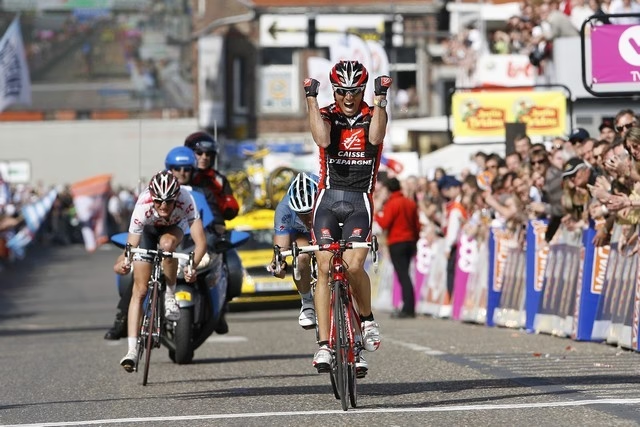
Caisse d’Epargne sat between two much longer chapters in the same Spanish team’s history, taking over as principal sponsor in 2006 before Movistar arrived in 2011. The name lasted five seasons, but the organisation had already won multiple Tours de France under Banesto and would continue from 2011 as Movistar. Its results in the intervening years were substantial: Óscar Pereiro became the recognised winner of the 2006 Tour, Alejandro Valverde won the 2009 Vuelta a España, and the team topped the 2008 UCI ProTour ranking.
The sponsor changed the jersey far more than it changed the team. Eusebio Unzué remained central to a structure that valued stage-racing depth, experienced support riders and a calendar extending well beyond the Tour. Its best riders could win Ardennes Classics, week-long stage races and Grand Tour stages, giving the team several ways to justify its sponsorship throughout a season.
The period also included serious disruption. Pereiro’s Tour title followed Floyd Landis’s disqualification rather than the normal Paris podium sequence. The team lost Isaac Gálvez in a fatal track-racing crash, and Valverde’s suspension over Operación Puerto removed its most successful rider in 2010. The five-year period was successful, but it was never a simple run of victories.
From Reynolds and Banesto to a new jersey
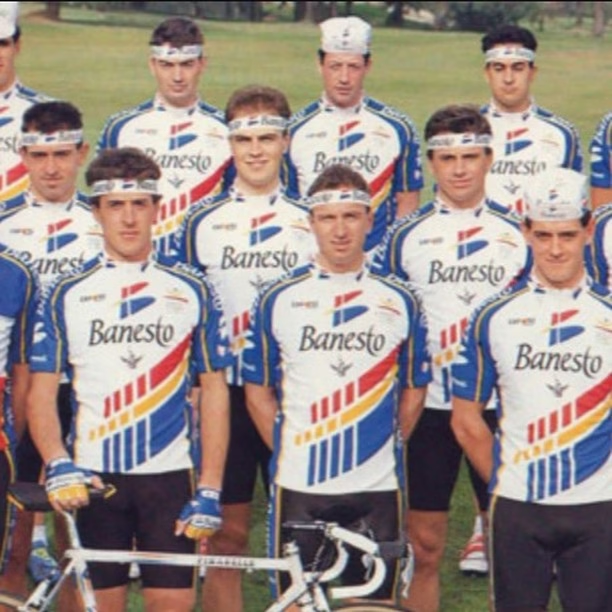
The team’s origins go back to the Reynolds professional squad in 1980. Under José Miguel Echávarri and later with Unzué, it grew into a leading Grand Tour organisation. Banesto’s sponsorship from 1990 to 2003 coincided with Miguel Induráin’s five successive Tour de France victories between 1991 and 1995, creating a reputation that survived long after the team stopped wearing the bank’s colours.
Illes Balears became the main sponsor for 2004 and 2005, with Banesto initially remaining in the name. The organisation continued to produce major stage-race performances and develop younger riders. Vladimir Karpets won the Tour’s young rider classification in 2004, while experienced riders including José Vicente García Acosta, Iván Gutiérrez and Pablo Lastras provided continuity through changes of sponsor.
The Caisse d’Epargne arrangement arrived in 2006 as professional cycling adapted to the UCI ProTour era. The squad already had the staff, infrastructure and race experience to compete immediately. It did not need to recruit an entirely new team around the sponsor’s arrival, and the continuity of management helped retain the established approach to stage races.
The handover makes more sense when viewed as part of one continuous organisation. ProCyclingUK’s Banesto team history covers the earlier Tour-winning years in detail. Caisse d’Epargne inherited that stage-racing experience, but its defining rider would be very different from Miguel Induráin: Valverde was faster, more explosive and capable of winning the biggest one-day races as well as stage races.
Pereiro’s Tour and Valverde’s first Classics breakthrough
The first season was memorable for two quite different reasons. Alejandro Valverde won La Flèche Wallonne and Liège-Bastogne-Liège in 2006, confirming that he could beat the strongest one-day specialists on steep finishes and demanding Ardennes terrain. He also led the UCI ProTour individual ranking, a reward for his ability to score across several race formats.
At the Tour de France, Óscar Pereiro rode himself back into overall contention through the long breakaway to Montélimar on Stage 13, gaining almost half an hour. He then defended that position through the mountains and final time trial, reaching Paris second overall behind Floyd Landis.
Landis subsequently tested positive for synthetic testosterone, and the case proceeded through a lengthy disciplinary and appeals process. His disqualification resulted in Pereiro being recognised as the 2006 Tour winner. The delayed decision meant Pereiro did not receive the conventional winning celebration in Paris, but it remains a Tour victory in the team’s official record. It also illustrates why the era’s results sometimes need explanation beyond the final classification.
The 2006 season contained a tragedy alongside those victories. Isaac Gálvez, an accomplished track and road sprinter, died following a crash at the Six Days of Ghent in November. The team’s own historical account places his death alongside its sporting successes, an acknowledgement of how abruptly a triumphant year could change. Other riders contributed important wins, including Joan Horrach’s Giro d’Italia stage victory.
 Photo Credit: Luc Claessen
A squad built to win across the calendar
The 2007 results showed the breadth of Caisse d’Epargne’s roster. Vladimir Karpets won the Volta a Catalunya and Tour de Suisse, Iván Gutiérrez took the Benelux Tour, and the team accumulated 29 victories. Joaquim Rodríguez won the Spanish road race championship, while the Vuelta a España teams classification reflected the depth of the squad over three weeks.
The composition was unusually useful for the different demands of stage racing. Luis León Sánchez brought time-trialling and the ability to finish off an attack; Karpets and Vladimir Efimkin were strong stage racers; José Joaquín Rojas provided speed; and riders such as Imanol Erviti and García Acosta could protect a leader for hours. Several could switch from supporting duties to chasing their own results when the race allowed it.
This flexibility distinguished the team from squads that devoted almost every race to one protected leader. A rider could win a national championship or a stage race while Valverde prepared for the Ardennes or a Grand Tour. The ranking points from those results accumulated throughout the year and kept the sponsor visible across different countries and types of racing.
The 2008 season brought the most complete expression of that approach. Valverde won Liège-Bastogne-Liège, the Clásica San Sebastián, the Critérium du Dauphiné and the Spanish road title. Gutiérrez won the Benelux Tour, while Rodríguez, Erviti and David Arroyo all delivered significant individual results. Caisse d’Epargne finished first in the UCI ProTour team classification, with Valverde also taking the individual title.
2008 was the peak of the Caisse d’Epargne era
Valverde opened the 2008 Tour de France with victory in Plumelec and the yellow jersey. At Super-Besse he crossed the line second behind Riccardo Riccò, but was later credited with the stage after Riccò’s results were disqualified. Luis León Sánchez then added another Tour stage win at Aurillac, giving Caisse d’Epargne several high-profile moments in the opening half of the race.
Valverde was an exceptional rider on short, steep climbs and difficult one-day courses, but the demands of a three-week Tour general classification were different. Sustained high-mountain efforts and time trials left less room to exploit his acceleration. He could lead the race and win stages without necessarily being its strongest overall contender by the third week.
That distinction mattered for the team’s tactics. Rather than reserve every rider for the final Tour classification, Caisse d’Epargne could pursue stages and smaller races while still supporting Valverde’s ambitions. The same approach produced wins at the Vuelta later in 2008, including stages for Erviti and Arroyo, and helped explain the breadth of the team’s season.
A strong ranking year did not remove the pressure to win a Grand Tour outright with Valverde. He had been a leading contender for several seasons, and his versatility made expectations particularly high. The 2009 Vuelta would finally give him a race where his form, the route and the team’s control came together across all three weeks.
The 2009 Vuelta victory and its complications
Valverde won the 2009 Vuelta a España ahead of Samuel Sánchez and Cadel Evans. He protected his advantage through the closing mountain stages rather than trying to win every difficult day. The team used its experienced riders to position him, manage threats and avoid wasting energy when rivals could be allowed a small advantage without endangering the overall lead.
It was a significant result for a rider who had already won major Classics and shorter stage races but had not previously finished a Grand Tour in first place. The victory also continued the organisation’s Spanish Grand Tour tradition, which stretched back through its earlier sponsors. Valverde’s ability to limit losses and make measured tactical decisions proved as important as the explosive attacks for which he was already known.
Luis León Sánchez won Paris-Nice in 2009, and Valverde again won the Dauphiné. The team finished second in the world rankings, demonstrating that its season was not built solely around the Vuelta. The two leaders offered different strengths, while the supporting roster continued to deliver across national championships and stages.
The unresolved Operación Puerto case still followed Valverde during that Vuelta victory. His 2009 result remains in the record, but the legal and sporting process would finally remove him from competition during Caisse d’Epargne’s last season.
2010, Arroyo and the transition to Movistar
In May 2010, the Court of Arbitration for Sport imposed a worldwide two-year suspension on Valverde, backdated to 1 January 2010. His pre-2010 results, including the 2009 Vuelta, were allowed to stand, while his 2010 results were removed. Caisse d’Epargne therefore lost its most successful rider while already preparing for the departure of its principal sponsor at the end of the season.
David Arroyo gave the team its standout Grand Tour performance of the year. A huge time gain by a breakaway reshaped the Giro d’Italia classification, and Arroyo took the pink jersey before defending it through demanding mountain stages. Ivan Basso eventually won the race, with Arroyo second overall. The performance showed how a dependable stage racer could seize an unexpected opportunity and then withstand sustained pressure from stronger favourites.
The team still won major races without Valverde. Luis León Sánchez took the Clásica San Sebastián, Iván Gutiérrez won the Spanish road championship, and David López and Imanol Erviti each won a Vuelta stage. Those results did not equal the scale of 2008, but they showed that the squad’s structure and competitive depth remained intact.
Telefónica took over sponsorship through the Movistar name for 2011. Unzué and the existing organisation continued, making the transition a change of commercial identity rather than the birth of a replacement team. The Caisse d’Epargne era had lasted five seasons, during which the squad won a Tour, a Vuelta, major Classics and the 2008 ProTour team title.
The Caisse d’Epargne record only really makes sense as part of the longer team history. Banesto’s Tours established the organisation’s reputation, Caisse d’Epargne proved it could win with a broader group of leaders, and Movistar inherited the same long-running Spanish structure. The five-year period included sporting success, serious personal loss and an anti-doping sanction that disrupted its final season, all of which belong in the account of what the team achieved.