
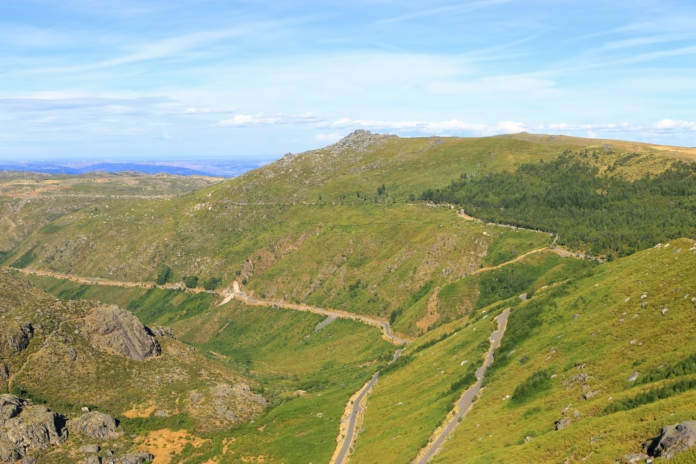
Serra da Estrela is the obvious place to go if you want serious mountain riding in mainland Portugal. Torre rises to 1,993 metres, the country’s highest mainland point, but reaching the summit is only part of the appeal. Long approaches, exposed high roads, granite villages and substantial changes in elevation make the whole range worth exploring rather than treating it as one famous climb.
It is also a very different cycling trip from the Portugal many riders know. Lisbon and the Algarve are easier to associate with sunshine, coastal roads and winter riding. Serra da Estrela sits high enough for proper mountain weather, long descents and days where elevation gain matters much more than the distance shown on the route file.
The relative lack of cycling tourism is another attraction. There are no endless lines of riders heading towards one famous col and less infrastructure aimed specifically at cyclists than in Mallorca, Girona or the Alps. For riders who enjoy planning their own routes and being fairly self-sufficient, that gives Serra da Estrela much of its character.

Serra da Estrela cycling at a glance
- Highest point: Torre, 1,993 metres
- Best bases: Covilhã, Seia and Manteigas
- Riding style: Long road climbs, mountain loops and high exposed roads
- Bike: Road bike with low climbing gears
- Tyres: 28mm or 30mm is a sensible all-round choice
- Best period: Late spring through autumn
- Winter: High roads can be affected by snow and poor weather
- Biggest planning issue: Conditions near Torre can be very different from the valleys
- Ideal trip length: Three to five riding days
Our Cycling in the rest of Europe guide places Serra da Estrela among the continent’s proper mountain destinations rather than treating it as another Portuguese warm-weather base. That is the most useful way to think about it.
Torre is the obvious first target
Every first visit eventually revolves around Torre.
At 1,993 metres, it is the highest point in mainland Portugal and can be reached by road from several directions. That immediately gives the mountain more variety than a simple out-and-back ascent where every cyclist follows exactly the same road.
From Covilhã, the climb begins almost from the town and develops into roughly 20km of sustained mountain riding depending on where you choose to start measuring. More than 1,000 metres of elevation separate the lower town from Torre, and the character of the ride changes steadily as the buildings disappear and the road moves towards Penhas da Saúde and the high plateau.
The average numbers do not tell the whole story. There are steeper sections capable of disrupting a comfortable rhythm, flatter moments where you can recover and long exposed stretches where wind can become as important as gradient.
That variation makes the climb more interesting than a uniform hour at six per cent.
Torre is also deeply connected to Portuguese professional cycling, repeatedly appearing as one of the defining mountain finishes of the Volta a Portugal. Riding it gives some context to why it has such a prominent place in the country’s racing culture. A climb that looks manageable when reduced to an average gradient feels very different once the entire approach has been ridden at race pace.

Covilhã is the easiest base for a first mountain trip
Covilhã makes a strong case as the most practical base if you are visiting Serra da Estrela for the first time.
The town sits directly beneath the eastern side of the mountain, allowing you to begin climbing almost immediately. That is useful on a cycling holiday because there is no need to load bikes into a car before every serious ride.
It is also large enough to make the rest of the trip straightforward. Accommodation, supermarkets, restaurants and ordinary town services are easier to find than from a smaller mountain base, while the ability to ride from the door means those conveniences do not come at the cost of lengthy transfers.
The compromise is the first and last part of the ride. Covilhã is a working town rather than a cycling resort, so some kilometres inevitably feel urban before the mountain takes over.
For most riders, that is a reasonable price for the flexibility.
You can make Torre the major ride, spend another day exploring lower roads around the eastern side and still have somewhere practical to recover afterwards. If the weather turns poor at altitude, it is also much easier to devise a shorter alternative from Covilhã than from accommodation perched high on the mountain.
Seia gives you a completely different route to Torre
Seia sits on the western side and makes the same summit feel like a different climb.
The approach is longer than the direct ascent from Covilhã and works well for riders who prefer sustained climbing with a less abrupt transition from town to high mountain. It also passes through a different side of the Serra da Estrela landscape, making it worth riding even if you have already reached Torre from the east.
This is one reason a multi-day visit works so well.
Simply ticking Torre off once misses much of the point. The roads leading towards it from Covilhã, Seia and Manteigas are distinct enough that riding the summit more than once does not feel like repeating the same route.
Seia can also make a better base if you want access to the western foothills and surrounding villages rather than spending every ride on the highest roads.
For a longer trip, splitting nights between Covilhã and Seia is possible, although changing hotels is not essential. The range is compact enough that a well-planned loop can expose you to both sides without turning the holiday into a series of transfers.

Manteigas is the most atmospheric cycling base
Manteigas offers something different again.
The town sits deep in the Zêzere valley, surrounded by steep mountain slopes, and feels much more immediately enclosed by the Serra da Estrela landscape. For a rider who wants to wake up in the mountains rather than below them, it is difficult to beat.
The riding reflects that location.
There is very little completely flat terrain once you leave town. Serious routes begin climbing quickly, and the road towards the higher mountain passes through the glacial valley before eventually connecting with the roads towards Torre.
That makes Manteigas excellent for a climbing-focused stay but less forgiving if you want a genuine recovery day.
The advantage is atmosphere. You are not spending the first half-hour of every ride escaping an urban area. The mountains are already around you, and routes can be constructed in several directions without feeling as though Torre is the only worthwhile objective.
It is the base I would favour for a trip where the riding matters more than having every possible service within walking distance.
The climb from Manteigas is worth treating as a major day
Riding from Manteigas towards Torre gives perhaps the strongest sense of being inside the mountain range.
The route climbs from the valley floor through increasingly dramatic terrain before reaching the exposed upper roads. It is a sustained ascent rather than a collection of short hills, so pacing matters from the beginning.
This is also where the difference between Serra da Estrela and coastal Portugal becomes particularly obvious.
A rider can leave Manteigas in warm sunshine and spend a long time climbing before reaching open terrain where temperature, cloud and wind feel completely different. The descent reverses that process, often with a substantial temperature difference between the summit and town.
Do not judge the required clothing from what you can see outside the hotel.
A light jacket or gilet weighs very little compared with the discomfort of descending for half an hour while cold.

The gradients reward patience more than aggression
Serra da Estrela’s main road climbs are difficult because they are long.
There are steep sections, but the range is not defined by endless 15 or 20 per cent walls. The more common challenge is finding a comfortable climbing rhythm and maintaining it while the elevation continues to accumulate.
That makes the riding accessible to a reasonably fit road cyclist provided the gearing is sensible.
It also makes poor pacing very easy.
A rider accustomed to shorter British climbs can begin a six or seven per cent section at a power that feels completely sustainable for the first five minutes. Twenty minutes later the road is still climbing. After 45 minutes, the same effort starts looking rather optimistic.
Ride the first major ascent more conservatively than you think necessary.
There is little reward for reaching the halfway point with impressive numbers if the second half becomes an exercise in survival.
Gearing matters more than having a lightweight race setup
A normal road bike is ideal for Serra da Estrela.
What matters is how it is set up.
A compact chainset with a wide cassette is far more useful than preserving gearing designed for flat British racing. Even riders with good climbing fitness benefit from a properly low gear when the route contains several major ascents rather than one isolated effort.
That becomes even more valuable on the third or fourth day of the trip. A gear that feels unnecessarily easy when fresh can become exactly what you want after 1,800 metres of climbing.
Tyres around 28mm or 30mm make sense for most riders. They provide enough comfort for variable mountain surfaces without compromising the feel of a road bike.
The more important mechanical preparation is basic maintenance.
Check brake pads, tyres and drivetrain before travelling. Long mountain descents expose equipment problems much more quickly than local rides at home. If your brake pads are already close to replacement, change them before the trip rather than deciding they probably have another week left.

Long descents deserve as much thought as the climbs
It is easy to plan a Serra da Estrela trip entirely around climbing.
The descents are where unfamiliarity can create more problems.
Mountain roads may contain rough patches, gravel, animals, unexpected vehicles or corners that tighten more sharply than they appear from above. A road that feels deserted while climbing can also encourage riders to assume nothing will be coming in the opposite direction.
That is not a useful assumption.
Stay on your side of the road, leave a margin into blind bends and remember that a 40-minute descent involves far more opportunities for one bad decision than the short hills many UK riders normally encounter.
Cold is another factor. Climbing generates enough heat that a summit can feel comfortable for several minutes, particularly if you stop for food or photographs. Once the descent begins and road speed increases, the calculation changes quickly.
Put the jacket on before you are cold.
Mountain weather is Serra da Estrela’s biggest planning variable
Portugal’s reputation as a warm-weather destination can cause riders to underestimate Serra da Estrela.
Conditions near Torre can bear little resemblance to those in Covilhã or Seia. Cloud, strong wind and much lower temperatures are all possible once the road reaches the exposed high ground.
That makes weather forecasting part of route planning rather than an afterthought.
Check conditions at altitude, not simply the forecast for the town where you are staying. If the upper mountain looks poor, move the major climb to another day.
This is where a three or four-day stay becomes far better than arriving with one fixed morning allocated to Torre. Flexibility gives you a much better chance of actually enjoying the mountain rather than forcing the ride in conditions that remove the view and make the descent unpleasant.
Serra da Estrela rewards riders willing to alter the plan.

Winter is very different from the Algarve
Anyone thinking of Portugal primarily as a winter cycling destination needs to separate Serra da Estrela from the coast.
The highest roads experience real winter conditions. Snow, ice and road restrictions can all affect access, and Torre is associated with Portugal’s ski area rather than year-round warm-weather riding.
A winter cycling trip designed around guaranteed mountain roads therefore makes little sense.
For that kind of holiday, lower Portugal is the better choice. Our cyclist’s guide to Lisbon and the Sintra coast shows how different the riding can be only a few hours away, with coastal routes and shorter climbs providing a far more realistic cool-season option.
Serra da Estrela is strongest once the high roads become dependable.
Late spring through autumn provides the most useful window, although summer creates another problem lower down: heat.
Summer means balancing hot valleys with cool summits
A clear summer day can produce two competing clothing problems.
The climb may begin in substantial heat. Lower roads around Covilhã, Seia or the surrounding valleys can feel very warm, particularly if you start after the morning has already developed.
Higher up, the exposed summit can be markedly cooler.
Starting early helps deal with both. You complete more of the climbing before the hottest part of the day while still leaving enough daylight if the route takes longer than expected.
Hydration needs to be planned around riding time rather than simply distance.
A 70km mountain route can take much longer than 70km at home. Two bottles disappear quickly when much of that time is spent climbing in direct sun.
Know where you can refill before leaving rather than assuming a café will appear at exactly the right moment.
Serra da Estrela is quiet, but it is not traffic-free
One of the pleasures of riding here is how quickly roads can become quiet once you move away from the main towns.
That does not mean they belong to cyclists.
The roads towards Torre are normal mountain roads used by local traffic, tourists, coaches and motorcycles. Popular viewpoints can become noticeably busier on summer weekends, particularly around the summit.
Early morning remains the best option if you want the quietest experience.
A rear light is sensible, especially if cloud reduces visibility higher on the mountain. Predictable road positioning is more useful than riding permanently on the extreme edge of the tarmac.
Quiet roads also create their own risk because riders become relaxed.
You can go several minutes without seeing another vehicle and then meet one immediately around a blind bend. The absence of constant traffic should make the ride more enjoyable, not change basic descending discipline.
Food and water require more planning than in a major cycling resort
Serra da Estrela has towns, cafés and places to buy food, but they are not distributed according to the needs of visiting cyclists.
That distinction matters.
In Mallorca or Girona, popular routes often pass stops that have effectively become part of cycling culture. In Serra da Estrela, a café is simply a café and may not appear exactly when your route planner suggests you need one.
Carry enough food to complete the ride if the planned stop does not work.
That does not mean loading the bike like an expedition. It means not beginning a four-hour mountain ride with one gel because there appears to be a village at kilometre 55.
The same applies to water.
Start major summer rides with two bottles and know where a refill is realistically available. The high roads are not the place to discover that a marked business is closed.
Self-sufficiency here is modest but important.
A first three-day trip should not begin with the hardest possible ride
The obvious temptation is to arrive, assemble the bike and head directly for Torre.
There is a better way to structure the trip.
Use the first day for a medium-length ride on lower roads. Add enough climbing to understand the gearing, road surfaces and local temperature without committing to the largest ascent immediately.
Make day two the major Torre ride if the forecast is good.
Starting from Covilhã gives the most direct first experience. From Manteigas, the day becomes more about moving through the heart of the mountains. From Seia, the longer western approach creates a different endurance challenge.
Day three should then be deliberately easier.
That does not mean completely flat, because finding flat terrain from a mountain base can be difficult. It means reducing the duration and elevation rather than automatically planning another 2,000-metre day.
If poor weather is forecast for day two, reverse the order. The summit ride should happen when the mountain makes sense, not because a spreadsheet says Tuesday is Torre day.
Four or five days let you experience more than one side of the mountain
Adding another couple of days makes the region substantially more rewarding.
After climbing Torre from one direction, use another day to approach from a different side. The change in scenery and road character is enough that it does not feel like simply repeating the same summit.
Manteigas deserves time even if you are based elsewhere, particularly because the Zêzere valley gives the range a very different visual character from the open roads around the plateau.
Lower routes through the surrounding villages can then provide the contrast.
This is also where Serra da Estrela begins to work as more than a training destination. Stopping in towns and mountain villages makes the trip feel less like repeatedly riding an interval route and more like actually travelling through central Portugal by bike.
The Travel & Riding Abroad hub has more ideas built around the same approach: choosing a region where the riding is strong enough to justify bringing the bike without requiring every day of the holiday to follow the same format.
You do not need to ride Torre every day
The prominence of the highest point can distort route planning.
Torre should be ridden. It should not necessarily dominate every ride.
The lower mountain contains plenty of climbing, and avoiding the summit can make it easier to build a loop rather than another long out-and-back. It also gives you alternatives when cloud or wind makes the upper mountain unattractive.
This is particularly useful on a recovery day.
From Covilhã, stay on lower roads and explore the surrounding terrain rather than climbing until the legs stop working. From Manteigas, a shorter valley-based route still gives you mountain scenery without another full summit effort. From Seia, the western foothills provide options that do not require returning to Torre.
A good mountain holiday is not measured by how many times you can make the elevation total exceed 2,000 metres.
Arriving at the final day still wanting to ride is usually a better sign.
-
 Photo Credit: quentinphotographiebe
 -
 Photo Credit: Getty
Serra da Estrela suits riders who like planning their own trips
This is not a cycling resort in the Mallorca sense.
There is less infrastructure organised specifically around road cyclists, fewer obvious group rides and less expectation that every hotel will understand the needs of somebody arriving with a bike box.
For some riders, that is a disadvantage.
For others, it is one of the best reasons to come.
Serra da Estrela still feels like a mountain region that happens to contain excellent cycling rather than somewhere shaped around visiting cyclists. The towns exist for reasons other than servicing training camps, and the roads do not feel as though every bend has been photographed a thousand times from the same angle.
The trade-off is responsibility.
Download the route. Carry the basic spares needed to repair a puncture. Know the weather. Have enough food. Do not assume every planned stop will be open.
None of that requires expedition-level planning, but it makes a significant difference to how relaxed the riding feels once you are on the mountain.
Serra da Estrela shows a different side of cycling in Portugal
A Lisbon and Sintra cycling trip works because the riding can be fitted around a wider city break. Serra da Estrela asks for more commitment.
Here the mountain becomes the reason for the trip.
Torre gives the region an obvious headline climb, but concentrating only on the summit undersells it. The eastern ascent from Covilhã, western approach from Seia and valley roads around Manteigas provide enough variation for several serious days without needing to repeat exactly the same route.
The quieter character matters too. You are unlikely to find the polished cycling ecosystem of the Alps or Mallorca, but you are also less likely to spend an entire climb passing groups of riders heading towards the same café.
Serra da Estrela is better suited to the cyclist who wants to choose a road, understand the terrain and make the day work independently.
Torre may be the reason you first put the region on the list. The roads around it are the reason to stay longer.

