The UCI Cyclo-cross World Cup is a season-long competition, not a single championship weekend. Riders score points for their finishing places at individual events and the highest cumulative total wins the overall title. The elite men and women follow the same headline scoring scale: forty points for a victory, thirty for second and twenty-five for third. The 2026–27 series has twelve rounds, beginning in Ostrava on 27 November 2026 and finishing at Hoogerheide on 24 January 2027.
The World Cup is the most internationally prominent regular series in cyclocross, but it is not the sport’s only competition. The Superprestige and X²O series have their own classifications, while HG Cross events do not share one points-based overall title. The UCI World Championships, meanwhile, award rainbow jerseys at a separate event rather than deciding the World Cup standings.
The distinction is important for newcomers because a rider can win the rainbow jersey, lead the World Cup and occupy a different place in the broader UCI ranking. Those achievements are related but not interchangeable. Each reflects a different set of races and rules.
How World Cup points are awarded
Points go to the first twenty-five finishers in an elite World Cup race. First place earns 40, second 30, third 25, fourth 22 and fifth 21. Thereafter the scale falls by one point per place from sixth through twenty-fifth, where a rider receives one point. A rider outside the top twenty-five adds nothing to their World Cup tally in that round.
The difference between winning and finishing second is ten points. That can be decisive when the leading riders race frequently, but it does not mean a rider with the most individual victories automatically claims the overall title. Two second places are worth sixty points, for example, whereas a victory and a tenth place add up to fifty-six. A consistent rider can therefore lead a more spectacular but less regular rival.
Missing an event is especially costly. A rider who sits out a weekend collects nothing while an opponent can earn up to forty points. That makes participation plans central to the overall competition. A road specialist who enters a handful of World Cups can still win important individual races, but a rider focusing on the full winter calendar has a substantial advantage in a season-long contest.
When riders finish on equal points, the official regulations prioritise the number of first places, then second places and subsequent placings for which points were awarded. If the tie remains unresolved, the result at the most recent event is used. That prevents a tie from being decided by an arbitrary alphabetical or national-order rule.
| Place | World Cup points |
|---|---|
| 1st | 40 |
| 2nd | 30 |
| 3rd | 25 |
| 4th | 22 |
| 5th | 21 |
| 10th | 16 |
| 15th | 11 |
| 20th | 6 |
| 25th | 1 |
The 2026–27 calendar and its twelve venues
The series starts with a Czech double-header: Ostrava on Friday 27 November and Tábor on Sunday 29 November. Glasgow follows on 13 December, bringing a World Cup round to Britain at Kelvingrove Park. The calendar then moves to Antwerp and Koksijde on 19 and 20 December, Gavere on Boxing Day, Namur on 27 December and Besançon on 29 December.
The new year brings Zonhoven on Sunday 3 January 2027, Benidorm on 17 January and a final double-header at Hamme on 23 January and Hoogerheide on 24 January. Every round features elite men and elite women. Junior and under-23 races are included at selected venues rather than universally across the calendar.
That sequence matters as much as the list of famous locations. Antwerp and Koksijde come on consecutive days, then Gavere, Namur and Besançon produce three more World Cups within four days after Christmas. Riders must recover, travel and adapt equipment quickly. The champion may be somebody who avoids a disastrous result when tired, rather than simply the rider who sets the fastest laps at the most suitable course.
Glasgow’s return is particularly significant for British riders and spectators. The competition last visited Britain for a World Cup event at Milton Keynes in 2014. A high-profile Scottish round offers a rare chance to see the same international field without travelling to the traditional Belgian or Dutch venues, although it will be every bit as important in the points table as those long-established stops.
| Date | Round |
|---|---|
| 27 Nov 2026 | Ostrava |
| 29 Nov 2026 | Tábor |
| 13 Dec 2026 | Glasgow |
| 19 Dec 2026 | Antwerp |
| 20 Dec 2026 | Koksijde |
| 26 Dec 2026 | Gavere |
| 27 Dec 2026 | Namur |
| 29 Dec 2026 | Besançon |
| 3 Jan 2027 | Zonhoven |
| 17 Jan 2027 | Benidorm |
| 23 Jan 2027 | Hamme |
| 24 Jan 2027 | Hoogerheide |
What the race format looks like on television
A World Cup cyclocross race is held on a short, repeated circuit with grass, mud, sand, paved connections and obstacles such as steps, planks or steep banks. Officials determine the number of laps so that the race comes close to the target duration. Elite men generally race for around one hour and elite women for about fifty minutes, but the kilometre distance differs widely between courses.
That is why comparing average speed between World Cups can be misleading. A slow lap in deep sand might indicate an unusually demanding circuit rather than poor form. The rider who wins often does so by running obstacles efficiently, using the best tyre setup and repeatedly accelerating out of turns without mistakes.
The opening lap is tactically important. Riders at the front can choose clean lines through obstacles, while those behind may lose time when somebody stops or slips. A short gap can grow rapidly if narrow passages make overtaking difficult. The race is not necessarily settled then, but recovering positions can require more energy than holding them.
Equipment pits allow a rider to switch to a prepared bike, particularly useful in mud when a clogged drivetrain or tyres can become a problem. Teams decide whether a fresh machine is worth the seconds lost entering and leaving the pit. In dry races riders may change less often. The best strategy depends on the surface and on how far the nearest rival is behind.
World Cup, World Championships and UCI rankings
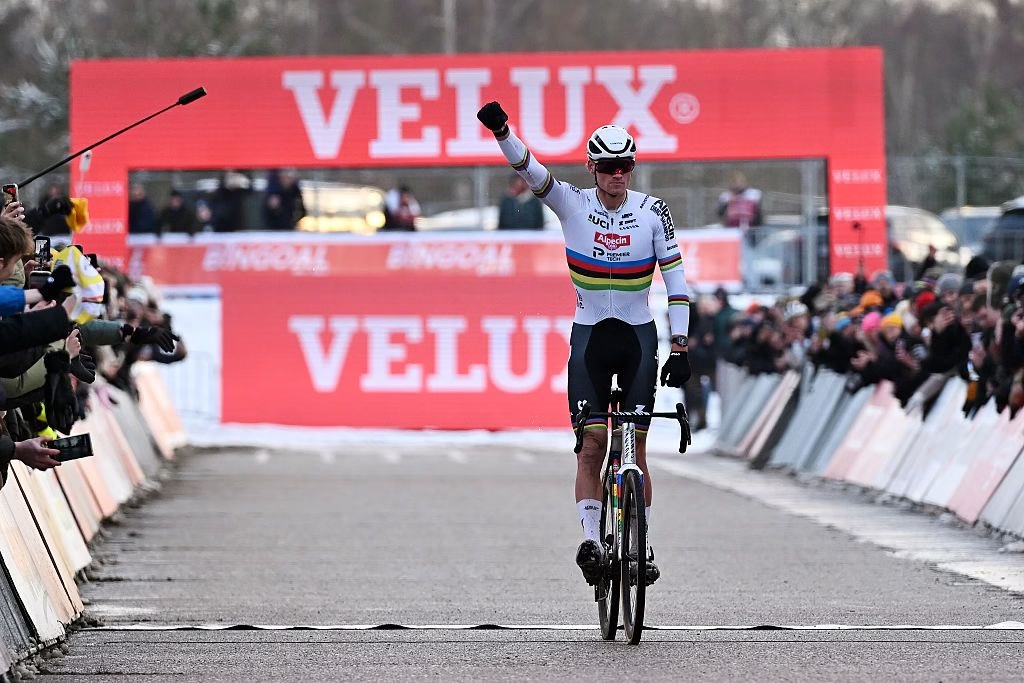
The World Cup decides an overall season champion through accumulated results. The World Championships award the rainbow jersey for winning an individual championship race. A rider can hold both titles, but a World Cup victory does not automatically make that person world champion.
The UCI cyclocross ranking is separate again. It includes eligible races outside the World Cup, with its own points and rolling calculation. A rider can therefore be high in the UCI ranking because of excellent Superprestige and other international results, while still having relatively few World Cup points if their programme has included only a couple of those rounds.
This distinction also affects television graphics. The leader’s jersey in a series, a national champion’s jersey and the rainbow jersey all communicate different achievements. When the World Cup standings appear during a race, they refer to the total of that series rather than an overall ranking of every result the rider has achieved.
The choice of surface makes every event distinct. Koksijde’s dunes demand running strength and an efficient technique in deep sand, while Namur is better known for wooded climbs and technical descents. Benidorm can produce much faster racing, and Zonhoven asks riders to cope with steep sand banks. A championship leader who looks dominant in one of those conditions may struggle on another, which is why an overall points total is a better measure of season-long performance than a single venue’s result.
The compact festive schedule places unusual demands on equipment and support staff. Mechanics have to prepare bikes for different tyres, levels of mud and gradients as the teams move rapidly between Belgian and French venues. There is little time to recover from illness or a heavy fall before the next round. A rider who can salvage sixth place on a bad day, worth twenty points, may protect an overall lead better than one who abandons while trying to recover a lost position.
Who won the last World Cup, and what to watch next
Mathieu van der Poel won the elite men’s World Cup overall in 2025–26, while Lucinda Brand won the elite women’s competition. Both recorded eight individual World Cup wins. Their performances demonstrate that dominating particular rounds and scoring consistently across the winter can go together, but the competition does not require a rider to win eight times.
For the 2026–27 campaign, viewers should track three facts as the winter progresses: who has entered each round, how the leading riders’ points totals change and which course suits their strengths. A rider who leads the classification may still be a less convincing favourite for the next individual race than an opponent who thrives on its sand or steep banks.
The final weekend at Hamme and Hoogerheide offers up to eighty points across two days. If the leaders remain close, those races can overturn an advantage built through much of the season. Conversely, a rider who has collected enough points early might arrive there with the overall classification almost settled. Either way, both rounds matter to the history of the individual race.
For more background, ProCyclingUK’s beginner’s guide to cyclocross explains the bicycles, race format and rules. The 2026–27 cyclocross calendar places the World Cup alongside other major winter events.