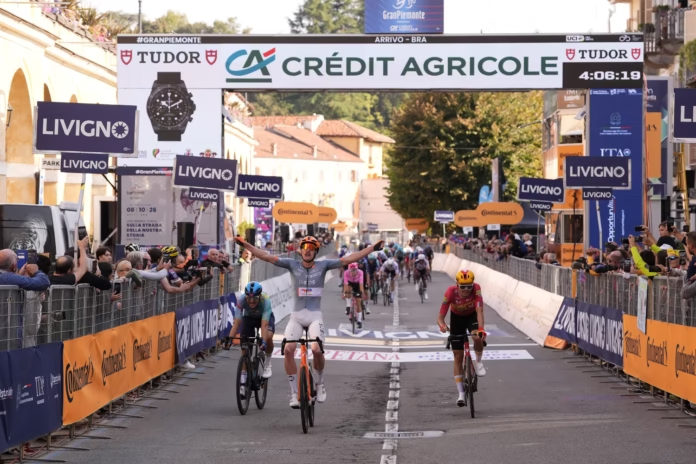
Dorian Godon won the 2026 Gran Piemonte for Netcompany INEOS, with Anthon Charmig finishing second and Alberto Bettiol taking third. The result came after a race that changed character several times, from an early nine-rider break gaining ground to a long, organised chase and then a sharply contested finale around La Morra.
The decisive shape formed in the closing 54 kilometres. The break was progressively reduced, the peloton accelerated with 30 kilometres remaining, and a succession of attacks followed on La Morra. Jhonatan Narváez and Isaac Del Toro were central to that late movement, but Del Toro was dropped four kilometres from the finish before Godon took the win.
Charmig and Bettiol completed a podium that emerged from a race of steady reduction rather than one clearly documented winning attack. Lukas Nerurkar finished fourth, followed by Quinten Hermans and Fred Wright, while Afonso Eulálio, Michael Matthews, Jhonatan Narváez and Pau Martí completed the top 10.
How it unfolded
Nine riders established a small break with 170 kilometres remaining, giving the race its first defined contest. The move had enough distance to become significant without yet threatening to decide the result, and by 154 kilometres to go the gap between the escape and the peloton was increasing.
That early expansion was reversed by 129 kilometres remaining, when the gap began to decrease. Bahrain Victorious was then pulling in the peloton, and the first clear signs of the break losing substance followed soon afterwards. Aless De Bock was caught with 123 kilometres still to race, reducing the number of riders able to maintain the escape.
The race was beginning to narrow at both ends. Manuele Tarozzi was struggling to hold the peloton with 110 kilometres remaining, while Bahrain Victorious and UAE Team Emirates – XRG were involved in the work at the front. The early break still existed, but its advantage was no longer developing in the same direction.
The chase takes control of the middle phase
UAE Team Emirates – XRG and Team Jayco AlUla were pulling in the peloton at 62 kilometres to go. Their presence showed that the pursuit had become a sustained feature of the race, rather than a short reaction to the original escape. The remaining breakaway riders were being brought within reach as the main field continued to organise.
The break reached La Morra with 54 kilometres remaining. The climb is listed as 7.1 kilometres at 3.8 per cent, and it provided the first clear late-race setting for the separation that followed. Daan Dijkman was pulling in the peloton at the same point, linking the chase to the approach of the closing sequence.
Two kilometres later, Luc Wirtgen, Davide Ballerini and Germán Darío Gómez were caught by the peloton. The catch removed three more riders from the front of the race and left the original nine-rider move increasingly fragmented. The escape was no longer one coherent block moving towards the finale.
Dijkman finished his turn at the front with 50 kilometres remaining. Brieuc Rolland was caught four kilometres later, and Valentin Ferron and Santiago Umba were brought back at 39 kilometres to go. Those successive catches mattered because they kept removing the riders who had carried the break into the latter part of the race, leaving the peloton with fewer escapees to bring under control.
La Morra turns pursuit into selection
An acceleration in the peloton came with 30 kilometres remaining. It was the clearest transition from a straightforward chase to a selection battle, following the gradual dismantling of the break and the earlier work by Bahrain Victorious, UAE Team Emirates – XRG and Team Jayco AlUla.
The peloton reached La Morra again with 20 kilometres to go. Gijs Leemreize attacked on the climb, while riders at the back of the peloton began to drop. The movement at the front and the losses behind showed that the climb was changing the size of the race in both directions.
Alexandre Trouvain accelerated one kilometre later, keeping the pressure on after Leemreize’s move. Multiple attacks followed at 18 kilometres remaining, making the climb a sustained period of acceleration rather than a single isolated effort. The race had moved beyond the question of whether the break would survive and into a contest over which riders could remain in the first group.
Narváez then accelerated for UAE Team Emirates – XRG, followed almost immediately by an attack from Del Toro. Their moves added a second layer to the late action. Leemreize and Trouvain had already forced movement, and the two UAE Team Emirates – XRG riders then ensured that the front of the race remained unsettled as the finish approached.
The sequence did not produce a stable escape. Instead, the race continued to change through repeated accelerations, with riders trying to create or reinforce a move while others attempted to close it. That pattern helps explain why the final podium was not identified by one early attack, even though the late climbing had already reduced the field.
Del Toro remains active, then fades
With 14 kilometres remaining, NSN Cycling Team and Team Jayco AlUla were pulling in the peloton. Their work kept the front group within reach and limited the chance that the preceding attacks would settle the result immediately. The response also maintained pressure on the riders who had moved clear or were attempting to do so.
Del Toro accelerated again at 13 kilometres to go. His second move extended his involvement in the decisive phase, but it also coincided with Finn Fisher-Black struggling to hold on. The repeated changes of pace were reducing the number of riders able to remain with the front of the race.
Five kilometres from the finish, the gap between the first group and the peloton was decreasing. The closing kilometres therefore remained open to a reshuffle, with the chasers still reducing the distance rather than conceding the result to the riders ahead.
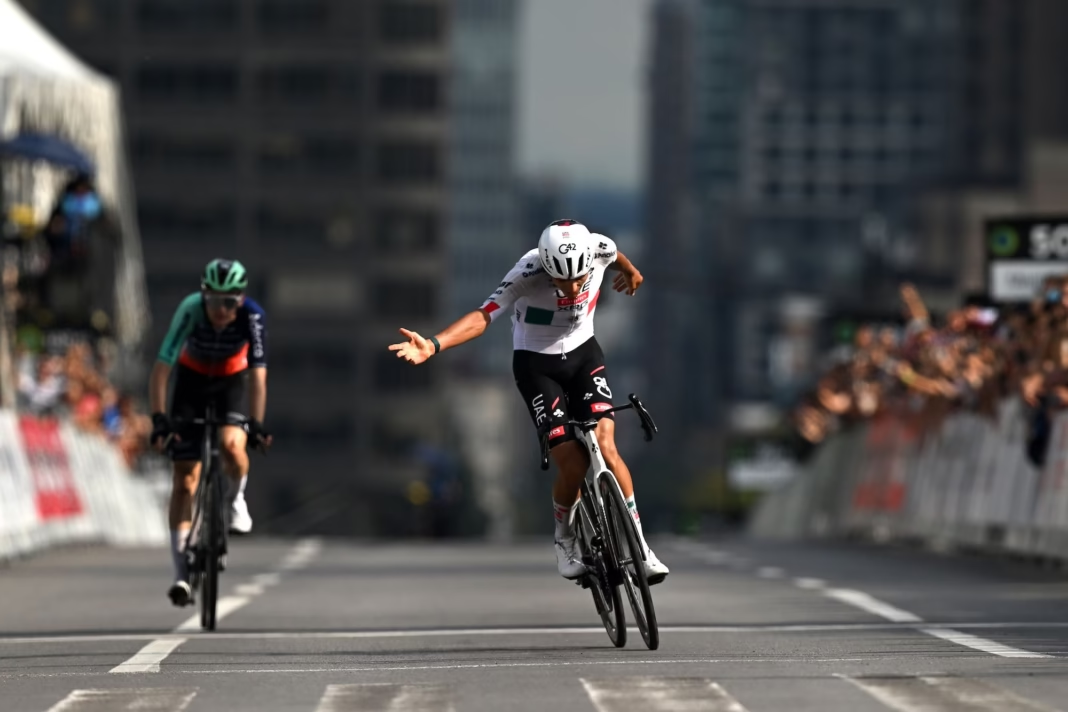
Del Toro was dropped with four kilometres remaining. His attacks had been among the most prominent features of the final climb, but his removal from the leading contest changed the balance again just before the finish. The rider responsible for the latest repeated accelerations was no longer able to continue at the head of the race.
Godon emerges from the final reduction
Godon’s victory followed that sequence of attacks, catches and drops. The event record does not attach a specific winning attack to him, so the clearest reading is that he was the rider who remained in front when the late selection had finished changing shape. The finish confirms that he converted that position into the race win.
Charmig came through for second place and Bettiol finished third. Their positions gave the outcome a clear hierarchy after the unstable final phase: Godon took the victory, Charmig was next across the line and Bettiol completed the podium.
The final stages had removed several possible contenders without producing one documented move that settled every place. Leemreize and Trouvain attacked on La Morra, Narváez and Del Toro followed with further acceleration, and Del Toro later dropped back. Godon’s result was therefore the consequence of emerging from a process of selection that continued almost to the finish.
Why the winning order held
Godon won because the race was steadily reduced before the final kilometres and because he was the rider left at the front when the late attacks failed to establish a lasting alternative. The original break had first gained ground, then lost riders and finally disappeared into the pursuit, while the peloton itself was thinned by the climb and the repeated accelerations.
Charmig and Bettiol occupied the next two places after negotiating the same narrowing contest. Their podium finishes came after the break had been dismantled and the late front group had been repeatedly disturbed. Nerurkar finished fourth, with Hermans fifth and Wright sixth.
Eulálio was seventh, Matthews eighth, Narváez ninth and Martí 10th. Narváez’s place in that final order came after his acceleration on La Morra, while Del Toro’s late drop illustrated how quickly a rider could move from the centre of the action to outside the leading contest.
The 2026 Gran Piemonte was thus decided by progression rather than one isolated incident. A nine-rider break established the early pattern, the chase reversed its advantage, and a succession of late attacks on La Morra transformed the race into a reduced contest. Godon was the rider who held first place when that sequence was complete, with Charmig and Bettiol joining him on the podium.
Gran Piemonte 2026 Result
| Pos. | Rider | Team / nation | Time / gap |
|---|---|---|---|
| 1 | Dorian Godon | Netcompany INEOS | 4:06:19 |
| 2 | Anthon Charmig | Uno-X Mobility | +0:00 |
| 3 | Alberto Bettiol | XDS Astana Team | +0:00 |
| 4 | Lukas Nerurkar | EF Education-EasyPost | +0:02 |
| 5 | Quinten Hermans | Pinarello-Q36.5 Pro Cycling Team | +0:02 |
| 6 | Fred Wright | Pinarello-Q36.5 Pro Cycling Team | +0:02 |
| 7 | Afonso Eulálio | Bahrain Victorious | +0:02 |
| 8 | Michael Matthews | Team Jayco AlUla | +0:02 |
| 9 | Jhonatan Narváez | UAE Team Emirates XRG | +0:02 |
| 10 | Pau Martí | NSN Cycling Team | +0:02 |