
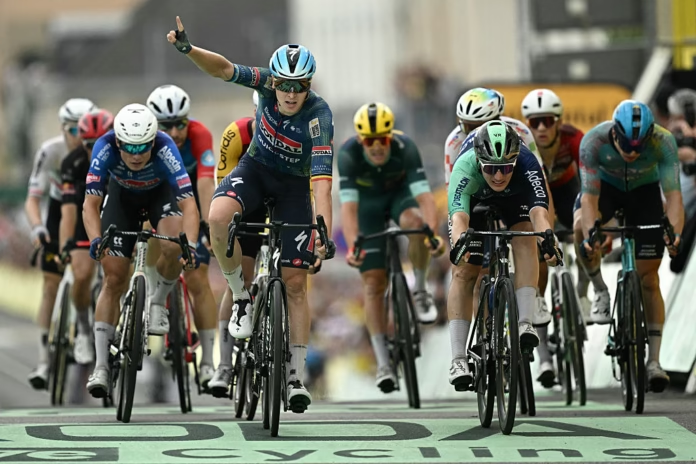
Tadej Pogačar retained the yellow jersey after stage 12 of the 2026 Tour de France, with the leading general classification riders finishing together on the crash-hit sprint stage into Chalon-sur-Saône.
Tim Merlier won the stage ahead of Olav Kooij and Jasper Philipsen, completing a hat-trick of victories after his earlier successes in Bordeaux and Bergerac.
The full race story is covered in our Tour de France 2026 stage 12 report and results.
The main GC gaps remain unchanged. Pogačar leads Jonas Vingegaard by 3:36, with Remco Evenepoel third at 4:06.
Mads Pedersen kept the green jersey after winning the sprint from the peloton at the intermediate point and finishing ninth in Chalon-sur-Saône. His advantage over Biniam Girmay is now 40 points, but Merlier and Philipsen both moved substantially closer.
Juan Ayuso remains in the white jersey, while Pogačar continues to lead the mountains classification. Vingegaard will wear the polka dots on stage 13 because Pogačar cannot wear two jerseys at the same time.
 Photo Credit: Getty
Tour de France 2026 jerseys after stage 12
| Classification | Leader after stage 12 | Advantage |
|---|---|---|
| Yellow jersey | Tadej Pogačar | 3:36 over Jonas Vingegaard |
| Green jersey | Mads Pedersen | 40 points over Biniam Girmay |
| Polka-dot jersey | Tadej Pogačar | 15 points over Jonas Vingegaard |
| White jersey | Juan Ayuso | 13 seconds over Paul Seixas |
| Team classification | Lidl-Trek | 24:18 over UAE Team Emirates-XRG |
| Stage 12 combativity | Baptiste Veistroffer | Most combative rider |
Pogačar leads both the yellow and polka-dot competitions.
The distinction between leading and wearing a jersey is explained in our guide to why Jonas Vingegaard is wearing the polka-dot jersey when Pogačar leads the mountains classification.
Lidl-Trek continues to control three separate standings through Pedersen’s green jersey, Ayuso’s white jersey and its lead in the team classification.
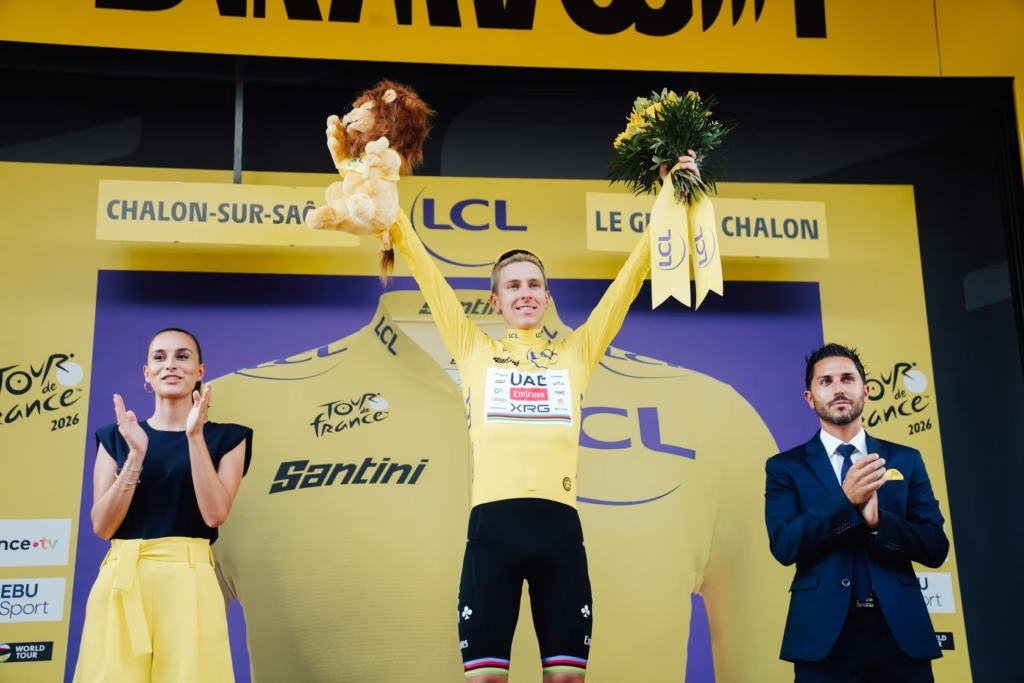 Photo Credit: A.S.O./Thomas Maheux
Tour de France 2026 general classification after stage 12
| Position | Rider | Team | Time or gap |
|---|---|---|---|
| 1 | Tadej Pogačar | UAE Team Emirates-XRG | 43:04:01 |
| 2 | Jonas Vingegaard | Team Visma-Lease a Bike | +3:36 |
| 3 | Remco Evenepoel | Red Bull-Bora-Hansgrohe | +4:06 |
| 4 | Juan Ayuso | Lidl-Trek | +4:22 |
| 5 | Paul Seixas | Decathlon CMA CGM | +4:35 |
| 6 | Florian Lipowitz | Red Bull-Bora-Hansgrohe | +4:44 |
| 7 | Isaac del Toro | UAE Team Emirates-XRG | +5:08 |
| 8 | Mattias Skjelmose | Lidl-Trek | +5:45 |
| 9 | Lenny Martinez | Bahrain Victorious | +6:34 |
| 10 | Tom Pidcock | Pinarello-Q36.5 Pro Cycling Team | +11:49 |
Pogačar avoids trouble before the Vosges
Stage 12 was never expected to change the Tour’s main hierarchy, but the final kilometres still contained significant risk.
The run towards Chalon-sur-Saône was fast, technical and crowded. A major crash inside the final few hundred metres brought down Fernando Gaviria, Søren Wærenskjold and several other riders.
Pogačar, Vingegaard, Evenepoel and the other leading GC contenders had already positioned themselves safely enough to avoid meaningful time losses.
That allowed the gaps created at Le Lioran to remain intact.
Pogačar continues to lead Vingegaard by 3:36 after gaining 54 seconds on his principal rival during stage 10. Evenepoel is another 30 seconds behind Vingegaard, keeping the fight for second place much closer than the contest for yellow.
The wider implications of Pogačar’s Le Lioran attack are covered in our analysis of whether the Tour de France is already over.
Stage 13 now takes the race into more difficult terrain, with the Col des Croix and Ballon d’Alsace appearing before the descending finish in Belfort.
Our Tour de France 2026 stage 13 preview explains why the breakaway is favoured but the GC riders cannot afford to switch off.
Vingegaard holds second with Evenepoel close behind
Vingegaard remains second overall at 3:36.
A bike change during stage 12 briefly required Victor Campenaerts to wait, but the incident occurred far enough from the finish to cause no lasting difficulty.
The larger concern comes from the mountain stages ahead.
Vingegaard needs to regain more than three and a half minutes from Pogačar, while also protecting a 30-second advantage over Evenepoel.
That creates a difficult balance.
A conservative approach may protect second place but do little to challenge Pogačar. A major attack risks exposing Vingegaard if Evenepoel, Ayuso or the other podium contenders remain close enough to counter.
Stage 13 may offer only limited scope for a sustained GC move because the Ballon d’Alsace summit comes almost 30km from Belfort.
The stage to Le Markstein should provide a much clearer opportunity.
Evenepoel remains within range of second place
Evenepoel stays third at 4:06, only 30 seconds behind Vingegaard.
The Belgian has been unable to follow Pogačar’s strongest mountain accelerations, but he remains firmly in the podium contest.
Red Bull-Bora-Hansgrohe also has Florian Lipowitz in sixth at 4:44.
That gives the team two riders inside the top six and creates tactical possibilities during the coming mountain block.
Lipowitz can attack without immediately forcing Evenepoel to respond. Rival teams must decide whether to chase him or allow Red Bull to place a rider further up the road.
Evenepoel’s time-trial strength could still become important later in the Tour, but the immediate priority is surviving the Vosges without losing contact with Vingegaard.
The white jersey fight remains extremely close
Ayuso continues to lead the young rider classification by only 13 seconds over Seixas.
Del Toro is another 33 seconds behind Seixas, placing the top three within 46 seconds.
Those gaps are small enough to disappear through one mountain acceleration, a minor positioning error or bonus seconds.
Ayuso sits fourth overall at 4:22, meaning his white jersey battle is also part of the podium contest.
Seixas is fifth at 4:35, while Del Toro occupies seventh at 5:08.
All three finished safely on stage 12.
The next three stages should provide a much clearer test of their relative climbing strength. Ayuso has the advantage but must also manage Lidl-Trek’s wider tactical responsibilities around Skjelmose and Pedersen.
Del Toro faces a different problem. UAE’s first priority is protecting Pogačar, which may restrict the freedom he receives to chase Seixas or Ayuso.
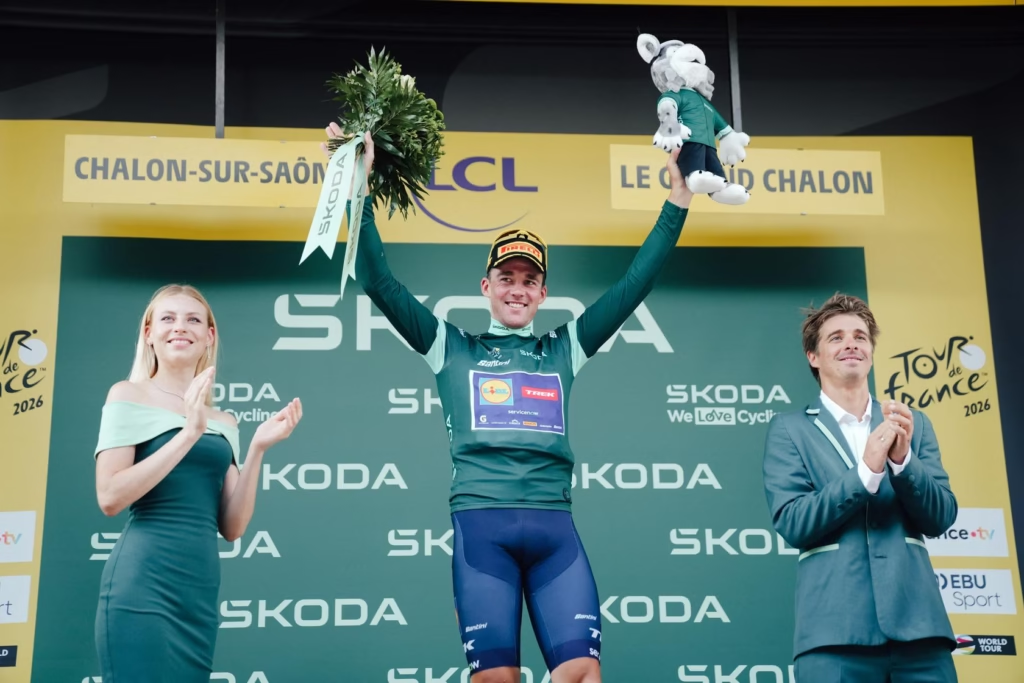 Photo Credit: A.S.O./Thomas Maheux
Tour de France 2026 green jersey standings after stage 12
| Position | Rider | Team | Points |
|---|---|---|---|
| 1 | Mads Pedersen | Lidl-Trek | 357 |
| 2 | Biniam Girmay | NSN Cycling Team | 317 |
| 3 | Jasper Philipsen | Alpecin-Premier Tech | 311 |
| 4 | Tim Merlier | Soudal Quick-Step | 307 |
| 5 | Max Kanter | XDS Astana Team | 239 |
| 6 | Olav Kooij | Decathlon CMA CGM | 210 |
| 7 | Søren Wærenskjold | Uno-X Mobility | 159 |
| 8 | Anthony Turgis | TotalEnergies | 129 |
| 9 | Milan Fretin | Cofidis | 117 |
| 10 | Tadej Pogačar | UAE Team Emirates-XRG | 107 |
Pedersen keeps green but the top four close up
Pedersen’s lead fell from 43 points after stage 11 to 40 after stage 12.
That represents a good defensive outcome from a day on which Merlier, Philipsen and Girmay all finished ahead of him.
Pedersen strengthened his position at the intermediate sprint in Decize.
Baptiste Veistroffer collected the maximum 25 points from the breakaway, but Pedersen won the sprint from the peloton ahead of Philipsen, Merlier, Kanter and Girmay.
Lidl-Trek then attempted to make the second half of the stage difficult enough to prevent a conventional sprint.
Mathias Vacek, Daan Hoole and several teammates were involved in attacks during the closing kilometres, while Pedersen also tried to follow moves rather than waiting passively for the finish.
The attacks were eventually closed, leaving Pedersen to contest the bunch sprint. His ninth place added enough points to take his total to 357.
The wider case for his green jersey challenge is covered in our analysis of whether Mads Pedersen can win the Tour de France points classification.
Merlier moves within 50 points
Merlier made the largest gain among the leading green jersey contenders.
His stage victory provided 70 points, while he also collected points at the intermediate sprint.
That moved him from fourth on 225 points after stage 11 to 307 after stage 12.
He is now only four points behind Philipsen and ten behind Girmay.
Merlier remains 50 points behind Pedersen, but his third victory confirms that he is the fastest pure sprinter at this Tour.
The problem is the route.
Stage 12 may have been the final conventional sprint opportunity before Paris. Merlier can collect points at intermediate sprints, but Pedersen and Girmay are better equipped to score on rolling or hilly terrain.
Merlier therefore needed the victory in Chalon-sur-Saône to keep the competition alive.
He delivered it.
Girmay remains Pedersen’s closest challenger
Girmay finished fourth on stage 12 and remains second in the points classification.
His total of 317 places him 40 points behind Pedersen.
The Eritrean continues to benefit from consistency rather than stage victories. He has regularly finished near the front without matching Merlier’s top speed.
That durability should help during the harder stages.
Girmay can survive rolling terrain better than most pure sprinters and may be able to contest intermediate sprints after Merlier and Philipsen have already been dropped.
Pedersen still holds the advantage, but Girmay remains the rider best placed to use the terrain rather than relying entirely on Paris.
Philipsen closes the gap without finding a victory
Philipsen finished third for the second consecutive stage.
He now has 311 points, six behind Girmay and four ahead of Merlier.
Alpecin-Premier Tech again delivered Philipsen near the front, but Merlier came from behind with greater speed.
The result continues a frustrating pattern.
Philipsen has remained involved in the main sprints and collected enough points to stay in the green jersey contest, but he has not converted those positions into a stage win.
Our analysis of what is going wrong for Jasper Philipsen at the Tour de France looks at the difference between reaching the final 200 metres in position and receiving a lead-out that produces the correct timing and momentum.
The four leading riders are separated by only 50 points.
Pedersen still has the strongest overall position because the upcoming terrain should suit him better than Merlier or Philipsen.
The contest is not finished.
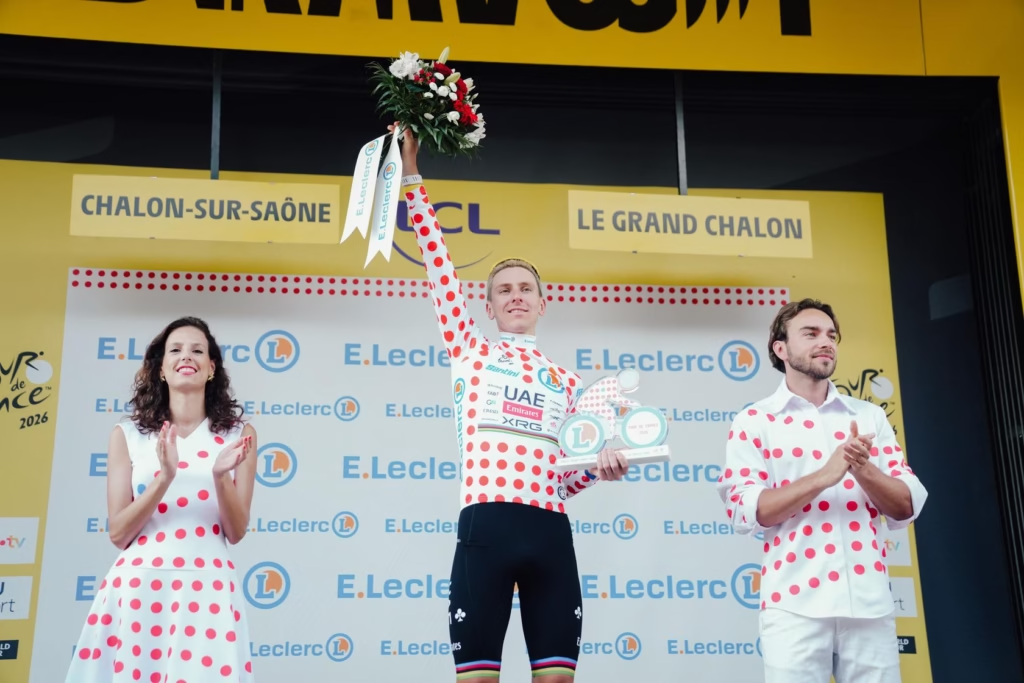 Photo Credit: A.S.O./Thomas Maheux
Tour de France 2026 mountains classification after stage 12
| Position | Rider | Team | Points |
|---|---|---|---|
| 1 | Tadej Pogačar | UAE Team Emirates-XRG | 42 |
| 2 | Jonas Vingegaard | Team Visma-Lease a Bike | 27 |
| 3 | Richard Carapaz | EF Education-EasyPost | 19 |
| 4 | Valentin Paret-Peintre | Soudal Quick-Step | 18 |
| 5 | Paul Seixas | Decathlon CMA CGM | 18 |
| 6 | Nicolas Prodhomme | Decathlon CMA CGM | 17 |
| 7 | Alex Baudin | EF Education-EasyPost | 16 |
| 8 | Lenny Martinez | Bahrain Victorious | 16 |
| 9 | Isaac del Toro | UAE Team Emirates-XRG | 14 |
| 10 | Florian Lipowitz | Red Bull-Bora-Hansgrohe | 12 |
Veistroffer takes the points but Pogačar keeps control
Stage 12 contained only three category-four climbs.
Veistroffer led over the Côte de Lanty and Côte de Cuzy, collecting one point on each ascent. He also remained involved long enough to secure the stage combativity award.
Those points were not enough to move him into the leading positions.
The third available point did not alter the top ten either.
Pogačar therefore remains on 42 points, 15 ahead of Vingegaard and 23 ahead of Carapaz.
The mountains competition is about to become significantly more valuable.
The Ballon d’Alsace on stage 13 is a category-one climb worth ten points. Stage 14 then contains several major Vosges ascents, giving riders in a breakaway the opportunity to move rapidly through the classification.
Pogačar may retain the lead through his GC performances, but Carapaz, Paret-Peintre and other breakaway specialists now have genuine opportunities to challenge.
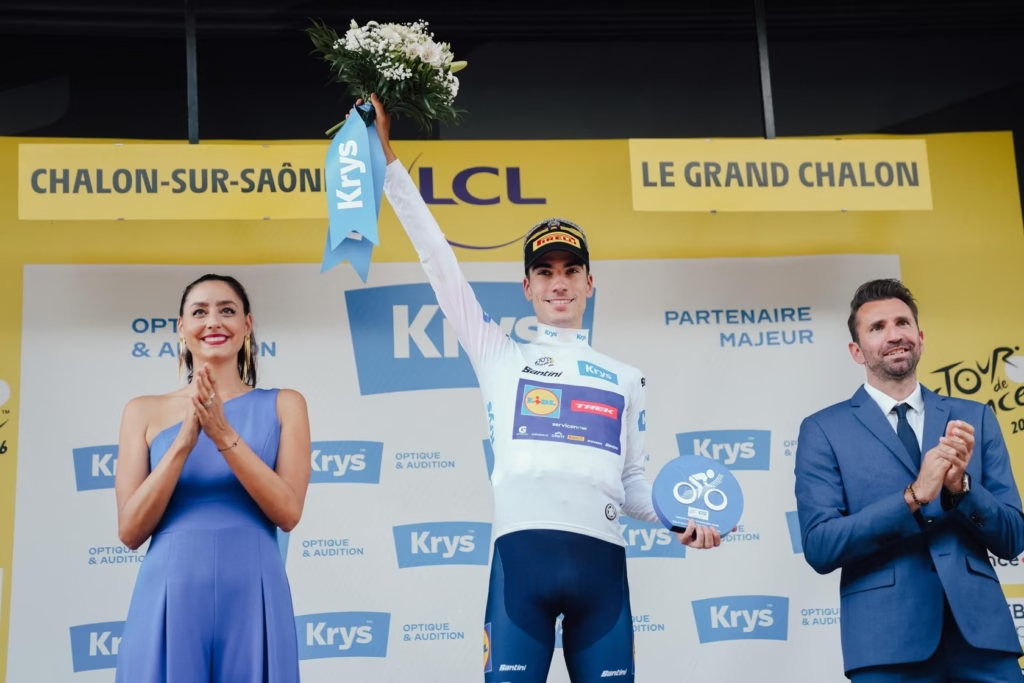 Photo Credit: A.S.O./Thomas Maheux
Tour de France 2026 white jersey standings after stage 12
| Position | Rider | Team | Time or gap |
|---|---|---|---|
| 1 | Juan Ayuso | Lidl-Trek | 43:08:23 |
| 2 | Paul Seixas | Decathlon CMA CGM | +0:13 |
| 3 | Isaac del Toro | UAE Team Emirates-XRG | +0:46 |
| 4 | Lenny Martinez | Bahrain Victorious | +2:12 |
| 5 | Davide Piganzoli | Team Visma-Lease a Bike | +9:16 |
| 6 | Ramses Debruyne | Alpecin-Premier Tech | +11:51 |
| 7 | Pablo Castrillo | Movistar Team | +16:10 |
| 8 | Mathias Vacek | Lidl-Trek | +48:57 |
| 9 | Quinn Simmons | Lidl-Trek | +1:04:49 |
| 10 | Antonio Tiberi | Bahrain Victorious | +1:09:10 |
Ayuso takes a narrow lead into the mountains
Ayuso has held the white jersey since stage 10, but his advantage remains fragile.
Thirteen seconds is almost nothing once the Tour reaches consecutive mountain stages.
Seixas has already shown that he can climb with the strongest riders for long periods. Del Toro remains close enough to return to the lead through one strong attack.
Martinez sits fourth at 2:12.
That is a more substantial deficit, but not one that removes him from the competition before a stage finishing close to his preferred terrain.
The white jersey contest could change on stage 13 even without a full GC battle. A late acceleration on the Ballon d’Alsace, a technical descent or a split in the final kilometres could produce enough separation to move the jersey.
Tour de France 2026 team classification after stage 12
| Position | Team | Time or gap |
|---|---|---|
| 1 | Lidl-Trek | 129:10:08 |
| 2 | UAE Team Emirates-XRG | +24:18 |
| 3 | Red Bull-Bora-Hansgrohe | +44:28 |
| 4 | Decathlon CMA CGM | +1:08:03 |
| 5 | Pinarello-Q36.5 Pro Cycling Team | +2:12:50 |
| 6 | TotalEnergies | +2:34:05 |
| 7 | Uno-X Mobility | +2:47:23 |
| 8 | Bahrain Victorious | +2:50:50 |
| 9 | Soudal Quick-Step | +2:54:34 |
| 10 | Tudor Pro Cycling Team | +3:13:29 |
Lidl-Trek retains its commanding team lead
Lidl-Trek continues to lead UAE Team Emirates-XRG by 24:18.
The team built most of that advantage through its successful stage 4 breakaway and has protected it through the opening mountain stages.
Ayuso and Skjelmose remain inside the overall top eight, while Pedersen leads the points classification.
That gives Lidl-Trek control of three competitions:
- Pedersen leads the green jersey classification
- Ayuso leads the white jersey classification
- Lidl-Trek leads the team classification
The stage 12 attacks involving Vacek, Hoole and the team’s other rouleurs also helped Lidl-Trek place enough riders near the front to avoid losing time in the team standings.
The yellow helmets will remain with the team on stage 13.
Baptiste Veistroffer takes another combativity award
Veistroffer was named the most combative rider after spending much of stage 12 ahead of the peloton.
He attacked alone after approximately 27km and collected the full points at the intermediate sprint.
Damiano Caruso, Ewen Costiou and Matteo Vercher later joined him, but Veistroffer attacked again when the breakaway began to lose momentum.
He collected two mountains points and remained ahead until the final third of the stage.
His solo effort never looked likely to defeat the sprint teams, but it again provided Lotto Intermarché with visibility on a day dominated by teams with faster finishers.
Veistroffer will wear the red combativity number on stage 13.
Tour de France 2026 jersey wearers on stage 13
| Jersey or distinction | Rider or team wearing it |
|---|---|
| Yellow jersey | Tadej Pogačar |
| Green jersey | Mads Pedersen |
| Polka-dot jersey | Jonas Vingegaard |
| White jersey | Juan Ayuso |
| Team classification yellow helmets | Lidl-Trek |
| Stage 12 combativity number | Baptiste Veistroffer |
Vingegaard continues to wear the polka dots because Pogačar leads both the general and mountains classifications.
The polka-dot jersey still belongs to Pogačar in the official standings.
Our Tour de France jerseys explainer covers how each competition works and what happens when one rider leads more than one classification.
What could change on stage 13?
Stage 13 is much more open than the two sprint days that preceded it.
The 205.8km route from Dole to Belfort contains the category-three Col des Croix and category-one Ballon d’Alsace.
A breakaway is expected to contest the stage victory, but the mountains classification could change substantially.
Ten points are available on the Ballon d’Alsace, giving Carapaz, Paret-Peintre, Seixas, Prodhomme and Baudin a reason to enter the escape.
The white jersey could also come under pressure if Ayuso, Seixas or Del Toro struggles on the final climb.
A major yellow jersey attack is less likely because the summit comes almost 30km before the finish. That long descent and run towards Belfort may discourage Vingegaard from committing fully.
The GC teams still need to remain alert.
Stage 13 may be designed for the breakaway, but the narrow gaps behind Pogačar mean one acceleration, split or poorly timed mechanical could alter the podium and white jersey contests before the Tour reaches Le Markstein.

