

The 2026 Giro d’Italia continues on Wednesday, 20th May with stage 11 from Porcari to Chiavari, a route that looks like a transition day at first glance but carries enough climbing, technical roads and late tension to make it much harder than a standard sprint stage.
After Filippo Ganna won the stage 10 time trial in Massa, the race moves away from the pure power test and back into road-racing uncertainty. Stage 11 is not a summit finish, so the main general classification contenders are unlikely to make it a planned showdown. It is also far too difficult for the sprint teams to assume they will get a clean bunch finish.
For UK viewers, this is a late-morning-to-afternoon watch. The stage is expected to start at around 11:30am BST, with the finish expected at around 4:15pm BST. The key live window should begin from around 2:45pm BST, when the race enters the more demanding second half and begins the climbs through the Ligurian roads towards Chiavari.
When does Giro d’Italia 2026 stage 11 start?
Stage 11 takes place on Wednesday, 20th May.
The route runs from Porcari to Chiavari, with the stage expected to start at around 11:30am BST. The finish is expected at around 4:15pm BST, although the exact timing will depend on race speed, weather, breakaway composition and how hard the peloton rides through the late climbs.
For UK viewers, the early phase should be useful for seeing how the breakaway forms, but the most important racing is likely to come later. The decisive viewing window should begin from around 2:45pm BST, with the final hour expected to decide whether the stage goes to the breakaway, a reduced sprint or a late attacker.
How to watch Giro d’Italia 2026 stage 11 in the UK
UK viewers can watch the Giro d’Italia live through TNT Sports and HBO Max. HBO Max is the main streaming platform for live cycling coverage in the UK, while TNT Sports carries the race through its usual TV and subscription routes.
The official Giro race centre will also provide live timing, text updates and race information throughout the day. That can be particularly useful on a stage like this, where the breakaway gap and the number of sprinters surviving in the peloton may determine the final hour.
Free live streams are available in some territories, including Italy, Australia and Switzerland, but those services are territory-based. For UK viewers, TNT Sports and HBO Max remain the proper live coverage route.
What time should UK viewers tune in?
The best time to tune in is from around 2:45pm BST. That should bring the race towards the more selective part of the route, with the peloton moving through the climbs and descents that will decide whether the sprint teams can still control the day.
Anyone who wants to follow the full tactical shape should start earlier, from around 11:30am BST, when the stage begins and the breakaway attempts start. The opening kilometres may not look decisive on the profile, but the composition of the early move could decide the whole stage.
If a strong group of stage hunters goes clear and the sprint teams hesitate, the breakaway could become increasingly difficult to bring back once the road turns more complicated. If the move is weak, or if teams with fast finishers remain committed, the stage may stay controlled until the late climbs after Sestri Levante.
The final 40km are the essential watch. That is where Colla dei Scioli and Cogorno can break the rhythm, weaken the sprint teams and open the door for late attacks before the descent and flat finish into Chiavari.
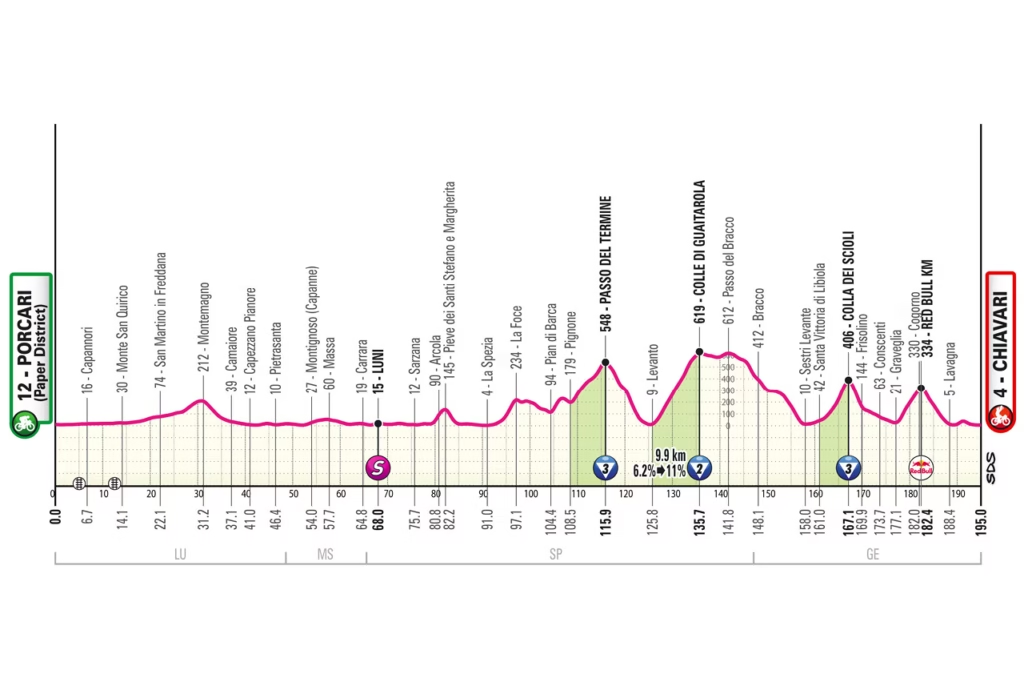
The stage 11 route
Stage 11 runs from Porcari to Chiavari, with a route that begins in Tuscany and moves towards the Ligurian coast. The first part is the least selective, giving the breakaway a chance to form before the road becomes more complicated later in the day.
The race should settle once it reaches the coastal roads, but that does not mean the stage is easy. The terrain becomes more awkward before and after La Spezia, with Passo del Termine and Colle di Guaitarola adding climbing and descending through the Cinque Terre area.
After Sestri Levante, the route becomes especially important. Colla dei Scioli and Cogorno are short, steep climbs that come late enough to influence the outcome. Neither is a huge mountain pass, but both arrive at a point when domestiques may already be tired and sprinters may be close to their limit.
The final 5km include a short climb and descent before the race straightens out for the final kilometre in Chiavari. The last 400 metres are flat and straight, so a group arriving together should sprint. The main question is whether that group is the peloton, a reduced bunch, or a handful of breakaway riders.
Why stage 11 is awkward for the sprint teams
On paper, Chiavari offers a finish that sprinters can target. The final straight is flat, and there is no summit finish or decisive climb in the final kilometre. But the route before that makes it hard to control.
The distance is long, the climbing is concentrated in the second half, and the hardest roads come late. That means sprint teams cannot simply keep the race together and wait for the final 10km. They need riders left after the climbs, enough control through the descents, and enough organisation to lead out a sprinter after a draining day.
Paul Magnier and Jonathan Milan may still look at the stage as an opportunity, especially with the ciclamino jersey battle still developing. Both would need their teams to judge the chase carefully. If the pace on the climbs becomes too hard, or if the breakaway contains strong riders, this can easily slip away from the sprinters.
Davide Ballerini could be an interesting option if the stage becomes too hard for the pure fast men but not hard enough for a small break to stay clear. This is the sort of stage where a resilient sprinter or Classics-style finisher may be better suited than a pure bunch-sprint specialist.
Why the breakaway has a real chance
Stage 11 comes at a good time for attackers. The peloton has just come through a long time trial, the main GC teams may want a calmer day, and the sprint teams cannot be completely confident in controlling the route.
A strong breakaway with riders who can climb, descend and finish quickly could be difficult to manage. The key is composition. If the move contains too many riders close on GC, it will be chased. If it lacks strength, it will be controlled. But a well-balanced group of stage hunters could put the peloton under pressure before the final climbs.
The late terrain helps the breakaway. Passo del Termine and Colle di Guaitarola can thin the field, while Colla dei Scioli and Cogorno give attackers places to split the front group. If the break reaches the final 40km with a useful advantage, it may become the favourite scenario.
That makes the opening hour important. A stage like this is often decided by the quality of the early move, not only by the final climb.
What the GC riders need to do
Stage 11 is unlikely to be a major planned GC day, but it still demands concentration. The climbs are not hard enough to force a showdown between the main favourites, and the finish is not selective enough to guarantee gaps among the top riders. But the roads are technical enough for mistakes to become costly.
After the stage 10 time trial, Afonso Eulálio remains in the maglia rosa, but his advantage over Jonas Vingegaard is down to 27 seconds. That makes every awkward day more stressful. Vingegaard does not need to attack on stage 11, but Team Visma | Lease a Bike will want him near the front through the late climbs and descents, where a split or crash could change the race without anyone intending to launch a GC move.
Eulálio, Vingegaard, Felix Gall, Jai Hindley, Thymen Arensman and Ben O’Connor will not want to lose time through poor positioning, a split on a late climb or a crash on the descent into Chiavari.
For the GC teams, the job is simple but stressful: stay near the front, avoid unnecessary work, and make sure no dangerous rider gets too much freedom. This is a protection stage rather than an attack stage, but that does not make it harmless.
-
 Photo Credit: A.S.O./Gaëtan Flamme
What kind of rider can win stage 11?
The stage suits a versatile rider more than a specialist. The winner needs enough endurance for a long road stage, enough climbing ability to handle the second half, enough technical confidence for the descents and enough speed for the flat finish if a small group arrives together.
Jhonatan Narváez fits that profile extremely well. He has already shown in this Giro that he can win hard, chaotic stages, and the mix of climbing, descending and a flat finish in Chiavari suits him. The problem is that he will now be heavily marked.
Giulio Ciccone is dangerous if the race becomes harder and more selective, but he would probably need to attack before the final flat section. Filippo Zana is another strong fit for a reduced breakaway or late move, especially if the stage becomes more tactical in the final 30km.
Magnier and Milan remain threats if the sprinters survive, while Ballerini may be one of the better options if the finish comes down to a reduced group rather than a full bunch.
Prediction
Stage 11 looks like a strong breakaway opportunity. The route is too hard for a straightforward sprint chase, but not hard enough for the GC teams to take control for their own leaders. That creates exactly the kind of space where attackers can build a winning move.
The decisive phase should come in the final 40km, where the late climbs after Sestri Levante can split both the breakaway and the peloton. If the sprinters survive with teammates, Chiavari could still end in a reduced sprint. But the more likely outcome is that the breakaway gets enough room, then breaks apart before the finish.
Prediction: Jhonatan Narváez to win again from a reduced breakaway, using the late climbs to thin the front group before the flat finish in Chiavari.

