
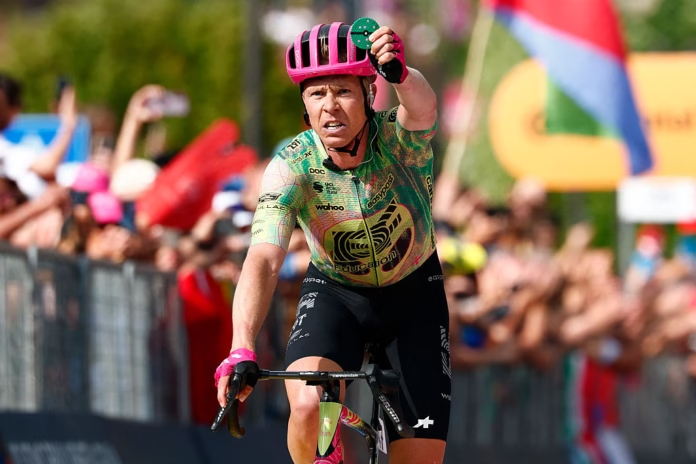
Michael Valgren took the first Grand Tour stage win of his career with a perfectly timed late attack on stage 17 of the Giro d’Italia 2026, striking inside the final 1.1 kilometres after a long and attritional breakaway battle into Andalo. The EF Education-EasyPost rider waited through repeated attacks from others, followed when the race split on the late climbs, then made the decisive move when the final group briefly came back together.
Andreas Leknessund finished second, continuing his run of near misses at this Giro, while Damiano Caruso took third from the reduced breakaway group. Behind them, the general classification contenders had a quiet day, finishing together in the peloton 5:15 down, with Jonas Vingegaard retaining the maglia rosa.
The 202-kilometre stage from Cassano d’Adda to Andalo always looked like prime breakaway territory. There were more than 3,000 metres of climbing, but much of the difficulty was loaded into the second half of the stage, while the opening 50 kilometres gave teams without a stage win one more reason to fight hard for the move. That made the first phase furious, the middle tactical, and the finale a proper battle of attrition.
A long fight to form the breakaway
The attacking started immediately after the official start, with Martin Marcellusi among the first riders to open a gap. That move was brought back quickly, but the race remained restless. Madis Mihkels, Johan Jacobs and Robin Froidevaux were among the next riders to go clear, while Paul Magnier and Jhonatan Narváez were locked into their own points classification duel behind.
Narváez tried to move early, but Magnier followed him, a reminder of how important the maglia ciclamino battle had become. With Narváez only 2 points behind before the stage, Soudal Quick-Step were never likely to let him slip away without a response.
A more substantial move eventually formed with Andreas Leknessund, Jan Christen, Valgren, Rémi Cavagna, Niklas Larsen, Alessandro Tonelli and Manuele Tarozzi. That group began to make progress, but there were still too many teams unhappy behind for the race to settle completely.
Counter-attacks followed, with riders including Mattia Bais, Lorenzo Milesi, Frank van den Broek, Mick van Dijke, Tobias Bayer and others trying to bridge as the road began to rise towards the Passo dei Tre Termini.
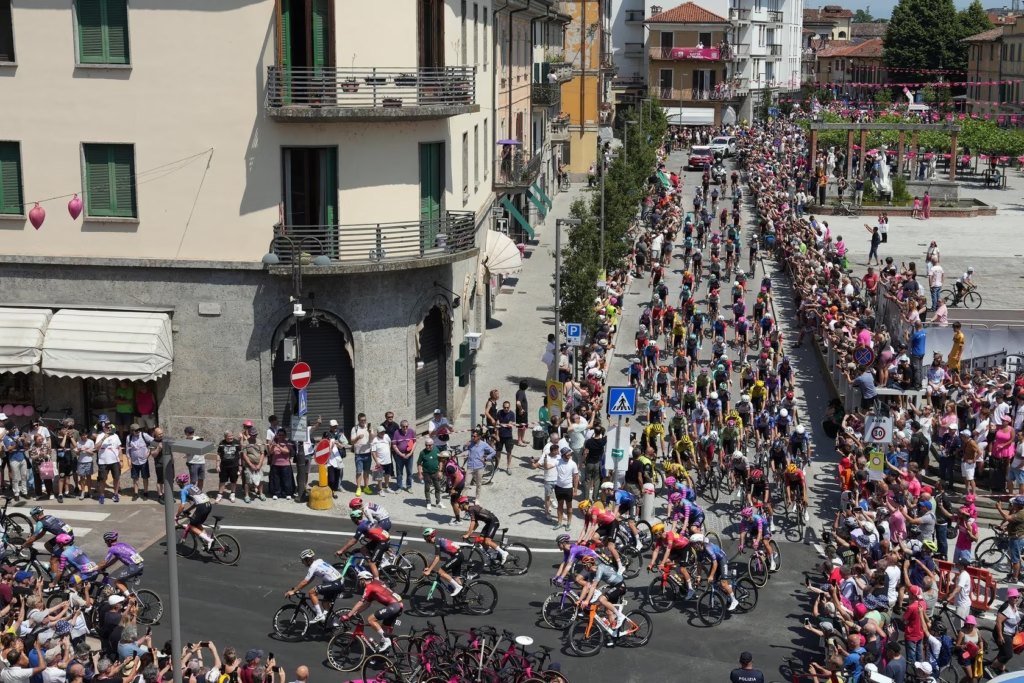 Photo Credit: RCS
Cavagna goes long before the race reshapes
The first major selection came on the Passo dei Tre Termini. The chasing groups began to close on the early leaders, and Bais took the KOM points as the front of the race came back together near the summit. At the same time, the Narváez group was forming behind, packed with strong climbers and dangerous stage hunters including Giulio Ciccone, Enric Mas, Caruso, Einer Rubio and Jardi Christiaan van der Lee.
Rémi Cavagna then made the move that defined the middle part of the stage. After initially attacking and sitting up, he changed his mind and pressed on alone. Behind him, the large chase group swelled to 28 riders, creating a strong breakaway structure but also one that was difficult to organise.
Cavagna’s lead grew steadily. He crested the Cocca di Lodrino alone, while Ciccone won the sprint for the remaining points behind ahead of Rubio and Van der Lee. By the time the race moved into the long middle section, Cavagna had more than 2 minutes on the chase group and almost 6 minutes on the peloton.
Team Visma | Lease a Bike were content to ride tempo behind for Vingegaard. Unlike stage 16, when they chased hard to set up another summit win for the Dane, this was a day where the breakaway was allowed to contest the stage.
Narváez takes control of the ciclamino battle
The points classification became one of the main subplots of the stage. Narváez had made the breakaway, while Magnier had been dropped from the peloton earlier on the climbing. That gave the UAE Team Emirates-XRG rider a clear chance to move into the virtual lead of the maglia ciclamino standings.
Cavagna’s lead began to fall before the intermediate sprint, with David de la Cruz attacking from the chase group and drawing the race closer to the lone leader. UAE worked behind to ensure the points were still available, and the catch was made just before the sprint.
Narváez delivered exactly what he needed, beating the others to the line despite an attempt from Soudal’s Jenno Berckmoes Van den Bossche to limit the damage on Magnier’s behalf. The Ecuadorian took the 12 points on offer and became the virtual leader of the points classification.
By the finish, Narváez had strengthened that position further, ending the day with 157 points to Magnier’s 145. With only four stages remaining, the ciclamino competition had tilted decisively towards the Ecuadorian, although the final days still left room for another swing.
Breakaway begins to split on the road to Andalo
Once the intermediate sprint was complete, the breakaway regrouped briefly before the real fight for the stage began. The road dragged uphill for much of the final 45 kilometres, and attacks started to come from the strongest riders.
Gianmarco Garofoli tried to move first, partly with Soudal’s points-classification interest still in mind, but Movistar shut that down. Caruso then attacked and took Valgren, Garofoli and Juan Pedro López with him. Leknessund chased across, and the front of the race began to form around the riders with the best climbing legs and strongest tactical sense.
Rubio, Aleksandr Vlasov and Igor Arrieta bridged later, while De la Cruz and Van Dijke also came back to the leaders. Behind them, Narváez and Ciccone found themselves in a chase group that never quite managed to regain control of the race.
Inside the final 30 kilometres, the leading group had been reduced but not settled. Caruso, Rubio, Valgren, Leknessund, Vlasov, Arrieta and others continued to attack each other, with the road constantly rising and the cohesion beginning to disappear.
Rubio and Valgren force the final selection
The San Lorenzo Dorsino climb, at 2.9 kilometres and averaging 6.4 per cent, sparked the next wave of attacks. Caruso tried first, Rubio countered, and Narváez launched from the chase group behind, still trying to bring himself back into contention.
Rubio attacked again and finally opened a gap, with Valgren and Arrieta able to respond. The trio went over the Red Bull Kilometre just ahead of the chasers, before Rubio and Valgren managed to press on together. Arrieta dropped back to the group containing Caruso, Vlasov, Leknessund and De la Cruz.
On the Andalo-Lever climb, Rubio took the KOM points uncontested as he and Valgren held a narrow advantage. The chase group behind briefly hesitated, allowing the duo to build a lead of around 15 seconds, but the gap began to come down again on the descent towards the final climb.
Leknessund, Vlasov and Caruso came back into the picture, and Arrieta also rejoined, leaving six riders together with less than 2 kilometres remaining. After more than 200 kilometres of racing, the stage was suddenly balanced again.
Valgren times the winning attack
The final climb to Andalo was short enough for hesitation to matter and steep enough to punish anyone who waited too long. Caruso attacked first from the six-man group, with Rubio and Valgren following. The others closed it down, but the move helped stretch the group and expose tired legs.
Then Valgren made his decision. With 1.1 kilometres remaining, he attacked from the group, and nobody immediately followed. It was the perfect moment. The others had just spent energy closing moves, Leknessund was still trying to recover from chasing, and Rubio had already attacked repeatedly.
Valgren quickly opened a gap and held it through the final kilometre. Leknessund tried to chase, but the distance was too short and the Dane’s advantage was too useful. Valgren crossed the line alone in Andalo, celebrating a victory that carried real emotional weight after the serious crash that threatened his career four years earlier.
For a rider with wins at Amstel Gold Race and Omloop Het Nieuwsblad already on his palmarès, this still felt different. It was his first Grand Tour stage win and one of the most significant victories of his career.

Leknessund second again as GC stays calm
Leknessund finished second, once again close but not quite able to turn a strong breakaway ride into victory. It was his third runner-up finish at this Giro, another sign of his consistency, but also another frustrating near miss.
Caruso took third, with the rest of the breakaway riders arriving in ones and twos behind. Narváez later won the sprint from a five-rider group, adding further points to his ciclamino lead and making his day successful even without a stage result.
The peloton rolled in 5:15 behind Valgren, with no change among the main GC contenders. Vingegaard remained safely in pink, while the podium fight behind him stayed as it was after the previous day’s mountain shake-up.
Stage 17 ultimately belonged to the breakaway riders who had fought from almost the first kilometre. Cavagna animated the middle of the race, Narváez changed the points classification, Rubio and Caruso kept attacking in the finale, and Leknessund again came close. But Valgren read the final kilometre better than anyone. He waited, struck once, and turned a long day of attrition into the Grand Tour stage win he had never previously managed.
Giro d’Italia 2026 stage 17 result
| Position | Rider | Team | Time/gap |
|---|---|---|---|
| 1 | Michael Valgren | EF Education-EasyPost | 4:41:33 |
| 2 | Andreas Leknessund | Uno-X Mobility | +0:03 |
| 3 | Damiano Caruso | Bahrain Victorious | +0:06 |
| 4 | Aleksandr Vlasov | Red Bull-BORA-hansgrohe | +0:06 |
| 5 | Einer Rubio | Movistar Team | +0:06 |
| 6 | Igor Arrieta | UAE Team Emirates XRG | +0:14 |
| 7 | Gianmarco Garofoli | Soudal Quick-Step | +0:52 |
| 8 | David de la Cruz | Pinarello-Q36.5 Pro Cycling Team | +1:08 |
| 9 | Jhonatan Narváez | UAE Team Emirates XRG | +1:44 |
| 10 | Mark Donovan | Pinarello-Q36.5 Pro Cycling Team | +1:44 |
Main photo credit: Getty

