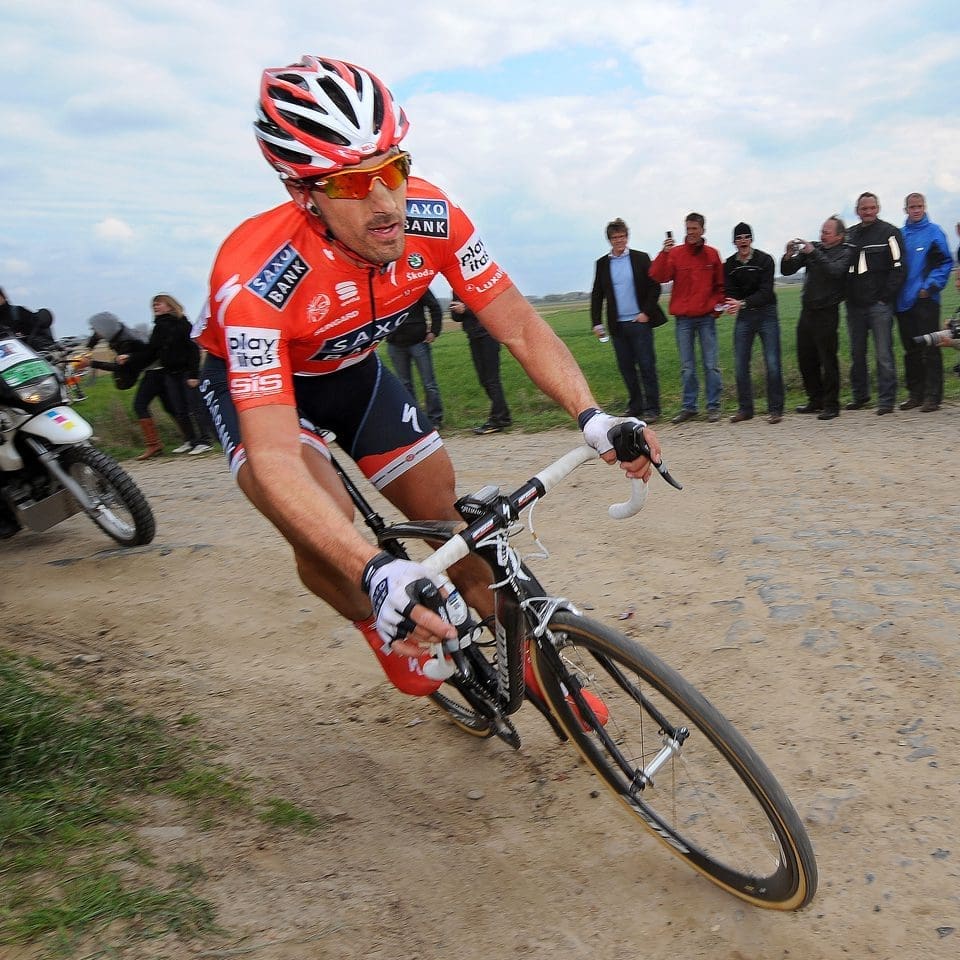
Fabian Cancellara was one of the great cobbled specialists of the modern era, but that label still only tells part of the story. He began as a time trial powerhouse, developed into a superb lead-out rider, then turned himself into one of the defining spring riders of his generation. Three wins at Paris-Roubaix, three at the Tour of Flanders and victory at Milan-San Remo, alongside four world time trial titles and two Olympic time trial gold medals, explain why he remains one of the key figures in men’s cycling history.
Rider history
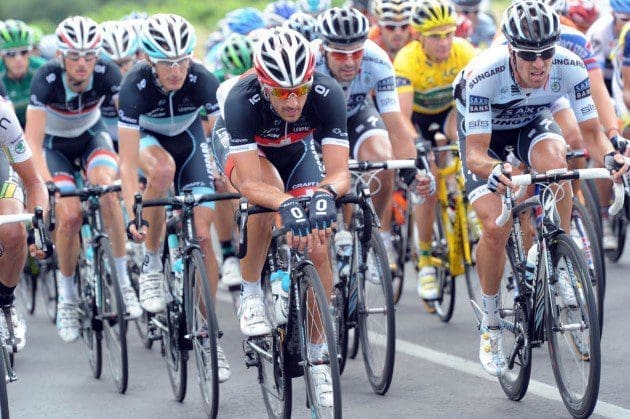
Cancellara turned professional with Mapei in 2001 and, in his earliest seasons, looked like a rider whose future would be built mainly around time trials and prologues. That part of his career developed quickly. After moving to Fassa Bortolo in 2003, he added more short time trial wins and took the opening prologue of the 2004 Tour de France, wearing yellow for the first time. Yet by then, there were already signs that his role would grow beyond that. In the same season, he finished 4th at Paris-Roubaix, a result that hinted at what his huge engine and technical skill could do on the cobbles.
The move to CSC ahead of the 2006 season was the next big shift. It was there that Cancellara fully became a Monument rider. He won his first Paris-Roubaix in 2006, then added Milan-San Remo in 2008. Around those wins, he also built one of the strongest time trial records of his era, taking world titles in 2006, 2007, 2009 and 2010, then Olympic gold in Beijing in 2008 before closing his career with another Olympic title in Rio in 2016. He was never simply switching between two disciplines. He was combining them, using his time trial strength as the base for a one-day racing style that very few rivals could match.
His peak as a Classics rider came between 2010 and 2014. Across the biggest spring races, especially Paris-Roubaix and the Tour of Flanders, Cancellara was relentlessly present at the front. In that period, he won the Tour of Flanders in 2010, 2013 and 2014, while adding further Paris-Roubaix victories in 2010 and 2013. He also won E3 Harelbeke three times and was constantly measured against Tom Boonen, whose rivalry with him defined the cobbled spring in those years. Boonen was the more natural pure cobbles rider, but Cancellara brought something slightly different: the ability to turn a Monument into an extended time trial once the decisive moment arrived.
That is what made Cancellara so distinctive. He was not a rider who won the Classics through repeated accelerations alone, or by simply surviving and sprinting. He often won by making one huge move and then sustaining it at a level nobody else could live with. By the time he retired at the end of 2016, Cancellara had secured his place among the greatest spring riders of the modern era.
Greatest race victory
2010 Tour of Flanders
There is a strong case for several Cancellara wins as the greatest of his career, but the 2010 Tour of Flanders stands out because it came head-to-head against Boonen and because it showed exactly how Cancellara could bend a race to his strengths.
Cancellara had to deal with a bike change in the final part of the race, which only added to the quality of the ride. On the Molenberg, with around 44 kilometres to go, he attacked and only Boonen could follow. That pairing quickly became the race-winning move. Together they built an advantage, but the real turning point came later on the Muur-Kapelmuur, where Cancellara launched again and this time dropped Boonen. Once clear, he did what he always did at his very best: he turned the last part of the race into a long, punishing solo effort and rode away.
He reached the finish 1 minute and 15 seconds ahead of Boonen, with Philippe Gilbert taking 3rd. That margin matters because Boonen was not just any rival, he was the outstanding cobbled rider of his generation and the man Cancellara most needed to beat in those years. Winning Flanders is one thing. Dropping Boonen on the Muur and then riding him off your wheel all the way to Ninove is another. In pure strategic and symbolic terms, that 2010 victory feels like the clearest expression of what made Cancellara great.
Spring Classics palmarès
Monuments
Milan-San Remo
2008
Paris-Roubaix
2006, 2010, 2013
Tour of Flanders
2010, 2013, 2014
Classics
Strade Bianche
2008, 2012, 2016
E3 Harelbeke
2010, 2011, 2013
-
 Photo Credit: Lezyne
 -
 Photo Credit: David Pintens / BELGA MAG/AFP via Getty Images