
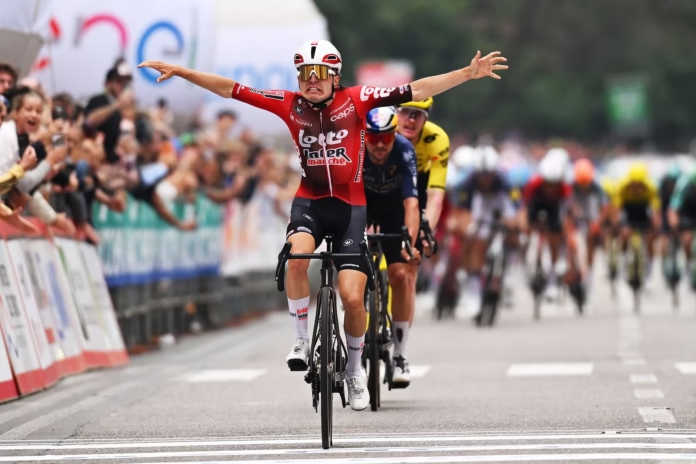
Jarno Widar won stage six of the 2026 Tour of Guangxi in 3:39:05, prevailing from a late three-rider move that only became clear in the closing metres. Thomas Pidcock finished second, six seconds behind, while Louis Barré completed the podium at 10 seconds.
The race was decided by the contrast between a breakaway being dismantled over the final third of the stage and a succession of late accelerations in the reduced groups behind it. The original escape was gradually pulled apart, the chase continued to reshape the front, and Barré’s attack with 400 metres remaining finally brought Widar and Pidcock into the decisive move.
Pidcock then attacked with 100 metres to go, but Widar countered before the finish. That final exchange determined the order among the three riders who had separated from the rest. Marco Brenner was fourth at 11 seconds, leaving only one second between him and Barré, but the podium had already been settled by the late trio.
How it unfolded
The early breakaway was formed by Jonas Rickaert, Stan Dewulf, Laurenz Rex and Yutao Shen. Its advantage was already decreasing with 67 kilometres remaining, indicating that the escape had lost some of the protection it needed to carry all four riders into the finale.
The breakaway reached the climb for the KOM sprint with 52 kilometres left, and Rex was later listed as the winner of the third KOM sprint at 120 kilometres. That result marked one of the last moments when the original escape could still be treated as a complete unit. The pressure of the chase was already changing its prospects.
At 23 kilometres remaining, Arjen Livyns accelerated. Three kilometres later, Rex and Shen were dropped from the breakaway. Rex was caught by the peloton with 17 kilometres left, while Shen stayed ahead until 13 kilometres to go. Their separate catches showed how the escape was being dismantled in stages rather than swept away all at once.
The breakaway loses its protection
The declining gap at 67 kilometres was the first clear sign that the early move was entering a different phase. Once the breakaway reached the KOM sprint, the four riders were still the named escapees, but the later accelerations and the loss of Rex and Shen meant that the original formation no longer had the same influence on the race.
Livyns’s acceleration came before the final members of that move were absorbed. The event sequence does not connect his effort directly to the winning attack, but it added another interruption to the chase and confirmed that the race was becoming increasingly selective well before the last kilometre.
Rickaert was then dropped from group one with 3.8 kilometres remaining. His loss came after Rex and Shen had already been brought back, and it further reduced the number of riders able to remain in the front contest. The closing kilometres were therefore shaped by successive reductions, with the early breakaway no longer intact and the front groups under pressure.
The chase keeps reshaping the front
Julius Johansen was pulling in the peloton with 7.8 kilometres to go, and UAE Team Emirates-XRG were again recorded working at 4.4 kilometres. During this phase, the gap between group one and the peloton was decreasing. The front of the race was not yet settled, and the chase remained close enough to affect which riders could contest the finish.
There was another acceleration in the peloton at 5.3 kilometres remaining. The move was not attributed to a named rider, so its importance lies in the pressure it placed on the reduced field rather than in a specific solo attempt. The subsequent drop of Rickaert from group one showed that the pace was still narrowing the group as the race approached its decisive section.
With 4.5 kilometres left, the gap between group one and the peloton was decreasing again, while UAE Team Emirates-XRG were pulling at the front of the chase. That combination kept the race open. Riders who had moved clear could not assume that the gap would hold, while those behind still had an opportunity to influence the final selection.
Carlos Verona was pulling in the peloton with 2.2 kilometres remaining. By then, the race had moved beyond the original breakaway story and into a contest between small groups and individual accelerations. The work behind also meant that any rider attacking late had to create separation quickly, because the response from the chase remained immediate.
Late attacks narrow the options
Joseph Pidcock accelerated with three kilometres remaining, followed 100 metres later by Rémy Rochas’s counter-attack. These were separate moves in a sequence that was already reducing the available numbers. Rochas’s effort briefly changed the shape of the finale, forcing the riders behind to respond rather than simply carry their positions towards the finish.
At 2.1 kilometres to go, the gap between Rochas and the peloton was increasing. That was a meaningful change from the earlier shrinking gaps around group one. Rochas had established enough distance to make the move relevant, although it did not survive as the decisive escape. The front was still being contested, and the riders behind had not stopped applying pressure.
Kévin Vauquelin and Peter Øxenberg both accelerated with 1.4 kilometres remaining. Their efforts added another layer to the late selection, but neither created the group that decided the podium. The repeated attacks had reduced the time available for a long move to develop, making the final few hundred metres increasingly important.
The pressure also had a clear consequence for riders who had remained near the front earlier. Rickaert’s drop at 3.8 kilometres came before the final sequence, while Rochas’s increasing gap and the later accelerations by Vauquelin and Øxenberg showed that the race was still changing after the early escape had disappeared. The eventual podium group was not simply the first group to survive, but the result of the final chain of attacks.
Barré creates the decisive trio
Barré attacked with 400 metres remaining. At 200 metres, a small gap had opened for Barré, Thomas Pidcock and Widar. This was the first event in the sequence to identify the three riders who would fill the podium, and it transformed a constantly changing finale into a direct contest between the eventual top three.
Barré’s move mattered because it created a gap at the point when there was almost no road left for the chase to organise. The earlier work by Johansen, UAE Team Emirates-XRG and Verona had helped maintain pressure in the approach, but the final trio formed only after Barré’s acceleration had separated those three riders from the remaining field.
The small gap was not yet the final order. Pidcock attacked with 100 metres remaining, attempting to change the arrangement inside the group. That effort was answered by Widar, who counter-attacked in the closing sequence. The race therefore moved from Barré opening the gap, to Pidcock challenging within it, to Widar making the final response.
Widar’s counter-attack was recorded at the finish, followed by his victory. Pidcock came in second and Barré third. The three riders had been together in the decisive move only moments earlier, but the final accelerations gave Widar the stage and established the separation reflected in the official result.
Widar turns the last move into victory
Widar’s win was not built on a long solo escape in the available race sequence. His decisive advantage came from surviving the late reduction and responding most effectively when the final trio began to fight for position. That distinction explains why the result was settled so late despite the race having been under pressure for many kilometres.
The early breakaway had already lost Rex and Shen, while Livyns’s acceleration and the later changes in group one kept the race unsettled. The work of the chasing teams then prevented the front from becoming static. By the time Barré attacked, the stage had passed through enough separate reductions that a move involving three strong riders could gain the road needed to decide the podium.
Pidcock was the closest challenger at six seconds. His acceleration with 100 metres remaining was the last named attempt to alter the order, but Widar’s counter left him second. Pidcock therefore came closest to the win, while the late timing of his attack meant that the result depended on the response within the trio rather than on a longer pursuit from behind.
Barré’s attack secured third at 10 seconds. He was the rider who initiated the move that brought the decisive three together, but the final response from Widar and the result of Pidcock’s attack left him behind both rivals. His podium place nevertheless reflected the importance of his 400-metre move in creating the winning configuration.
A narrow fight behind the podium
Marco Brenner finished fourth at 11 seconds, only one second behind Barré. That was the closest margin immediately behind the podium and underlined how little separated the next finisher from third place once the decisive trio had gone clear.
Martin Tjøtta was fifth at 15 seconds, with Juan Ayuso Pesquera sixth at 16 seconds. Peter Øxenberg finished seventh at 19 seconds after his late acceleration, while Clément Braz Afonso and Afonso Eulalio shared eighth at 21 seconds. Maxim van Gils completed the top 10 at 23 seconds.
The final order therefore combined a very late winning move with a tightly grouped chase. Widar had enough separation to win the stage, but the gaps behind him remained compact: Pidcock was six seconds down, Barré 10, and Brenner only one second further back. The decisive difference came in the final exchanges, when Widar answered Pidcock and turned the closing trio into a stage victory.
Tour of Guangxi Stage 6 2026 Result
| Pos. | Rider | Team / nation | Time / gap |
|---|---|---|---|
| 1 | Jarno Widar | LOI | 3:39:05 |
| 2 | Thomas Pidcock | PQT | +0:06 |
| 3 | Louis Barre | TVL | +0:10 |
| 4 | Marco Brenner | TUD | +0:11 |
| 5 | Martin Tjøtta | UXM | +0:15 |
| 6 | Juan Ayuso Pesquera | LTK | +0:16 |
| 7 | Peter Øxenberg Hansen | NCI | +0:19 |
| 8 | Clément Braz Afonso | GFC | +0:21 |
| 9 | Afonso Eulalio | TBV | +0:21 |
| 10 | Maxim Van Gils | RBH | +0:23 |

