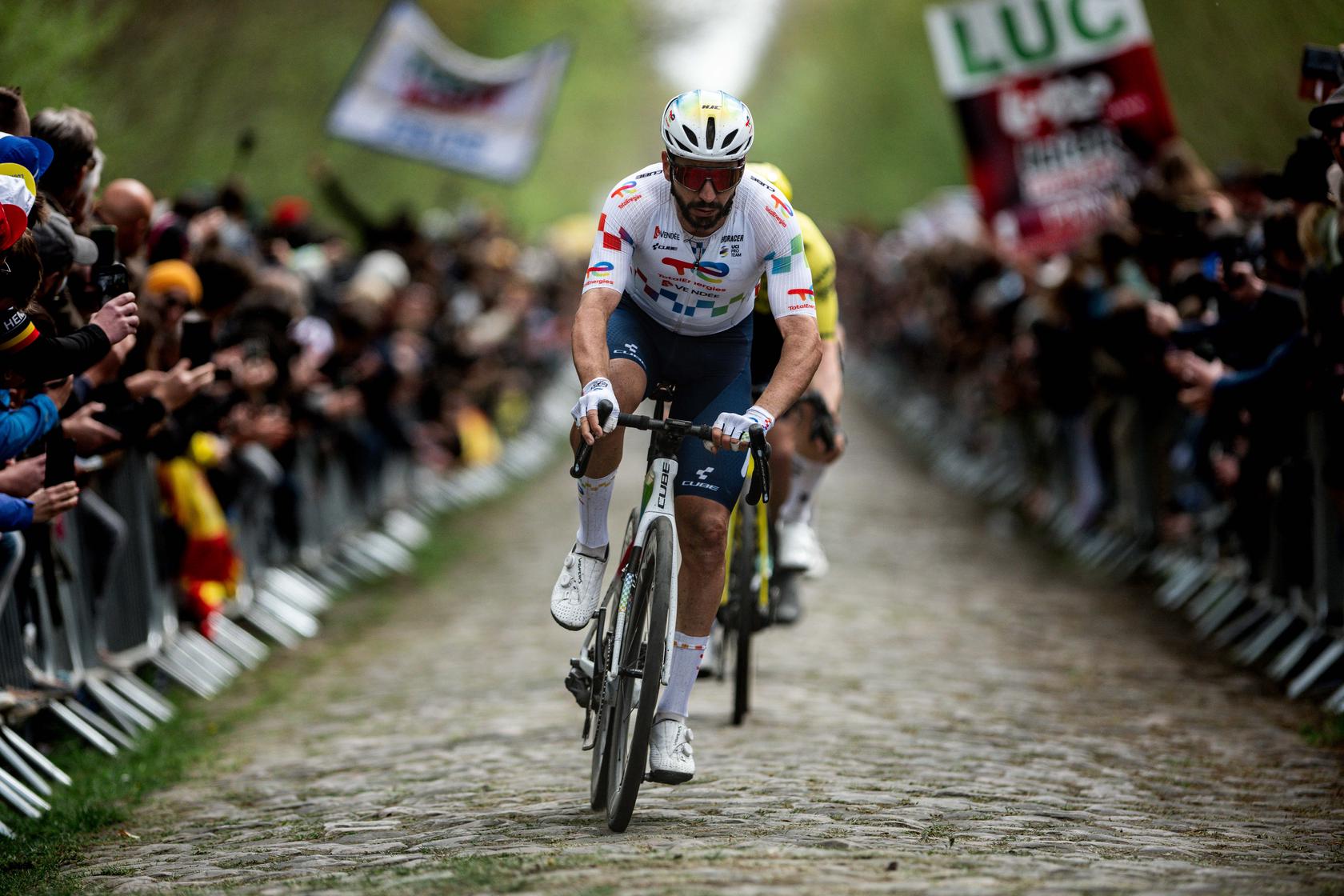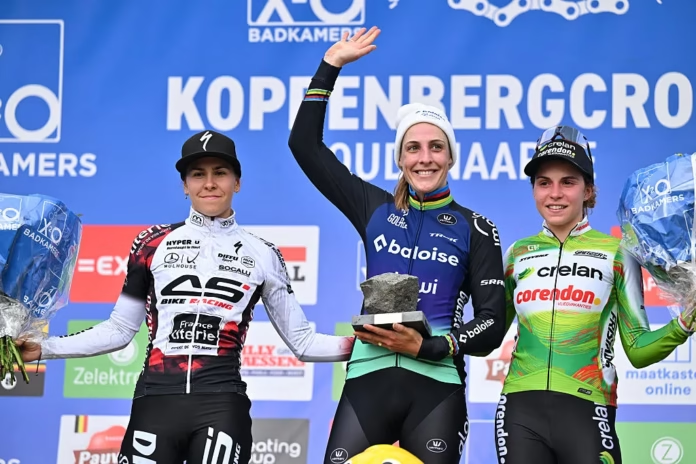
Lucinda Brand returns to the Koppenbergcross on Sunday, 1st November as defending champion, with the opening round of the 2026–27 X²O Badkamers Trofee providing an early test of climbing strength and handling. The elite women’s race begins at 13:45 in Belgium, or 12:45 GMT in the UK. The cobbled rise above Melden supplies the familiar photograph. The race is often shaped much earlier, on the awkward fields and off-camber slopes where a small error costs several bike lengths.
Brand won here for the first time in 2025, finishing 19 seconds ahead of Célia Gery. Sara Casasola took third that afternoon. A year later, the Dutch world champion arrives with another strong start to the winter, while Casasola is preparing to make her first cyclocross appearance of the season. The final official start list was not available at the time of writing, so this preview separates reported participation from riders whose recent form makes them relevant to the discussion.
When and where the women race
The Koppenbergcross takes place in Oudenaarde, East Flanders, on Sunday, 1st November. The women’s elite start is scheduled for 13:45 CET, which is 12:45 GMT. The men’s elite event follows at 15:00 CET, or 14:00 GMT. Junior races and the men’s under-23 event occupy the earlier part of the programme. The Belgian and British clocks have both moved back by the race weekend, so there is still a one-hour difference.
This is the first of eight rounds in the X²O Badkamers Trofee, not a UCI World Cup or a Superprestige meeting. The series will subsequently visit Hamme-Zogge, Beringen, Hofstade, Loenhout, Baal, Lille and Brussels. It is a different competition from the HG Cross meetings that opened the autumn and from the Superprestige race at Overijse on 25th October. Our 2026–27 cyclocross calendar brings the separate competitions together.
Why the Koppenberg is so difficult
The famous cobbled climb is the image most people associate with this race, but treating the event as a single hill-climb misses much of its character. Riders repeatedly move from faster ground into heavy, uneven grass, awkward corners and exposed slopes. A good lap requires enough power to crest the steepest sections without losing the ability to accelerate out of the next bend. That combination makes it difficult to settle into a comfortable rhythm.
Conditions can change the balance considerably. Firm ground favours riders who can preserve speed through the turns and attack the slopes out of the saddle. Rain makes the grassy banks slippery and increases the value of traction and precise line choice. The climb then becomes more than a test of raw strength: a mistake lower down can force a rider to run, and the time lost is hard to recover when the race is already stretched into small groups.
Position on the opening lap can be expensive to recover: the course narrows quickly, and overtaking on slippery ground brings its own risks. A rider who enters a technical section several places back may have to wait while someone ahead makes a mistake. The strongest riders can recover from a modest start, but they pay for it in repeated accelerations. Our Koppenbergcross history and course guide looks at the event’s distinctive terrain and previous winners in more detail.
Brand’s defence and the returning Casasola
Brand’s 2025 win came after she and Gery established themselves at the front. The French rider challenged again late in the race, but Brand had enough in hand to hold the gap to the finish. For all her victories elsewhere, the Koppenberg had resisted Brand until that afternoon. It also illustrated why her ability to combine sustained effort with clean technical riding is so valuable on this circuit.
Her recent form gives the title defence credibility. Brand won the 2026 Superprestige Overijse race on 25th October and has been a consistent presence at the front of the opening events. The level of opposition and the weather will matter, but she has already shown she can win on demanding Belgian courses this autumn. The fact that she knows exactly how to manage the Koppenberg is another advantage, even if last year’s performance guarantees nothing this time.
Casasola adds an interesting uncertainty. Crelan-Corendon announced that the Italian champion would return to cyclocross at the Koppenbergcross after completing her road season. She finished third in the 2025 race, and her earlier performances in the discipline include victories in major Belgian series. Yet this is her first cross of the winter, so her immediate sharpness and handling under race pressure are harder to judge than Brand’s.
Casasola’s road programme has included the Tour de France Femmes and the World Championships. That gives her endurance work, but it is not the same as repeated technical laps with short recoveries. Her opening race may be as much about establishing where she stands as chasing the victory. A clean start and the ability to hold contact on the first few climbs would provide useful evidence about how quickly she can return to her previous level.
Other riders and the start-list question
Recent races have featured strong performances from Ceylin del Carmen Alvarado, Amandine Fouquenet and Marie Schreiber, among others. Alvarado won at Heerde on 24th October, while Fouquenet has shown the ability to challenge on courses that reward sustained pressure. Schreiber’s fast starts can make her a factor before the race has settled. These are form comparisons rather than a claim that all three have confirmed entries for Oudenaarde.
A preview written before the final entries needs that distinction. Race previews often circulate with long lists of favourites before organisers have published the final entries. The field can change through illness, travel decisions or late programme adjustments. Brand and Casasola have been reported as attending, but the official start list should still be checked close to Sunday rather than treating an early preview as a definitive roster.
Célia Gery’s second place last year is another useful reminder of the type of rider who can emerge here. She was able to match Brand for long stretches and finished well clear of much of the field. That does not automatically make her a contender in 2026, particularly without confirmed participation, but it shows that a rider with a strong climbing rhythm can challenge more established names on the right day.
How the X²O classification changes the tactics
The X²O Badkamers Trofee uses cumulative time rather than the points system familiar from other cyclocross series. Each round therefore matters beyond the immediate podium. A rider who loses 40 seconds in Oudenaarde carries that deficit into the next meeting; a rider who wins by a large margin can build an early buffer. The series also awards time bonuses linked to early and fastest-lap performances, giving riders a reason to attack even when an outright victory looks difficult.
Missing a round or failing to finish brings a fixed time penalty under the series rules. That makes consistency particularly valuable over eight meetings. It also means that riders choosing selective winter programmes may prioritise individual victories rather than the overall trophy. For the full explanation of the timing system, see our guide to the X²O Badkamers Trofee.
At the Koppenberg, the time-based format can encourage an aggressive opening. A rider who gains a few seconds before the first major selection may protect that advantage when the course becomes congested. Equally, attacking too hard early can be expensive if the repeated climbs expose a lack of race sharpness. Getting to the front early helps, but only if a rider still has enough left for the final ascent.
What will decide the race
Watch the first passage through the difficult grass and the first full ascent of the cobbles. If Brand is already clear with one or two rivals, the race may become a test of who can keep their lines clean and avoid giving away seconds through small mistakes. If a larger group remains together, the acceleration onto the climb and the transition back onto technical ground should create repeated opportunities for separation.
Casasola’s return gives the early laps an extra point of interest. She has the strength to be competitive on this terrain, but the first few minutes will reveal more than any pre-season training report. For the other leading riders, the challenge is to stay close enough to the strongest climbers that one error does not end their chances. On a course like this, gaps that look manageable at the end of one lap can become decisive after two more climbs.
The women’s race starts at 12:45 GMT on Sunday, 1st November. A final entry list and a clearer weather forecast will sharpen the picture before the first lap.