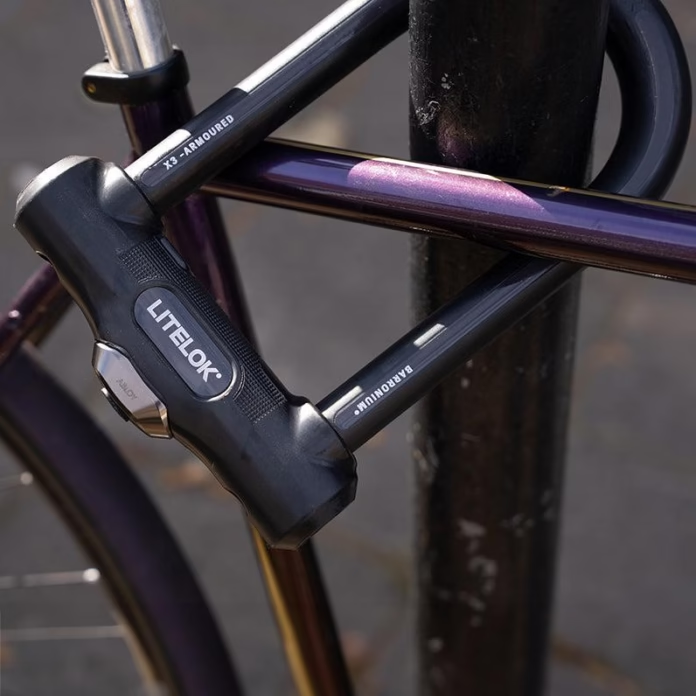
A lock can have the highest security rating for bicycles without offering the same resistance to an angle grinder as another Diamond-rated lock. That is the central distinction between the Hiplok DX and Litelok X3. One is a compact, wearable D-lock intended to make everyday security easy. The other is a substantially heavier, substantially more expensive attempt to slow a determined thief armed with power tools.
Both make credible claims to protect valuable bicycles, but they are not interchangeable. The right purchase depends on where the bike is parked, how long it is left, what it is secured to and whether you will actually carry the lock on every ride. This is a research-led comparison informed by manufacturer specifications, Sold Secure classifications and independent destructive and real-world testing. ProCyclingUK has not performed its own attack tests.
Litelok X3 vs Hiplok DX specifications
| Specification | Litelok X3 | Hiplok DX |
|---|---|---|
| UK manufacturer’s listed price | £279.99 | £79.99 |
| Claimed weight | 2.1kg | About 1.1kg |
| Internal locking area | 100 × 195mm | 85 × 150mm |
| Sold Secure pedal-cycle rating | Diamond | Diamond |
| Sold Secure powered-cycle rating | Diamond | Gold |
| Main construction | Barronium composite armour around hardened steel | 14mm hardened-steel shackle with double deadlocking |
| Carrying arrangement | Sleeve included; separate mount options | Clip + Ride attachment for belt or bag strap |
| Principal advantage | Very high resistance to angle-grinder attacks | Compact size, portability and much lower cost |
These prices are the manufacturers’ UK listings checked in November 2026, rather than a claim that every retailer has the same offer. Litelok lists the X3 at £279.99 and Hiplok lists the DX at £79.99, a £200 gap. Both list the products for purchase through their UK websites. A promotional price or retailer stock position can change before the reader buys.
What the Sold Secure Diamond rating actually means
Both locks hold Sold Secure Pedal Cycle Diamond certification. It would be easy to read that as equivalent protection, but the separate Powered Cycle classifications tell a more useful story. The X3 reaches Powered Cycle Diamond, while the DX is Powered Cycle Gold. These are independently administered security categories with different attack requirements. The higher powered-cycle grading is a meaningful advantage for the X3, although no certification makes a bicycle impossible to steal.
The DX has a 14mm hardened-steel shackle, double deadlocking and anti-rotation features. That is a serious specification for a compact commuter lock. The X3 uses a much bulkier armoured construction with Litelok’s Barronium material integrated with a hardened-steel core. Its main selling point is resistance to cutting discs, not simply a thicker piece of ordinary steel. The manufacturers use different construction and measurement conventions, so comparing the nominal shackle dimensions alone would be misleading.
Check the exact minimum Sold Secure category required by your own insurer before buying. Some policies distinguish bicycles from e-bikes, apply conditions by insured value, or require locking to an immovable object. The rating is an important starting point, not a substitute for reading the policy wording. If the bike is secured to a weak rail, or the frame is left unsecured, a premium lock cannot compensate for that.
Angle-grinder resistance is where the £200 goes
Independent attack tests explain the X3’s appeal better than the promotional language does. In road.cc’s 2025 examination, its cutting disc had degraded significantly after two minutes of angle-grinder use without breaking the lock. OutdoorGearLab’s separate test took two cuts, eight discs and almost eight minutes to defeat the lock. Cycling UK’s grinder-resistant lock group test also failed to cut through the X3 in its timed attempt. Those are different protocols with different tools and fixtures, not a single guaranteed theft-resistance time.
The Hiplok DX was not included in those same head-to-head grinder trials, so claiming that it lasts a particular number of seconds against an equivalent attack would be invented precision. What can be stated is that the DX uses a conventional hardened-steel shackle and carries a lower powered-cycle security grade. That is a reason to prefer the X3 where exposure to portable grinders is a primary concern, not proof that the DX is unsuitable for every city stop.
Time is not everything. Attack noise, visibility, the number of available discs and an awkward locking position can matter just as much. A determined thief might attack the stand, remove the parts not secured by the lock, or steal a different bicycle. The aim is to create enough delay and difficulty that the opportunity becomes unattractive. Against that objective, the X3 has unusually persuasive independent evidence.
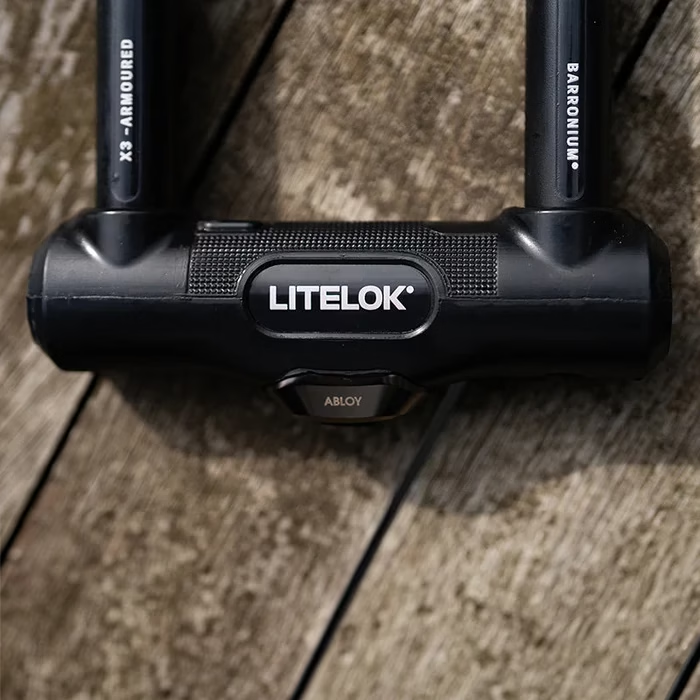 Photo Credit: Litelok
Weight and carrying convenience favour the Hiplok
At approximately 1.1kg, the DX is close to half the weight of the 2.1kg X3. A kilogram difference may not sound decisive when compared with a rider and bike, but it is noticeable when a lock is carried every day in a bag, on a belt or on a lightweight commuter. The DX is designed around its Clip + Ride carrying system, which lets the lock attach to suitable clothing and bag straps without a conventional bottle-cage-mounted bracket.
The X3’s size is part of what makes it formidable. It is also a reason riders may leave it at home on a quick errand. OutdoorGearLab highlighted transport inconvenience and the absence of a standard included frame mount in its review. A protective sleeve helps when carrying it in luggage, and compatible mount options can be purchased, but those do not turn a 2.1kg lock into a light accessory. A heavy lock that stays attached to a regular parking stand can be practical; one that has to come on every fast commute is a different proposition.
Hiplok’s carrying method deserves qualification too. Clipping a hard, kilogram-plus object to a jersey pocket or waist may not suit everyone, particularly on a sporty road bike. A secure backpack strap or a compatible frame-mount solution may be preferable. The relevant advantage is having more options for easy carrying, rather than the assertion that any rider will find wearing a D-lock comfortable.
Which lock is easier to fit around a bicycle?
The X3 has an internal space of 100 × 195mm, while Hiplok quotes 85 × 150mm for the DX. This gives the X3 extra reach when connecting a frame, wheel and stand. The smaller DX opening can help keep vulnerable gaps tight around a suitable rack, but it will be more awkward around wide street furniture, chunky e-bike frames or some combinations of wheel and frame.
Before buying either, look at the actual place the bicycle is normally parked. A D-lock must pass around a suitable, fixed stand while enclosing the frame, and ideally a wheel, without forcing the shackle. A large lock may provide greater flexibility but also greater room to attack with leverage if placed poorly. A small lock can fit securely at a convenient Sheffield stand yet be nearly useless around a broad lamppost. Dimensions are not a substitute for that physical check.
 Photo Credit: Hiplok
Cost matters, but match it to the risk
The manufacturer’s £200 price difference is large enough to fund additional security: a second lock, secure storage hardware, or a robust locking point at home. For a low- or medium-risk commute with a place to lock briefly, the DX’s existing Diamond pedal-cycle rating may be the most rational use of money. It offers properly certified protection without turning the ride into a heavy-cargo exercise.
The X3 makes more sense for a high-value e-bike or cargo bike left for long periods in a theft-prone area, especially when the lock can remain at the destination. The Powered Cycle Diamond rating, supported by independent grinder testing, addresses a different level of threat. It may also be justified for somebody who has already had an expensive bike stolen from a conventional D-lock. None of that removes the importance of checking a bike-specific insurance policy.
It is sensible to secure both the frame and wheels, and never rely solely on a cable to protect an easily removed wheel. Even a strong D-lock covers only what sits inside its shackle. Our UK commuting bike-lock guide explores lighter and cheaper alternatives, while the shed and garage security guide covers fixed anchors and home storage.
The verdict for everyday cyclists
Choose the Hiplok DX when you want credible, independently certified protection that you will actually carry to the shops or office. The compact dimensions and Clip + Ride concept are useful, and the £79.99 UK price leaves substantial room for additional security. It is the better everyday value for many ordinary pedal-cycle journeys, provided its shackle fits your parking arrangements.
Choose the Litelok X3 when resistance to a powered cutting attack outranks weight and cost. Its expensive construction is backed by unusually strong independent testing, not just marketing. It is particularly compelling as a destination lock for a valuable bike or for a rider who routinely parks in an area where grinder theft is a realistic concern. The compromise is carrying more than two kilograms of security on every journey.
For more detail on each product, see our Litelok X3 review and Hiplok DX review. Current product details can be checked directly at Litelok and Hiplok. These are direct manufacturer links, not commission-tracked links.
-
 Photo Credit: Cor Vos
-
 Photo Credit: David Pintens / BELGA MAG/AFP via Getty Images
-
 Photo Credit: Cor Vos