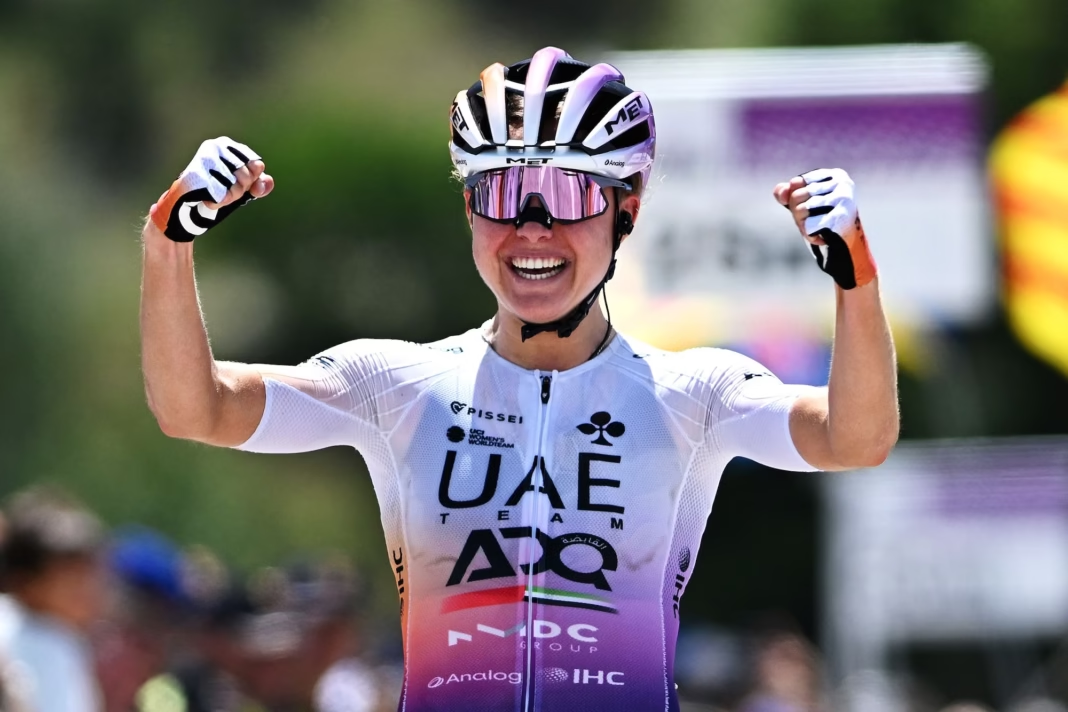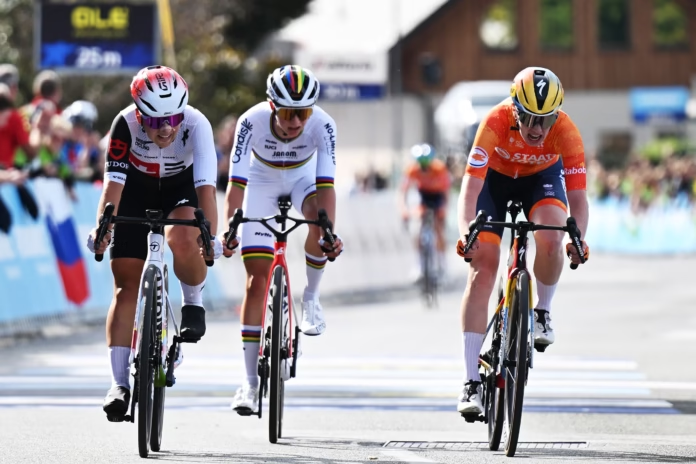
Mara Winter won the women’s under-23 road race at the 2026 European Championships in Šenčur, beating Nienke Vinke and world champion Viktória Chladoňová after a tense four-rider finale on the steep Slovenian circuit.
The 20-year-old Swiss rider launched a long sprint from the front after the final corner and held off Vinke by little more than a bike length. Chladoňová took bronze, while Megan Arens finished fourth after spending much of the closing kilometres working for Dutch teammate Vinke.
Winter’s victory came only eight days after she finished fourth at the U23 World Championships in Montréal and represents the biggest road result of a career that has developed remarkably quickly. She only began racing seriously at national level in 2025 and is still in her first full season of international road competition.
How it unfolded
The women’s U23 race was different from the other major road races on the 2026 European Championships route. Rather than approaching Šenčur from Ljubljana, the riders started directly on the finishing circuit and completed four laps for a total of 88.43km.
That meant four ascents of Možjanca, the 2.1km climb averaging 10.2% that will also shape the elite races. With gradients reaching almost 16%, there was little room for riders to hide once the stronger nations began increasing the pace.
An early breakaway never established a large advantage, largely because the Netherlands kept the race moving over the first two climbs. The Dutch arrived with one of the strongest squads in the field and had several possible routes to victory through Vinke, Arens and Rosita Reijnhout.
Much of the opening phase was difficult to follow because of technical problems with the television coverage, but by the time the race situation became clear Winter and Arens had moved to the front.
Behind them, the race had already been heavily reduced. A chasing group of around 10 riders remained, while Sweden’s Stina Kagevi spent time between the leaders and the main chase.
Winter and Arens built an advantage of around a minute, putting the Netherlands in an excellent tactical position. Arens could contribute at the front while her teammates were under no obligation to organise the chase behind.
Vinke attacks on the final climb
The advantage began to shrink as the race approached the fourth and final ascent of Možjanca.
Vinke made the decisive move from the chase on the steep climb, accelerating away in an attempt to bridge across to Arens and Winter. Only Chladoňová could initially follow.
That immediately changed the balance of the race. Chladoňová had won the U23 world road title in Montréal the previous week and had already shown that she could survive repeated hard climbing before finishing quickly from a reduced group. Vinke therefore tried several times to distance her rather than carry the Slovakian towards the finish.
She could not shake the world champion.
The pair reached Winter and Arens, producing a front group of four with two Dutch riders against Switzerland and Slovakia.
On paper, the Netherlands now had the clearest tactical advantage. Arens could attack or sacrifice herself for Vinke, while Winter and Chladoňová had to cover both possibilities without allowing the chasing group behind to return.
 Photo Credit: Cor Vos
Dutch numbers cannot decide the race
The problem for the Netherlands was that the group behind remained close enough to prevent prolonged tactical games.
Spain were particularly active in the chase and the gap continued to fall through the closing kilometres. Any hesitation among the leading four risked bringing another group back into contention for the title.
Arens therefore committed herself to keeping the quartet clear and setting up Vinke. Rather than using their numerical advantage for repeated attacks, the Dutch effectively converted it into a lead-out.
That suited Winter more than might have been expected.
At the World Championships a week earlier she had narrowly missed bronze in a small-group sprint. Afterwards, Winter explained that a longer sprint suited her better than a short explosive acceleration.
Šenčur gave her the opportunity to prove it.
Winter commits early and refuses to fade
The four leaders still had only a small margin as they entered the final kilometre, meaning there was no opportunity to slow almost to walking pace and wait for somebody else to open the sprint.
Arens had already spent much of her remaining energy working for Vinke. Chladoňová and Vinke then allowed Winter to reach the final corner at the front.
The Swiss rider did not wait.
Winter accelerated immediately out of the bend and turned the finish into a long drag race. For several seconds it appeared that she might have opened too early, particularly with Vinke sitting behind and beginning to close rapidly.
But Winter kept enough speed to prevent the Dutch rider drawing alongside. Vinke gained ground through the final metres but ran out of road, leaving Winter to throw her bike across the line first and claim the European title.
Chladoňová finished third in the same time, adding European bronze to the rainbow jersey she won in Montréal. Arens crossed four seconds later after her work for Vinke left her unable to contest the medals.
From fourth at Worlds to European champion
Winter’s victory is particularly striking given how little road racing sits behind it.
She only began competing regularly at national level in 2025, when victory in the mountainous Chur-Arosa race brought her to the attention of Swiss Continental team Nexetis. The 2026 season has been her first complete campaign mixing international road racing with an existing mountain bike programme.
Winter won the Swiss U23 time trial title in June and also finished fourth in the elite national road race. She then continued racing mountain bike World Cups before turning her attention back towards the road for the World Championships.
Her fourth place in Montréal was already well beyond what her experience suggested should be expected. She finished only centimetres away from a bronze medal after recovering ground in the final sprint.
Eight days later, faced with Vinke, Chladoňová and a Dutch numerical advantage, Winter handled the finale differently. This time she was first into position, started the sprint on her own terms and made the finish long enough to play to her strengths.
Behind the leading four, Justyna Czapla won the sprint from the chase group for fifth place at 24 seconds. Reijnhout was sixth, followed by Eleonora Ciabocco, Paula Ostiz, Giada Silo and Tess Moerman.
Winter succeeds Paula Blasi as European U23 champion and leaves Slovenia with a major title only a little over a year after emerging onto the Swiss road scene.
Women’s U23 European Championships road race 2026 result
| Pos. | Rider | Nation | Time/gap |
|---|---|---|---|
| 1 | Mara Winter | Switzerland | 2:26:48 |
| 2 | Nienke Vinke | Netherlands | same time |
| 3 | Viktória Chladoňová | Slovakia | same time |
| 4 | Megan Arens | Netherlands | +0:04 |
| 5 | Justyna Czapla | Germany | +0:24 |
| 6 | Rosita Reijnhout | Netherlands | +0:24 |
| 7 | Eleonora Ciabocco | Italy | +0:24 |
| 8 | Paula Ostiz | Spain | +0:24 |
| 9 | Giada Silo | Italy | +0:24 |
| 10 | Tess Moerman | Belgium | +0:24 |
Main photo credit: Getty
-
 Photo Credit: quentinphotographiebe
 -
 Photo Credit: Getty