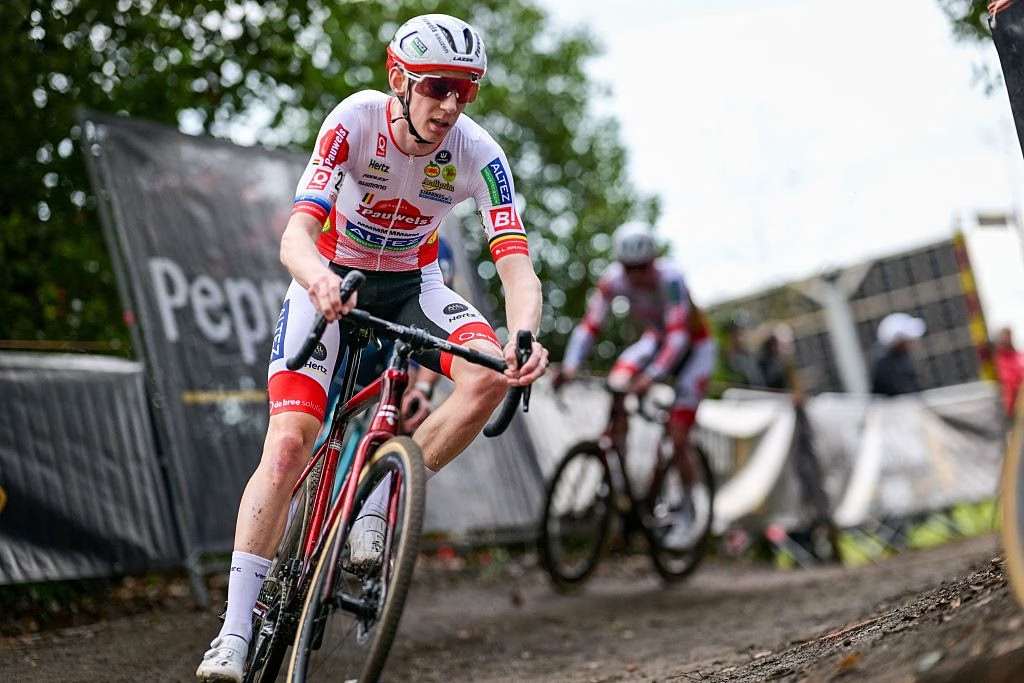
Thibau Nys’s first cyclocross appearance of the 2026–27 season produced one of the most revealing races of the autumn. He crashed twice at the Koppenbergcross on 1 November, chased back to Michael Vanthourenhout and still won by seven seconds. One result cannot settle a winter, but it showed how quickly the hierarchy can change when a leading road rider returns to the mud.
The early races have already produced several different kinds of form. Vanthourenhout has been winning through sustained pressure, Niels Vandeputte has remained prominent in the rankings and Superprestige, while Joran Wyseure, Joris Nieuwenhuis and Cameron Mason have made their cases on very different courses. Mathieu van der Poel and Wout van Aert remain major names to consider later in the winter, but reputation and a rolling UCI ranking are not evidence that they have already started racing this season.
Thibau Nys has already changed the picture
Nys began his cyclocross winter at the Koppenbergcross and immediately won. It was not a controlled procession. Two crashes left him chasing Vanthourenhout, who had been the strongest rider through much of October. Nys worked his way back, caught the leader in the closing stages and made the decisive move on the steep cobbled climb.
The seven-second winning margin understates the difficulty of the recovery. Nys had to use energy repeatedly to repair his position, yet he still had the power to make the final selection. That combination makes him a serious threat on climbing-heavy circuits and on courses where repeated accelerations matter more than one long, steady effort.
The result carried a warning alongside the victory. Crashes and handling mistakes cost him time, and a similarly untidy race against a stronger field could prove more expensive. His ability to win despite those errors is impressive, but it should not become an excuse to ignore them. The European Championships at Zeddam will ask a different set of technical questions.
Michael Vanthourenhout has the strongest early consistency
Vanthourenhout set the standard before Nys returned. He won the Superprestige opener at Overijse on 25 October after recovering from a poor start, waiting while the front group repeatedly split and then making the decisive attack late in the race. Witse Meeussen finished second, 15 seconds behind, and Vandeputte was third at 18 seconds.
That victory was his fourth in five cyclocross starts of the season, according to the contemporary race reporting. His second place at the Koppenbergcross a week later was hardly a collapse. He spent much of the race in front and was beaten by a rider capable of producing an exceptional late comeback. The difference between first and second there was seven seconds, not a gulf in form.
Vanthourenhout’s strength is the way he can absorb changes in pace without losing his race. On a demanding course, he does not always need the best start to win. He can work forward, stay patient and attack when opponents are beginning to pay for their earlier efforts. That makes him a credible contender across different winter series, not just at a venue that suits his preferred style.
Niels Vandeputte is more than a ranking position
The UCI men’s elite cyclocross ranking published on 27 October placed Niels Vandeputte first on 2,260 points, ahead of Mathieu van der Poel on 2,240 and Nys on 2,153. That table is useful context, but it is a rolling ranking rather than a simple scoreboard for the opening weeks of 2026–27. Van der Poel’s high position does not mean he has already raced this autumn.
Vandeputte has nevertheless earned attention on current results. His third place at Overijse kept him near Vanthourenhout and Meeussen in a race that required repeated accelerations and careful positioning. He can remain competitive even when the strongest riders make the race difficult from the start.
The next step is turning consistent podium-level riding into more major victories when Nys, Vanthourenhout and eventually other road specialists are present. A strong ranking reflects a broad body of work. Winning a particular Superprestige or World Cup round demands that everything comes together on the day. Vandeputte’s winter will be judged on both.
Joran Wyseure and Joris Nieuwenhuis suit demanding courses
Wyseure’s victory at the HG Cross Heerderstrand in October showed the value of choosing the right line through deep sand. He attacked on the final lap and beat Nieuwenhuis by seven seconds, with Vandeputte third. It was not a victory built solely on superior power. The choice of a firmer line close to the water allowed Wyseure to maintain speed when others were struggling for traction.
Nieuwenhuis finished second in that race and remains a rider to watch on courses that reward sustained pressure and careful handling. His 16th place at the Koppenbergcross on 1 November was a reminder that form is not uniform across venues. A poor result on a steep, technical circuit should not erase a stronger performance in the sand a week earlier.
Both riders can force the better-known favourites to race on their terms. If Wyseure or Nieuwenhuis establishes an early advantage on a course that suits him, Nys and Vanthourenhout may have to chase rather than control the pace. That can change the tactical balance of an entire round.
Cameron Mason, Felipe Orts and the international challenge
Cameron Mason has already shown that he can race near the front of strong Belgian fields. He was fourth at Overijse, 20 seconds behind Vanthourenhout, and fifth at the Koppenbergcross, just over a minute behind Nys. Those are different courses with different demands, making the results more useful together than either would be in isolation.
Mason’s development is significant for British cyclocross because he is competing against riders who spend much of the winter in the sport’s most demanding races. His challenge is to turn regular high placings into a win against the very best on a day when the field is deep. Clean starts and the ability to hold a fast line through technical passages are central to that ambition.
Spain’s Felipe Orts is another rider who has repeatedly shown he can remain competitive outside the traditional Belgian-Dutch centre of the sport. His sixth place at Overijse placed him among a strong group of contenders. A podium or victory in a major series race would be a further step, but his consistency already makes him an important part of the international picture.
The riders who could disrupt the established order
Gerben Kuypers was third at the Koppenbergcross and had been prominent at Overijse before a crash affected his chances. His performances suggest that he can be more than a supporting presence when the race becomes selective. Witse Meeussen’s second place at Overijse was another reminder that a strong result can come from a rider who is not the headline favourite before the start.
Pim Ronhaar finished fourth at the Koppenbergcross, while younger riders such as Tibor del Grosso remain worth monitoring as the season develops. A breakthrough need not arrive as one spectacular victory. A sequence of top-five finishes against the established leaders can be a better sign that a rider is ready to challenge regularly.
It is also worth watching how national championship and European Championship selections influence racing. Riders may skip a particular Superprestige round or alter their training before a target event. An absence from one start list does not necessarily indicate injury or poor form. The final entries, rather than social-media expectations, should determine who is considered a starter.
Van der Poel and Van Aert remain separate questions
Mathieu van der Poel and Wout van Aert have the ability to reshape the winter when they race, but their road programmes and individual schedules mean their cyclocross campaigns cannot simply be assumed to mirror those of full-time specialists. A preview written in early November must separate their historical ability from what has actually happened in the current season.
Van der Poel’s second place in the UCI ranking on 27 October illustrates the problem. The ranking incorporates results from a wider period and is not a list of riders who have competed in the last fortnight. It is accurate to describe him as one of the sport’s outstanding riders; it would be inaccurate to use that ranking alone as proof of early-season form.
Van Aert requires the same caution. His return, whenever confirmed, will change the tactical calculations for major races, but predicting a specific start or level of fitness without a reliable announcement would add little. Until schedules are established, the strongest evidence comes from the riders already racing and the results they have produced.
The races that will test this early form
The Superprestige continues at Middelkerke on Thursday, 5 November, with an unusual floodlit evening race. The European Championships follow at Zeddam on Saturday and Sunday, 7–8 November. The proximity of those events may influence who starts and how aggressively riders approach the Superprestige, particularly with a continental title available only days later.
Zeddam’s reconstructed staircase and technical course should provide a different test from the Koppenberg’s steep cobbled climb or the sand at Heerderstrand. The differences between those circuits explain why early form is difficult to rank. The strongest rider on one circuit is not automatically the fastest on another, and an early winter ranking can conceal important differences in handling and pacing.
For current context, see our Koppenbergcross report on Nys’s comeback win, Vanthourenhout’s Overijse victory and the 2026–27 cyclocross calendar. Those results and dates are a firmer basis for assessing the winter than treating the biggest names as automatic favourites in every race.
-
 Photo Credit: RCS Sport
-
 Photo Credit: RCS Sport
-
 Photo Credit: Getty