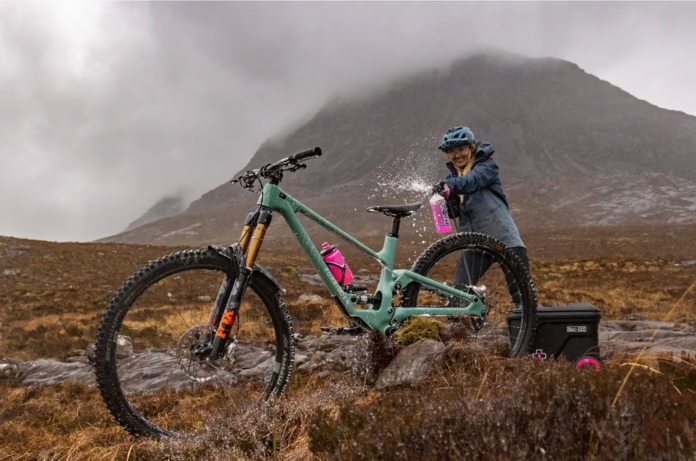
A muddy bike needs cleaning before grit works its way into the drivetrain, but the right tool depends heavily on where that cleaning happens. The Muc-Off Mobile Pressure Washer and Kärcher OC 3 Foldable both work without a hosepipe or mains socket. They are not, however, interchangeable versions of the same idea. Muc-Off has built a substantial cordless pressure washer around a 20-litre tank. Kärcher has made a compact, low-pressure rinse system that can fold down for storage.
The difference is visible in the numbers: 45 bar in Muc-Off’s normal Boost setting against 5 bar for the Kärcher, and £250 against a current UK listing of £129. The Muc-Off offers much more cleaning force and water capacity, while the Kärcher is lighter, quieter and easier to keep in a flat or car boot. Neither is automatically better simply because it delivers more pressure.
This is a research-based comparison using manufacturer specifications, current UK listings and independent hands-on assessments. ProCyclingUK has not tested these two machines side by side. The important distinction is between their published capabilities and what reviewers have actually reported using them.
Muc-Off Mobile Pressure Washer vs Kärcher OC 3 Foldable specifications
| Specification | Muc-Off Mobile Pressure Washer Starter Bundle | Kärcher OC 3 Foldable |
|---|---|---|
| UK price checked 31 October 2026 | £250, Muc-Off direct | £129, Craigmore; Argos lists £140 |
| Water tank | 20 litres, rigid and integrated | 8 litres, collapsible |
| Rated cleaning pressure | 35 bar Eco / 45 bar Boost | 5 bar low pressure |
| Maximum pressure | 65 bar with adjustable lance, not standard output | 5 bar |
| Claimed battery runtime | Up to 24 minutes Eco / 15 minutes Boost | Up to 15 minutes |
| Battery | Removable 40V lithium-ion | Integrated lithium-ion |
| Charging | Mains charger, about 3-4 hours | USB-C, about 2.25 hours |
| Dry weight | About 7.66kg | About 2.2kg |
| Hose | 5 metres | About 1.8 metres in Kärcher documentation |
| Accessories | Bike, motorcycle, adjustable and snow-foam lances | Low-pressure flat-jet nozzle |
| Best suited to | Heavy mud, several bikes, fixed cleaning base | Quick rinses, small homes, transport and storage |
The prices refer to specific products rather than an arbitrary comparison of discounted bundles. The Muc-Off figure is for the Mobile Pressure Washer Starter Bundle, including battery and charger. The Kärcher figure is an in-stock UK listing for the OC 3 Foldable; local availability and delivery costs can change. Both are direct, non-affiliate links.
Cleaning power is the biggest difference
Muc-Off’s 500W motor gives it the ability to shift thick mud that a gentle rinse may leave behind. The brand specifies 35 bar in Eco and 45 bar in Boost, with a higher 65-bar maximum through its adjustable lance. That maximum figure should not be mistaken for the pressure delivered constantly through the bike-specific lance. For a muddy mountain bike, cyclocross machine or gravel bike after a wet ride, the additional force is genuinely useful.
Independent testing supports that distinction. Cyclingnews found the Muc-Off effective at removing stubborn dirt and praised its selection of lances, although the reviewer considered it noisy and expensive. MBR also rated the cleaning performance highly while identifying a serious transport problem. This is an unusually powerful battery-operated unit, not simply a larger water bottle with a spray attachment.
Kärcher takes the opposite approach. Its 5-bar output feels more like a strong shower than a conventional pressure washer, and the flat spray is designed to lift fresh dirt without encouraging users to blast vulnerable components. Cyclingnews found it effective for routine post-ride cleaning and particularly useful in a home without an outside tap. Thick, dried-on mud will take more patience, perhaps a soft brush, and sometimes a second rinse.
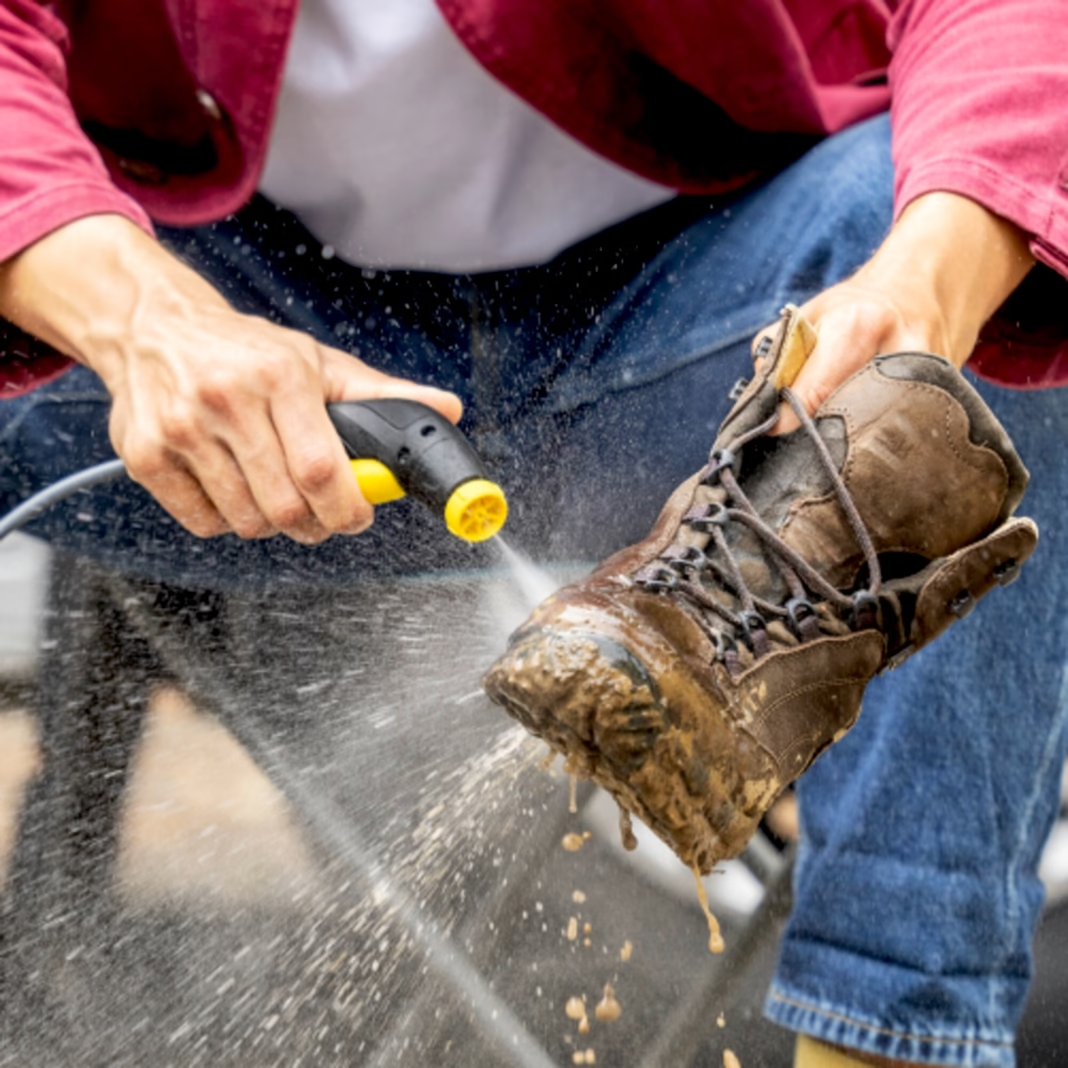 Photo Credit: Kärcher
Water capacity matters, but so does how quickly it is used
A 20-litre tank sounds dramatically more useful than eight litres, and for washing several bikes at a club session or after a muddy weekend it can be. Muc-Off specifies a rated flow of 3.3 litres per minute in its standard setting and 2.5 litres per minute in Eco. At continuous flow, that is only about six or eight minutes from a full tank. Trigger control and switching off while brushing make the water last much longer, but the quoted 15- or 24-minute battery runtime does not mean one tank will spray continuously for that long.
The Kärcher’s smaller reservoir is less limiting than it looks because its maximum flow is around two litres per minute. Even so, eight litres can disappear in roughly four minutes if the trigger is held down continuously. The practical lesson is the same for both products: wet the bike, stop spraying while working on the dirt, then rinse. A low-pressure washer is not a substitute for a brush when grit is stuck around the chainstay or tyres.
Portability is where the Kärcher pulls ahead
The OC 3 Foldable is built to be stored and transported empty. Its collapsible tank shrinks the machine into a compact shape, and the roughly 2.2kg dry weight is manageable when carrying it downstairs or putting it in a car. Filled, the water alone adds eight kilograms, but the point is that you can travel with the unit empty, carry water separately and set up where you need it. The integrated USB-C charging is convenient when storage space is limited.
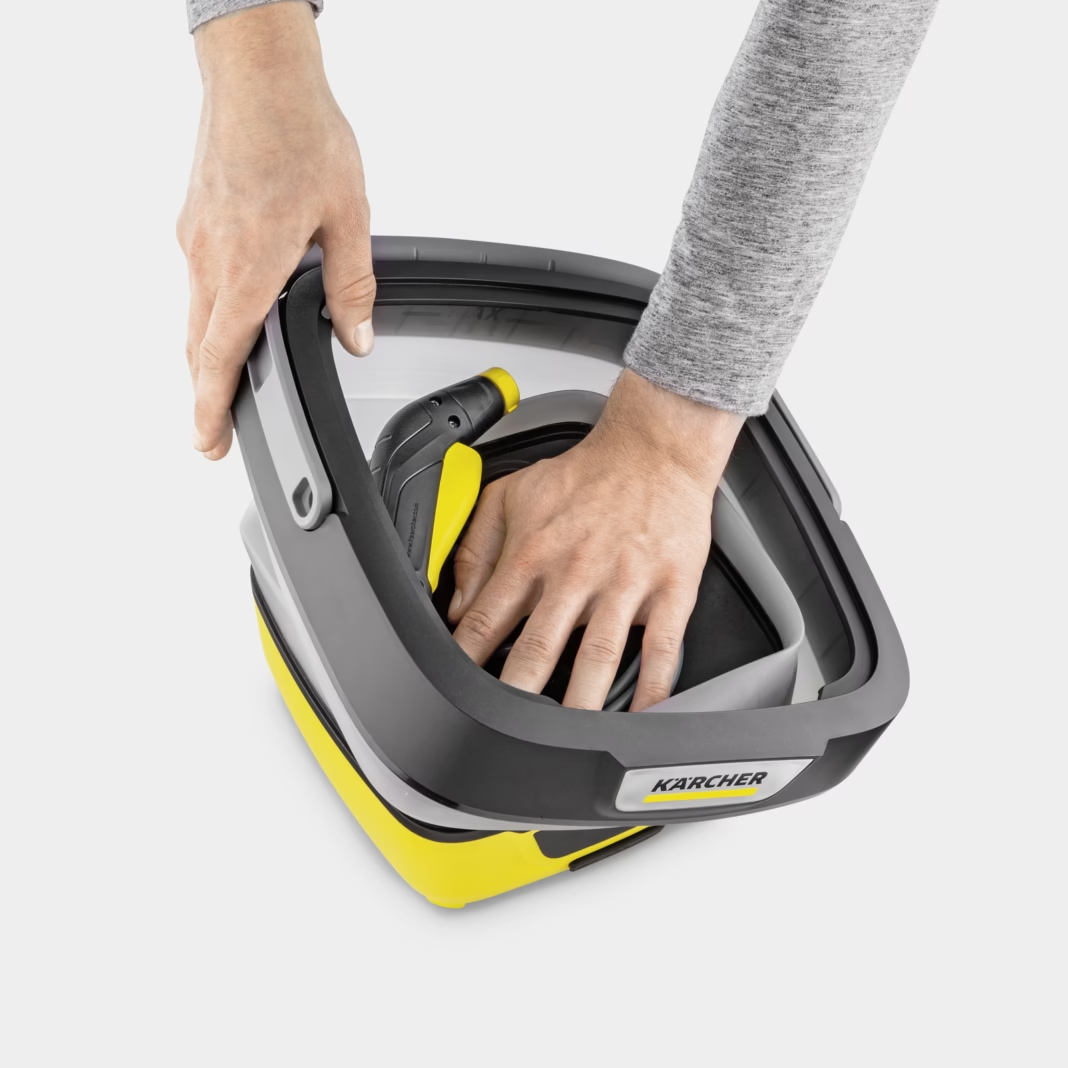 Photo Credit: Kärcher
Muc-Off’s unit weighs around 7.7kg before adding water. Fill its 20-litre tank and the total rises towards 28kg, which is a different proposition altogether. It has wheels and a pull handle, but those help once you have arrived; they do not make lifting a full machine into a boot sensible. The larger body also needs somewhere to live between rides.
There is a more serious issue than size. The Muc-Off reservoir is not sealed for travel. Muc-Off itself advises users to fill it just before cleaning rather than drive with it full, while both Cyclingnews and MBR identified leakage as a significant weakness. That matters because a self-contained washer sounds ideal for taking to a race. In practice, you may need a separate water container, which undermines part of the convenience that the larger tank promises.
Battery life, charging and working away from home
Muc-Off uses a removable 40V battery with claimed runtimes of 15 minutes in Boost and 24 in Eco, followed by a charging period of around three to four hours. The removable pack is useful if you buy a spare, although that adds to an already substantial purchase price. A five-metre hose lets the machine stay put while you move around the bike. The four supplied lances also make it more versatile for heavier cleaning jobs.
Kärcher claims up to 15 minutes from its integrated battery, with a roughly 2.25-hour USB-C recharge. Its shorter hose means you may have to reposition the unit, but the low-pressure output is quiet enough to be more neighbour-friendly than the Muc-Off. In Cyclingnews testing, one charge covered several routine bike washes. As with every battery claim, water temperature, trigger use and cleaning conditions will influence the result.
What about bearings, paint and drivetrain components?
Neither product gives you permission to point a concentrated jet directly at headset bearings, bottom-bracket seals, hub end caps or suspension seals. The Muc-Off’s higher pressure makes nozzle choice and distance particularly important. Use the bike-specific lance, keep the jet moving and work from a sensible distance. The 65-bar adjustable setting is not a target for cleaning delicate bicycle components.
The Kärcher’s 5-bar spray is less aggressive, making it the more forgiving option for a quick rinse of a road bike or an expensive gravel build. Low pressure is not a guarantee of zero risk, though. Avoid forcing water into electrical connectors, and dry and lubricate the chain afterwards. Neither machine removes the need for sensible drivetrain maintenance.
Accessories and the cost of ownership
The Muc-Off Starter Bundle includes a dedicated bicycle lance, an adjustable lance, a motorcycle lance and a snow-foam attachment, as well as the battery and charger. That gives it a wider range of uses, particularly if you also clean a muddy car, motorcycle or garden equipment. The snow-foam option is useful for pre-soaking grime, but it is an extra step involving cleaner rather than a substitute for washing and rinsing properly.
 Photo Credit: Muc-Off
The Kärcher is intentionally simpler. A flat-jet nozzle, integrated tank and compact hose are enough for a quick post-ride wash. Its lower price also leaves room in the budget for brushes, a chain cleaner and a separate water container. The comparison is not simply £250 versus £129, because Muc-Off delivers a stronger, more adaptable cleaning system. But if all you need is a rinse after road rides, much of that extra hardware may sit unused.
Which washer makes more sense for your riding?
For a flat, shared home or small storage cupboard: choose the Kärcher OC 3 Foldable. Its collapsible design, low weight and gentle spray solve the main problem without demanding a large storage space. The limited water capacity is manageable if you rinse promptly and use a brush rather than expecting pressure to do everything.
For regular muddy mountain bike or cyclocross sessions: the Muc-Off has a stronger case. The additional cleaning force, larger tank and multiple lances are useful when bikes arrive covered in thick mud. It makes most sense if you can fill the tank at the cleaning location and leave the machine on the ground rather than carrying it full.
For washing at a trailhead before driving home: consider how you will transport the water. The Muc-Off’s unsealed tank is a genuine drawback if you expected to arrive with 20 litres already inside. The Kärcher is easier to pack, but you will still need water available when you get there. Neither eliminates that logistical question.
For mixed road and gravel riding: the Kärcher is the better value for most riders. A road bike rarely needs the Muc-Off’s full pressure, and £121 is a meaningful saving at the UK prices checked. If you regularly wash several heavily soiled bikes, that calculation can change.
There is also a broader buying decision. If you already have an outdoor tap, a conventional hose and brush may be sufficient. These cordless washers earn their place when access to water and electricity is awkward. For the wider field, our portable bike washer buying guide covers four models, while the separate Muc-Off Mobile Pressure Washer review and Kärcher OC 3 Foldable review examine each machine in greater detail.
-
 Photo Credit: Alpecin-Premier Tech (official team announcement)