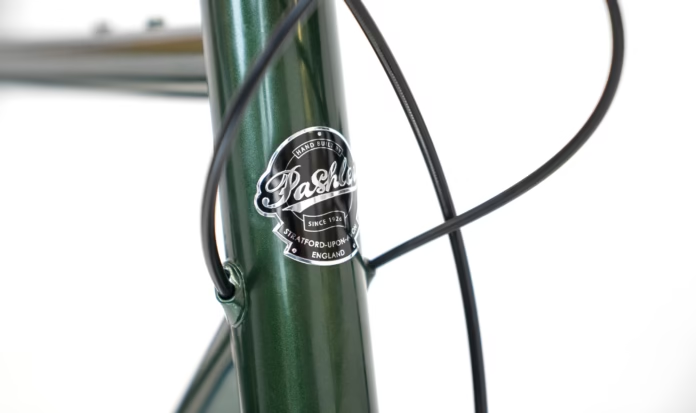
Pashley’s Roadfinder collection has moved from a 2025 launch into a broader permanent range. The core idea is unchanged: hand-built Reynolds steel frames made in Stratford-upon-Avon, modern components and enough tyre clearance and luggage capacity to cover road riding, gravel, commuting and light touring.
The range is now easier to understand than it was at launch because the models have settled into clear roles. The Roadfinder and Roadfinder X remain the non-electric all-road and gravel options, the Roadfinder E and XE add Mahle X20 assistance, and the newer Roadfinder SL pushes the platform towards faster road riding.
As of September 2026, complete Roadfinder and Roadfinder X bikes start at £2,795, the Roadfinder E and XE start at £3,995, the Roadfinder SL starts at £3,595 and the standard Roadfinder frameset is £1,795. Pashley builds the range to order rather than treating it as a mass-market stock bike.
Pashley Roadfinder range at a glance
| Model | Main use | Current starting price | Key difference |
|---|---|---|---|
| Roadfinder | Road, endurance, light gravel | £2,795 | Reynolds 853 steel, road-focused setup and 45mm tyre clearance |
| Roadfinder X | Gravel and mixed-surface riding | £2,795 | Gravel gearing and tyres with the same handmade steel platform |
| Roadfinder E | Assisted road and all-road riding | £3,995 | Mahle X20 rear-hub motor and 250Wh internal battery |
| Roadfinder XE | Assisted gravel and trail riding | £3,995 | Electric assistance with gravel-focused specification |
| Roadfinder SL | Faster road riding | £3,595 | Lighter, sharper road-focused evolution of the original platform |
| Roadfinder frameset | Custom builds | £1,795 | Reynolds steel frame ready for a bespoke build |

The original Roadfinder concept still makes sense
Pashley launched the Roadfinder around the idea of one steel platform covering several kinds of riding rather than forcing buyers into a narrowly defined road or gravel category. That remains the most convincing part of the design.
The standard Roadfinder uses Reynolds 853 double-butted steel tubing with Pashley’s 3D-printed stainless-steel frame details and a Columbus Futura carbon fork. Tyre clearance extends to 45mm, while the frame includes bottle and luggage mounts, internal routing and a T47 bottom bracket. The geometry is deliberately more stable than a traditional race bike without becoming as upright as a touring bike.
That puts it in the same broad all-road space now occupied by many endurance and gravel bikes. The difference is the hand-built steel construction and the amount of customisation available. Pashley remains one of the few British manufacturers still building this kind of frame in-house, something covered more broadly in our guide to Pashley bikes and its Stratford-upon-Avon manufacturing.

Roadfinder vs Roadfinder X
The Roadfinder and Roadfinder X share the same basic philosophy but are sold with different riding priorities. The normal Roadfinder is the faster road-biased option, using 35mm Panaracer GravelKing slick tyres and road groupsets including Shimano 105, Ultegra Di2 and Campagnolo Super Record.
The Roadfinder X moves further towards gravel, with options based around Shimano GRX, Campagnolo Ekar and SRAM Rival AXS. Current builds use 45mm GravelKing tyres, giving the X more volume and grip for bridleways, forest roads and rough tracks.
Both start at £2,795 in the UK in September 2026. That makes the choice more about where you ride than budget. Riders spending most of their time on tarmac with occasional gravel will be better served by the Roadfinder, while the X makes more sense if mixed surfaces are a regular part of the route.

Roadfinder E and XE add Mahle X20 assistance
The electric Roadfinder models use Mahle’s X20 rear-hub system rather than a large mid-drive motor. On the Roadfinder E, Pashley quotes 55Nm of assistance from the hub motor with a 250Wh internal battery, while complete-bike weight is around 13kg depending on specification.
That is an important distinction from heavier utility e-bikes. The Roadfinder E is intended to retain the handling and appearance of a conventional road bike while providing assistance on climbs and longer rides. The XE applies the same principle to gravel riding, with wider tyres and gravel-specific gearing.
Both electric versions currently start at £3,995. They are expensive compared with mainstream aluminium e-bikes, but the proposition is different: these are hand-built Reynolds steel bikes with discreet assistance rather than transport-focused machines.

The Roadfinder SL expands the family towards performance road riding
The biggest change since the original Roadfinder launch is the arrival of the Roadfinder SL. It uses a refined Reynolds 853 and 725CS steel frame, a more aggressive road position and a Columbus Futura SLX fork, with Pashley positioning it as the lighter and sharper member of the family.
Complete SL bikes start at £3,595, while the SL frameset is available separately. Its arrival makes the range more coherent: the original Roadfinder remains the versatile all-road option, the X handles gravel, the electric models add assistance and the SL gives riders a more focused road bike without leaving Pashley’s steel-frame approach.
Who is the Pashley Roadfinder for?
The Roadfinder is not trying to compete with budget carbon race bikes on weight or price. Its appeal is to riders who want a bike built around versatility, steel ride quality and British frame-building, with enough modern detail to avoid the compromises associated with deliberately retro machines.
For a rider who wants one bike for club rides, commuting, light touring and occasional gravel, the normal Roadfinder is the logical starting point. The X is the stronger choice when off-road riding is frequent, while the E and XE suit riders who want the same style of bike with discreet assistance.
Pashley’s wider range has also grown since the original Roadfinder launch. The newer Pashley Prospero collection takes the company’s hand-built steel approach into a more urban direction, making the Roadfinder family the more performance-focused side of the modern line-up.