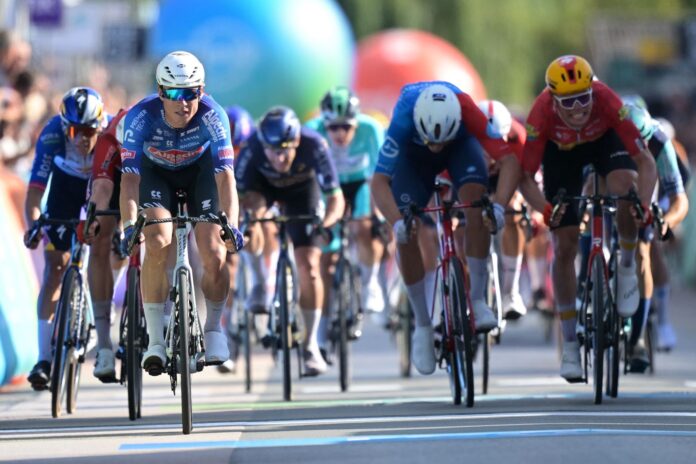
Jasper Philipsen won stage 2 of the 2026 Renewi Tour in Ardooie, sprinting clear after a chaotic, wind-hit finale that took several of his biggest rivals out of contention.
The Alpecin-Premier Tech rider came through the disorder best, launching into open road and winning by a clear margin after a messy final kilometre. The victory also moved Philipsen into the race lead after opening-stage winner Jonathan Milan crashed heavily earlier in the stage and was unable to contest the sprint.
Olav Kooij and Tim Merlier were both caught up in the final chaos, with Merlier slipping off his pedal in the closing metres and Kooij unable to properly open his sprint. After Milan had beaten Kooij by the narrowest of margins on stage 1, stage 2 produced another sprint finish, but with a very different shape.
A flat stage with plenty of hidden danger
Stage 2 took the riders from Blankenberge to Ardooie, a familiar Renewi Tour route that looked like a sprint stage on paper but carried the usual Belgian complications.
The roads were flat, fast and exposed. That meant the threat was not climbing, but wind, positioning and crashes. After the rain-soaked opening stage in Diest, where Milan beat Kooij in a photo finish after a late breakaway was caught inside the final kilometre, the sprinters’ teams came into stage 2 expecting another bunch finish.
The route encouraged that expectation. Ardooie has become a regular sprint destination in this race, and the past editions on similar roads have often gone to fast men who can survive the nervousness and hold position through the final kilometres.
The problem was that the stage never settled into a clean procession. The wind made the race edgy, the peloton repeatedly split and reformed, and the finale became less about raw speed than survival and timing.
Milan starts in the leader’s jersey
Milan began the day in the race lead after his photo-finish victory on stage 1. The Lidl-Trek sprinter had edged Kooij in Diest after a long, wet chase of the breakaway, taking the first leader’s jersey and establishing himself as the early reference point.
That made stage 2 a chance to defend yellow and potentially add another sprint victory. Milan had already won on the Blankenberge to Ardooie road in a previous edition of this race, and the finish suited his power.
But the leader’s jersey also meant greater pressure. Lidl-Trek had to keep him out of trouble on roads where teams were constantly fighting for position and where the wind could turn even a flat stage into a selection race.
That pressure eventually told. Milan’s stage changed not in the sprint, but much earlier, when a heavy crash took him out of the fight for victory.
Wind keeps the race nervous
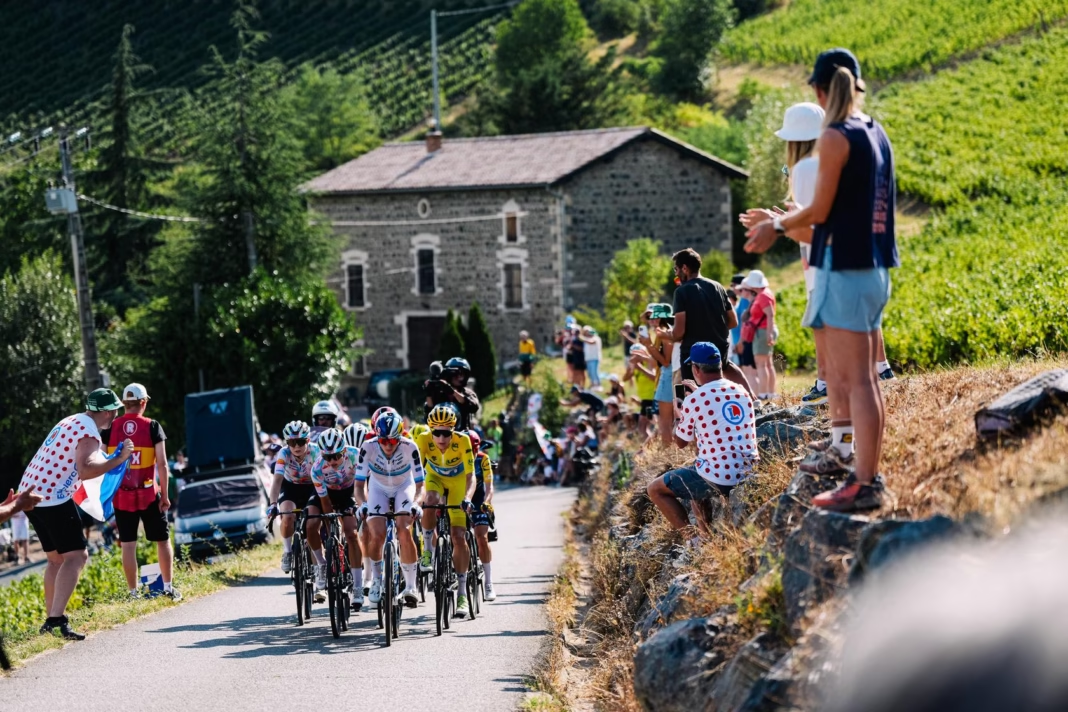
The wind was the defining feature of the stage long before the finish. On exposed roads heading away from the coast, the peloton repeatedly stretched across the road as teams tried to hold position and avoid being caught behind splits.
This is the kind of racing the Renewi Tour often produces. The profile may look flat, but the fight for position can make it harder than a hilly day. Once the bunch is lined out in crosswinds, any hesitation, puncture or crash can put a rider in a second group with little time to recover.
The sprinters’ teams had to stay permanently alert. Alpecin-Premier Tech were especially sharp around Philipsen, while Decathlon CMA CGM, Soudal Quick-Step and Lidl-Trek were all trying to keep their leaders near the front.
The stage was still likely to finish in a sprint, but not necessarily with every favourite still involved.
Milan crashes heavily
The biggest turning point came when Milan crashed in the leader’s jersey.
The Italian went down heavily and although he was able to continue, the crash effectively ended his hopes of contesting the finish. Later reports suggested he was ordered to pull over after being lapped by the peloton following the incident, underlining how completely his stage had unravelled.
It was a brutal reversal after the previous day’s victory. Milan had started stage 2 as race leader and one of the obvious favourites to win again in Ardooie. Instead, he was removed from the sprint picture by the kind of crash that can define these flat, nervous Belgian stages.
For Lidl-Trek, the situation changed immediately. Their race was no longer about setting up Milan for another sprint. It became about damage limitation and getting the leader to the finish.
For Philipsen, Kooij and Merlier, one major rival had gone. But the finale would remove others too.
Alpecin-Premier Tech stay calm
Philipsen’s victory was built on staying calm while the race around him became increasingly messy.
Alpecin-Premier Tech had been well positioned through the wind and the late tension. That mattered because the final sprint did not reward the fastest rider coming from deep. It rewarded the rider who could stay out of trouble, hold the correct wheel and avoid the traffic that swallowed several rivals.
Philipsen has sometimes been criticised for waiting too long in messy sprints, but in Ardooie he judged it correctly. He did not get boxed in. He did not hesitate when the opening appeared. He launched into space while others were still trying to recover their positions.
It was not a perfectly choreographed lead-out victory. It was a sprinter reading chaos better than everyone around him.
Kooij and Merlier lose their chance
Kooij and Merlier both came into the finale as stage-winning threats, but neither was able to properly contest the sprint.
Kooij had finished second on stage 1, only just losing to Milan in the photo finish. Stage 2 looked like an immediate chance for revenge, especially with Milan out of contention. Instead, he was caught up in the disorder of the closing kilometre and could not properly launch.
Merlier’s sprint was also ruined. The Soudal Quick-Step rider slipped off his pedal in the final stretch, losing the momentum needed to fight for the win. In a finish decided at high speed, that kind of disruption is terminal.
That left Philipsen with the clearest path. He still had to finish the job, but the sprint had opened in his favour. Two of the fastest men in the race had been removed from the equation by positioning, contact and bad luck rather than pure speed.
Philipsen wins by a distance
Once Philipsen found the gap, the result was emphatic. He powered clear and crossed the line first in Ardooie, taking both the stage victory and the overall lead.
The margin at the line reflected the chaos behind him. This was not a tight photo finish like stage 1. Philipsen had open road, while the riders behind were still trying to reorganise after the final kilometre had gone wrong for several teams.
It was an important win for several reasons. It gave Philipsen a WorldTour stage victory on home roads, it moved him into the race lead, and it came against one of the strongest sprint fields assembled in a short stage race this season.
Milan had crashed. Kooij and Merlier had been disrupted. Philipsen was the one who made it through cleanly, and on a stage like this, that was the whole point.
The race lead changes hands
Philipsen moved into the Renewi Tour lead after the win, taking over from Milan after the Italian’s difficult day.
That changes the race. The Renewi Tour is not just a run of sprint stages. The coming days include more selective terrain, especially the stage to Geraardsbergen and the final weekend roads where time bonuses, positioning and short climbs can all matter.
Philipsen now has a reason to think beyond stage wins. He has shown before that he can survive hard Belgian terrain, and with bonus seconds already in his favour, he becomes more than simply a sprinter chasing individual stages.
The question is whether Alpecin-Premier Tech can defend the jersey once the race moves away from pure sprint terrain. Stage 2 has put them in control, but the Renewi Tour rarely stays controlled for long.
A costly day for Milan and Lidl-Trek
For Milan, stage 2 was a harsh reminder of how quickly a race can turn. He had started the day in the leader’s jersey after a perfect opening stage. By the end, the jersey was gone, and his own sprint chance had disappeared through a heavy crash.
The immediate concern will be how he recovered physically. Crashes on flat, fast roads can look routine until the consequences become clear later. Even if Milan remains in the race, losing the leader’s jersey and missing the sprint in Ardooie is a significant blow.
Lidl-Trek will also have to reassess their approach. Milan is still one of the fastest riders in the race if he is healthy, but the GC situation has changed, and the next stages may be harder to manage from a recovery standpoint.
Stage 1 showed his power. Stage 2 showed the risk that comes with defending a lead in Belgian conditions.
A sprint stage that was not simple
On the results sheet, stage 2 will look like a bunch sprint won by Philipsen. In reality, it was much more complicated.
The wind thinned and stressed the peloton. Milan crashed out of the fight for the stage and the lead. Kooij was unable to contest the sprint properly. Merlier’s final kick was derailed when he slipped off his pedal. Philipsen did not just win because he was fast. He won because he and Alpecin-Premier Tech navigated the chaos better than anyone else.
That is often the difference in the Renewi Tour. The race offers flat stages, but rarely easy ones. The roads are exposed, the sprinter field is deep, the final kilometres are crowded and every team knows that a small mistake can cost a stage or a jersey.
Philipsen made no such mistake in Ardooie.
Renewi Tour 2026 stage 2 result
| Position | Rider | Team | Time/gap |
|---|---|---|---|
| 1 | Jasper Philipsen | Alpecin-Premier Tech | 3:11:27 |
| 2 | Joshua Giddings | Lotto-Intermarché | same time |
| 3 | Søren Wærenskjold | Uno-X Mobility | same time |
| 4 | Matteo Milan | Groupama-FDJ United | same time |
| 5 | Arvid de Kleijn | Tudor Pro Cycling Team | same time |
| 6 | Arne Marit | Red Bull-BORA-hansgrohe | same time |
| 7 | Žak Eržen | Bahrain Victorious | same time |
| 8 | Huub Artz | Lotto-Intermarché | same time |
| 9 | Sam Bennett | Pinarello-Q36.5 Pro Cycling Team | same time |
| 10 | Tim Merlier | Soudal Quick-Step | same time |
Main photo credit: Getty