Just after half past 2pm on 23rd September 2006, 135 riders rolled out of Salzburg’s Mirabellplatz for six laps of a demanding 22.2km World Championship circuit. Two climbs punctuated each lap, with the drag to Elixhausen standing out as the tactical hinge of the day. Cresting it meant a near-continuous nine-kilometre descent to the line – enough road for attacks to fly, but not always enough to sustain them.
For the established contenders, this was a course to be controlled and survived. For a fearless 19-year-old Marianne Vos, riding her first elite World Championships, it was an invitation.
The Dutch teenager had already proved herself alarmingly versatile during her debut year. Ten road victories, including the European U23 title, the Limousin overall and the Dutch national championship, had marked her as one to watch. Her cyclocross season before that had been even more emphatic – seven wins and a world title. Yet she arrived in Salzburg with no pressure and no burden of leadership. The Dutch team had experience in Chantal Beltman; the favourites, though, were Germany’s Judith Arndt and Regina Schleicher, and Britain’s World Cup winner Nicole Cooke.
Early moves and steady control
Predictably for a championship race, the first laps were restless. Anne Samplonius and Natalia Boyarskaya broke clear early, stretching their advantage over the second climb but never gaining enough to unsettle the main nations. Germany, with depth and cohesion, took responsibility for the chase. Arndt in particular worked hard to keep the race within reach and prevent any dangerous combinations from forming.
Their caution was justified. When Cooke launched her first major attack on the penultimate lap, she did so with a clear objective. As she later wrote in The Breakaway, the move had been pre-planned: hit the bottom of the climb, force an elite selection, and take only climbers with her. It worked. Vos and Swiss rider Nicole Brändli responded, forming a promising trio. But when Arndt committed herself behind, the elastic snapped back. The leaders were caught.
The tone was set. Every lull triggered another acceleration; every acceleration provoked a counter. Gradually, a sizeable front group formed, already with more than a minute on a fragmented peloton. And still no one blinked.
Cooke tries again – and the final selection
Cooke is not a rider inclined to wait for a sprint, especially not against a teenager already known for her finishing speed. She attacked again on the last lap, Brändli and Vos once more quick to react. Yet the story repeated itself. The Germans were too organised, the group too strong, and the trio were reeled in.
With one kilometre remaining, 15 riders were still in contention, setting up a sprint that had once seemed unlikely on such a hard course.
Vos, sitting sixth, was where she needed to be. Cooke was two wheels ahead, on Oenone Wood’s slipstream. German sprinter Trixi Worrack hovered ominously.
A decisive bend and a perfect sprint
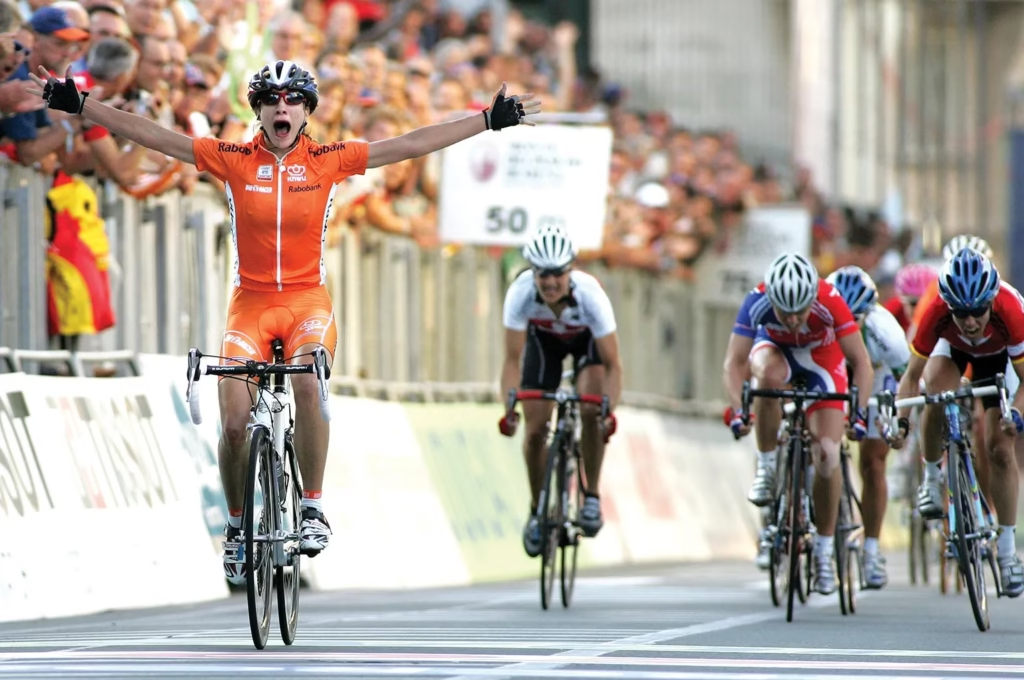
At 400 metres to go came the critical bend to the left. Vos chose to hug the inside barrier, sensing that the shorter line was worth the risk. Cooke took the wider path on the right. For a rider still technically a first-year professional, Vos’ commitment was remarkable.
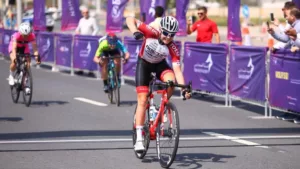
She launched at 200 metres. There was no hesitation, no flick of the elbows, no second thought. She simply powered into the open space she had created, and no one could live with it. Worrack came closest but never threatened. Cooke sprinted to third, frustrated but beaten.
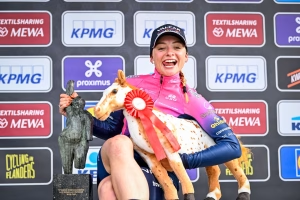
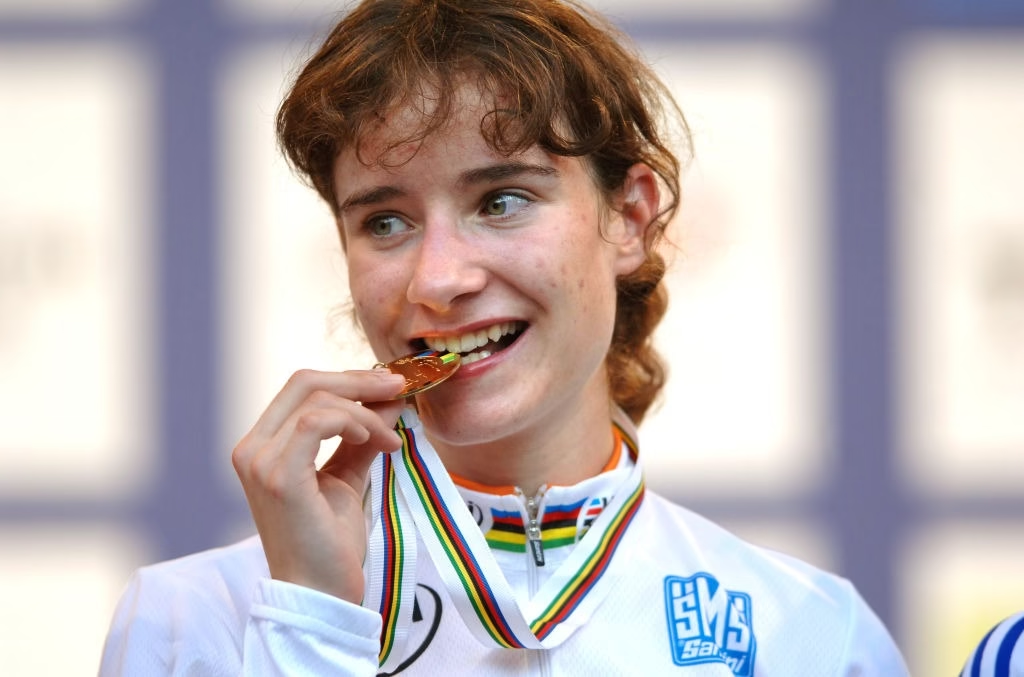
A 19-year-old had just won her first elite rainbow jersey at the first attempt.
In the Netherlands, NRC Handelsblad captured it perfectly: “Marianne Vos surprised herself and the world.” Vos’ own reaction reflected that same disbelief: “I’m surprised if I win a criterium – can you imagine how I feel now?”
Inside the Dutch camp
Vos later revealed how calmly the Dutch team had assessed their options once the main group had gone clear. Beltman, an experienced campaigner, recognised the truth immediately: Vos was the best sprinter in the move. She told her young teammate not to panic, not to follow every surge, and simply to be ready.
Vos recalled: “She really pointed it out. From that moment we discussed things.”
Beltman even proposed a long-range move to soften the others – a plan Vos supported. Their intent wasn’t to guarantee a solo victory. It was to make the finale harder for everyone else and easier for Vos. And so it proved.
Aftermath of a breakthrough
The victory changed everything. “The Cannibal” era, though no one knew it yet, had begun.
In the immediate hours after the race, Vos found herself in an odd situation. The Dutch squad headed out to celebrate, but in classic teenage fashion, she first had to dig through her suitcase to find something to wear. “They forgot me,” she laughed years later. “They were already on their way until Chantal realised, ‘Where’s Marianne?’ They came back to pick me up.”
It was the most unassuming start imaginable to one of the greatest careers the sport has ever seen.
Context from the race documents
Official records emphasise just how hard the final circuits were. Cooke’s attack on the Gschaiderberg climb created massive splits, drawing out a breakaway populated by an exceptional cast: Brändli, Arndt, Senff, Worrack, Doppmann, Beutler, Bubnenkova, Wood, Amber Neben, and Vos. Multiple moves followed on the last lap, but nothing stuck. A reduced bunch sprint was inevitable – and Vos handled it with startling maturity.
Her post-race comments reinforced this:
“It was hard to stay with Brandli and Cooke but after we were pulled back, I thought I might just have a chance in the sprint. I had no idea I could win so clearly. When I saw there was nobody else there, I knew I’d done it.”
For Cooke, who had shaped the race more than any other rider, there was pride but also resignation:
“Marianne and I worked very hard in the break, but we weren’t strong enough with the German squad chasing. I’m happy with my ride – I helped shape the race all the way through.”
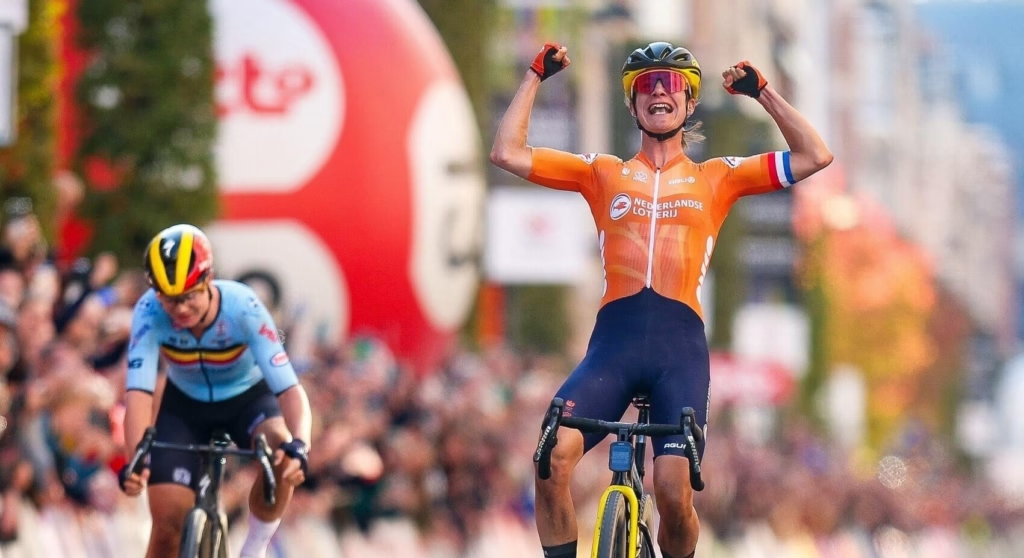 Photo Credit: Cor Vos
Legacy of Salzburg 2006
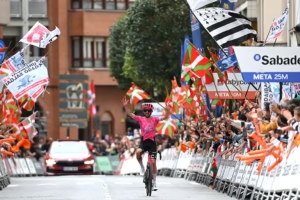
Vos’ win was only the beginning. Eighteen years later, she would add a Gravel World Championship to a palmarès that already included world titles across road, track and cyclocross, an Olympic gold, victories in the Giro, Flèche Wallonne, the Tour of Flanders and countless others. No rider in history has matched such all-terrain dominance.
But Salzburg retains its unique place in the story. It was where she proved she belonged, where her instincts first translated into world-class brilliance, and where a teenager with no pressure announced herself as the defining cyclist of her generation.
One final detail cements the sense of history: of the 135 riders who took the start that day in 2006, Marianne Vos is the only one still racing at elite level in 2025.
A career of astonishing breadth began with one perfect sprint on a cold afternoon in Austria.