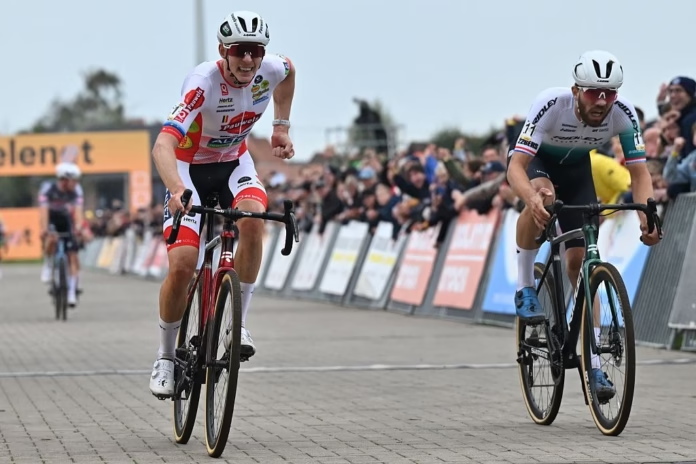
Michael Vanthourenhout has already won twice in October, and the defending Overijse champion has a compelling form argument as the Telenet Superprestige begins on Sunday 25 October 2026. The elite men’s race starts at 15:10 CET in Belgium, equivalent to 14:10 GMT in the UK. Overijse is a familiar but demanding stage for cyclocross, with wooded gradients, rapid changes of pace and little room for a rider to recover from successive handling mistakes.
Joris Nieuwenhuis supplied another major marker of early form by winning the Nacht van Woerden on 20 October in his first race of the season, finishing thirteen seconds ahead of Niels Vandeputte and fifteen ahead of Felipe Orts. Vanthourenhout had previously won both the opening HG Cross at Dendermonde and the Meulebeke round, where Jente Michels and Vandeputte completed the podium. That sets up a useful comparison if the strongest riders appear at Overijse, although those results do not replace a confirmed start list.
Vanthourenhout won the 2025 men’s Druivencross ahead of Pim Ronhaar and Emiel Verstrynge. Thibau Nys won the 2024 race, while Eli Iserbyt took the 2023 edition. Overijse therefore has a roll of honour spanning very different rider types: punchy accelerators, strong climbers and riders capable of surviving awkward transitions after a steep effort.
The 2026 race is the opening round of an eight-event Superprestige calendar, rather than a one-off race carrying no overall consequence. The official organiser has confirmed the programme and venue, but the final men’s start list and exact updated lap map are not available on its published event page in the source checked. This preview separates those verified facts from the likely competitive picture.
Previous Winners
| Year | Winner | Other podium riders |
|---|---|---|
| 2025 | Michael Vanthourenhout | Pim Ronhaar, Emiel Verstrynge |
| 2024 | Thibau Nys | See official classification |
| 2023 | Eli Iserbyt | See official classification |
Vanthourenhout’s 2025 success helped establish him as one of the men most comfortable on this type of course. Ronhaar’s second place matters too, given the Dutchman’s ability to force pace over repeated hard sections. The 2024 win for Nys underlines that a rider with a powerful acceleration can make decisive use of the short climbs, particularly when the approach to the technical section is already selective.
 Photo Credit: Getty
The Overijse circuit: where the men may be separated
The Vlaamse Druivencross is held in the Belgian grape-growing country outside Brussels and is one of the older names in cyclocross. The circuit uses the wooded slopes around Begijnhof, combining changes in gradient with technical turns and stretches where the grip can alter quickly. It is not a uniform climbing race: the important work often occurs on the transition from a hard uphill effort into a descent or corner.
At the top of a rise, a rider has to judge whether there is enough traction and space to accelerate immediately. Those behind may be riding at a different speed or using a compromised line after losing position. On a course where hills and tight sections arrive repeatedly, a stronger competitor can turn that difference into a gap without needing one exceptionally long attack.
Rain would make the descents and off-camber surfaces more difficult, but the precise conditions cannot be fixed several days out. The final 2026 circuit map is also not yet confirmed in the public organiser information, so a specific bank, barrier or descent from a previous edition should not be described as guaranteed. What can be said confidently is that Overijse usually demands careful handling between steep efforts.
The start is particularly important because a rider arriving at the first narrow section in traffic may have no route around a small mistake. If the strongest favourites reach the front quickly, the pace can stretch out the field before anybody deliberately attacks. Conversely, an early fall or puncture can leave a major contender spending half the race riding back through smaller groups.
The fastest lap is not necessarily the one ridden most aggressively. Riders sometimes gain time by keeping a little more control through slippery bends and accelerating cleanly afterwards. A rival who brakes too late and loses grip may need another 20 seconds of intense riding merely to restore the position that a smoother line would have preserved.
Vanthourenhout and the challengers: what October’s results show
Vanthourenhout won HG Cross Dendermonde on 11 October, then followed up with victory at Meulebeke on 17 October. Michels finished second in the latter race and Vandeputte third. Success on two different courses suggests the defending Overijse champion is already capable of sustaining a winning intensity, which matters more at this point in the season than last winter’s results in isolation.
Nieuwenhuis’s Woerden win on 20 October was especially interesting because he had missed the first part of the season before returning. He won in 1:03:37, with Vandeputte thirteen seconds behind and Orts another two seconds back. The win establishes current race speed, but Overijse’s gradients will ask a different question from the fast urban circuit at Woerden. If Nieuwenhuis starts, a strong opening position could let him dictate the early tempo.
Vandeputte has repeatedly reached the front group without necessarily turning those performances into victory. A podium at Meulebeke and second in Woerden within four days provide good evidence of consistency. He won the overall Superprestige title in 2025–26, so accumulating points across the series may be as important to his winter strategy as winning one race in October.
Michels followed Vanthourenhout home at Meulebeke and finished fourth at Woerden. Those results suggest he can recover well between races while maintaining a strong level. Ronhaar was second at Overijse in 2025 but did not finish among the leading riders at Woerden on 20 October. Course familiarity remains relevant, though form on the same weekend will matter more than an older podium.
Thibau Nys is a prominent local name and the 2024 Overijse winner, but his past result should not be presented as a confirmed entry. The local authority’s event information encourages supporters to watch for him, while the organiser’s public event page has not finalised its list in the source consulted. That distinction matters: a headline predicting a duel with a rider who later does not start would be of little value to readers.
Tactics and the cost of racing on consecutive days
Heerde takes place on Saturday, with Overijse the following afternoon. Anyone racing both events will have less than a day between race efforts, travel, recovery and pre-race practice. Heerde’s coarse sand asks for repeated explosive accelerations after dismounting; Overijse tends to reward the ability to push on steep gradients while continuing to control the bicycle when the terrain turns against a rider.
A rider who spends a long time chasing in Heerde may pay for that effort on Sunday, particularly if Overijse begins at an unusually high pace. That does not mean the strongest competitors will automatically conserve energy on Saturday, because a win carries its own value. It does make the balance between an economical technical performance and a desperate chase worth watching.
An early escape at Overijse can prove difficult to reverse if the leader maintains the same pace over the climbs. The chasing group must not only close the gap in the faster sections, but also avoid losing the newly recovered time on every descent or corner. Riders able to apply steady pressure over multiple laps therefore have a strong case, even against a rival with a faster finishing sprint.
There is also a points argument. The current Superprestige regulations give fifteen points to the winner, fourteen to second place and one fewer down to fifteenth. Over eight rounds, a rider who avoids one disastrous result can benefit more than someone who wins early and then misses several races. The opening round sets the tone, but the full winter programme remains the real test of consistency.
ProCyclingUK’s Overijse history guide covers the longer record, while the 2026–27 cyclocross calendar shows how the series fits alongside World Cup racing and HG Cross.
When to watch in Britain and getting to Overijse
The elite men start at 15:10 CET on Sunday 25 October, or 14:10 GMT in Britain. European HBO Max listings indicate a live stream beginning around 15:07 Belgian time, equivalent to 14:07 GMT. Rights can differ by territory, so UK viewers should look for the Overijse men’s event within the HBO Max TNT Sports section rather than assuming a particular numbered TNT Sports channel. The elite women start at 13:40 CET, or 12:40 GMT.
The move to GMT on Sunday is important. Both the UK and Belgium change their clocks overnight, so the time difference remains one hour, but the British clock is no longer on BST. Heerde on Saturday uses BST; Overijse on Sunday uses GMT. A saved reminder that mixes those standards will be an hour wrong.
Advance tickets for Overijse cost €16.50 including the booking charge, rising to €18.50 on the day. Children born in 2014 or later enter free with a ticket, and residents of Overijse have a local free-ticket arrangement. The main race area is around Begijnhof, with separate spectator parking information on the organiser’s site. Walking or cycling to a safe viewing point should be planned around race-day road closures.
The first men to reach the steep and technical sections cleanly are likely to dictate the race. Vanthourenhout’s two October wins, Nieuwenhuis’s return at Woerden and Vandeputte’s consistent podium form all offer solid reasons to follow them, provided they appear on the final entry list. The shape of the opening laps will tell us quickly whether Overijse rewards an early solo move or a smaller group that remains together into the closing circuits.
Top 3 Prediction
Subject to all three starting: Michael Vanthourenhout, Joris Nieuwenhuis, Niels Vandeputte. This is a form-based prediction, not a substitute for the organiser’s confirmed 2026 entry list.