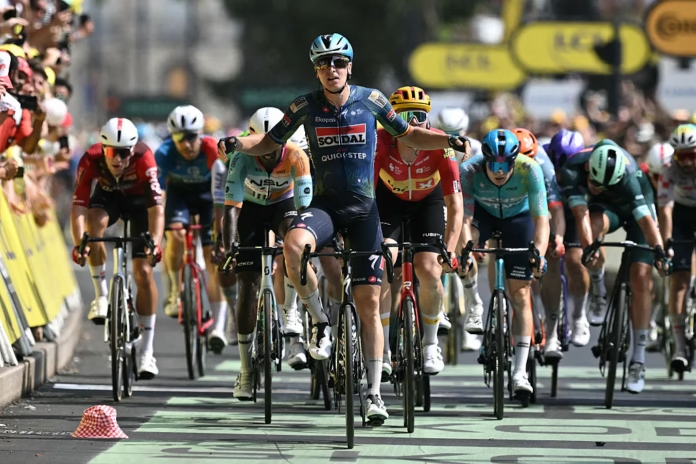
Tim Merlier won stage 7 of the 2026 Tour de France in Bordeaux, sprinting to victory for Soudal Quick-Step after a fast and controlled run-in beside the Garonne. The Belgian beat Søren Wærenskjold of Uno-X Mobility and Biniam Girmay of NSN Cycling Team, with Max Kanter fourth for XDS Astana Team and Jasper Philipsen fifth for Alpecin-Premier Tech.
Phil Bauhaus finished sixth for Bahrain Victorious, ahead of Huub Artz, Dorian Godon, Mads Pedersen and Tom Van Asbroeck. All of the top 10 were credited with the same time of 3:44:20 after a stage that had looked almost certain to end in a bunch sprint from the opening kilometres.
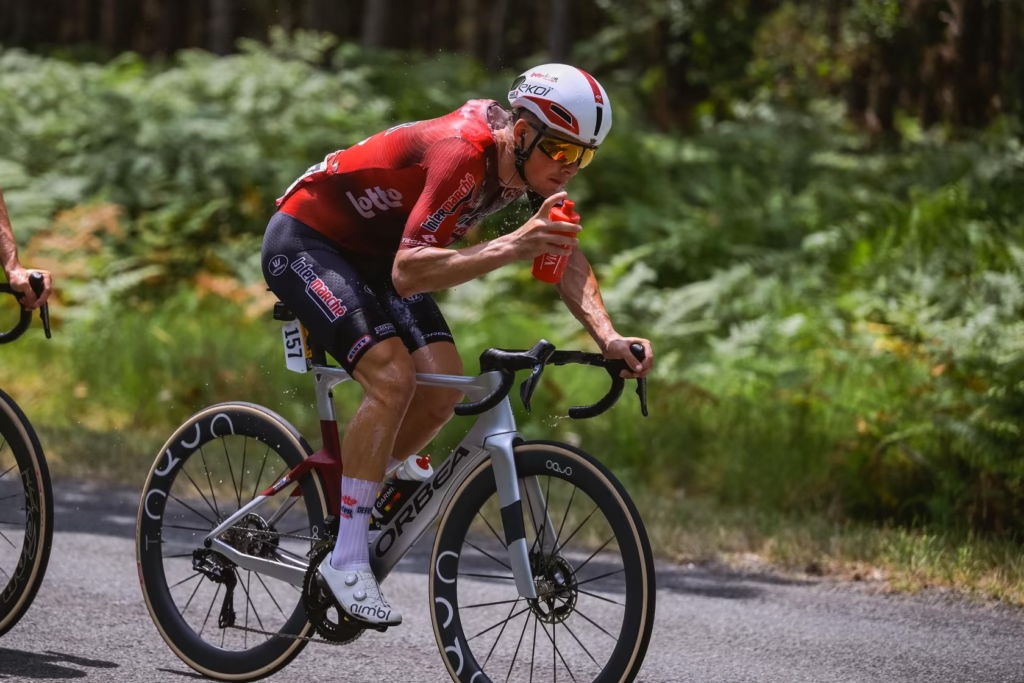
The day had been animated by Baptiste Veistroffer and Jakub Otruba, who attacked from kilometre zero and spent 157 kilometres at the front before being brought back inside the final 20 kilometres. Veistroffer, already aggressive earlier in the race, was named the most combative rider for the second time in three days.
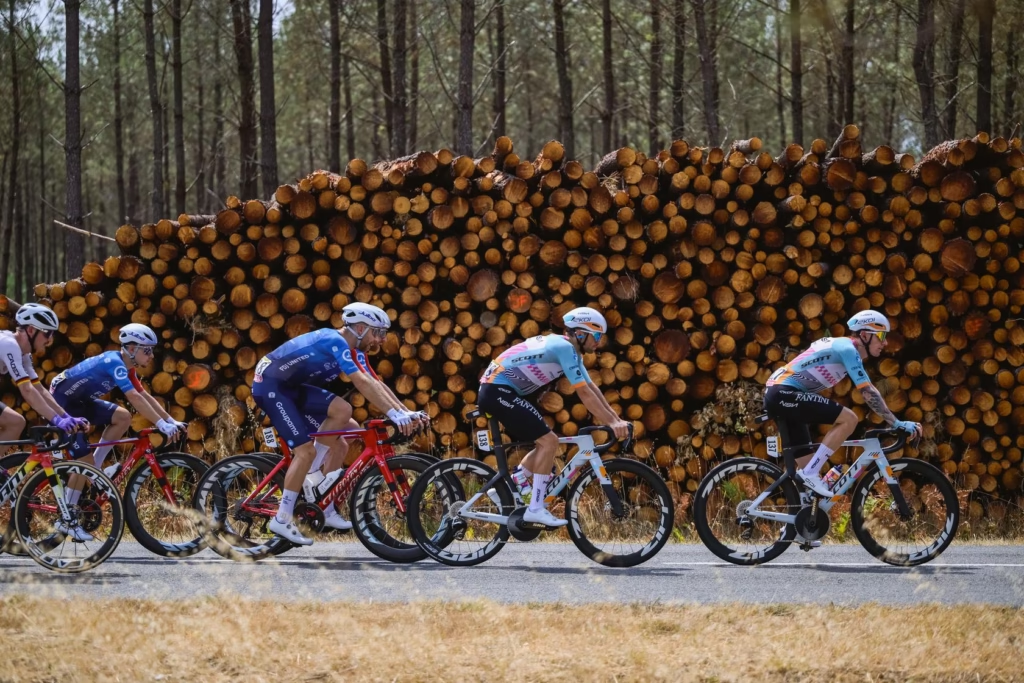 Photo Credit: A.S.O./Charly López
A sprint stage into Bordeaux
Stage 7 took the riders over 175.1 kilometres from Hagetmau to Bordeaux, a city with deep Tour de France history and a long association with sprint finishes. After Pogačar’s Tourmalet demolition on stage 6, this was a day for the fast men, even if the heat and fatigue from the Pyrenees made it far from effortless.
The profile was almost entirely flat, with only the category 4 Côte de Béguey offering a single mountains point inside the final third of the stage. The main tactical question was not whether the sprinters’ teams would chase, but how tightly they would keep control.
Tadej Pogačar started the day in yellow after taking command of the race at Gavarnie-Gèdre. The GC favourites had little reason to complicate the day, and the sprint teams had every reason to make use of a rare clear opportunity in the opening week.
Bordeaux offered a wide, fast finale rather than a highly technical one. There were only a few turns in the final 5 kilometres, including a right-left chicane before the Simone-Veil Bridge, then a long run along the Garonne before the line came into view with around 560 metres remaining.
Veistroffer attacks again
The breakaway formed immediately. Veistroffer, riding for Lotto Intermarché, attacked as soon as the flag dropped, repeating the same instinct that had sent him up the road on stage 5. This time, he was joined by Jakub Otruba of Caja Rural-Seguros RGA.
The peloton did not react with panic, but it also refused to give the pair much room. Alpecin-Premier Tech and Soudal Quick-Step moved quickly to control the gap, working for Philipsen and Merlier respectively. The margin was already being managed at around 1:20 after only a handful of kilometres.
That told the story of the stage. The sprinter teams wanted the breakaway visible, manageable and close enough to discourage a more dangerous counter-move from behind. The gap rarely moved much beyond 1:30, even though Veistroffer and Otruba were strong enough to make the peloton keep working.
For Veistroffer, the move continued an impressive opening week. With Lotto Intermarché having lost Arnaud De Lie earlier in the race, the Frenchman has become one of the team’s main sources of visibility and aggression.
Sprinter teams keep the race locked down
The first half of the stage was controlled but not entirely passive. Alpecin-Premier Tech and Soudal Quick-Step did most of the work, while other sprint teams waited behind. The pace was steady rather than frantic, partly because the riders were still carrying the fatigue from the previous day’s high mountain stage.
There were moments when the gap came down almost by accident, forcing the bunch to ease slightly to avoid catching the break too early. The risk was obvious: if Veistroffer and Otruba were brought back too soon, fresher attackers could launch and create a harder chase.
Uno-X Mobility tried to disturb the pattern at around 110 kilometres to go, with several riders moving aggressively from the peloton. Jonas Abrahamsen was among those involved, but the move was brought back and the race settled again.
Pedersen also tried to go on the attack later in the stage, followed by riders including Abrahamsen, Campenaerts, Verstrynge and Guernalec. That move also failed to split the bunch, and Dylan van Baarle soon returned to the front for Soudal Quick-Step.
Pedersen strengthens green jersey lead
The intermediate sprint in Landiras was the main point of interest before the finale. Veistroffer rolled through first to take 25 points, with Otruba second for 20, but the real contest came behind from the peloton.
Pedersen opened his sprint early and held off Girmay to take the best of the remaining points. Kanter, Philipsen and Merlier followed, meaning the green jersey contenders all scored but Pedersen extended his advantage again.
The Dane’s strategy was clear. He may not be the fastest pure sprinter in the race, but he has been collecting points through breakaways, intermediate sprints and harder stages. Landiras was another example of that approach paying off.
The intermediate sprint also briefly pulled the break’s advantage down to around 25 seconds, but the peloton allowed the pair to move back out again. There was still one categorised climb to come, and the bunch had no need to force the catch too early.
Veistroffer takes the only KOM point
The Côte de Béguey, 1.2 kilometres at 4.4 per cent, was the only classified climb of the day. Veistroffer and Otruba reached it with just under a minute in hand, giving the Lotto Intermarché rider the chance to add one more small prize to his breakaway.
Veistroffer took the KOM point ahead of Otruba. Behind them, Matej Mohorič briefly accelerated on the climb, but his move was quickly shut down. The sprinter teams were still in control and were not allowing the climb to open a more complicated finale.
The gap dropped again after the climb, but the leading pair did not immediately surrender. Veistroffer and Otruba had paced their effort well, and with fewer than 50 kilometres remaining they were still forcing the peloton to chase properly.
Their ride was not just symbolic. They covered the first 100 kilometres at an average of 44.9km/h, and by the time they were eventually caught, their full breakaway had averaged 46.3km/h. It was a serious effort, even if the stage always looked weighted towards the bunch.
Uno-X try to disrupt the sprint
With the breakaway coming under pressure, Uno-X Mobility tried again. Anders Skaarseth and Jonas Abrahamsen attacked with around 22 kilometres remaining, briefly opening a small gap and forcing Soudal Quick-Step and the sprint teams to respond.
The move was caught, but it showed that the sprint was not entirely settled. Veistroffer and Otruba were still ahead, and the peloton had to react to fresh attacks rather than simply bring the break back on schedule.
The leading pair were caught inside the final 20 kilometres after 157 kilometres out front. Veistroffer still had enough energy to try one more acceleration before the catch, but Otruba followed and the peloton closed them down soon afterwards.
Uno-X tried again with 12 kilometres to go, this time with Huub Artz, Kasper Asgreen and John Degenkolb following the move from Skaarseth and Abrahamsen. But the response was fast, and the race was all together again with 10 kilometres remaining.
Fast, stretched run-in to Bordeaux
The final 10 kilometres were fast and increasingly tense. Picnic PostNL had warned its riders on race radio about a narrowing at 7.2 kilometres to go, where the road moved down to one lane on the right. That increased the fight for position well before the final sprint trains fully formed.
Netcompany INEOS and Cofidis were prominent inside the last 6 kilometres, with Dorian Godon and Milan Fretin both well protected. NSN Cycling Team also moved up for Girmay, while Alpecin-Premier Tech and Soudal Quick-Step waited for the right moment to take over.
The peloton was travelling at around 60km/h in the final kilometres, stretching into a long line as riders were distanced at the back. Benjamin Thomas took a turn for Cofidis, while the road furniture and roundabouts forced teams to choose lines carefully.
Inside the final kilometre, Alpecin-Premier Tech moved to the front with a long lead-out for Philipsen. Mathieu van der Poel was in place to deliver the Belgian, but Merlier had also been positioned well by Soudal Quick-Step.
Merlier beats Wærenskjold and Girmay
Alpecin-Premier Tech looked to have taken control at the right moment, but Merlier came through best when the sprint opened. Philipsen had Van der Poel in front of him, yet the expected Alpecin finish did not land.
Merlier launched with the timing and speed to beat the rest, taking the stage win for Soudal Quick-Step. Wærenskjold produced an excellent sprint for second after Uno-X Mobility had spent parts of the finale trying to attack as well as set up the bunch finish.
Girmay completed the podium for NSN Cycling Team, continuing his consistent points scoring after also taking 14 points at the intermediate sprint. Kanter, who had scored again at Landiras, finished fourth, while Philipsen had to settle for fifth despite Alpecin-Premier Tech’s late control.
Bauhaus, Artz, Godon, Pedersen and Van Asbroeck completed the top 10. For Merlier, the win was a sharp response after missing out in Pau and another reminder that he remains one of the fastest pure sprinters in the Tour.
Sprint hierarchy shifts again
The 2026 Tour sprint picture has already changed several times. Kooij won in Pau after a crash-split reduced the front group. In Bordeaux, there was a cleaner bunch sprint, and Merlier proved fastest.
Philipsen had looked one of the obvious favourites given the history of Bordeaux and Alpecin-Premier Tech’s lead-out strength, but fifth place was another frustration after his fifth in Pau. He remains in the green jersey conversation, but the stage wins have not yet followed.
Wærenskjold’s second place was an important result for Uno-X Mobility. The team had been aggressive late on and still managed to place its sprinter on the podium, showing that their ambitions extend beyond opportunistic attacks.
Girmay’s third keeps him close in the points fight, while Kanter’s fourth continued his steady accumulation. Pedersen, despite finishing ninth, again added to his green jersey total through the intermediate sprint and remains the rider shaping that competition through consistency rather than pure bunch-sprint dominance.
Calm day for Pogačar and the GC contenders
After the violence of the Tourmalet stage, the GC favourites had a quieter day. Pogačar stayed safe in yellow, with no splits or crashes affecting the main contenders. The weather remained hot, but the pace through much of the stage was controlled enough for the peloton to recover from the previous day’s damage.
There were still subplots. Vingegaard began the day after losing heavily to Pogačar on stage 6 and had little reason to take risks. Evenepoel, meanwhile, was under attention after his frustration with Florian Lipowitz, though the stage itself gave Red Bull-Bora-Hansgrohe no real need to reveal anything tactically.
Tom Pidcock also entered the day after admitting disappointment with his position on GC following the high mountain losses. A flat stage to Bordeaux was not the place to change that, but it did at least move the race away from the immediate pressure of the Pyrenees.
The GC race now waits for the next opportunity. Stage 7 belonged to the sprinters, and Merlier took full advantage.
Tour de France 2026 stage 7 result
| Position | Rider | Team | Time/gap |
|---|---|---|---|
| 1 | Tim Merlier | Soudal Quick-Step | 3:44:20 |
| 2 | Søren Wærenskjold | Uno-X Mobility | same time |
| 3 | Biniam Girmay | NSN Cycling Team | same time |
| 4 | Max Kanter | XDS Astana Team | same time |
| 5 | Jasper Philipsen | Alpecin-Premier Tech | same time |
| 6 | Phil Bauhaus | Bahrain Victorious | same time |
| 7 | Huub Artz | Lotto Intermarché | same time |
| 8 | Dorian Godon | Netcompany INEOS Cycling Team | same time |
| 9 | Mads Pedersen | Lidl-Trek | same time |
| 10 | Tom Van Asbroeck | NSN Cycling Team | same time |
Main photo credit: Getty
-
 Photo Credit: Cs-wolves / Wikimedia Commons, CC BY-SA 4.0