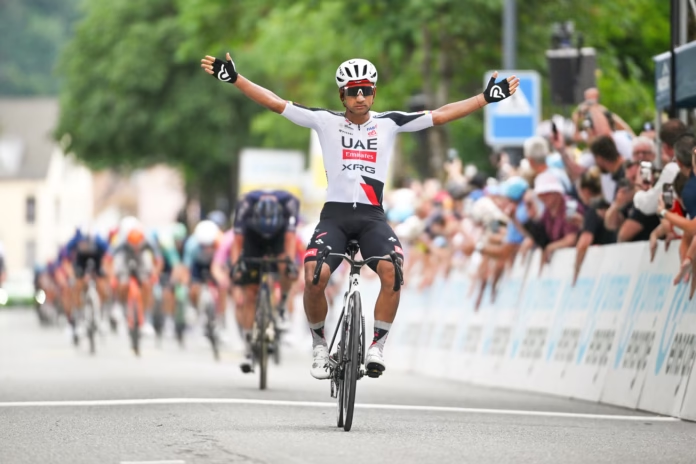
Jhonatan Narváez won stage 3 of the 2026 Tour de Suisse in Bad Ragaz after a two-rider breakaway held off the sprinters’ teams by the narrowest of margins. The UAE Team Emirates-XRG rider beat Xandro Meurisse of Pinarello-Q36.5 in a head-to-head sprint after the pair had gone clear on the day’s second climb and defended their advantage across the flat final 55 kilometres.
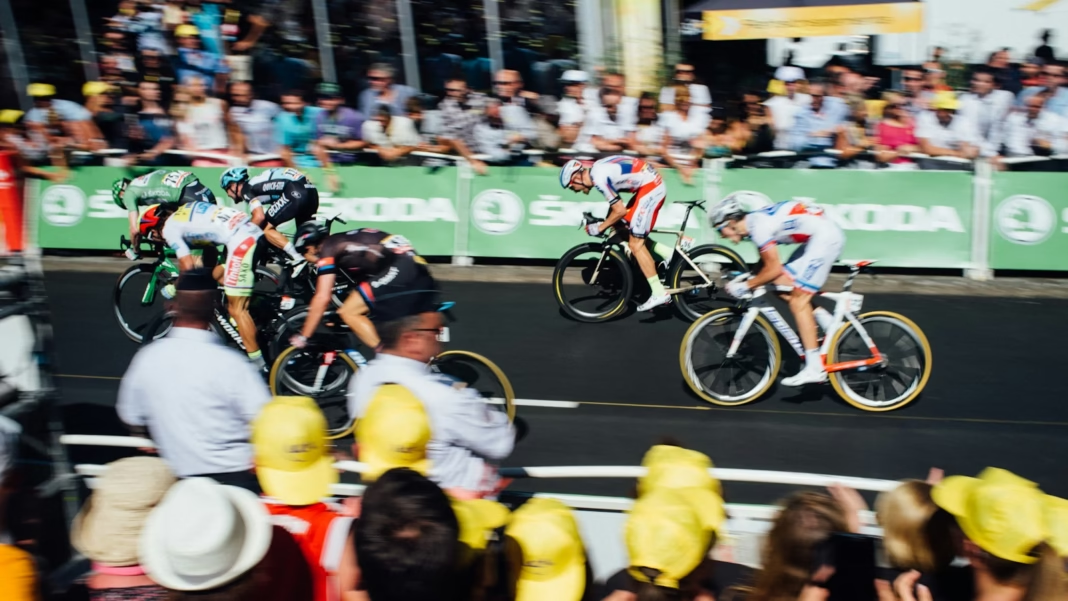
The peloton came home right behind them, with Magnus Cort leading the bunch sprint just a few bike lengths after Meurisse crossed the line. Narváez had forced Meurisse to the front as the pace slowed in the final 500 metres, then launched his sprint with just under 200 metres to go. The Belgian had no answer, and Narváez stormed clear to take the stage.
Tadej Pogačar retained the yellow jersey after a rare quiet day in the bunch. After attacking from long range on stage 1 and chasing hard on stage 2, the race leader was able to sit in the peloton while teammate Narváez gave UAE Team Emirates-XRG another stage win. With the time-trial and final mountain stage still to come, Pogačar remains firmly in control of the general classification.
Delayed start before a hard opening
Stage 3 started and finished in Bad Ragaz, covering 157.4 kilometres on a route that looked like a possible sprint opportunity if the peloton could survive the early climbing and bring the race back on the flat run-in. The roll-out was delayed briefly, but once the riders reached kilometre zero, the fight for the breakaway began immediately.
The early roads were already difficult, with an uncategorised climb stringing out the peloton and dropping several riders. Bauke Mollema was among the first to try a move, but the decisive early break formed after around 15 kilometres of racing.
Seven riders went clear: Axel Laurance, Sam Oomen, Sander De Pestel, Lorenzo Germani, Louis Vervaeke, Simon Dalby and Marco Brenner. The peloton had briefly split behind them but reformed, allowing the move to grow to around 40 seconds, then 90 seconds after 25 kilometres.
It looked like the day’s break had formed, but the first categorised climb changed everything. The Wildhaus, 9.4 kilometres at 6.6 per cent, gave stronger riders a chance to bridge and reshuffle the whole stage.
Wildhaus reshapes the race
The breakaway reached Wildhaus with a modest lead, but the climb quickly brought the peloton back into attacking range. The gap dropped below a minute, and riders began jumping across from the bunch.
Narváez, Enric Mas, Paul Double and Jan Hirt were among those who bridged, while more riders continued to chase behind. The front group swelled to 16, but the pressure was high enough that the situation remained unstable.
Vervaeke led over the top of Wildhaus ahead of Double and Alexandr Vlasov, but the descent fragmented the peloton and left the race still far from settled. On the flatter section between the two main climbs, the peloton was effectively split into two large groups, while fresh attacks continued before the Schwägalp.
That second climb, 4 kilometres at 8.4 per cent, became the launchpad for the decisive move. Michal Kwiatkowski, Narváez and Meurisse attacked as the race moved towards the foot of the climb, with more riders trying to follow.
Narváez and Meurisse go clear
Kwiatkowski was soon dropped, leaving Narváez and Meurisse alone at the front as the ramps of the Schwägalp bit. Behind them, an eight-rider chase group formed with Vlasov, Kwiatkowski, Antonio Tiberi, Ewen Costiou, Emiel Verstrynge, Max Schachmann, Dalby and Brenner.
The two leaders quickly built a serious advantage. Meurisse led Narváez over the top of the climb, with almost 2 minutes on the chase group and close to 4 minutes on the peloton. That margin made the move dangerous, even if the profile still gave the bunch a long flat run-in to organise a chase.
Narváez looked the more comfortable rider on the descents, taking corners more fluently while Meurisse had to work harder out of bends. Even so, the pair continued to trade turns well, and their gap to the peloton rose to 4:30 with 80 kilometres still to race.
The chase group, by contrast, began to lose purpose. They slipped to almost 3 minutes behind the leaders and were gradually drawn back towards the peloton. Once that happened, the race became simple: two riders out front against a peloton that expected to sprint.
Rain complicates the chase
With 70 kilometres remaining, Narváez and Meurisse had around 4 minutes on the bunch. The final 55 kilometres were largely flat, which made a catch seem likely if enough sprint teams committed, but the weather began to interfere.
A sudden downpour hit the race on a fast descent, soaking the roads and making the peloton more cautious. Narváez and Meurisse handled the conditions better, while the bunch descended more carefully. The gap initially dipped, then began to nudge out again.
By 50 kilometres to go, the chase group had been caught, leaving one full peloton behind the leading duo. The margin was still 3:50, and the race looked chaseable if the sprinters’ teams organised properly. Team Visma | Lease a Bike had interest for Matthew Brennan, EF Education-EasyPost had fast options in the reduced bunch, and Jayco AlUla had Michael Matthews. Movistar, Lidl-Trek and NSN also had reasons to work.
The issue was coordination. UAE Team Emirates-XRG were prominent near the front, but with Narváez up the road and Pogačar in yellow, they had no reason to help the sprint teams. If anything, their presence only complicated the rhythm behind.
Peloton leaves itself too much to do
With 40 kilometres remaining, the gap was still 3:10. Only 40 seconds had been taken back in the previous 10 kilometres, and the chase was not yet moving at the required rate. The rain intensified again, with water bouncing off the tarmac, and the peloton’s organisation remained uneven.
Jayco AlUla, Team Visma | Lease a Bike, EF Education-EasyPost and later Lidl-Trek and Movistar all contributed at different points, but the chase never settled into a long, consistent line. At 30 kilometres to go, Narváez and Meurisse still had 2:40. The bunch had the firepower on paper, but not the continuity.
The catch began to look more realistic inside the final 20 kilometres. The gap dropped to 1:40, then below 2 minutes, then down to 1 minute with 10 kilometres remaining. The peloton had finally started to take time back at the necessary rate, but the earlier hesitation meant there was now no room for error.
Narváez and Meurisse continued to work cleanly. They also swept up the maximum bonus seconds at both Tissot sprints inside the final 14 kilometres, although by then the only real concern was whether they could survive to the finish.
Narváez and Meurisse hang on
Inside the final 10 kilometres, the race balanced on a knife-edge. The gap was 50 seconds with 8 kilometres left, 42 seconds with 6 kilometres, then 35 seconds with 4 kilometres. The peloton was closing, but not decisively enough.
The chase started to fall apart at exactly the wrong time. Pinarello-Q36.5 sent a rider towards the front of the bunch, but with Meurisse ahead, there was no incentive to help. That kind of disruption mattered. The sprint teams needed a smooth, committed line, and instead the rhythm kept breaking.
With 2 kilometres remaining, Narváez and Meurisse still had 30 seconds. They could not afford to start looking at each other, but the balance had shifted. Pogačar briefly found himself on the front of the peloton and had no intention of chasing his teammate. NSN then tried to lift the pace again, but the leaders still had enough.
Television pictures and race communications dropped in the final kilometre, adding confusion to the finish. When coverage returned, the result was clear: Narváez had beaten Meurisse, and the peloton had arrived just too late.
Narváez wins the sprint
The replays showed how Narváez handled the final metres. He put Meurisse on the front as the pace slowed in the last 500 metres, making the Belgian commit first. Then, with just under 200 metres to go, he opened his sprint.
Meurisse had no real response. After such a long effort together, Narváez still had the sharper finish and enough strength to open a clear gap before the line. The peloton was right behind, but not close enough to deny the two leaders.
Cort led the bunch sprint a few bike lengths behind Meurisse, with the peloton given the same time. For the sprint teams, it was a frustrating miss. The route had offered a clear chance after the early climbs, but the chase started too late and lost structure too often in the final 40 kilometres.
For UAE Team Emirates-XRG, it was a near-perfect outcome. Narváez won the stage, Pogačar stayed safe in yellow, and the team had no need to spend unnecessary energy chasing. After Pogačar’s stage 1 dominance and the near-catch on stage 2, this time UAE used the race situation in a different way.
Pogačar keeps yellow before decisive weekend
Pogačar’s quiet day may end up being useful. The next two stages should decide the race, with the time-trial followed by the final mountain stage, and the Slovenian already has a commanding overall lead from his opening-day raid in Sondrio.
Stage 3 did not change the GC picture, but it did show how much control UAE Team Emirates-XRG can exert without always riding on the front. With Narváez up the road, they forced other teams to take responsibility, and when those teams hesitated, the breakaway had enough room to survive.
Meurisse came close to a major victory for Pinarello-Q36.5, and his ride was central to the escape’s success. He worked honestly with Narváez, survived the climbs and helped hold off a peloton that always seemed likely to catch them until the final few kilometres. The only thing missing was the sprint.
For the sprinters, Bad Ragaz became a missed opportunity. Brennan, Matthews, Cort and others had the scenario they wanted once the race flattened out, but a two-man move with a strong UAE rider and a committed partner proved just too resilient.
The Tour de Suisse has now delivered three very different stages: Pogačar’s long-range destruction in Sondrio, Grégoire’s breakaway sprint in Locarno, and Narváez’s two-up escape in Bad Ragaz. The general classification still belongs firmly to Pogačar, but the fight for stage wins is proving far less predictable.
Tour de Suisse 2026 stage 3 result
| Position | Rider | Team | Time/gap |
|---|---|---|---|
| 1 | Jhonatan Narváez | UAE Team Emirates-XRG | 3:34:46 |
| 2 | Xandro Meurisse | Alpecin-Premier Tech | same time |
| 3 | Magnus Cort | Uno-X Mobility | same time |
| 4 | Marijn van den Berg | EF Education-EasyPost | same time |
| 5 | Mathieu van der Poel | Alpecin-Premier Tech | same time |
| 6 | Corbin Strong | NSN Cycling Team | same time |
| 7 | Axel Laurance | Netcompany INEOS Cycling Team | same time |
| 8 | Michael Matthews | Team Jayco AlUla | same time |
| 9 | Pau Miquel | Bahrain Victorious | same time |
| 10 | Finn Fisher-Black | Red Bull-BORA-hansgrohe | same time |
Main photo credit: Getty