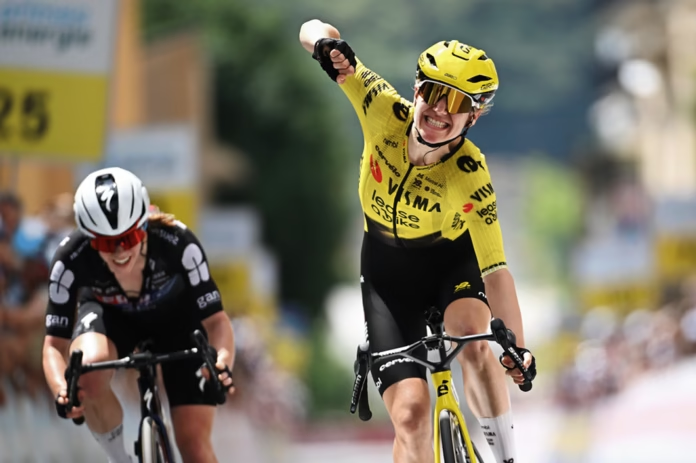
Femke de Vries took the first professional win of her career on stage 1 of the 2026 Tour de Suisse Women, winning in Sondrio after a bold late move with Lauren Dickson survived the final climbs and descent. The Team Visma | Lease a Bike rider beat Dickson in the sprint after the pair had gone clear from the day’s decisive selection, giving her team a WorldTour victory and the opening leader’s jersey.
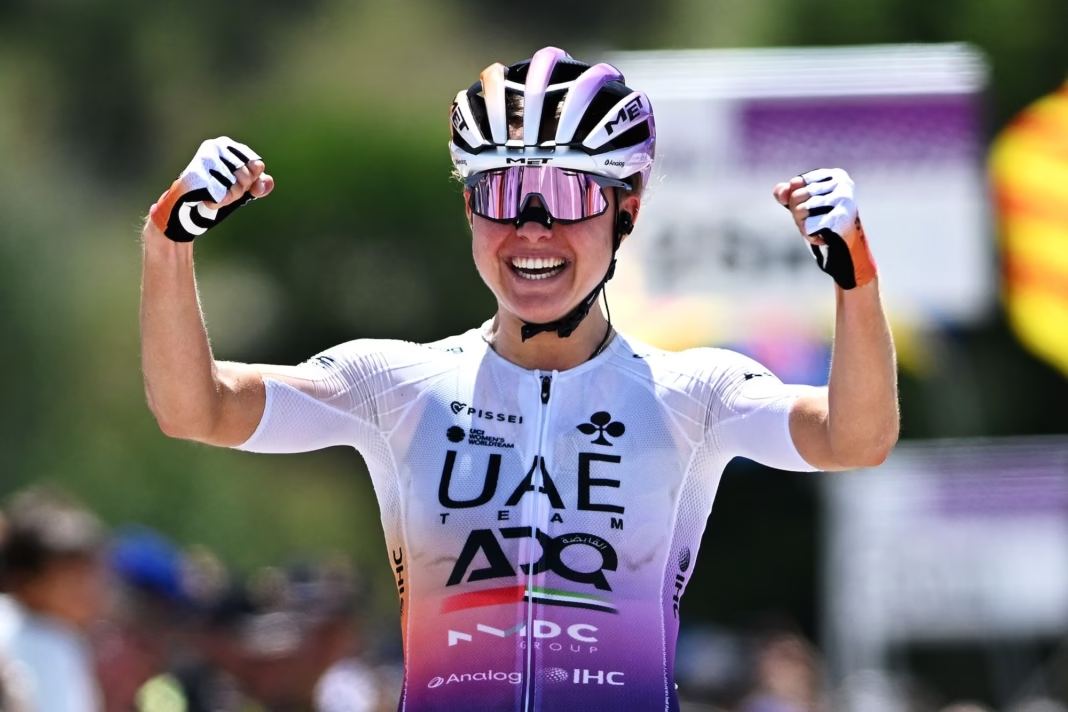
Dickson finished second for FDJ United-SUEZ after an impressive ride of her own, having bridged across to De Vries and Urška Žigart before staying with De Vries through the final 20 kilometres. Cédrine Kerbaol took third for EF Education-Oatly at 30 seconds after using the final descent to move clear of the main GC group, while Kim Le Court led in the reduced favourites’ group.
For De Vries, this was a major breakthrough. The Dutch rider came late to cycling, developed through club and continental racing, and only joined the WorldTour in 2024. In Sondrio, she rode like a rider ready to take control of a stage race, attacking on the climbs, descending with confidence and finishing off the move against another rider chasing a first professional win.
Fast start in Sondrio
The opening stage of the 2026 Tour de Suisse Women took place on Italian roads, with a 109.3-kilometre loop around Sondrio. The route was not long, but it carried enough difficulty in the final half to make it a genuine first test for the general classification. The Buglio in Monte, Triangia and Bordighi climbs meant this was never likely to be a straightforward sprint stage.
Racing began quickly after a short neutralised section, with attacks coming almost immediately. Mackenzie Coupland, Brodie Chapman and Morgane Coston were among the early movers, but the peloton refused to let anything meaningful go. There were also early mechanical problems for Elisa Longo Borghini and Letizia Borghesi, though both came at a stage when the race was still together.
The opening hour was rapid, with the average speed reaching around 43km/h. Daniela Hezinová eventually managed to get clear for Picnic PostNL, building a lead of around 50 seconds, but the peloton lifted the pace as the race moved towards the first categorised climb and she was brought back before the road tilted properly upwards.
That left the race together approaching the Buglio in Monte, a short but severe category 2 climb of 3 kilometres at 10 per cent, with ramps touching 20 per cent. It was the first real filter of the stage.
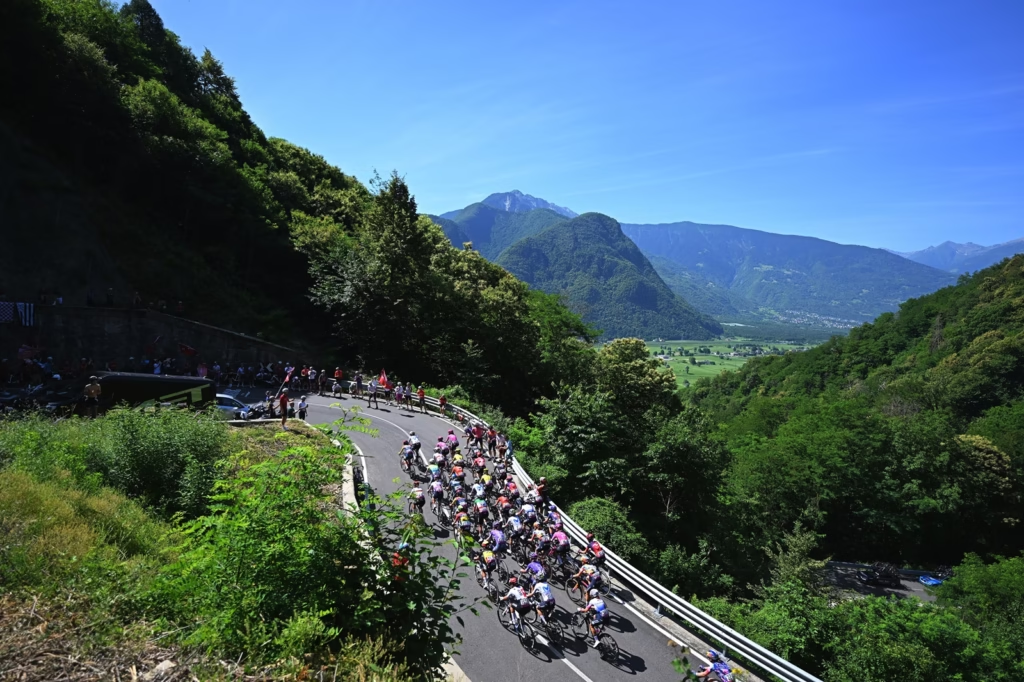
Buglio in Monte splits the race
The pace rose sharply before the climb, with Shari Bossuyt and Marie Le Net among those moving to the front. Once the ascent began, the peloton shrank quickly. Letizia Paternoster was one of the fast finishers distanced, while EF Education-Oatly set tempo with Axelle Dubau-Prévot riding strongly near the front.
Steffi Häberlin took the first QOM points of the race for Team SD Worx-Protime, ahead of Megan Arens and Marlen Reusser. The climb itself did not create the winning move, but the descent that followed immediately changed the race. The peloton split as the road dropped away, and the GC riders had to react.
The first Tissot Kilometre then became a launchpad. Karlijn Swinkels took the first set of bonus seconds ahead of Liane Lippert, before a dangerous group attacked. Franziska Koch, Thalita de Jong, Clémence Latimier, Lippert, Zoe Bäckstedt, Jasmin Liechti, Nienke Vinke, Žigart and Swinkels were all involved, with more riders bridging across.
By the second Tissot sprint, Bäckstedt took the bonus ahead of Lippert and Swinkels, and the front group had become a serious threat. Dickson managed to bridge, while Arens attacked from the peloton behind. The race had shifted from a controlled GC opener into a rolling battle between a strong front selection and a Movistar-led peloton.
Žigart forces the decisive selection
With around 35 kilometres remaining, the front group included several riders capable of shaping the stage and the overall standings. Žigart, De Vries, Koch, Casasola, Vinke, Dickson, De Jong, Lippert, Swinkels, Häberlin and Latimier were all present, while Bäckstedt had been distanced and Arens was chasing.
Movistar led the peloton behind, but the leaders still held close to a minute as they approached the Triangia climb, 4.3 kilometres at 7.3 per cent with a maximum gradient of 13 per cent. That climb proved decisive.
Žigart attacked on the ascent and immediately selected the strongest riders. De Vries went with her, while Dickson bridged across after being caught slightly behind when the move went. Casasola could not follow, and the rest of the front group began to break apart.
De Vries led over the top ahead of Dickson and Žigart. Behind them, Thalita de Jong led a chasing group across at 44 seconds, while the peloton was at 1:38. At that point, the stage looked as though it would come from the leading trio, but the technical descent changed the balance again.
De Vries and Dickson drop Žigart
De Vries pushed on during the descent, testing the others and opening a gap. Dickson was able to rejoin, but Žigart struggled to match their descending speed and began to lose ground. With 20 kilometres remaining, De Vries led just ahead of Dickson and Žigart, with the chasers and peloton spread out behind.
Dickson and De Vries then came together properly, while Žigart fell to around 30 seconds down. The AG Insurance-Soudal rider continued to chase, but she could not get back on. The final 20 kilometres became a direct contest between two riders both looking for a first professional victory.
The chase behind briefly threatened to reorganise. Longo Borghini, Kasia Niewiadoma-Phinney, Juliette Berthet, Antonia Niedermaier and others attacked from the peloton, while Reusser, Le Court and Dubau-Prévot worked back into position. But the five-rider chase group from earlier was eventually caught, and Žigart was also reeled in before the final climb.
By 10 kilometres to go, De Vries and Dickson still had enough of a gap to believe. The peloton was closing, but not quickly enough. The final climb of Bordighi, 1.2 kilometres at an average of 12 per cent and with a maximum of 16.2 per cent, would decide whether they could survive.
Favourites attack too late
The leading pair reached Bordighi with just over a minute on the reduced peloton. De Vries and Dickson had both spent a lot of energy, but they still had the advantage of being clear when the climb began.
Behind them, Movistar moved back to the front for Reusser before UAE Team ADQ placed Swinkels on the front for Longo Borghini. Then the expected attack came. Niewiadoma-Phinney launched on the steep climb, with the main favourites trying to follow her.
The Polish champion went over the top solo, 26 seconds behind the leading pair, while Longo Borghini, Yonna van Dam, Le Court and Häberlin initially joined the chase before the group began to stretch again. Kerbaol then used the descent to her advantage, gapping the favourites and moving into third place on the road.
For De Vries and Dickson, the danger was still real at the flamme rouge. They had around 40 seconds on the GC favourites, enough to make the win likely, but not enough to relax. The reduced group behind had run out of road, and the pair entered the final kilometre with the stage between them.
De Vries wins the sprint
The sprint was a contest between two riders still searching for a first professional win. Dickson had ridden superbly, bridging to the decisive move, surviving the climbs and staying with De Vries once Žigart was distanced. De Vries, though, had looked the more forceful rider on the descents and had repeatedly pushed the pace when the race was at its most dangerous.
In the final metres, De Vries had enough left to finish the job. She beat Dickson to the line in Sondrio, taking her first professional victory at WorldTour level and moving straight into the race lead.
Kerbaol crossed for third at 30 seconds, a strong result after a well-timed descent from the favourites’ group. Le Court then led in the main GC contenders from a reduced sprint, limiting the damage after a day that had briefly looked as though the race might slip much further away.
Team Visma | Lease a Bike had started the race with only four riders, but ended the day with De Vries in the leader’s jersey and Van Dam also high in the standings. That gives them a strong position, but not an easy one, with four stages still to race and control likely to be difficult with a reduced squad.
De Vries takes control of the race
This was a first stage that immediately gave the Tour de Suisse Women a clear GC shape. De Vries won the stage and took the leader’s jersey, Dickson confirmed her own climbing and tactical strength, Kerbaol gained time on several rivals, and the main favourites were forced into damage limitation earlier than expected.
The route had been designed as a lumpy opener, but the combination of steep climbs, technical descents and bonus seconds made it more selective than a normal first stage. The Buglio in Monte began the sorting process, Triangia created the decisive move, and Bordighi gave the favourites one last chance to rescue the day.
De Vries was simply the rider who made the best use of every part of the course. She climbed with the strongest, descended aggressively, worked with Dickson when the winning move formed and still had the sprint to take the stage.
The race now moves into another lumpy day, with the GC riders and puncheurs likely to be back in play before the sprinters get their only clearer opportunity on stage 3. De Vries has the jersey, but with Team Visma | Lease a Bike starting short-handed, defending it will be a different challenge from winning it.
Tour de Suisse Women 2026 stage 1 result
| Position | Rider | Team | Time/gap |
|---|---|---|---|
| 1 | Femke de Vries | Visma | Lease a Bike | 2:56:23 |
| 2 | Lauren Dickson | FDJ United-SUEZ | same time |
| 3 | Cédrine Kerbaol | EF Education-Oatly | +0:29 |
| 4 | Kim Le Court-Pienaar | AG Insurance-Soudal | +0:38 |
| 5 | Sarah Van Dam | Visma | Lease a Bike | +0:38 |
| 6 | Steffi Häberlin | Team SD Worx-Protime | +0:38 |
| 7 | Elisa Longo Borghini | UAE Team ADQ | +0:38 |
| 8 | Marlen Reusser | Movistar Team | +0:38 |
| 9 | Kasia Niewiadoma | Canyon SRAM | +0:38 |
| 10 | Juliette Berthet | FDJ United-SUEZ | +0:57 |
Main photo credit: Getty
-
 Photo Credit: quentinphotographiebe
 -
 Photo Credit: Getty