The European women’s season restarted on Mallorca with the Trofeo Marratxi-Felanitx, a 128.8km one-day race from Marratxí to the summit finish on Puig de Sant Salvador. Most of the day was manageable terrain, but the long, steady final climb was always going to decide it, especially with several teams arriving with fresh climbers and unfinished lead-out structures.
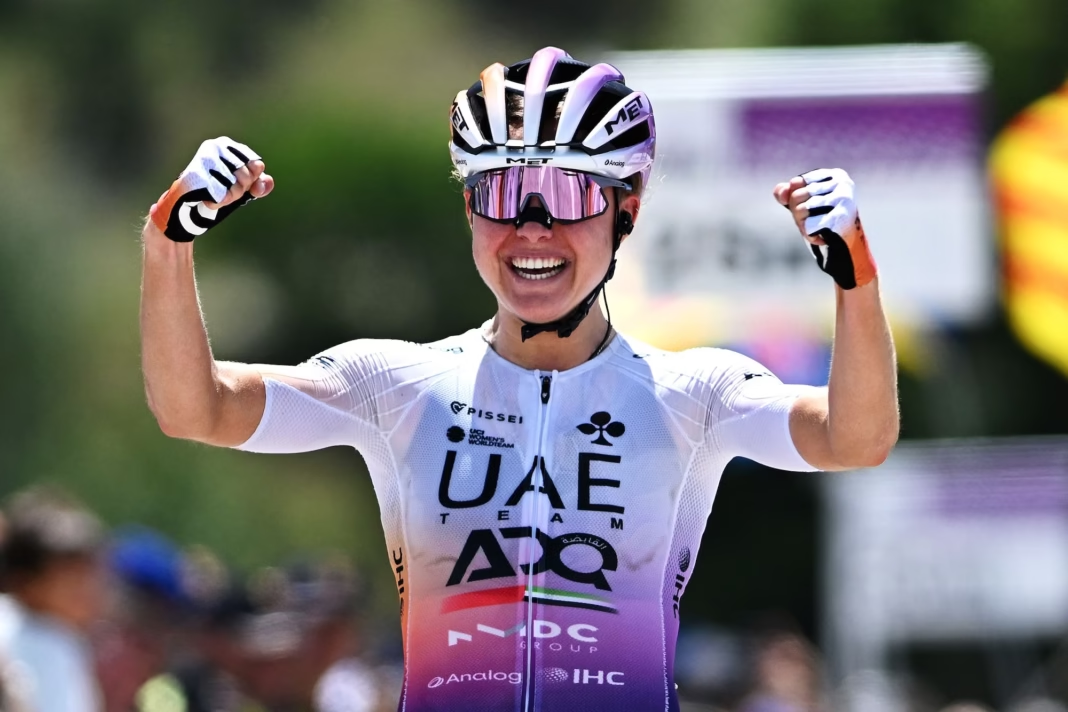
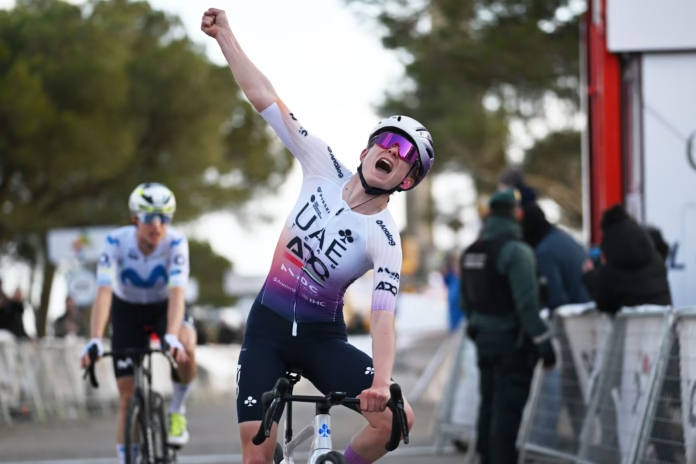
Maeva Squiban delivered the first big statement of 2026 for UAE Team ADQ, outmanoeuvring Marlen Reusser on the final ascent before beating her in a two-up sprint. The race turned when UAE lifted the pace on the lower slopes, thinned the favourites group, and allowed Squiban to attack repeatedly until only Reusser could follow.
A restrained opening that kept the finale in mind
For a race built around a summit finish, the early kilometres rode with a particular logic. There was little incentive for long-range moves on the flatter approach, and the peloton never looked willing to gift time to anything that might complicate the base of Sant Salvador.
That conservative shape mattered later. With most teams protecting leaders rather than spending helpers early, the final climb began with more riders still present, and with more uncertainty about who could take responsibility for setting a pace.
A late break forces the peloton to reveal its priorities
The first proper separation came only in the second half of the race, when Anne van Rooijen drove a move clear and the group’s composition changed as the kilometres ticked down. Marta Pavesi and Eva Anguela proved the most durable companions as the road started to tilt more often and the finish draw closer.
Their advantage was never stable. It grew to minutes, then shrank rapidly once the peloton began to organise with the climb approaching, which suggested a shared assumption: the winner would come from the favourites, but only if the bunch arrived at the foot of the ascent in control.
Movistar’s chase brings Reusser to the climb exactly where she wanted to be
Movistar’s contribution behind the break was purposeful rather than frantic, aimed at a clean start to the decisive ascent. By the time the road headed towards Sant Salvador, the gap was already collapsing, and the escape was caught early on the climb, roughly four kilometres from the line.
That timing was crucial. It meant the fight for the win began immediately, not after a lull, and it created a scenario where the strongest climbers could race each other head-to-head rather than having to first rescue the race from a tactical problem.
UAE set the tempo, then let Squiban turn it into a duel
Once the break was absorbed, UAE Team ADQ took over the climb with clear intent. Silvia Persico and Karlijn Swinkels set a hard, steady tempo on the lower slopes that reduced the contenders group to a more selective set and removed any ambiguity about how aggressive the finale would be.
From there, Squiban raced like a rider with a specific plan: attack, force a response, and repeat until the elastic either snaps or the rival is isolated. Reusser answered the first acceleration, then the next, choosing to manage the effort at her own rhythm rather than trying to counter and risk overreaching.
A sprint that rewarded the more explosive climber
The dynamic became simple but not easy. Squiban had the punch, Reusser had the control. As the climb ran out of road, the pair carried a small gap over the chasers, with Persico among those left to limit losses behind rather than contest the win.
Inside the final metres, Squiban’s advantage was obvious. She waited until the sprint mattered, then opened it with enough speed to prevent Reusser from coming past on the line, converting the day’s repeated attacks into a clean finish at the summit.
2026 Women’s Trofeo Marratxi-Felanitx result
Results powered by FirstCycling.com
Main photo credit: Getty
-
 Photo Credit: quentinphotographiebe
 -
 Photo Credit: Getty