
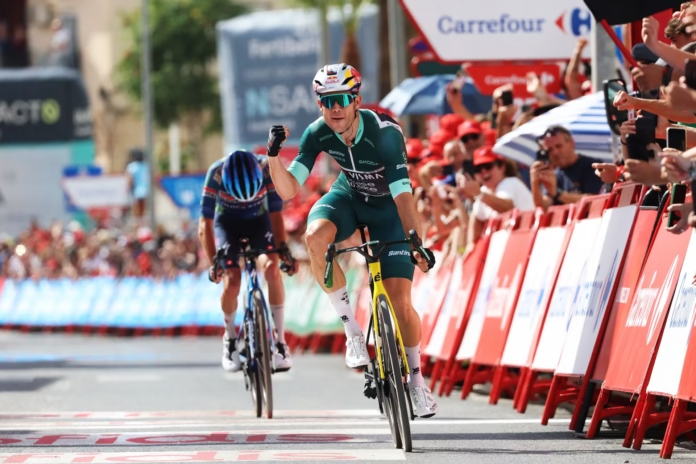
Wout van Aert won stage 13 of the 2026 Vuelta a España in Loja, attacking from the reduced breakaway in the final kilometres and holding off Valentin Paret-Peintre to take his first victory of this year’s race.
The Team Visma | Lease a Bike rider made the decisive move with around 4 kilometres remaining after a day of constant attacking from a large breakaway. Only Paret-Peintre could follow when Van Aert accelerated, but the Soudal Quick-Step rider could not come past at the finish.
Matthew Brennan completed the podium for Team Visma | Lease a Bike, leading home the chasing group 24 seconds later. Jarno Widar finished fourth for Lotto-Intermarché, ahead of Vincenzo Albanese, Finn Fisher-Black, Kevin Vermaerke, Léo Bisiaux, Simon Dalby and Filippo Zana.
For Van Aert, it was a victory built on patience as much as force. He had spent much of the day in the break, chased points, survived the repeated splits, used Brennan as a second Visma card, then chose the right moment to turn the finale into a two-rider move.
A stage made for the breakaway
Stage 13 took the Vuelta from Almuñécar to Loja over 192.8 kilometres, on terrain that always looked difficult to control.
It was not a summit finish like stage 12 on Calar Alto, but it was far from easy. The race climbed early, crossed rolling inland roads and included enough categorised climbing to make the sprinters’ teams hesitant. The key climbs were the Alto de la Venta de la Cebada, the Alto del Legionario and the Puerto de Granada, with the final climb coming close enough to the finish to force the decisive selection.
That was the balance set out in the stage 13 preview. The day suited a strong breakaway, but only if the right riders got clear and only if the front group could survive the inevitable tactical mess once the finish came into view.
The heat also mattered. Temperatures were again pushing towards 40 degrees, making the constant attacking even more draining. This was not the kind of stage where a team could simply place three riders on the front and control everything for hours.
That gave the breakaway a genuine chance. It also meant the front group was likely to be large, aggressive and difficult to organise.
That is exactly what happened.
Early attacks fail to settle the race
The first move of the day came quickly.
Domen Novak, Enzo Paleni, Asbjørn Hellemose and Fabio Van den Bossche opened the first gap, using the flatter early kilometres before the road began to climb. Their advantage moved out to around 40 seconds, but it never felt secure.
The Alto de la Venta de la Cebada arrived early, and with it came the first real fight for the break. Urko Berrade, second on stage 12, tried to chase across. Lorenzo Fortunato then went on the move after the original escape was caught, while Van Aert began to show himself near the front.
The early attacks were less about forming one stable move than testing who really wanted to be there. Teams knew the break could win, but they also knew that a small group was unlikely to survive almost 200 kilometres of lumpy roads and heat.
Eventually, the race opened up properly.
A huge break goes clear
A huge group formed after the early climbing, and that became the foundation of the stage.
The move eventually grew to around 43 riders, with almost every major team represented. Team Visma | Lease a Bike placed Van Aert, Brennan and Bruno Armirail in the move. Bahrain Victorious had Pello Bilbao, Santiago Buitrago and Pau Miquel. Uno-X Mobility had Magnus Cort Nielsen, Simon Dalby, Andreas Kron and Andreas Leknessund. Soudal Quick-Step had Paret-Peintre and Zana, while Lotto-Intermarché had Widar, Lars Craps and Reuben Thompson.
There were GC implications too. Mattias Skjelmose was in the move for Lidl-Trek, while Widar, Clément Berthet, Cristián Rodríguez, Léo Bisiaux and others all had reasons to try to gain time. Movistar could not simply ignore the break, but they also did not need to bring everything back for a stage win.
That made the day tactically complicated. The break was too big to work smoothly. The peloton had to control the GC threat without destroying itself. And Team Visma | Lease a Bike had the best attacking combination at the front.
Van Aert and Brennan gave them two very different ways to win.
Mühlberger abandon hurts Decathlon
The early phase also brought bad news for Decathlon CMA CGM.
Gregor Mühlberger crashed and later abandoned, removing one of Felix Gall’s most important climbing domestiques from the race. That mattered beyond the stage itself. Gall had been one of the few riders repeatedly willing to test Enric Mas in the mountains, and Mühlberger had been central to Decathlon’s ability to make those climbs hard.
With the Vuelta still carrying several major GC tests, losing that kind of support is significant. It did not decide stage 13, but it changed the broader balance of the race.
Pavel Sivakov also abandoned, adding to UAE Team Emirates-XRG’s difficult race after already losing Tadej Pogačar, Pablo Torres and Jay Vine. Pogačar’s crash on stage 8 had already transformed the entire shape of the race, and his Vuelta abandon remains the moment that turned the GC fight into something very different.
The breakaway was racing for the stage. Behind it, the Vuelta’s attrition kept building.
The break starts to split
The front group was never going to stay together.
It was too large, too full of conflicting interests and too stacked with riders who did not want to carry Van Aert or Brennan to the finish. Attacks began to split the group on the rolling terrain before the Alto del Legionario, with Kron, Cristián Rodríguez and Iñigo Elosegui among the riders trying to go clear.
Brennan, Leknessund and Vermaerke then forced another strong selection. Albanese, Paret-Peintre, Axel Laurance and others became involved as the break broke into pieces, then partially came back together, then split again.
That was the defining pattern of the stage. There was never one settled front group for long. Every time a move looked stable, another acceleration changed the picture.
For Team Visma | Lease a Bike, that chaos was useful. Brennan could follow the sharper moves, while Van Aert could use Armirail behind to help bring the right pieces back together.
Visma use Brennan and Van Aert as two cards
The strength of Team Visma | Lease a Bike’s position became clear as the race moved through the middle phase.
Brennan had already won three stages in this Vuelta, including the Lorca sprint on stage 11, and was one of the fastest finishers in the race. That made him a threat in any reduced sprint. Van Aert, meanwhile, had the engine and timing to win with a late attack. Armirail gave the team a crucial worker in the chase when Van Aert was temporarily behind the front selection.
That created a problem for everyone else. If the front group worked smoothly with Brennan present, they risked taking the fastest finisher to the line. If they attacked repeatedly, they risked opening the door for Van Aert. If they hesitated, Visma could use the numbers to control the tempo.
The team still had to get the tactics right, but the structure was excellent.
When the race needed to be chased, Armirail worked. When attacks came, Brennan followed. When the decisive moment arrived, Van Aert was fresh enough to take it.
Albanese takes points on Alto del Legionario
The Alto del Legionario helped reduce the break further.
Albanese took the mountains points on the climb, ahead of Guillaume Martin-Guyonnet and Kron. By then, the front of the race had already narrowed, and the chasers were beginning to lose ground. The peloton, led by Movistar and EF Education-EasyPost at different moments, remained several minutes back, more concerned with controlling GC threats than with the stage win.
Albanese’s presence at the front made sense. He had the speed for a reduced finish and the strength to survive repeated climbs, making him one of the more dangerous riders if the race reached Loja in a small group.
The climb did not produce the final winning move, but it stripped the break down to the riders who could actually win the stage.
Van Aert was still there. Brennan was still there. That was the key.
Brennan takes intermediate sprint points
Brennan added to Visma’s day by winning the intermediate sprint at Tocón.
The British rider took the 20 points and 6 bonus seconds, ahead of Cristián Rodríguez and Leknessund. It was a useful move on two levels. It protected Van Aert’s position in the points classification and also strengthened Brennan’s own place near the top of that competition.
It also showed that Brennan was still dangerous. Riders in the group already knew he could sprint. Seeing him take the intermediate points only reinforced the need to get rid of him before the finish.
That shaped the final 50 kilometres. The others could not afford to wait. A reduced sprint with Brennan and Van Aert was a losing scenario for most of the group.
The Puerto de Granada was therefore always going to become the place where the attacks came.
Puerto de Granada lights up the finale
The final climb of the day, the Puerto de Granada, was 7.4 kilometres at 5.6 per cent.
It was not a high-mountain monster, but it was hard enough after a long, hot, aggressive stage. More importantly, it came close enough to the finish to shape the winning move.
Armirail began to bring Van Aert back towards the front of the race, cutting into the advantage of the leaders and changing Visma’s emphasis. Brennan had looked comfortable in the leading group, but the team clearly wanted Van Aert back into the stage-winning picture.
That was a bold call. If Van Aert came back and failed, Visma might have weakened Brennan’s chances. But if it worked, they would have two cards in the decisive phase.
It worked.
Vermaerke attacked near the top of the Puerto de Granada. Brennan reacted quickly. Leknessund countered. Albanese struggled briefly. Bisiaux set the pace. The front of the race was constantly changing, but Van Aert was moving better and better with every acceleration.
By the summit and descent, the pieces began to come back together.
Nine riders emerge for the win
After the Puerto de Granada, a group of nine formed at the front.
Van Aert and Brennan were there for Team Visma | Lease a Bike. Paret-Peintre represented Soudal Quick-Step. Widar gave Lotto-Intermarché a strong GC and stage option. Albanese remained dangerous for EF Education-EasyPost. Fisher-Black was there for Red Bull-Bora-Hansgrohe, Vermaerke for UAE Team Emirates-XRG, Bisiaux for Decathlon CMA CGM and Dalby for Uno-X Mobility.
It was a fascinating group because almost nobody wanted the same finish. Brennan would have wanted a sprint. Van Aert could win either from a small group or with an attack. Paret-Peintre, Vermaerke, Bisiaux and Dalby had to try to disrupt Visma. Widar was also riding with the general classification in mind.
Behind them, Skjelmose had missed the split and was in the chase group. That limited the scale of his possible GC gain, although he was still taking time on the peloton.
In front, the stage was reduced to nine riders and one obvious tactical question: could anyone stop Visma?
Vermaerke and Bisiaux try to break Visma’s grip
The answer from the group was to attack.
Vermaerke tried more than once, looking like one of the strongest riders in the finale. Each time, Van Aert was alert. The Belgian marked one move directly, then controlled the group as the attacks continued.
Dalby also tried in the final 5 kilometres, forcing Brennan to close. Then Bisiaux attacked, looking strong enough to create real danger. Brennan had to make a major effort to bring that move back, while Fisher-Black was forced to swing off after reacting.
Those attacks mattered even though they did not succeed. They forced Brennan to spend energy and created exactly the kind of disorder that might have opened a chance for someone else.
But they also gave Van Aert the information he needed. He could see who was still strong, who was hesitating and who was willing to chase.
Then he made his move.
Van Aert attacks with Paret-Peintre on his wheel
Van Aert launched the decisive attack with around 4 kilometres remaining.
It was a proper acceleration rather than a probing move. Only Paret-Peintre could follow, and even he was immediately under pressure. Behind, the rest of the group hesitated just enough for the gap to grow.
That hesitation was understandable. Brennan was still behind, so no one wanted to drag him back to Van Aert. Vermaerke had already spent energy attacking. Bisiaux and Dalby had tried their moves. Albanese had done work to bring attacks back. Widar had GC considerations as well as the stage.
Van Aert had picked the right moment. The group had been softened by repeated attacks, Brennan’s presence complicated the chase, and Paret-Peintre was strong enough to follow but not strong enough to turn the move against him.
Inside the final 2 kilometres, Van Aert and Paret-Peintre had a clear gap. The chasers were close enough to keep the finish tense, but not close enough to regain control.
Van Aert finishes the job
Van Aert and Paret-Peintre entered the final kilometre with the chasers still around a dozen seconds behind.
At that point, the stage was almost certainly between the two leaders. Paret-Peintre had done well to follow, but the finish always favoured Van Aert if the pair arrived together. The Belgian had the better sprint, more experience in this type of finale and the confidence of having shaped the closing phase himself.
Van Aert finished it off without giving Paret-Peintre a chance to come around. He crossed the line in 4:34:00, taking his first victory of the 2026 Vuelta after repeatedly going close and after playing a central role in the points classification across the race.
The win also carried a sense of release. Van Aert had already been visible almost everywhere in this Vuelta: sprinting, climbing for points, working, chasing and attacking. Stage 13 finally turned that presence into a stage victory.
It was not a gift from the breakaway. It was a win he constructed piece by piece.
Paret-Peintre comes close
Paret-Peintre finished second, on the same time as Van Aert.
The Soudal Quick-Step rider was the only one able to follow the decisive move, which tells its own story. When Van Aert accelerated, the rest of the group stalled. Paret-Peintre had the legs and positioning to react immediately, and that gave him a shot at the stage.
But following Van Aert and beating Van Aert are different things.
Paret-Peintre stayed with him to the finish, but the sprint was always difficult. He had survived the right move, but he could not turn it into a win. Even so, second place was a strong result on a day where the breakaway was full of stage winners, fast finishers and GC outsiders.
Soudal Quick-Step did not get the stage, but they were present at the decisive moment.
-
 Photo Credit: Getty
 -
 Photo Credit: Olly Hassell/SWPix.com
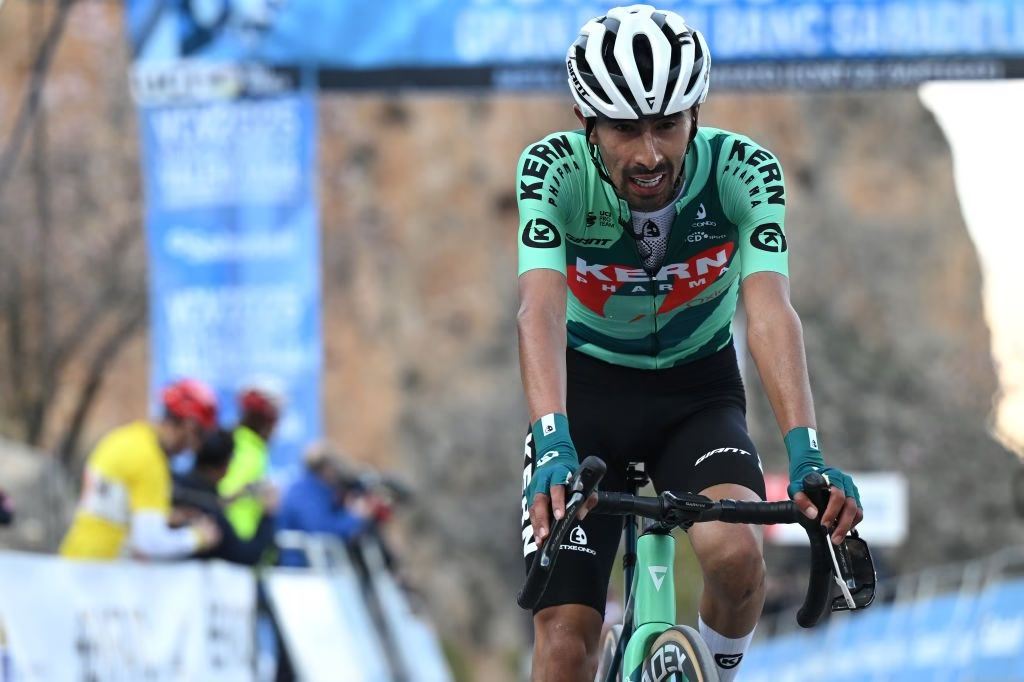
Brennan completes Visma’s one-three
Brennan led the chasers home for third, 24 seconds down.
That result underlined just how strong Visma were. Their young British sprinter had already worked to close attacks in the final kilometres and still had enough speed to win the sprint from the chasing group. Behind Van Aert, he remained the fastest rider left.
It also justified the way Visma played the finale. They could have tried to keep everything together for Brennan, but that would have invited attacks from every other rider in the group. Instead, Van Aert attacked late, and Brennan’s presence behind discouraged a clean chase.
The outcome was almost perfect: Van Aert won, Brennan finished third, and the team strengthened its grip on the points competition.
For a team that had already won three stages through Brennan, this was a different kind of success. It showed they could win the race even when everyone knew they were the strongest team in the front group.
Widar and Albanese stay prominent
Widar’s fourth place was another strong result in a Vuelta where young riders have repeatedly shaped the race.
The Lotto-Intermarché rider finished in the same chasing group as Brennan and Albanese, gaining time from the break and again showing why he remains a rider to watch in hard, rolling stages. He could not follow Van Aert’s final move, but he survived the selection and finished ahead of several experienced stage hunters.
Albanese was fifth after another active day. He took mountains points, chased attacks and remained in the reduced front group all the way to the finish. That kind of ride suited him: hard enough to remove the pure sprinters, but not so mountainous that he was out of contention.
Fisher-Black, Vermaerke, Bisiaux and Dalby also came away with top-10 finishes after playing visible roles in the final phase. Vermaerke in particular deserved more than seventh for the amount of pressure he applied, but his repeated attacks helped create the race that Van Aert eventually won.
Mas keeps red as breakaway takes the stage
Behind the stage fight, Mas had a more controlled day in the red jersey.
Movistar did not need to chase the stage. Their priority was to manage the GC danger in the break, particularly Skjelmose and the riders close enough to threaten the lower end of the top 10. EF Education-EasyPost also helped in the peloton, with Carapaz’s position in mind.
For Mas, that made the stage more about calculation than aggression. After gaining time on Calar Alto, he did not need to respond to every move in a breakaway that was clearly racing for the stage. The important thing was keeping the gap within a range that did not create a major threat to his lead.
That was achieved. The breakaway took the win, some riders gained time further down the overall standings, but the top of the general classification remained centred on Mas and the rivals who will need to attack him in the bigger mountain stages.
This was a day for Van Aert, not a day when Mas had to prove anything.
Skjelmose’s move only partly pays off
Skjelmose’s presence in the break made the race more awkward for Movistar and Netcompany Ineos Cycling Team.
The Lidl-Trek rider began the day close enough to make a GC jump if the break gained enough time, and at different points he was moving high in the virtual standings. That forced the teams behind to keep a closer eye on the gap than they might have done otherwise.
But Skjelmose missed the decisive nine-rider selection in the finale. That limited his gain and meant he did not get the full reward his early aggression had promised.
Even so, it was the kind of move that made sense. The top GC riders were likely to mark each other on harder mountain stages, so riders just outside the podium fight needed days like this to shift the race in their favour.
Skjelmose did not win the stage and did not make the front split, but he still helped shape how the peloton managed the break.
Van Aert gets the win his race deserved
Van Aert’s victory felt like the result his Vuelta had been building towards.
He had already collected points, chased mountain points, worked for Brennan and put himself in breakaways. Stage 13 finally gave him the right terrain and the right tactical balance: hard enough to shed most of the sprinters, open enough for a breakaway, and tactical enough for a rider with his instincts to make the difference.
The final attack was classic Van Aert. It did not come from desperation. It came after he had read the group, let others spend energy, used Brennan as a tactical brake behind, and then accelerated at the moment when the chase was least organised.
Paret-Peintre was strong enough to follow, but not strong enough to beat him. The rest were trapped by the presence of Brennan and by their own earlier efforts.
That is why the win was so convincing. Van Aert did not simply have the best legs. He had the clearest route to victory.
Vuelta a España 2026 stage 13 result
| Position | Rider | Team | Time/gap |
|---|---|---|---|
| 1 | Wout van Aert | Visma | Lease a Bike | 4:34:00 |
| 2 | Valentin Paret-Peintre | Soudal Quick-Step | same time |
| 3 | Matthew Brennan | Visma | Lease a Bike | +0:24 |
| 4 | Jarno Widar | Lotto-Intermarché | +0:24 |
| 5 | Vincenzo Albanese | EF Education-EasyPost | +0:24 |
| 6 | Finn Fisher-Black | Red Bull-BORA-hansgrohe | +0:24 |
| 7 | Kevin Vermaerke | UAE Team Emirates-XRG | +0:24 |
| 8 | Léo Bisiaux | Decathlon CMA CGM | +0:24 |
| 9 | Simon Dalby | Uno-X Mobility | +0:28 |
| 10 | Filippo Zana | Soudal Quick-Step | +0:32 |
Main photo credit: Getty

