
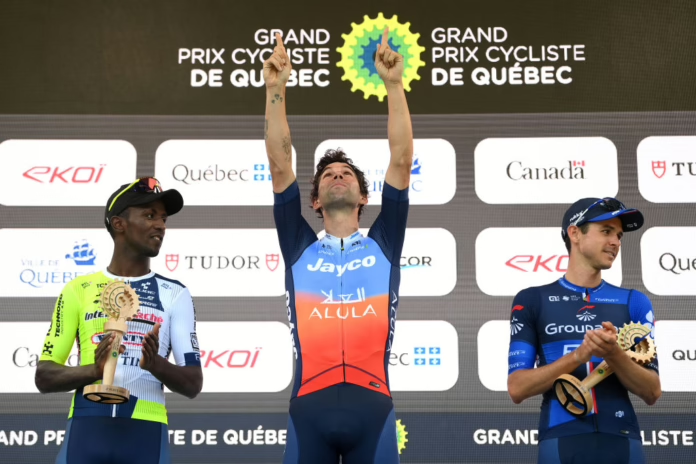
The 2026 Grand Prix Cycliste de Québec has enough headline names to produce an obvious favourites list, but Friday’s race is more complicated than simply asking whether Remco Evenepoel, Isaac del Toro, Tom Pidcock or Paul Seixas is strongest.
The redesigned Québec City circuit is only 10.3km long and is repeated 20 times, packing approximately 2,780 metres of climbing into 206km. Each lap brings another ascent of the Côte de la Montagne, 600 metres at 9% with sections approaching 13%, followed by more rising road towards the finish on the Plains of Abraham. The GP Québec 2026 route guide explains why reducing the length of the circuit has actually concentrated the difficulty.
That creates several possible versions of the same race. Michael Matthews wants enough riders to survive for a reduced uphill sprint. Evenepoel needs to remove riders with a faster finish. Del Toro and Pidcock have the acceleration to attack before the final kilometre, while teams such as Lidl-Trek, Visma | Lease a Bike and UAE Team Emirates-XRG have enough depth to make the closing laps difficult long before their principal leaders move.
The full GP Québec 2026 start list also contains several teams without an outright favourite but with riders capable of changing the race if the biggest names hesitate. That could matter just as much as individual strength once the same short climb has been ridden 15 or 16 times.
 Photo Credit: Getty
UAE Team Emirates-XRG
Key riders: Isaac del Toro, Brandon McNulty, Jhonatan Narváez, Tim Wellens, Adam Yates
UAE Team Emirates-XRG have the strongest collection of options in the race and little reason to reduce everything to one protected leader.
Isaac del Toro is the obvious finishing card. The repeated short climbs fit his ability to accelerate after a hard race, while the run beyond the Côte de la Montagne is long enough for him to continue pressing an advantage rather than immediately being brought back on a descent. His best scenario is a selective final 30km where the quicker sprinters have already been removed or isolated.
The depth around him is what makes UAE particularly awkward. Brandon McNulty can attack from further out, Jhonatan Narváez has the speed to survive into a reduced finish, Tim Wellens is built for repeated punchy climbs and Adam Yates gives them another rider nobody can comfortably allow into a dangerous move.
That means UAE do not need Del Toro to chase. They can place another rider up the road and make Jayco, Red Bull or Pinarello-Q36.5 decide whether to spend resources closing the gap. If the race fragments early enough, they may reach the final lap with more usable options than anyone else.
Red Bull-Bora-hansgrohe
Key riders: Remco Evenepoel, Maxim Van Gils
Evenepoel has one of the clearest tactical problems among the main favourites. A sizeable group reaching the final few hundred metres gives Matthews, Pidcock, Van Gils and several other riders a better finishing scenario than it gives him.
Red Bull therefore need to make the final laps difficult before the race reaches its expected sprint point.
Evenepoel does not necessarily have to attack directly on the steepest part of the Côte de la Montagne. A longer effort over the summit and through the rising roads towards the Plains of Abraham may be harder to organise against, particularly once teams have lost domestiques and the chasing group contains riders reluctant to work for Matthews.
Maxim Van Gils gives Red Bull a crucial second option. He can wait longer than Evenepoel and has a better finish from a reduced group, which means the team do not have to commit both riders to the same plan. Evenepoel attacking with two laps remaining can force others to chase without necessarily sacrificing Van Gils.
That tactical split makes Red Bull more dangerous than a team built solely around an Evenepoel long-range move.

Pinarello-Q36.5 Pro Cycling Team
Key rider: Tom Pidcock
Pidcock arrives in Canada with form already confirmed after winning GP Industria & Artigianato at Larciano, where he attacked on the final climb and finished alone.
Québec offers several ways to use the same strengths.
Pidcock can follow Evenepoel if the Belgian launches from distance, accelerate himself on the Côte de la Montagne or wait for a smaller finish. He is quicker than many of the strongest climbers but would rather not bring Matthews to the final straight, so the ideal race sits somewhere between complete fragmentation and a controlled sprint.
Pinarello-Q36.5 have little reason to help Jayco stabilise the closing laps. Pidcock is most dangerous when the race becomes unpredictable and riders are forced to make decisions without a full team around them.
His handling also matters on a circuit where repeated descents, corners and positioning battles gradually add to the workload. Pidcock can keep applying pressure after the obvious climbing sections rather than treating the Côte de la Montagne as the only place to race.
Team Jayco AlUla
Key riders: Michael Matthews, Mauro Schmid
Michael Matthews remains the rider against whom almost every attacking team has to plan.
No one has won GP Québec more often. His victories in 2018, 2019 and 2024 sit alongside several other podium finishes, and the reasons are obvious. Matthews can absorb repeated short climbs without losing the sprint that makes him so difficult to beat after 200km.
The revised circuit should make his task harder, but not necessarily too hard. Twenty passages of the Côte de la Montagne increase the attrition, yet none of those climbs individually requires Matthews to produce a sustained mountain effort. If Jayco can keep him protected and prevent the decisive group getting away, he remains one of the most obvious winners.
Mauro Schmid gives the team an important alternative. Jayco do not have to make every late move Matthews’ problem because Schmid can follow attacks or enter one himself. That is particularly useful against UAE, who have enough riders to keep sending threats up the road.
Jayco’s race is about control without wasting riders too early. Matthews does not require a quiet afternoon, but he does need the final selection to remain within reach.
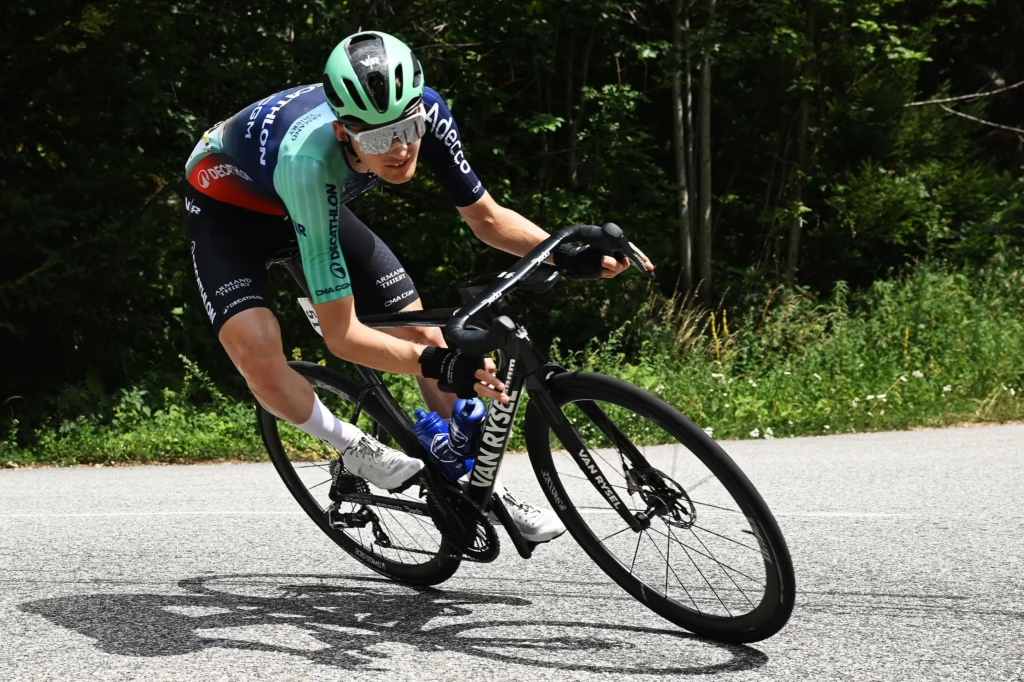 Photo Credit: Getty
Decathlon CMA CGM Team
Key riders: Paul Seixas, Paul Lapeira, Tiesj Benoot
Paul Seixas is likely to find Sunday’s GP Montréal more naturally suited to his climbing strength, but the redesigned Québec course is difficult enough for him to matter here as well.
The issue is the finish. Seixas does not want to reach Avenue George VI alongside Matthews, Pidcock, Van Gils and the quicker puncheurs, so Decathlon need the accumulated climbing to become genuinely selective rather than merely uncomfortable.
Tiesj Benoot can help create that race. His value is not necessarily in producing one decisive attack but in driving difficult phases before Seixas has to expose himself. Paul Lapeira gives Decathlon a completely different card if the selection remains larger than expected.
That balance allows them to delay committing fully to Seixas. If the race becomes brutal, they can build around the teenager. If enough faster riders survive, Lapeira remains relevant while Seixas can attack.
They have more flexibility than a pure climbing squad.
Lidl-Trek
Key riders: Quinn Simmons, Giulio Ciccone, Juan Ayuso
Lidl-Trek have too many credible attackers to spend the day riding passively.
Quinn Simmons may be the rider whose characteristics best fit an anticipatory move. He does not need to wait for the final ascent and is strongest when he can commit before the favourites have settled on who should chase. Québec’s repetitive circuit gives him several chances to make that sort of attack.
Giulio Ciccone and Juan Ayuso shift the balance towards a more selective race. Neither wants a large group sprinting for victory, but both can use the accumulated climbing if Lidl-Trek begin increasing the pressure before the final lap.
The important advantage is numbers. A Simmons move with 25km remaining is harder to dismiss when Ciccone and Ayuso are sitting behind. If another team closes him down, Lidl-Trek should still have riders available for the next attack.
Their worst version of Québec would be seven riders spending 190km protecting one leader before discovering Matthews is still there.
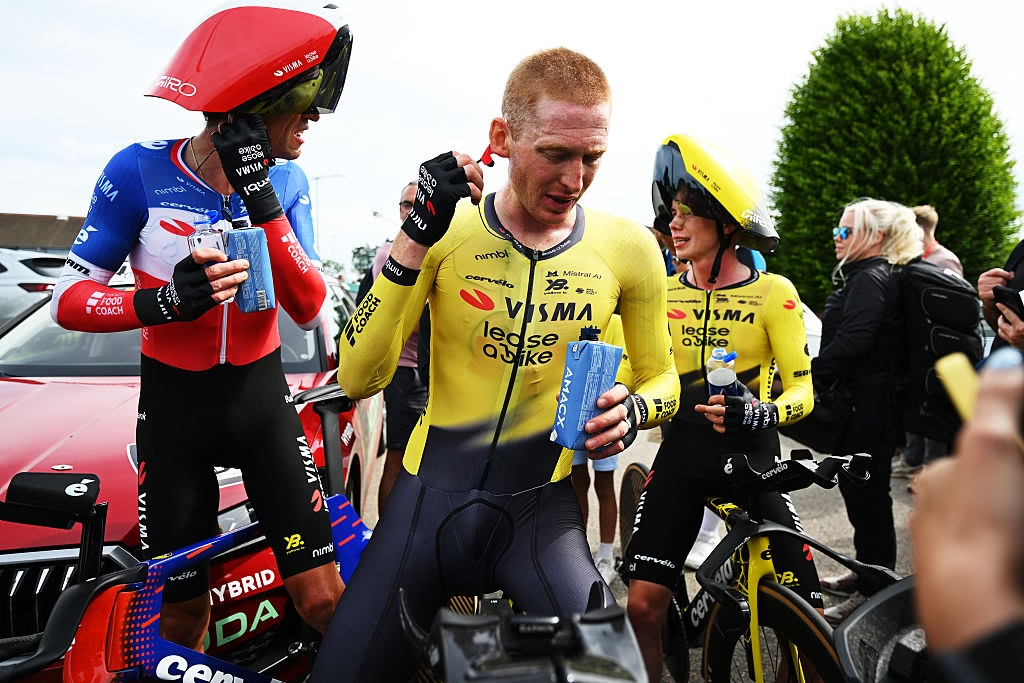 Photo Credit: Getty
Team Visma | Lease a Bike
Key riders: Matteo Jorgenson, Louis Barré, Bart Lemmen, Wilco Kelderman
Visma arrive without an obvious favourite for a reduced uphill sprint, which simplifies their tactical choice.
They should attack.
Matteo Jorgenson has the endurance to remain strong after 200km and enough climbing ability to cope if UAE or Red Bull make the final laps selective. His opportunity is more likely to come through a move than by waiting to beat the quickest riders on the finishing straight.
Louis Barré and Bart Lemmen give Visma other options for the same approach, while Wilco Kelderman can survive a hard race and help ensure the team still have numbers when the field begins shrinking.
The key is timing. Following every Evenepoel or Del Toro acceleration is unlikely to work. Visma are better placed if they can put someone ahead of those attacks and make the favourites spend energy coming across.
On a 20-lap circuit, the move immediately before the expected decisive move can be just as important.
Lotto-Intermarché
Key riders: Jenno Berckmoes, Lennert Van Eetvelt
Lotto-Intermarché’s plans changed when Arnaud De Lie was ruled out after failing to recover from the illness that ended his Renewi Tour.
De Lie won GP Québec in 2023 and would have given the team one of the strongest possible answers to a reduced sprint. His withdrawal, covered in our update on De Lie missing GP Québec and GP Montréal, removes the need to spend the afternoon protecting one obvious finisher.
Jenno Berckmoes now becomes particularly interesting. He can survive a difficult race and still finish quickly from a smaller group, allowing Lotto-Intermarché to retain some of the characteristics they would have had with De Lie without carrying the same weight of expectation.
Lennert Van Eetvelt gives them a more aggressive climbing option. If the repeated Côte de la Montagne passages begin removing the heavier puncheurs, he can become more important deep into the race.
Their best approach is probably to avoid taking responsibility. Let Jayco protect Matthews, allow Red Bull and UAE to make the race hard, then use Berckmoes or Van Eetvelt once those teams have already spent riders.
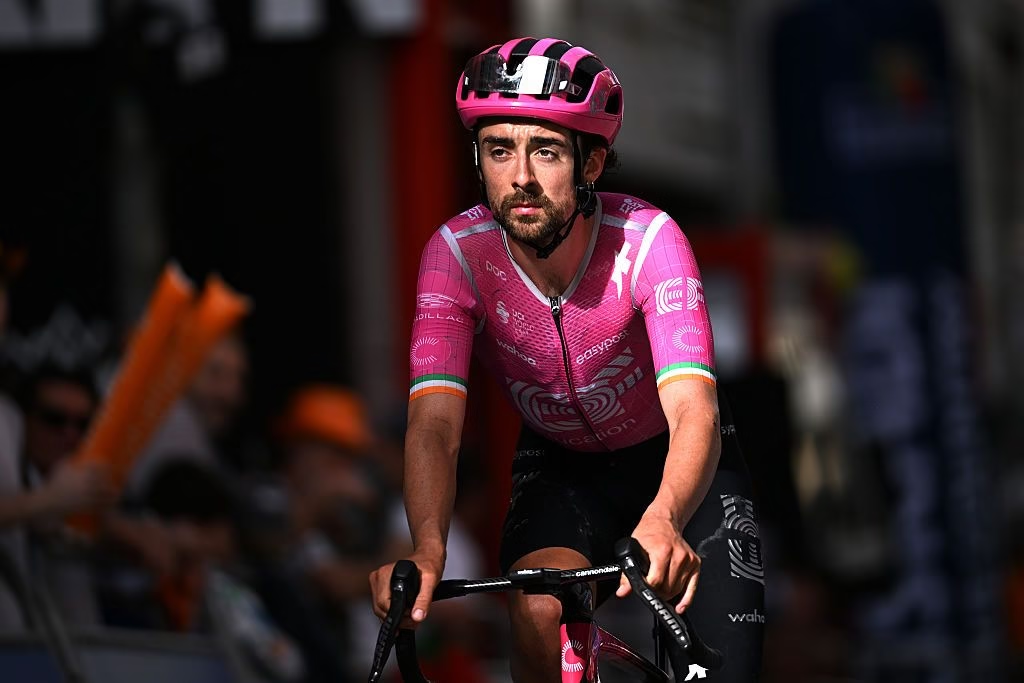 Photo Credit: Getty
EF Education-EasyPost
Key rider: Ben Healy
Ben Healy is one of the riders most likely to appreciate a race that refuses to settle.
A controlled final lap is not his ideal outcome. Healy is far more dangerous when the attacks begin early enough for the peloton to lose its structure and riders have to commit without knowing whether the move in front is the winning one.
The new circuit provides plenty of opportunities. He can attack on the Côte de la Montagne, over the top or on one of the rolling sections after teams have briefly stopped chasing.
EF do not have to dominate the race. Their objective should be getting Healy into the phase where he can race instinctively rather than asking him to beat Pidcock, Matthews or Van Gils in a neat finale.
If the last 30km become disorderly, his chances rise sharply.
XDS Astana Team
Key rider: Alberto Bettiol
Alberto Bettiol has already shown that Québec suits him. He finished third behind Julian Alaphilippe and Pavel Sivakov in 2025 after becoming part of the attacking group that decided the race.
That result provides a useful template.
Bettiol does not want to wait for the fastest riders, but he is powerful enough to sustain an effort once a small group has escaped. The 2026 circuit asks for that same combination of punch and strength, only more frequently.
XDS Astana do not need to invent a complicated strategy. Their best chance is getting Bettiol involved before the favourites begin reducing the race to a series of marked attacks.
A repeat of last year’s podium is entirely realistic if another late group gains enough cooperation to keep Matthews’ chase behind.
 Photo Credit: Getty
Bahrain Victorious
Key riders: Afonso Eulálio, Edoardo Zambanini, Alec Segaert
Bahrain have several riders who can survive deep into the race but no single favourite around whom every decision needs to revolve.
Afonso Eulálio should benefit if the final laps become increasingly selective, while Edoardo Zambanini gives them more finishing speed if a larger group survives. Alec Segaert offers another route through an earlier attack.
That should encourage Bahrain to keep numbers rather than committing one rider too soon.
Their opportunity may come when one of the main favourites attacks and forces a first selection. If Bahrain can get two riders into that group, they can begin playing tactically instead of simply following wheels.
Waiting until the final ascent with everyone still together leaves them competing against riders with stronger sprints. Creating an uneven race gives them more possibilities.
Groupama-FDJ United
Groupama-FDJ United arrive with a team built more around collective strength than one overwhelming Québec favourite.
Ewen Costiou and Quentin Pacher are both capable of contributing when the race becomes harder, while Thibaud Gruel gives the squad a younger rider with finishing speed if the selection remains larger.
The aim should be to preserve multiple riders into the final five laps. Groupama gain more from being able to alternate moves than from nominating one leader and spending the afternoon closing gaps for him.
The shorter circuit encourages exactly that approach. An attack that might look harmless with 40km remaining is only four laps from the finish, and stronger teams may be reluctant to commit domestiques when they know the major moves are still coming.
Groupama need to be among the teams exploiting those moments.
Movistar Team
Movistar do not arrive with a rider who starts alongside Evenepoel, Del Toro or Pidcock among the obvious favourites, but their team contains enough climbing strength to survive a selective edition.
Davide Formolo is the clearest rider for a race that becomes difficult early. He is unlikely to want a reduced sprint, so his chances improve considerably if the strongest climbers begin attacking with several laps remaining.
Michel Hessmann and Pavel Novák give Movistar further options in an attritional race, while Nelson Oliveira provides the experience and power required to support moves over a circuit where positioning can become almost as tiring as the climbing.
Their challenge is avoiding a purely reactive afternoon. Following the favourites until the last lap is unlikely to create a winning opportunity. Getting Formolo or another rider ahead of the principal attacks at least gives Movistar something the stronger teams have to consider.
 Photo Credit: Getty
Netcompany INEOS
Key riders: Dorian Godon, Michał Kwiatkowski
Dorian Godon gives Netcompany INEOS one of the best second-line options in the field.
His first season with the team has already shown how useful his combination of endurance and speed can be. Québec is harder than a conventional sprint race but not so mountainous that a rider such as Godon should automatically disappear.
The problem is Matthews. If both arrive in the same group, Godon does not begin as the favourite, which gives INEOS reason to use their wider strength before the finish.
Michał Kwiatkowski has spent much of his career thriving in races where tactical judgement counts as much as pure physical superiority. He can help make the final laps difficult or enter a move that forces rival teams to chase.
INEOS do not need to ride the front for long stretches. They need enough riders present when the field starts breaking apart to ensure Godon is not left responding to every move himself.
Team Picnic PostNL
Team Picnic PostNL should find more value in an attritional race than a straightforward finish.
Frank van den Broek and Warren Barguil both have the climbing ability to survive once the repeated Côte de la Montagne begins reducing the peloton, while the team’s chances improve if the finale is decided by a small group rather than the quickest puncheurs.
That makes anticipation important. Neither needs to wait for Evenepoel to make the first major attack.
A move during the penultimate three or four laps can force teams with better sprinters to chase and potentially leave Picnic PostNL with a rider ahead while stronger names mark one another behind.
The team’s realistic target is not controlling the race. It is making sure somebody is still in position to exploit it when control disappears.
 Photo Credit: Getty
Uno-X Mobility
Key rider: Anthon Charmig
Anthon Charmig arrives with timely evidence of his condition after finishing third at GP Industria & Artigianato behind Pidcock.
That makes him more than a rider simply hoping to survive the closing laps.
Uno-X have traditionally been comfortable racing aggressively when the established WorldTour favourites begin watching one another, and Québec rewards exactly that willingness. Charmig can cope with repeated climbing, but his chances improve if he reaches the final circuit ahead of Matthews and the other fast finishers rather than alongside them.
The team should be prepared to commit before the obvious favourites.
A move containing Charmig with 20km remaining cannot be dismissed as simple breakaway representation after his result in Italy. That alone gives Uno-X useful leverage.
Tudor Pro Cycling Team
Key rider: Marc Hirschi
Tudor return to Québec as the defending team, although Julian Alaphilippe is no longer available after retiring during 2026.
Marc Hirschi is an obvious rider to inherit responsibility. Few riders are better suited to a race built around repeated short climbs, tactical attacks and an uphill finish after more than 200km.
The difficulty is that his characteristics are well known. Teams are unlikely to give Hirschi the same freedom Alaphilippe eventually exploited last year, particularly if he tries to move during the final two laps.
That makes Tudor’s supporting riders important. Yannis Voisard and the rest of the squad need to help create situations where Hirschi is not the only rider other teams have to watch.
The history of GP Québec shows how often the race has rewarded riders willing to attack rather than accept the expected sprint. Tudor used that route perfectly in 2025. They have good reason to try it again.
NSN Cycling Team
NSN Cycling Team have several riders whose chances depend on exactly how hard the new circuit proves.
Corbin Strong gives them a route towards a reduced sprint if he survives the repeated climbing, while the Canadian presence within the squad adds another dimension to a race with obvious importance for the team.
Their task is avoiding unnecessary work before the final hour.
Strong does not need NSN to produce the selection themselves. UAE, Red Bull and Decathlon all have stronger reasons to push the climbing, and Matthews ensures Jayco have reason to contribute to any chase.
If Strong can use those teams to reach the final lap without having spent too much energy, he becomes a dangerous rider for anyone expecting only Matthews and Pidcock to contest the finish.
Alpecin-Premier Tech
Alpecin-Premier Tech arrive without Mathieu van der Poel after his programme changed ahead of the World Championships.
That removes one of the riders who would otherwise have dictated how every rival approached the finale.
For Alpecin, it also creates freedom.
They are no longer obliged to spend six riders protecting one of the race favourites. Instead, they can target moves and use the closing circuits aggressively without worrying about compromising a Van der Poel sprint or attack.
That may reduce their outright chance of victory, but it can make them tactically awkward. Teams built around major leaders cannot allow every Alpecin move to disappear simply because Van der Poel is absent.
An attacking race is their route to relevance.
Soudal Quick-Step
Soudal Quick-Step arrive without the obvious superstar leadership role they would once have had with Evenepoel, who now lines up for Red Bull-Bora-hansgrohe.
That gives the current squad a very different task.
Maximilian Schachmann and Ilan Van Wilder both have the strength to survive a hard edition, while Steff Cras provides another option if the repeated climbs create a more severe selection. None wants a large group arriving together for an uphill sprint.
Soudal therefore need to get ahead of the race rather than wait for it.
Schachmann is particularly suited to making a move after other teams have already spent their first attacks. He can handle a long effort and is tactically experienced enough to recognise when a group contains the right combination of teams to survive.
The absence of one overwhelming leader may actually help. Soudal can race the circuit rather than protect a pre-determined finish.
-
 Photo Credit: Billy Ceusters / Getty Images

Modern Adventure Pro Cycling
Modern Adventure enter one of the largest WorldTour races on their calendar against a field containing almost every major men’s team.
The temptation for a ProTeam in that position is to focus entirely on the early break. Visibility matters, but sending every useful rider up the road in the opening hour would limit what they can learn and potentially achieve later.
Stefan de Bod gives them a rider with enough experience to judge a more ambitious target. If he or another team-mate can remain in the peloton deep into the closing circuits, the opportunity to follow a late move may be worth considerably more than spending 150km in an escape with little chance of surviving.
They should still be represented early if the right group develops. The stronger option is not treating that as their only route into the race.
Team Canada
The Canadian national selection has a unique place in the field, particularly with the World Championships in Montréal approaching immediately after the Canadian WorldTour races.
Michael Woods’ return adds the biggest name.
Woods is coming back to road competition specifically around the home World Championships, and Québec gives him a demanding first test on familiar Canadian roads. The repeated short climbs suit his natural strengths far more than a flat one-day race would, although the intensity of 20 circuits will reveal quickly how much sharpness he has after time away.
For the other Canadian riders, the early break will naturally be attractive. A home national selection should be visible in a home WorldTour race.
That does not mean every rider needs to chase the first escape. Reaching the final hour alongside WorldTour leaders would provide a more meaningful opportunity for the strongest members of the squad, particularly with the Montréal World Championships so close.
Why the final five laps should decide the team battle
The most interesting feature of this year’s race is that the principal favourites need different things from the same circuit.
Matthews wants attrition without complete separation. Evenepoel wants enough damage done that the fastest finishers disappear. Del Toro and Pidcock can operate somewhere between those two extremes, while Seixas needs a genuinely hard race if he is going to remove riders with more speed.
The teams around them complicate those plans further.
UAE can attack with McNulty, Wellens, Narváez or Yates without immediately committing Del Toro. Red Bull have Van Gils behind Evenepoel. Lidl-Trek can use Simmons before Ayuso or Ciccone. Jayco can send Schmid into a move while preserving Matthews.
That is why waiting for the twentieth ascent of the Côte de la Montagne may be too late for several teams.
The GP Québec 2026 contenders preview has Evenepoel, Pidcock, Del Toro and Matthews at the centre of the favourites discussion, but the winning move may depend on what their team-mates do before any of them attack.
Twenty laps gives every squad plenty of time to understand who is struggling.
The difficult part is recognising the moment when observation needs to become action.

