
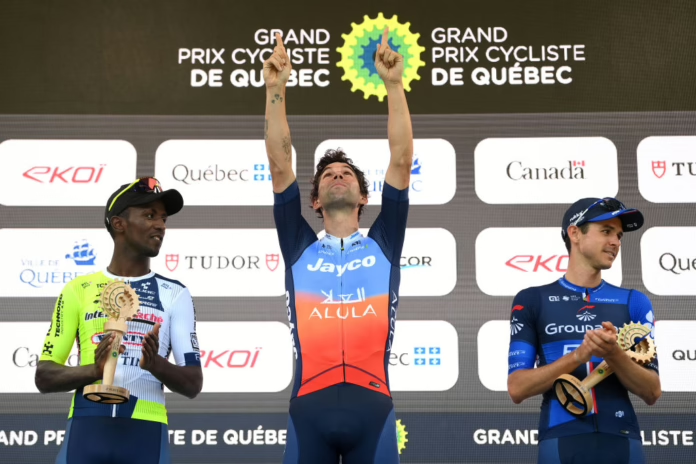
The Grand Prix Cycliste de Québec has been made shorter for 2026, but almost everything about the redesigned circuit points towards a harder and more concentrated race.
Friday 11 September’s WorldTour Classic covers 206km across 20 laps of a 10.3km Québec City circuit, starting and finishing around the Plains of Abraham. That is ten kilometres shorter than the 2025 edition, yet the total climbing has increased to approximately 2,780 metres. Instead of reducing the difficulty, organisers have compressed more of the terrain that matters into every lap.
The familiar Côte de la Montagne remains the pivotal climb. It measures 600 metres at 9%, including sections reaching 13%, and is followed almost immediately by another kilometre of rising road towards Avenue George VI and the finish. Twenty repetitions mean the riders effectively face the same two-part uphill finale again and again, with increasingly little time to recover as the race progresses.
That gives GP Québec an unusual character. The individual climbs are too short to make it a conventional climbers’ Classic, while almost 2,800 metres of accumulated ascent makes life increasingly difficult for pure sprinters. It remains a race for puncheurs, resilient Classics riders and fast finishers who can repeatedly absorb short, sharp efforts.
For anyone new to the event, ProCyclingUK’s beginner’s guide to the Grand Prix Cycliste de Québec 2026 explains how the Canadian WorldTour race works and why the repeated circuit produces such distinctive racing.
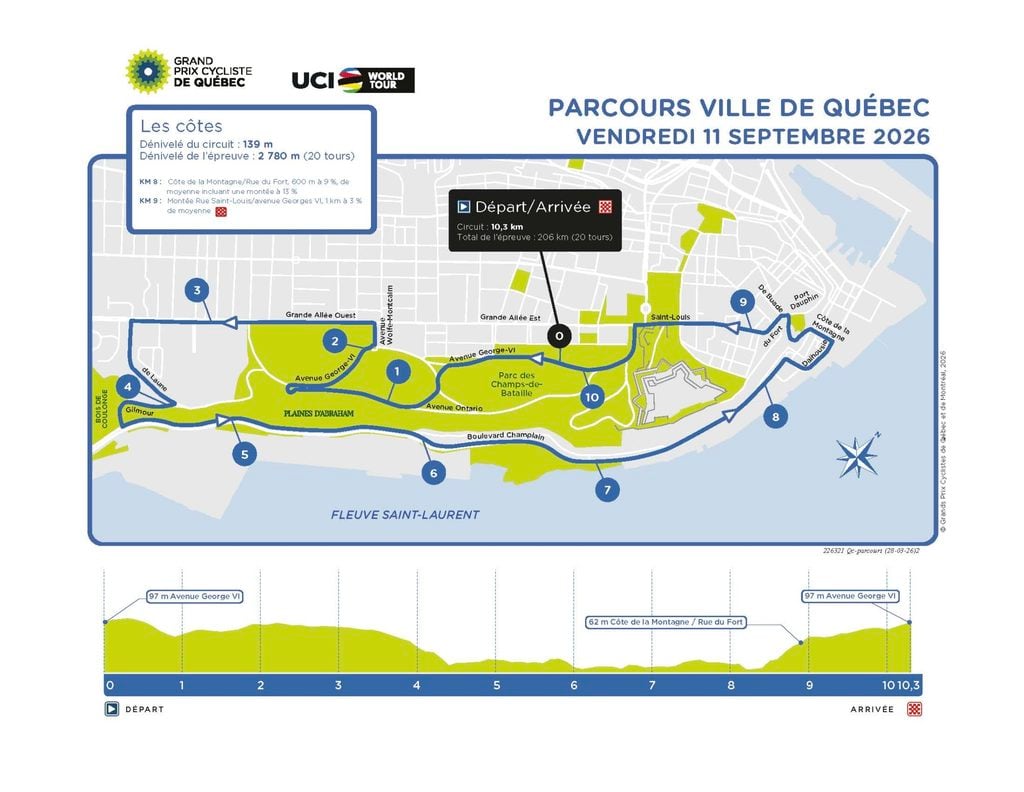
GP Québec 2026 route at a glance
| Detail | GP Québec 2026 |
|---|---|
| Date | Friday 11 September 2026 |
| Start and finish | Plains of Abraham, Québec City |
| Distance | 206km |
| Circuit length | 10.3km |
| Number of laps | 20 |
| Elevation gain per lap | Approximately 139 metres |
| Total climbing | Approximately 2,780 metres |
| Key climb | Côte de la Montagne, 600m at 9%, maximum around 13% |
| Final uphill section | Approximately 1km at 3% towards Avenue George VI |
| Race start | 11:00 local time |
| Classification | UCI WorldTour, 1.UWT |
GP Québec is part of the wider late-season programme tracked in ProCyclingUK’s men’s cycling race hub, with GP Montréal following two days later on Sunday 13 September.
What has changed for GP Québec in 2026?
The most important change is the circuit itself.
In 2025, riders completed 18 laps of a circuit of roughly 12km, producing a total race distance of 216km. For 2026, each lap has been reduced to 10.3km but the number of repetitions rises to 20.
The result looks contradictory at first. The race has lost ten kilometres while gaining climbing.
That makes the 2026 edition more concentrated rather than easier.
Several roads used during the 2025 circuit have disappeared, creating a more compact loop based heavily around the Plains of Abraham, Grande Allée, Boulevard Champlain and the steep return towards the upper city.
The peloton consequently reaches its principal pressure points more often, with less road between repetitions.
That matters more than the reduction in total distance.
A longer circuit can provide several kilometres in which teams settle, riders eat and drink and the peloton reorganises after a difficult section. The 2026 route continually brings the race back towards the Côte de la Montagne and the uphill run towards the finish.
By the time one climb has been processed and the group has reorganised, another lap is already developing.
It is why the simplest way to describe the new GP Québec is denser.
There is slightly less racing, but a greater proportion of those 206 kilometres is spent dealing with the roads that actually make the event selective.

The Plains of Abraham begin each lap
Each circuit begins around Avenue George VI on the Plains of Abraham, one of the most recognisable settings in North American professional cycling.
The opening kilometres are not where GP Québec is normally decided, but they are tactically important because the relatively open roads allow teams to reorganise after the previous passage through the finish.
The route initially rolls across the upper part of the city before heading west along the Grande Allée.
The profile here is gently undulating rather than genuinely difficult. Early in the race, this should effectively serve as a recovery section after the previous ascent from the lower city.
Later, its role changes.
Teams with a protected sprinter or puncheur need to use these kilometres to move riders back towards the front before the course begins dropping towards the Saint Lawrence River.
If a contender starts the descending section too far back, moving through the peloton becomes increasingly difficult. With 20 laps, those positioning efforts gradually accumulate alongside the climbing itself.
The descent towards Boulevard Champlain changes the rhythm
Around the middle of each circuit, the race begins dropping from the heights around the Plains of Abraham towards Boulevard Champlain and the Saint Lawrence River.
This is one of the characteristics that makes GP Québec different from a straightforward hilly circuit.
The riders do not simply climb and descend along wide roads. The course moves between very different levels of Québec City, creating repeated changes in speed and position.
Descending stretches the peloton.
That can make life particularly difficult for riders positioned near the back because opportunities to move forward become limited. Once the strongest teams begin increasing the pressure during the final laps, every position lost before the descent potentially has to be regained before the Côte de la Montagne.
Being a good climber is therefore only part of the equation.
A rider who repeatedly loses 20 positions on the descent may have to begin every ascent from the wrong end of the front group. Over 20 circuits, continually correcting that mistake consumes considerable energy.
Boulevard Champlain offers the last real recovery
The lowest section of the circuit comes along Boulevard Champlain beside the Saint Lawrence River.
Visually, it is the easiest part of the profile. Once the peloton reaches river level, there is an opportunity for the race to settle before the road suddenly turns back towards the upper city.
For much of the afternoon, Boulevard Champlain should allow teams to establish control.
Breakaway advantages can be monitored. Domestiques can organise the chase. Riders who have drifted backwards can attempt to regain position.
Its tactical role changes completely during the closing laps because everyone knows what is waiting at the other end.
The approach to the Côte de la Montagne becomes one of the most intense positioning contests on the circuit.
Entering the climb tenth rather than 50th can make an enormous difference when the front of the peloton begins accelerating on double-digit gradients.
By the final laps, therefore, expect the speed along the river to increase even though the road itself is not especially demanding.
The race to the climb becomes almost as important as the climb.
 Photo Credit: Getty
Côte de la Montagne remains the defining ascent
The signature climb remains the Côte de la Montagne, incorporating the rise along Rue du Fort close to the end of every lap.
At 600 metres with an average gradient of 9% and sections approaching 13%, it is short enough for powerful riders to survive but steep enough for genuine puncheurs to create meaningful separation.
On the first few laps, the peloton should cross it quickly without the overall shape of the race changing greatly.
The fifteenth ascent is different from the fifth.
By then, the riders have accumulated more than 2,000 metres of climbing while repeatedly accelerating out of corners, fighting for position and climbing from the Saint Lawrence back towards the upper city.
The nineteenth and twentieth repetitions are different again.
At that stage, 600 metres at 9% becomes a violent effort performed after close to five hours of racing.
That is why simply looking at the climb’s length understates the difficulty of GP Québec.
Nobody is being eliminated because 600 metres is beyond their basic climbing ability. They are being eliminated because they have already been asked to produce almost exactly the same effort 19 times.
The Côte de la Montagne is not the finish
One of the most important aspects of the 2026 route is that reaching the top of the Côte de la Montagne does not end the climbing.
The road continues upwards towards the Plains of Abraham and the finish on Avenue George VI.
That final section measures approximately one kilometre at around 3%.
Three per cent does not sound particularly selective in isolation.
Immediately after 600 metres at 9%, it matters considerably more.
There is very little opportunity for a rider to recover after attacking on the steep section. Someone who creates five or ten seconds on the Côte de la Montagne needs to maintain the effort along the rising final kilometre rather than immediately benefiting from a descent.
Equally, the gradient is shallow enough for a chasing group to organise effectively.
That creates the central tactical problem of GP Québec.
Attack hard enough on the Côte de la Montagne and a rider may establish the gap required to win. Go too deep and the chasing group can use the final kilometre to bring them back.
Wait instead and the race may remain together for a reduced uphill sprint.
Julian Alaphilippe showed the attacking route to victory in 2025, using the final part of the race to escape rather than allowing the faster riders an opportunity to settle the result. His Québec success became one of the final major victories of Alaphilippe’s career before his retirement in 2026.

Why the shorter circuit could be harder to control
Reducing the lap to 10.3km means the decisive sections return more frequently.
That creates a significant problem for teams trying to control GP Québec for a fast finisher.
Every attack over the Côte de la Montagne has to be managed. A dangerous group may need chasing. Riders then have to reorganise and prepare for exactly the same sequence little more than ten kilometres later.
That requires numbers.
Imagine a team reaching the final three laps with its leader and only one remaining domestique.
An attack goes on the eighteenth Côte de la Montagne. The helper closes it.
Another move goes one lap later.
By the final circuit, the protected rider is potentially isolated and has to decide whether to follow attacks personally or gamble on another team doing the work.
That is how circuit races become tactically unstable even when everyone knows the roads perfectly.
Familiarity does not necessarily make control easier.
Sometimes it simply means every rival knows exactly where the controlling team is most vulnerable.
The final three laps should transform GP Québec
For much of the race, the objective is attrition rather than immediate separation.
The final three laps should look considerably different.
With approximately 30.9km remaining, aggressive one-day riders no longer have much reason to conserve themselves. A move over the Côte de la Montagne at that point does not necessarily need to survive another three circuits.
It may simply force a rival team to begin using its remaining domestiques.
The penultimate lap becomes particularly interesting.
A rider attacking with around 12km remaining effectively needs to survive one complete circuit. If several strong riders join the move and the quickest finishers have already lost support, organising the chase can become difficult remarkably quickly.
Then comes the twentieth and final Côte de la Montagne.
From its foot, only a little over two kilometres remain.
That is short enough for a committed attack to work.
It is also long enough for anyone who goes too deep on the steep section to pay for the effort during the final 3% rise.
This is therefore not a conventional uphill sprint where the contenders simply wait for the final 200 metres.
The winning attack can begin significantly earlier.
What type of rider does the GP Québec 2026 route favour?
The ideal GP Québec rider occupies the territory between a puncheur and a sprinter.
Michael Matthews remains perhaps the clearest historical example.
The Australian has won GP Québec three times because he can repeatedly absorb short climbing efforts while retaining the speed required to beat a reduced group. His record in Canada has become an important part of a career that will continue after Matthews extended his Team Jayco AlUla contract through 2027.
Peter Sagan fitted much the same profile during his peak years. Simon Gerrans could survive difficult races and finish quickly. Philippe Gilbert offered the alternative solution of simply attacking before the sprint.
More recently, Benoît Cosnefroy demonstrated that an explosive late move can defeat the faster riders, while Arnaud De Lie showed that genuine sprint speed can still prevail if the rider carrying it is durable enough.
The 2026 changes probably shift the balance fractionally towards puncheurs and aggressive Classics riders.
There is more climbing overall, the steepest section returns more frequently and teams have fewer kilometres in which to restore order between efforts.
That does not rule out another Matthews-style sprint.
It simply makes reaching one more difficult.
-
 Photo Credit: Getty

Québec remains less selective than GP Montréal
The Canadian WorldTour races are often discussed as a pair, but their route profiles are distinctly different.
Québec offers short, explosive climbing and generally keeps faster riders in contention for longer.
The Grand Prix Cycliste de Montréal 2026 shifts much further towards sustained climbing ability. Its Mount Royal circuits accumulate more difficult climbing and have increasingly produced winners from the Grand Tour and Ardennes end of the peloton.
The history of GP Montréal reflects that difference, with the two Canadian races developing separate identities despite being created together in 2010.
That makes Friday’s race particularly interesting tactically.
A rider who expects Montréal to suit them better can afford to attack Québec aggressively. A durable sprinter has far more incentive to protect Friday because Sunday’s course may move beyond their range.
In 2026 that relationship matters even more because Montréal hosts the UCI Road World Championships later in September.
A route designed around repeated attacks rather than one decisive climb
GP Québec’s difficulty can easily be underestimated because nothing on the profile appears especially imposing when viewed individually.
There is no major mountain. There is no ten-kilometre climb. There is no single ascent that obviously excludes half the start list.
Instead, the race asks essentially the same questions 20 times.
Can you descend cleanly?
Can you remain near the front along the river?
Can you absorb 600 metres at 9%?
Can you continue climbing for another kilometre?
Can you recover quickly enough to do it again?
The 2026 circuit increases the frequency of that examination.
Across 20 laps, the riders accumulate approximately 2,780 metres of climbing over 206km, making this a substantially harder race than the headline distance might suggest.
That is the central point of the redesign.
GP Québec 2026 is not easier because it is shorter.
It is more concentrated.
And when the peloton reaches the Côte de la Montagne for the twentieth time, that distinction should be impossible to miss.

