
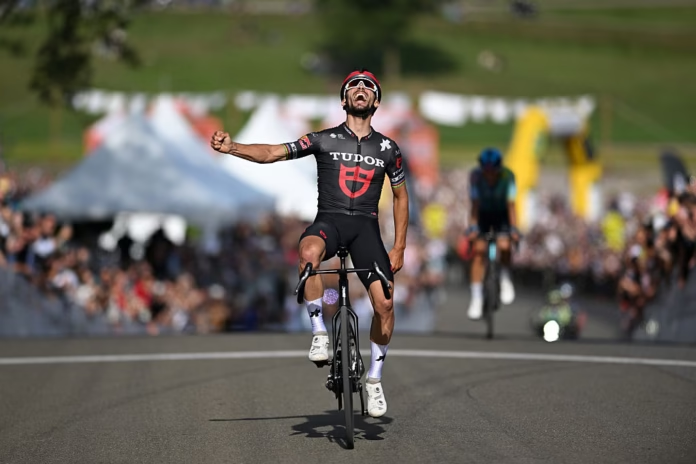
The Grand Prix Cycliste de Québec is one of the youngest one-day races on the men’s WorldTour, but it did not need decades to establish a recognisable identity. Since Thomas Voeckler won the inaugural edition in 2010, the streets of Québec City have produced a winners list containing Philippe Gilbert, Peter Sagan, Michael Matthews, Simon Gerrans, Rigoberto Urán and Julian Alaphilippe.
What separates GP Québec from many modern additions to the calendar is how quickly the course itself became familiar. The race is built around repeated laps through Québec City’s historic centre, with the Côte de la Montagne and rising finish towards the Plains of Abraham giving punchy riders and resilient sprinters repeated opportunities to make the difference.
The Grand Prix Cycliste de Québec 2026 will be the 15th edition, with only the Covid-related cancellations of 2020 and 2021 interrupting the sequence since its creation. It remains one half of Canada’s WorldTour double alongside the Grand Prix Cycliste de Montréal, providing some of the highest-level regular professional road racing in North America.
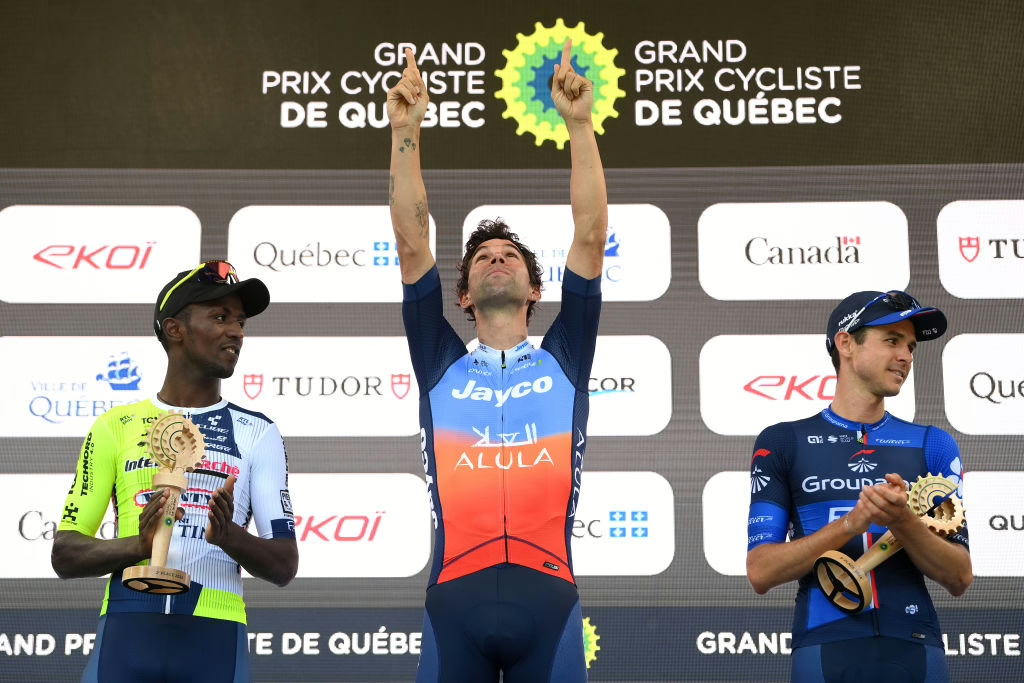
GP Québec history at a glance
| Detail | Grand Prix Cycliste de Québec |
|---|---|
| First edition | 2010 |
| Location | Québec City, Québec, Canada |
| Race type | Men’s one-day race |
| Classification | UCI WorldTour, 1.UWT |
| Traditional month | September |
| Signature feature | Côte de la Montagne and repeated Québec City circuits |
| Editions completed through 2025 | 14 |
| Cancelled editions | 2020 and 2021 |
| Record winner | Michael Matthews, 3 wins |
| 2025 winner | Julian Alaphilippe |
| 2026 edition | Friday 11 September |
GP Québec brought the ProTour to North America
Canada already possessed significant professional cycling history before 2010, particularly around Montréal.
The 1974 World Championships had been held on Mount Royal, where Eddy Merckx won the men’s road race, while the Grand Prix des Amériques brought World Cup racing to Montréal between 1988 and 1992.
Québec City offered something different.
Rather than reviving a former World Cup event, the Grand Prix Cycliste de Québec was established as a new race alongside Montréal as part of an ambitious attempt to create a permanent place for top-level Canadian cycling on the international calendar.
The inaugural edition took place on 10 September 2010 and became the first UCI ProTour race staged in North America.
Thomas Voeckler was an appropriate first winner.
Wearing the French champion’s jersey, Voeckler attacked with around 800 metres remaining and held off Edvald Boasson Hagen and Robert Gesink. It immediately demonstrated that the uphill finish could reward tactical aggression rather than simply becoming a conventional sprint.
Two days later, the peloton travelled to Montréal for the second half of a pairing that has remained together ever since.
The history of the Grand Prix Cycliste de Montréal has developed differently, but the existence of both races has been central to establishing September’s Canadian WorldTour weekend.
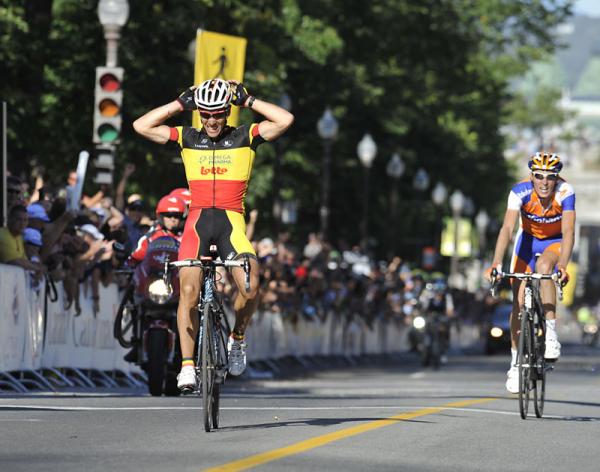
Philippe Gilbert showed exactly what kind of rider Québec suited
If Voeckler introduced the race, Philippe Gilbert’s victory one year later helped define it.
Gilbert arrived during his extraordinary 2011 season, when he was arguably the strongest one-day rider in the world. His combination of climbing strength, explosiveness and finishing speed was almost perfectly matched to Québec.
He beat Robert Gesink and Rigoberto Urán to become the second winner.
The result established a pattern that remains visible more than a decade later. GP Québec is difficult enough to remove many pure sprinters but generally not hard enough to ensure that lightweight climbers control the outcome.
Instead, its most successful riders tend to occupy the substantial territory between those categories.
They need enough power to repeatedly handle short climbs and changes of pace, but also require either a strong sprint or sufficient explosiveness to escape during the closing kilometres.
It is why the race has proved so suitable for puncheurs and Classics riders.
Simon Gerrans becomes Québec’s first repeat winner
Simon Gerrans provided the first evidence that GP Québec could become a race specialists learned to master.
The Australian won in 2012 before returning two years later for a second victory.
His 2014 success came from a reduced finish, with Gerrans beating Tom Dumoulin and Ramūnas Navardauskas on the Grande Allée.
Two days later he won again in Montréal, becoming the first rider to complete the Québec-Montréal double during the same season.
The achievement highlighted both the similarities and the important differences between Canada’s two WorldTour races.
Québec generally gives faster Classics specialists a greater opportunity to stay involved, while Montréal’s repeated Mount Royal climbing shifts the advantage further towards riders with stronger climbing credentials. ProCyclingUK’s beginner’s guide to GP Montréal 2026 looks more closely at that contrast.
Gerrans possessed an ideal balance for both.
Between his two Québec victories, Gesink won the 2013 edition. Urán then succeeded in 2015, further demonstrating that the race did not require a conventional sprinting profile.
Peter Sagan becomes the first back-to-back winner
The Peter Sagan era began in 2016.
Few riders in modern cycling have fitted GP Québec more naturally. Sagan could climb well enough to survive a selective WorldTour Classic while possessing a sprint that made taking him towards the finish enormously dangerous.
He won in 2016 and returned the following year to become the first rider to successfully defend his Québec title.
Those victories came at the height of Sagan’s career. He won three consecutive world road race titles between 2015 and 2017 and had developed into one of the sport’s most difficult riders to remove before a reduced sprint.
Québec provided exactly that type of challenge.
Sagan’s two victories set the benchmark for consecutive success until another Australian began building an even stronger relationship with the race.
 Photo Credit: Getty
Michael Matthews becomes the king of GP Québec
No rider has won the Grand Prix Cycliste de Québec more often than Michael Matthews.
The Australian had already collected strong results at the race before finally winning in 2018, beating Greg Van Avermaet and Jasper Stuyven after a late attack was caught close to the finish.
Matthews then travelled to Montréal and won again two days later.
He became only the second rider after Gerrans to complete the Canadian double, confirming how well his combination of climbing endurance and finishing speed suited both events.
A year later he successfully defended his Québec title.
The Covid-19 pandemic then interrupted the race at precisely the point when Matthews had established himself as its dominant rider. The 2020 and 2021 editions were both cancelled before the Canadian WorldTour races finally returned in 2022.
Matthews’ sequence had been broken, but his relationship with Québec had not.
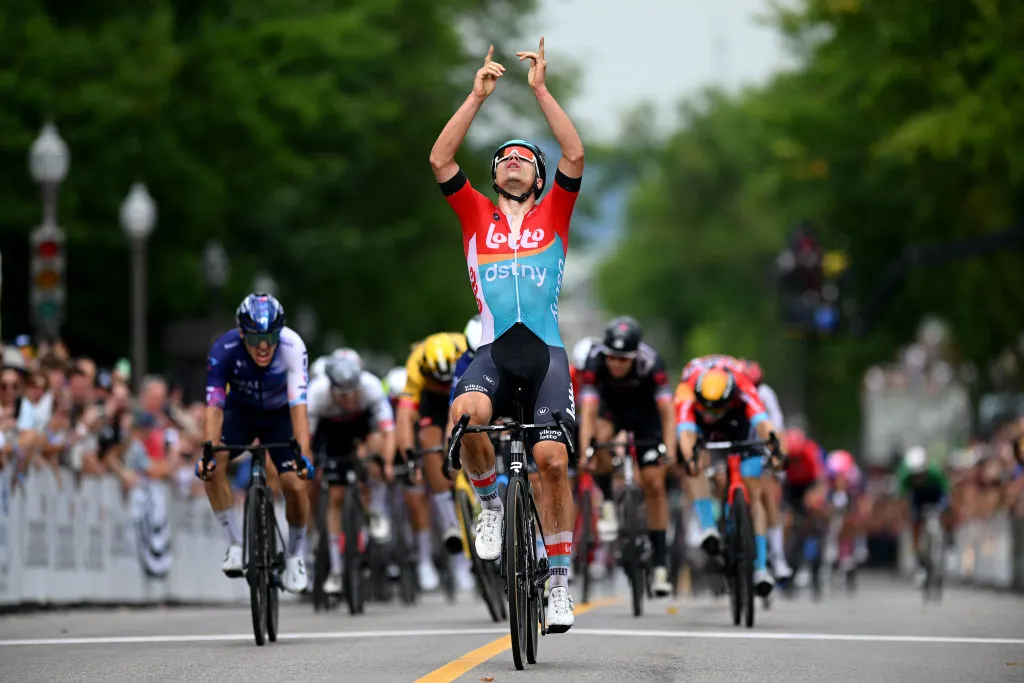 Photo Credit: Getty
Cosnefroy and De Lie show the different ways to win
Benoît Cosnefroy won the comeback edition in 2022 with a late attack rather than accepting a sprint against Matthews.
The Frenchman finished four seconds ahead of the Australian, with Biniam Girmay third.
That podium neatly represented the range of riders suited to Québec.
Cosnefroy was the explosive puncheur. Matthews was the durable Classics sprinter. Girmay combined elements of both.
Arnaud De Lie moved the balance back towards outright speed in 2023.
The Belgian beat Corbin Strong and Matthews after surviving the repeated climbing, showing that a powerful sprinter can still succeed if he is capable of absorbing the accumulated efforts of the circuit.
Those editions demonstrated why GP Québec remains tactically difficult despite taking place on repeated laps.
Everybody knows where the climbs are. Everybody understands the finish. The uncertainty is not in the roads themselves, but in what remains of the peloton by the final passage.
Matthews returns to make history in 2024
Matthews returned to the top step in 2024, five years after his previous victory.
He beat Biniam Girmay and Rudy Molard to claim a record third GP Québec title, moving clear of Gerrans and Sagan on the all-time list.
The time between his victories was almost as significant as the number itself.
Matthews first won Québec at 27 in 2018. By the time he took his third victory, he was 33 and competing against a substantially different generation of riders.
Yet the characteristics required to win had remained almost perfectly aligned with his own.
Québec repeatedly asks whether a fast rider can retain enough speed after several hours of climbing and accelerations. Matthews has spent much of his career answering that question better than almost anyone.
His success in Canada is a major part of the palmarès that helped earn Matthews a new Team Jayco AlUla contract through 2027.
Greg Van Avermaet came remarkably close without winning
Matthews owns the victory record, but another rider developed an unusual relationship with GP Québec without ever reaching the top step.
Greg Van Avermaet finished second four times.
That statistic says almost as much about the race as the victories of Sagan or Matthews.
Van Avermaet possessed virtually every quality required. He could repeatedly handle short climbs, race aggressively, position himself through technical sections and sprint from a reduced group.
He was also one of the strongest one-day riders of his generation.
Yet the exact combination of timing and speed required to win Québec continually escaped him.
His record illustrates one of the deceptive elements of the course. Because so many different riders can realistically win, getting the tactical details right becomes unusually important.
Julian Alaphilippe breaks the sprint pattern in 2025
The 2025 edition produced one of the most aggressive victories in the race’s short history.
Changes to the circuit created a longer and increasingly attritional contest while retaining the Côte de la Montagne as the defining climb.
Julian Alaphilippe refused to wait for the expected late confrontation.
The Frenchman became involved in the attacking race from around 75km out before the decisive selection developed later in the afternoon. With Pavel Sivakov and Alberto Bettiol among the remaining leaders, Alaphilippe attacked again in the finale and was not caught.
He finished two seconds ahead of Sivakov, with Bettiol another two seconds behind.
It was particularly significant because it ultimately became one of the final major victories of Alaphilippe’s career. The double world champion retired in 2026, making his Québec success one of the last reminders of the aggressive racing style that had defined him at his peak.
The victory also brought GP Québec neatly back towards its beginnings.
Fifteen years earlier, Voeckler had refused to accept the sprint and attacked inside the final kilometre. Alaphilippe reached the same basic conclusion in 2025, although his victory had been constructed through a much longer period of aggressive racing.

The Côte de la Montagne has become Québec’s signature climb
The identity of the race is inseparable from Québec City itself.
Rather than travelling through the surrounding countryside before entering a finishing town, GP Québec is essentially an extended circuit race through the provincial capital.
The peloton repeatedly passes some of the city’s best-known landmarks, including the Plains of Abraham and the fortified old town, while steep descents and short climbs create a rhythm completely different from a conventional flat urban circuit.
The Côte de la Montagne is its defining ascent.
The road rises sharply from the lower part of the old city towards the upper town and forces riders to accelerate after already spending several hours repeatedly climbing.
Its numbers in isolation do not resemble those of a significant mountain.
That misses the point.
Québec is a race built around accumulation.
A rider who comfortably climbs the Côte de la Montagne during the opening laps may experience a completely different ascent after almost 200km of racing, repeated positioning battles and constant accelerations.
The approach towards the Plains of Abraham then rewards whoever has managed those efforts without destroying their ability to sprint or attack.
It explains how riders as different as Urán and De Lie can both appear on the winners list.
-
 Photo Credit: Getty
 -
 Photo Credit: Olly Hassell/SWPix.com
Québec and Montréal created their own September tradition
GP Québec is rarely considered entirely in isolation.
From its creation it has been paired with GP Montréal two days later. Teams race on Friday in Québec, transfer to Montréal and race again on Sunday.
The two have gradually established a distinctive Canadian WorldTour weekend.
Only Gerrans in 2014 and Matthews in 2018 have managed to win both races during the same trip.
Québec is generally the faster of the pair. Montréal typically rewards stronger climbers and more aggressive racing, while Québec keeps a wider group of sprinters and puncheurs in contention.
Together, they give riders two high-level one-day races close to the end of the season and have repeatedly become important preparation for the World Championships.
That role was particularly visible in 2024, when Tadej Pogačar, Tom Pidcock and Biniam Girmay headed to the Canadian races as part of the build towards the Zürich World Championships.
The 2026 season strengthens that relationship further, with Montréal itself hosting the World Championships shortly after the Canadian WorldTour races.
GP Québec reaches its 15th edition in 2026
The 2026 Grand Prix Cycliste de Québec takes place on Friday 11 September, two days before GP Montréal and during one of the most important periods of the late-season men’s cycling calendar.
Michael Matthews remains the benchmark with three victories. Gerrans and Sagan have two each, while Voeckler, Gilbert, Gesink, Urán, Cosnefroy, De Lie and Alaphilippe make up a strikingly varied group of single winners.
That list tells the story of GP Québec better than any simple description of its course.
It is not a sprinters’ Classic, although sprinters can win it. It is not a climbers’ race, although Grand Tour climbers have succeeded. Waiting for the sprint can work, but Voeckler, Cosnefroy and Alaphilippe have all demonstrated the value of attacking before one can happen.
What Québec consistently rewards is versatility.
After only 14 completed editions, it already has a recognisable type of champion: a rider strong enough to survive the repeated climbing, tactically sharp enough to stay near the front through Québec City’s technical roads and still explosive enough to decide the race when the Plains of Abraham appear for the final time.

