
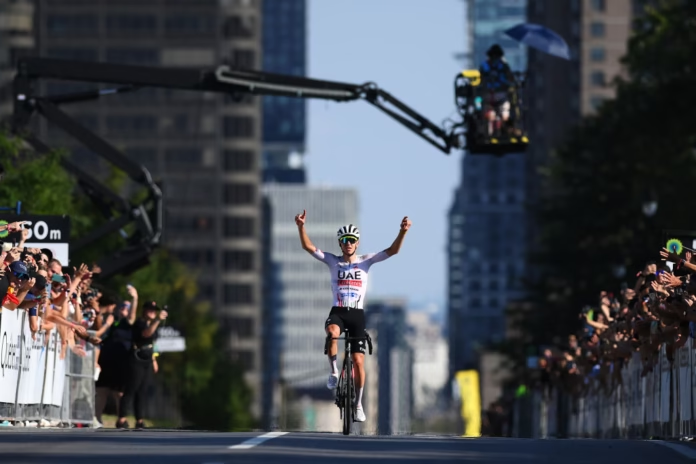
The Grand Prix Cycliste de Québec returns on Friday 11 September 2026, bringing the men’s WorldTour to Québec City for one of the most distinctive one-day races on the calendar.
Often shortened to GP Québec, the race sits somewhere between an uphill sprint Classic and a race for explosive climbers. The peloton repeatedly loops through Québec City, accumulating almost 2,800 metres of climbing before the final uphill run towards the Plains of Abraham. It rewards riders who can absorb repeated short climbs, fight for position and still produce either a powerful attack or fast finish after more than 200km.
The race comes two days before the Grand Prix Cycliste de Montréal and has added importance in 2026 because the UCI Road World Championships take place in Montréal later in September. That makes the Canadian double-header one of the final major tests for riders targeting the rainbow jersey.
GP Québec also forms part of the wider late-season WorldTour programme covered in ProCyclingUK’s 2026 men’s racing calendar.

Grand Prix Cycliste de Québec 2026 at a glance
| Detail | Information |
|---|---|
| Race | Grand Prix Cycliste de Québec 2026 |
| Date | Friday 11 September 2026 |
| Classification | UCI WorldTour, 1.UWT |
| Edition | 15th |
| Location | Québec City, Canada |
| Distance | Around 206km |
| Circuit laps | 20 |
| Elevation gain | Around 2,780 metres |
| Key climb | Côte de la Montagne |
| Finish | Plains of Abraham |
| 2025 winner | Julian Alaphilippe |
| Companion race | Grand Prix Cycliste de Montréal, 13 September |
Québec and Montréal are the two Canadian one-day races on the men’s WorldTour and have occupied an unusual place on the calendar since their introduction in 2010. ProCyclingUK looked at the importance of the pair when Tadej Pogačar, Tom Pidcock and Biniam Girmay headed to the Canadian races in 2024.
What is the Grand Prix Cycliste de Québec?
GP Québec is a one-day circuit race through Québec City rather than a traditional point-to-point Classic.
The riders repeatedly pass many of the same landmarks, climbs and finishing roads, making it particularly spectator-friendly. Fans can stay in roughly the same area and see the peloton repeatedly rather than watching it disappear after a single passage.
For the riders, that repetition is exactly what makes the race difficult.
A short climb that causes few problems on the first few laps becomes increasingly painful after several hours. Each circuit adds another fight for positioning, another acceleration and another opportunity for a team to increase the pressure.
The 2026 race uses 20 laps of a compact circuit, with the start and finish both around the Plains of Abraham. The relatively short lap creates a relentless rhythm because the principal climbs return quickly and there is limited time for teams to reorganise.
What has changed for GP Québec in 2026?
The Québec course was redesigned in 2025 and has been adjusted again for 2026.
The overall distance falls to around 206km, while the number of circuit laps rises to 20. The total amount of climbing is close to 2,800 metres, meaning this should not be confused with a shorter and easier version of the race.
In some ways, the more compact structure could make it harder.
The climbs arrive more frequently and there is less time between efforts. Instead of long periods where domestiques can restore order, the peloton keeps returning to the same pressure points.
For beginners, the simplest way to understand the change is that GP Québec has become more concentrated. There is slightly less distance, but a greater proportion of the race is spent dealing with the roads that actually make the event selective.
The Côte de la Montagne is the climb to remember
If you remember only one road from GP Québec, make it the Côte de la Montagne.
The climb is roughly 600 metres long at around 9%, with steeper sections reaching into double figures.
Those figures do not sound especially intimidating compared with a Grand Tour mountain, but the purpose is completely different. Nobody is trying to climb for half an hour at threshold. The Côte de la Montagne encourages explosive accelerations lasting one or two minutes.
That makes it ideal territory for puncheurs.
The strongest riders can hit the steep section hard enough to open a gap, while sprinters capable of climbing must decide how much energy they are willing to spend staying attached.
The climb is followed by further uphill roads towards the Plains of Abraham, so reaching its summit does not mean the difficult work is finished. A rider who loses five or ten metres may find it extremely difficult to regain contact.
Why does climbing it 20 times matter?
One ascent of the Côte de la Montagne would barely register in a major WorldTour Classic.
Twenty passages are entirely different.
Repeated climbing gradually strips away riders who might comfortably survive the same gradient once. Lead-out riders disappear, domestiques become tired and teams have fewer resources available to chase attacks.
The other factor is positioning.
Riders do not simply expend energy on the climb. They also have to fight for the front before it. Entering the Côte de la Montagne in 60th position may require an enormous effort just to reach the wheel of the leaders, whereas starting near the front allows a rider to absorb some of the acceleration without immediately being dropped.
Over 20 laps, those small differences accumulate.
That is why GP Québec can remain relatively controlled for several hours before suddenly becoming much more selective.
How is GP Québec normally won?
There are two main routes to victory.
The traditional scenario is a reduced uphill sprint. The repeated climbs remove the pure sprinters and weaker riders, but a sizeable group still reaches the final kilometre together.
That type of race explains why riders such as Michael Matthews, Peter Sagan, Simon Gerrans and Arnaud De Lie have succeeded here. They can survive a demanding one-day race and still sprint at the end.
The second option is to attack before the sprint becomes possible.
Julian Alaphilippe demonstrated that perfectly in 2025. The Frenchman was part of a strong move that developed well before the final lap, then attacked again on the last Côte de la Montagne and held his advantage to the finish.
That victory showed how difficult controlling the newer Québec circuit can become once strong riders get ahead.
 Photo Credit: Getty
What type of rider wins GP Québec?
The race tends to favour several overlapping types of rider rather than one specialist category.
Puncheur-sprinters
These are probably the riders best suited to GP Québec.
They can survive repeated short climbs but still possess enough speed to win from a group. Michael Matthews is the clearest example.
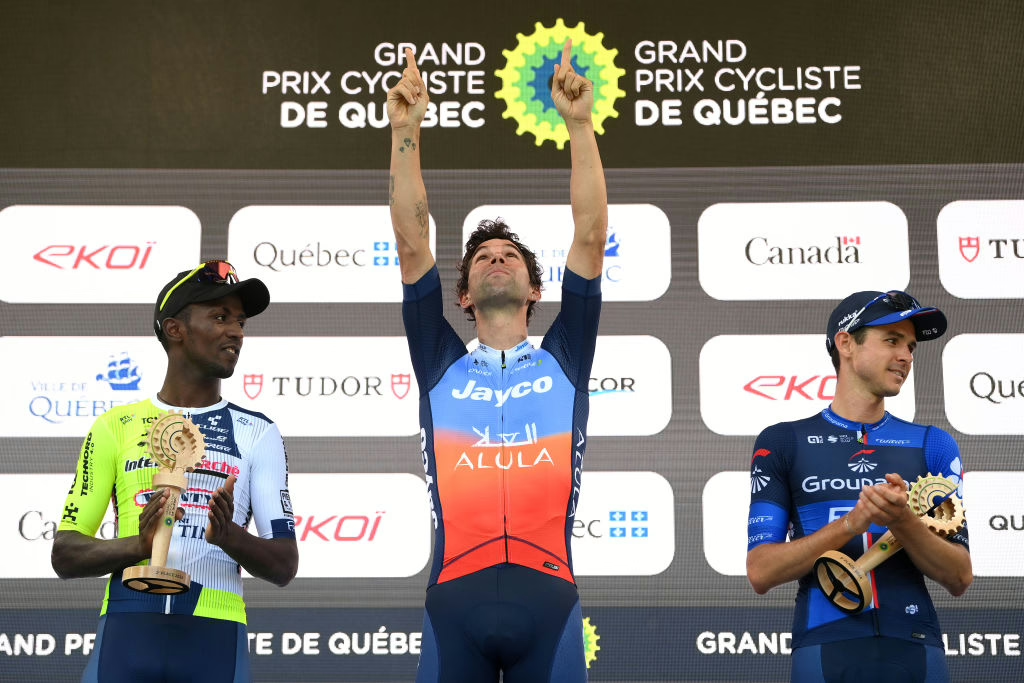
The Australian has won the race three times and remains one of the best riders of his generation at converting difficult, reduced sprints. His long-term importance to Jayco-AlUla was reinforced when Michael Matthews extended his contract with the team through 2027.
Explosive Classics riders
These riders may not want to wait for Matthews or another quick finisher.
Instead, they attack on the Côte de la Montagne and try to establish enough separation to survive the final drag.
Alaphilippe’s 2025 victory was the clearest recent example.
Strong all-round climbers
Pure climbers are not automatically favourites because the individual climbs are so short, but riders with enough explosiveness can make the accumulated elevation count.
Their best strategy is normally to make the race harder well before the final sprint.
Durable sprinters
The strongest fast men can survive surprisingly deep into GP Québec.
The key distinction is between a pure sprinter and somebody who can repeatedly climb at high intensity. Biniam Girmay, for example, has twice finished second in Québec and fits the race particularly well because his sprint remains dangerous after difficult racing.
Girmay begins a new chapter of his career in 2026 after signing a three-year deal with NSN Cycling Team.
Why Michael Matthews has been so successful in Québec
Few riders explain GP Québec better than Michael Matthews.
Matthews is not a pure climber and would rarely expect to beat the world’s best mountain specialists on a long ascent. He is also not the fastest rider in a flat 70km/h bunch sprint.
Québec occupies the space between those two extremes.
Repeated climbing eliminates riders with greater raw sprint speed, while the climbs are not long enough to guarantee that lightweight climbers can ride him off the wheel.
That leaves Matthews with exactly the sort of group he wants.
His third Québec victory in 2024 was another demonstration of that formula, with Matthews surviving the hard racing before beating Girmay and Rudy Molard in the final sprint.
Later that month, he discussed the confidence gained from his Canadian form ahead of the World Championships, covered in ProCyclingUK’s feature on Michael Matthews and his belief that he could out-sprint Tadej Pogačar.

Why Simon Gerrans also fitted the race so well
Before Matthews became Australia’s Québec specialist, Simon Gerrans possessed many of the same qualities.
Gerrans was an explosive one-day rider with enough climbing ability to survive selective terrain and enough sprint speed to finish races off.
He won GP Québec in 2012 and later completed the Canadian double by winning both Québec and Montréal in 2014.
That combination of results forms part of a career that also included Milan-San Remo and Liège-Bastogne-Liège victories. ProCyclingUK looks back at those achievements in What happened to Simon Gerrans?.
The comparison between Gerrans and Matthews helps explain the race better than simply describing the elevation profile. Québec repeatedly rewards fast riders who climb well, rather than specialists at either extreme.
Who is expected to race GP Québec in 2026?
The final start list will not be confirmed until much closer to September, so individual names should still be treated cautiously.
All 18 WorldTeams are expected as part of the WorldTour field, alongside invited teams and a Canadian national selection.
Remco Evenepoel has GP Québec and GP Montréal on his planned 2026 programme, making the Canadian races an important part of his build towards the World Championships. His wider season schedule, including Québec on 11 September and Montréal two days later, is covered in our 2026 men’s racing calendar.
The timing also makes the start list unusually dependent on other major objectives. The Vuelta a España ends on 13 September, while the World Championships follow shortly afterwards, so riders’ final Canadian programmes may depend on how their summers develop.
A full start list and separate contenders preview will make more sense once those selections are confirmed.

Why GP Québec is different from GP Montréal
The two Canadian races are often grouped together, but they are not simply copies of one another.
Québec is generally the more favourable race for powerful riders with a sprint.
Its climbs are short and explosive, and a reasonably large group can survive until the finale. A rider such as Matthews or Girmay can realistically spend much of the race thinking about the sprint.
Montréal is harder.
Its circuit around Mount Royal accumulates substantially more climbing and generally rewards riders closer to the climber and Ardennes specialist end of the spectrum.
That difference is part of what makes the Canadian weekend work so well. Riders who are favourites on Friday may find Sunday’s race too difficult, while riders who need greater selectivity can use Québec aggressively before becoming more obvious contenders in Montréal.
Why the 2026 race matters before the World Championships
The calendar gives both races additional significance this year.
The 2026 UCI Road World Championships take place in Montréal from 20 to 27 September, beginning only a week after the Canadian WorldTour double-header.
That creates an obvious link.
Riders targeting the rainbow jersey can arrive in Canada early, compete against WorldTour-level opposition and then remain in the country ahead of the championships.
Québec is not a direct rehearsal for the World Championship course. Montréal is much more relevant in that respect because the championship racing also takes place around Mount Royal.
Québec instead provides something slightly different: a final high-intensity one-day race in which riders can assess their explosiveness, positioning and ability to respond repeatedly after a long racing break or training block.
The proximity of the Worlds also means the race should carry more tactical significance than usual. Riders will be interested not only in who wins, but in who appears to be building towards peak form.
A brief history of GP Québec
The Grand Prix Cycliste de Québec was first held in 2010, when Thomas Voeckler won the inaugural edition.
Since then, the winners list has become a useful guide to the type of rider the course rewards.
Recent GP Québec winners
| Year | Winner |
|---|---|
| 2025 | Julian Alaphilippe |
| 2024 | Michael Matthews |
| 2023 | Arnaud De Lie |
| 2022 | Benoît Cosnefroy |
| 2021 | Cancelled |
| 2020 | Cancelled |
| 2019 | Michael Matthews |
| 2018 | Michael Matthews |
| 2017 | Peter Sagan |
| 2016 | Peter Sagan |
The race was cancelled in 2020 and 2021 during the COVID-19 pandemic before returning in 2022.
Matthews’ three wins make him the record holder, while Sagan and Gerrans both won twice.
The range is revealing. Matthews, Sagan and Gerrans were all elite sprinters after difficult races. De Lie fits a similar category, while Cosnefroy and Alaphilippe demonstrate how explosive attackers can win when the race becomes more selective.
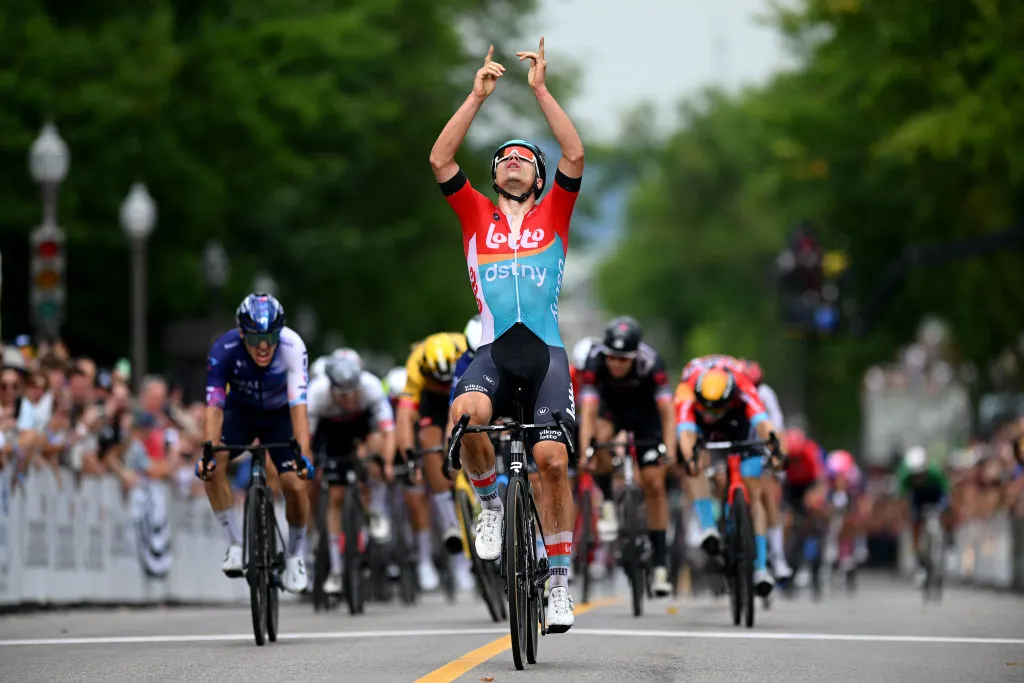 Photo Credit: Getty
Is GP Québec a Classic?
Yes, in the broader cycling sense.
The term Classic is sometimes reserved informally for Europe’s oldest and most prestigious one-day races, particularly the five Monuments, but it is also regularly used to describe major standalone one-day events.
GP Québec carries 1.UWT status, meaning it is part of the UCI WorldTour, the highest level of men’s professional road cycling.
It is not a Monument and does not have the century-long history of races such as Paris-Roubaix or Liège-Bastogne-Liège, but it still belongs to the sport’s top-tier calendar.
ProCyclingUK’s men’s cycling race hub places Québec alongside the other WorldTour one-day races and stage races across the 2026 season.
Why are Québec and Montréal important to North American cycling?
The WorldTour calendar remains overwhelmingly centred on Europe.
GP Québec and GP Montréal therefore occupy an unusual position as major North American races capable of bringing virtually the entire men’s WorldTour peloton across the Atlantic.
That matters for Canadian cycling.
A national team receives the opportunity to race against the world’s strongest professional squads, while Canadian fans can watch WorldTour racing without travelling to Europe.
The races have also increasingly become part of the build towards major championships. In 2024, Pogačar, Girmay, Matthews and several other leading riders used the Canadian races before the Zürich World Championships, a pattern explored in ProCyclingUK’s preview of the major names heading to Québec and Montréal.
In 2026, with the World Championships themselves taking place in Montréal, that relationship becomes even stronger.
Where does GP Québec finish?
The finish is around the Plains of Abraham, one of Québec City’s most recognisable historic areas.
Unlike a traditional road race that spends hours crossing rural terrain before entering a city for the finish, GP Québec remains closely tied to its urban circuit throughout the day.
The final sequence is particularly important.
Riders descend towards the old city, tackle the Côte de la Montagne and then continue across further rising roads towards the finish.
That means there is no simple moment where everybody crests the final climb and prepares for a flat sprint.
The effort continues almost all the way to the line.
-
 Photo Credit: Getty
 -
 Photo Credit: Olly Hassell/SWPix.com
What should beginners watch during GP Québec?
There is little need to watch all 20 circuits with the same level of concentration.
During the early laps, concentrate on the breakaway and which teams are taking responsibility for controlling it. The individual climbs matter less at this point because most of the peloton should still be capable of surviving them.
Once the race enters its final five or six laps, watch the size of the peloton.
That tells you whether the accumulated climbing is beginning to work.
Also look at which teammates remain around the favourites. A rider may appear comfortable while quietly losing all of the domestiques needed to chase attacks later.
With around three laps remaining, attacks become increasingly important. Riders without a sprint have little reason to wait until the final kilometre.
On the final lap, watch the positioning before the Côte de la Montagne. Anyone starting the climb too far back will spend valuable energy moving through traffic before even attempting to respond to the decisive attacks.
Then watch what happens over the top.
The race is often decided not simply by who climbs fastest, but by whether the strongest riders cooperate afterwards or begin watching one another and allow an attacker to stay clear.
When is the Grand Prix Cycliste de Québec 2026?
The Grand Prix Cycliste de Québec takes place on Friday 11 September 2026, with the Grand Prix Cycliste de Montréal following on Sunday 13 September.
That places the two WorldTour races immediately before one of the biggest cycling events Canada has hosted in decades, with Montréal welcoming the UCI Road World Championships the following week.
For newcomers, the simplest way to understand GP Québec is to imagine an uphill one-day Classic compressed into a city circuit. Take a short, steep climb, repeat it 20 times, gradually remove the weaker riders and then ask whoever is left to attack or sprint uphill for victory.
That combination is why Québec can look controlled for hours before becoming brutally difficult in its final laps.

