
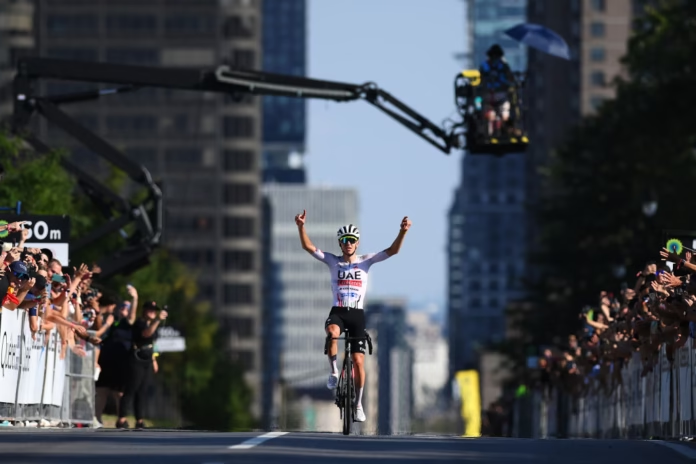
The Grand Prix Cycliste de Montréal is one of the younger races on the men’s WorldTour, but the roads around Mount Royal have played an important role in international cycling for more than half a century.
The modern race was created in 2010 alongside the Grand Prix Cycliste de Québec, establishing a permanent pair of top-level Canadian one-day races on the calendar. Montréal quickly developed the harder identity of the two, with repeated climbing around Mount Royal producing a race suited to riders who combine Grand Tour-level climbing ability with the explosiveness required for a Classic.
Its winners list reflects that balance. Peter Sagan, Greg Van Avermaet, Michael Matthews, Tim Wellens, Adam Yates and Tadej Pogačar have all won in Montréal, while recent editions have increasingly favoured outright climbers. Pogačar, Yates and Brandon McNulty have taken the last four editions between them for UAE Team Emirates-XRG.
The beginner’s guide to the Grand Prix Cycliste de Montréal 2026 explains how the modern race works. Its history, however, starts decades before Robert Gesink became the first GP Montréal winner in 2010.
 Photo Credit: Getty
GP Montréal history at a glance
| Detail | Grand Prix Cycliste de Montréal |
|---|---|
| First modern edition | 2010 |
| Location | Montréal, Québec, Canada |
| Race type | Men’s one-day race |
| Classification | UCI WorldTour, 1.UWT |
| Traditional month | September |
| Main feature | Repeated climbing around Mount Royal |
| Completed editions through 2025 | 14 |
| Cancelled editions | 2020 and 2021 |
| Record winners | Greg Van Avermaet and Tadej Pogačar, 2 wins |
| 2025 winner | Brandon McNulty |
| 2026 edition | Sunday 13 September |
Montréal’s cycling history began with the 1974 World Championships
Mount Royal was already established as international cycling terrain long before the creation of GP Montréal.
In 1974, Montréal hosted the UCI Road World Championships, the first road Worlds ever held outside Europe. Eddy Merckx won the elite men’s road race on 25 August, defeating Raymond Poulidor and Mariano Martínez, while France’s Geneviève Gambillon had won the women’s title the previous day.
Merckx’s victory became one of the defining results of his career because it completed the Giro d’Italia, Tour de France and World Championship treble in the same season. The difficulty of the Mount Royal circuit was central to that race and established a template that Montréal cycling has repeatedly returned to ever since.
The roads were back on the international stage two years later during the 1976 Montréal Olympic Games, again reinforcing Mount Royal’s reputation as a place capable of producing genuinely selective racing without requiring a traditional mountain.
That basic principle remains at the heart of GP Montréal. None of its principal climbs is extraordinary in isolation. The difficulty comes from tackling them repeatedly until a manageable ascent becomes decisive after four or five hours.
The Grand Prix des Amériques brought the professionals back
The modern GP Montréal also has a more direct predecessor.
From 1988 to 1992, the city hosted the Grand Prix des Amériques, a major professional one-day race on a hilly circuit around Mount Royal. From 1989 it formed part of the UCI Road World Cup, placing Montréal alongside many of Europe’s most prestigious Classics.
The first edition produced an ideal result for Canadian cycling. Steve Bauer won in 1988, finishing ahead of Massimo Ghirotto and Gilles Delion shortly after taking fourth overall at the Tour de France.
The subsequent winners were Jörg Müller in 1989, Franco Ballerini in 1990, Eric Van Lancker in 1991 and Federico Echave in the final edition in 1992, when the event was known as the Grand Prix Téléglobe.
The race disappeared after only five editions, leaving Montréal without an equivalent international Classic for almost two decades. When Serge Arsenault returned with the concept that eventually became the current Canadian WorldTour races, he was reviving a tradition rather than creating one entirely from scratch.
GP Montréal arrives on the top calendar in 2010
The modern Grand Prix Cycliste de Montréal was launched in 2010 alongside the new Grand Prix Cycliste de Québec.
The pairing was crucial. Bringing the entire elite peloton across the Atlantic for one race would always have been difficult to sustain, but two major one-day events within the same trip gave WorldTour teams a compelling reason to make Canada a regular part of their September programmes.
Montréal did not have to work gradually through cycling’s lower classifications. The inaugural race entered the UCI ProTour immediately, placing it at the highest level from its first edition.
Robert Gesink became the inaugural winner on 12 September 2010.
The podium could hardly have provided a better launch. A 20-year-old Peter Sagan finished second, while Canadian Grand Tour contender Ryder Hesjedal was third.
From the beginning, the result demonstrated the range of riders Mount Royal could reward: a climber won, one of the most versatile Classics riders of the next decade finished second and the leading Canadian rider stood on the podium.
Rui Costa and Lars Petter Nordhaug underline the early variety
The first years produced almost no repeat pattern in terms of nationality or rider type.
Rui Costa won in 2011, two years before becoming world champion in Florence, while Team Sky’s Lars Petter Nordhaug took the 2012 edition.
Both fitted the developing Montréal profile. They could climb extremely well, but neither needed one long mountain to create an advantage. Instead, they were capable of repeatedly absorbing hard efforts and remaining competitive when a one-day race became increasingly selective.
The variety continued for years. In fact, the first six editions produced six different winners.
It quickly became clear that Montréal was not going to belong to one specialist category in the way some Classics favour cobbled riders or pure sprinters.
Peter Sagan returns to win in 2013
Sagan had finished second in the inaugural GP Montréal and returned three years later to win.
His 2013 victory remains one of the best illustrations of the race’s unusual demands. Sagan possessed the speed to beat elite sprinters but was also capable of surviving terrain that removed almost all of them, making Mount Royal a natural fit.
He finished ahead of Simone Ponzi, with Hesjedal third for the second time in four editions.
Sagan’s victory also gave the young Canadian race another major name for its honours list. By the end of only four editions, Gesink, Rui Costa, Nordhaug and Sagan had already won it.
The status of GP Montréal was becoming established remarkably quickly.
Simon Gerrans completes the first Canadian double
The Grand Prix Cycliste de Québec and Montréal are often grouped together, but their characteristics are different enough that winning both in the same year is difficult.
Québec generally keeps more fast puncheurs involved, while the additional climbing in Montréal shifts the advantage further towards riders with greater endurance uphill. ProCyclingUK’s beginner’s guide to GP Québec 2026 looks in more detail at the contrast between the two Canadian races.
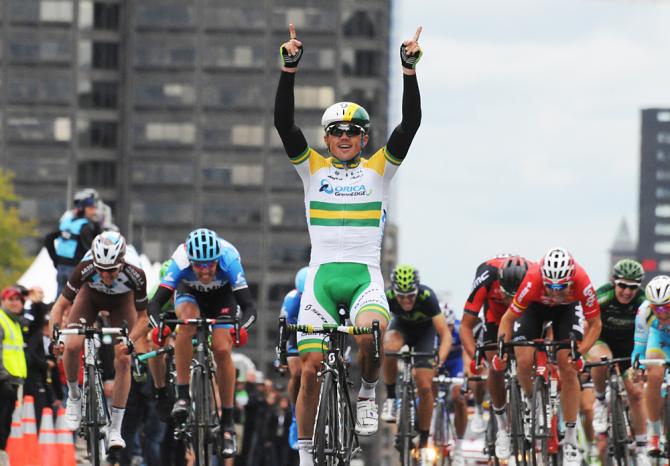
Simon Gerrans became the first rider to win both in the same season in 2014.
He won GP Québec on the Friday and repeated the result in Montréal two days later, completing what became known as the Laurentian Double.
It was a perfect match for Gerrans’ characteristics. He had enough climbing ability to survive selective races but retained a sprint that made him extremely difficult to beat once the field had been reduced.
Michael Matthews would later repeat the Canadian double in 2018, but Gerrans was the rider who first proved it could be done.
Tim Wellens takes his first major one-day victory
Tim Wellens won GP Montréal in 2015, beating Adam Yates and Rui Costa.
It became one of the early major one-day victories of a career subsequently defined by aggressive racing across hilly Classics and difficult stages. His long-term consistency and the significance of Montréal within his palmarès were revisited when Tim Wellens extended with UAE Team Emirates-XRG through 2027.
The 2015 result was also the sixth edition of GP Montréal and produced its sixth different winner.
That sequence finally ended the following year.
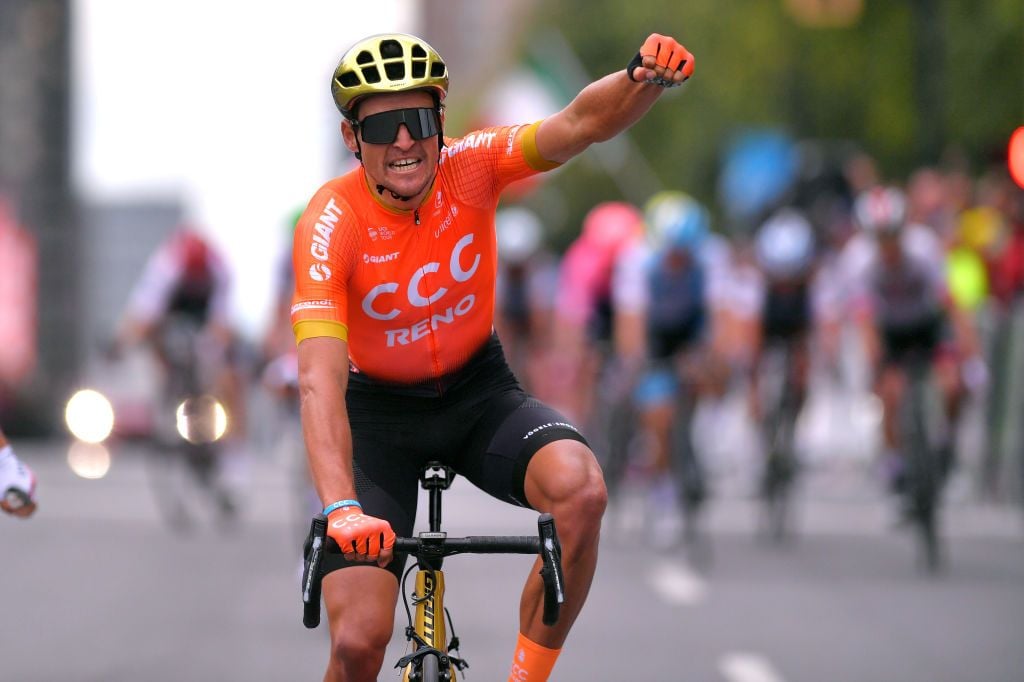 Photo Credit: Getty
Greg Van Avermaet becomes Montréal’s first multiple champion
Greg Van Avermaet’s characteristics were almost designed for Montréal.
He could climb far better than a conventional sprinter, remained strong after long attritional races and possessed enough speed to win from a reduced group.
He took his first GP Montréal victory in 2016, only weeks after winning Olympic road race gold in Rio de Janeiro. Peter Sagan finished second, giving the race another heavyweight duel between two of the defining Classics riders of their generation.
Diego Ulissi won in 2017 and Michael Matthews completed his Canadian double in 2018 before Van Avermaet returned in 2019 to take a second victory.
That made him the first rider in the modern race’s history to win twice.
He remained the sole record holder until Pogačar eventually joined him.
Michael Matthews shows why Montréal is not just for climbers
Matthews’ 2018 victory is important when understanding how the race has evolved.
Modern editions have increasingly rewarded riders with obvious Grand Tour climbing strength, but Montréal has never been exclusively a climbers’ Classic.
Matthews is one of the best riders of his generation at surviving races that are too difficult for conventional sprinters. The repeated Mount Royal ascents remove rivals with more outright speed while still leaving a rider such as Matthews capable of producing a strong finish.
He beat Sonny Colbrelli and Van Avermaet in 2018, completing the same Québec-Montréal double Gerrans had managed four years earlier.
The result demonstrated the balancing act at the heart of the race. A rider does not necessarily have to be the best climber, but anyone depending on a sprint must survive enough climbing to ensure there are very few genuine sprinters left.
Covid removes the Canadian races for two seasons
The first decade of GP Montréal ran uninterrupted from 2010 through 2019.
Then the pandemic stopped it.
Both the 2020 and 2021 editions were cancelled because of Covid-19, with the logistical challenges of transporting international teams to Canada making the races particularly vulnerable to travel restrictions.
It created a three-year gap between Van Avermaet’s 2019 victory and the race’s eventual return.
When Montréal came back in 2022, one rider immediately began changing the modern history of the event.

Tadej Pogačar wins on his Montréal debut in 2022
Tadej Pogačar won the 2022 Grand Prix Cycliste de Montréal, beating Wout van Aert and Andrea Bagioli.
It was an almost perfect race for his characteristics.
The repeated climbs are hard enough for Pogačar to remove most faster riders but short enough for him to attack explosively rather than settle into the sustained rhythm of a Grand Tour mountain. If the race does regroup, he also possesses a sprint strong enough to win from a small selection.
His 2022 victory began a remarkable period of UAE dominance.
No rider outside UAE Team Emirates-XRG has won GP Montréal since.
Adam Yates keeps the title within UAE in 2023
Pogačar did not defend his victory in 2023, but his team did.
Adam Yates won ahead of Pavel Sivakov and Alex Aranburu, eight years after finishing second behind Wellens.
The result was another indication that the balance of the race was beginning to shift further towards riders normally associated with stage-race GC battles.
Yates is not a conventional Classics specialist and does not depend on a finishing sprint. His greatest strengths are repeated climbing, endurance and the ability to maintain an extremely high level after a difficult race.
Montréal increasingly rewarded those qualities as teams became more aggressive on Mount Royal.
The sequence of recent winners would make that trend even clearer.
Pogačar’s 2024 solo becomes one of the race’s defining performances
Pogačar returned in 2024 and produced one of the most dominant victories in GP Montréal history.
UAE controlled the race before Pogačar attacked on the penultimate lap with a little more than 23km remaining. Nobody could follow and he rode alone to Avenue du Parc, winning by 24 seconds over Pello Bilbao, with Julian Alaphilippe third.
ProCyclingUK’s 2024 GP Montréal race report covers how quickly the decisive attack settled the race.
Its significance increased almost immediately.
Pogačar had returned to competition in Canada specifically as part of his build towards the World Championships. ProCyclingUK had looked at that programme when Pogačar, Tom Pidcock and Biniam Girmay headed to the Canadian races.
Less than two weeks after dominating Montréal, Pogačar travelled to Zürich and won the rainbow jersey with another extraordinary long-range attack. His Canadian performance had provided one of the clearest signs of what was coming, with his 2024 World Championship challenge already being viewed through the form he had shown on Mount Royal.
The Montréal victory also made Pogačar the second two-time winner after Van Avermaet.
Brandon McNulty completes an extraordinary UAE one-two in 2025
The 2025 edition made UAE’s control even more emphatic.
The race covered 209.1km over 17 laps, producing more than 4,500 metres of climbing. Pogačar again proved to be the strongest rider, attacking with around 35km remaining before eventually riding clear with team-mate Brandon McNulty.
The pair were completely beyond the rest of the field.
Quinn Simmons eventually finished third, more than a minute behind, while McNulty and Pogačar reached the finish together. Pogačar handed the victory to his American team-mate rather than pursuing what would have been a record third Montréal win.
For McNulty, it was one of the largest one-day victories of his career.
For UAE, it completed an extraordinary run:
- 2022: Tadej Pogačar
- 2023: Adam Yates
- 2024: Tadej Pogačar
- 2025: Brandon McNulty
Four successive editions had been won by the same team, with three different riders.
It also strengthened the modern tendency towards outright climbing strength. The last three individual winners, Yates, Pogačar and McNulty, are all riders equally comfortable playing major roles in mountain stages.
Every Grand Prix Cycliste de Montréal winner
| Year | Winner | Country |
|---|---|---|
| 2010 | Robert Gesink | Netherlands |
| 2011 | Rui Costa | Portugal |
| 2012 | Lars Petter Nordhaug | Norway |
| 2013 | Peter Sagan | Slovakia |
| 2014 | Simon Gerrans | Australia |
| 2015 | Tim Wellens | Belgium |
| 2016 | Greg Van Avermaet | Belgium |
| 2017 | Diego Ulissi | Italy |
| 2018 | Michael Matthews | Australia |
| 2019 | Greg Van Avermaet | Belgium |
| 2020 | Cancelled | Covid-19 pandemic |
| 2021 | Cancelled | Covid-19 pandemic |
| 2022 | Tadej Pogačar | Slovenia |
| 2023 | Adam Yates | Great Britain |
| 2024 | Tadej Pogačar | Slovenia |
| 2025 | Brandon McNulty | United States |
Through 2025, Greg Van Avermaet and Tadej Pogačar share the record with two victories each.
Thirteen different riders have won the 14 completed editions, with Van Avermaet and Pogačar the only repeat champions.
Canada is still waiting for a winner of the modern race
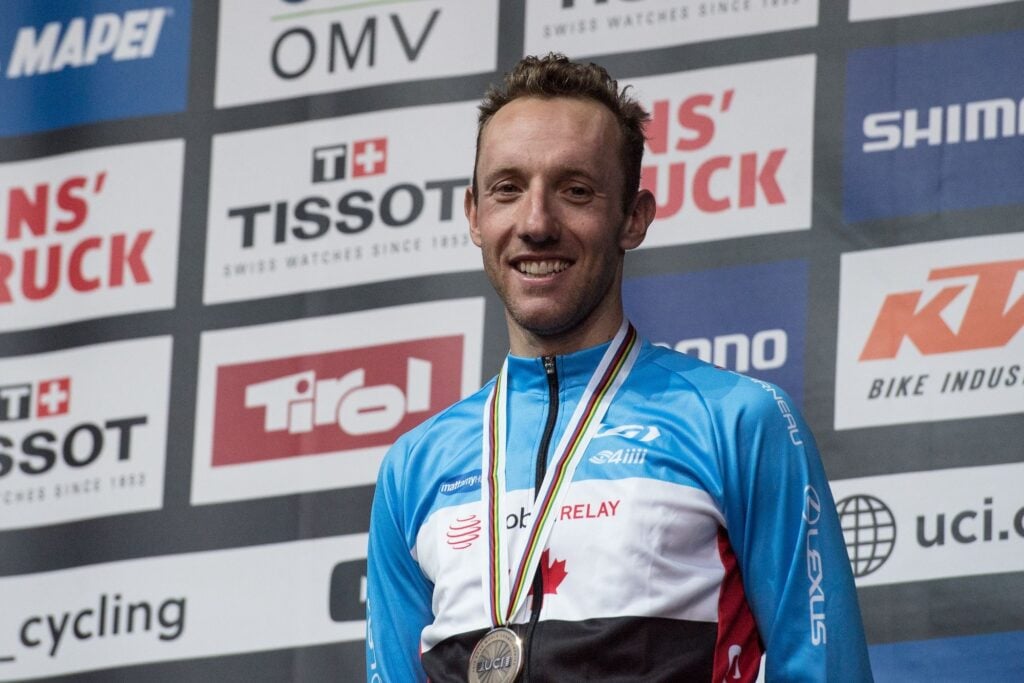
Despite the city’s cycling history, no Canadian has yet won the Grand Prix Cycliste de Montréal in its modern form.
Ryder Hesjedal came closest during the race’s early years, finishing third in both 2010 and 2013. His podiums gave the home crowd a contender during the period when he was also becoming Canada’s first Giro d’Italia winner.
The absence of a Canadian GP Montréal victory provides an interesting contrast with the earlier Grand Prix des Amériques. Steve Bauer won the very first edition of that race in 1988.
Canadian riders still receive an unusual opportunity through the national selection invited to the modern race, allowing domestic riders who may not normally compete on the WorldTour to race against the sport’s leading teams at home.
More than 35 years after Bauer’s Mount Royal victory, however, Canada is still waiting for the equivalent result in GP Montréal.
Mount Royal links every era of Montréal cycling
The names and formats have changed, but Mount Royal is the constant running through Montréal’s cycling history.
It shaped the 1974 World Championships and returned for the 1976 Olympics. The Grand Prix des Amériques used similar terrain during its five-year run. Since 2010, the Grand Prix Cycliste de Montréal has built its identity almost entirely around repeatedly crossing the hill.
That is what makes the race distinctive.
There is no Tourmalet or Alpe d’Huez-sized ascent. Instead, the riders repeatedly tackle Côte Camillien-Houde, the steep roads around the Polytechnique and the rising approach towards Avenue du Parc.
A climb that barely registers early in the race gradually becomes more significant each time it returns. Positioning becomes harder, domestiques disappear and riders lose the ability to recover between accelerations.
The final laps can consequently look completely different from the opening ones even though the roads themselves have not changed.
It is a form of difficulty created through repetition rather than scale.
-
 Photo Credit: Tomasso Pelagalli/SCA/Cor Vos

GP Québec and GP Montréal have grown together
The modern Montréal race would be much harder to sustain without its companion in Québec City.
The two races were deliberately created as a pair in 2010, and their different characteristics have become one of their strengths.
The Grand Prix Cycliste de Québec generally gives faster riders a greater chance. Its short climbs and uphill finale have produced multiple victories for riders such as Sagan, Gerrans and Matthews.
Montréal shifts the equation towards climbing.
That distinction means the same field can race twice within three days without simply repeating the first event. A rider who is difficult to drop in Québec may find the accumulated Mount Royal climbing too much, while a climber who lacks the speed to win on Friday can become much more dangerous on Sunday.
The Canadian pair now occupy an established place within the 2026 men’s racing calendar, bridging the end of the Grand Tour season and the build towards the final major one-day objectives.
The 2026 World Championships bring Montréal full circle
The 2026 Grand Prix Cycliste de Montréal takes place on Sunday 13 September, with the UCI Road World Championships beginning in the city only seven days later.
It is an unusually significant edition.
The Championship road races use many of the same Mount Royal roads, so GP Montréal becomes far more than a normal preparation event. Riders targeting the rainbow jersey can test their form at full WorldTour intensity on terrain that will matter again only a week later.
That connection brings the history of Montréal cycling almost perfectly full circle.
In 1974, Mount Royal hosted the World Championships when the event left Europe for the first time.
The Grand Prix des Amériques later returned elite professional racing to those roads.
The modern GP Montréal established them as an annual WorldTour fixture from 2010 onwards.
Now the World Championships are coming back.
Pogačar had been an obvious central figure in that story after winning GP Montréal twice, but his Stage 8 crash and withdrawal from the 2026 Vuelta a España has thrown his entire September programme into doubt. Whether he can return to the roads where he won in 2022 and 2024 will depend on his recovery from a fractured clavicle, concussion and stable C7 fracture.
Even without him, the historical connection remains unusually strong. The same Mount Royal terrain that crowned Eddy Merckx more than half a century ago will host a WorldTour Classic on 13 September and then help decide another rainbow jersey only days later.
For a race first held in 2010, the Grand Prix Cycliste de Montréal is remarkably young.
The roads on which it is raced are anything but.

