
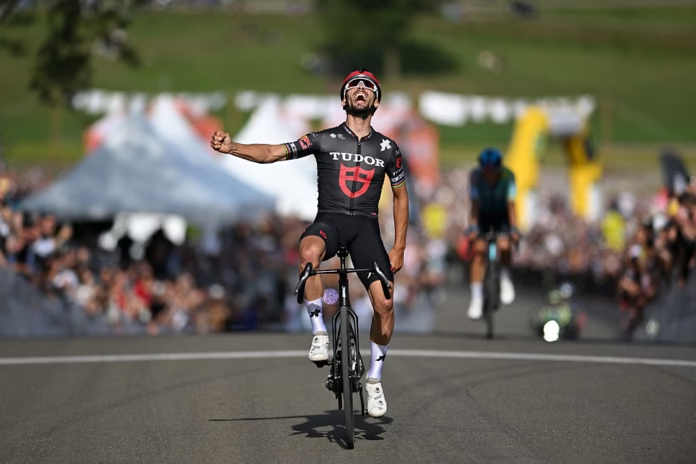
Remco Evenepoel arrives at the Grand Prix Cycliste de Québec as the strongest individual rider on the start list, but Friday’s race gives him no obvious way to turn that status into a straightforward victory.
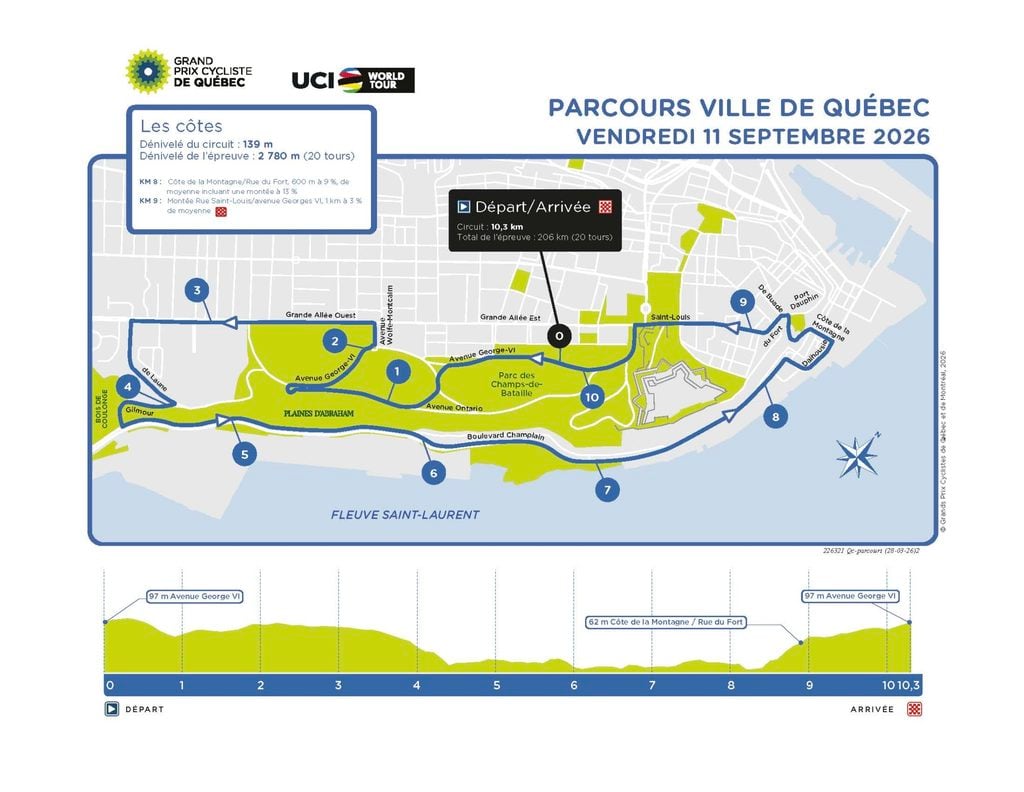
The redesigned Québec City circuit covers 206km across 20 laps of 10.3km, producing approximately 2,780 metres of climbing. Each lap contains the Côte de la Montagne, 600 metres at 9% with sections approaching 13%, before another kilometre of rising road towards the finish on Avenue George VI. The full GP Québec 2026 route guide explains why shortening the circuit has actually concentrated the race’s difficulty.
That leaves several different types of rider with a chance. Evenepoel, Tom Pidcock, Isaac del Toro and Paul Seixas can try to break the race apart. Michael Matthews wants enough of those attacks neutralised to reach the final kilometre with a group. Matteo Jorgenson, Maxim Van Gils, Quinn Simmons and Mauro Schmid can exploit the moments when the principal favourites start looking at each other.
The absences matter too. Tadej Pogačar’s season ended after his Vuelta crash, Mathieu van der Poel has changed his programme and will race the Tour de Luxembourg instead, while Arnaud De Lie has withdrawn from both Canadian WorldTour races because of illness.
There is no defending champion either, with Julian Alaphilippe having retired earlier this season. The full GP Québec 2026 start list therefore contains plenty of quality without the race having an obvious controlling force.
Why the new circuit makes Québec difficult to predict
Québec has always occupied the space between a puncheur’s Classic and a race for unusually durable fast finishers.
Michael Matthews is the clearest example. He has won three times because he can repeatedly absorb the short climbs and still sprint after more than 200 kilometres. Peter Sagan and Simon Gerrans succeeded for similar reasons, while Benoît Cosnefroy and Julian Alaphilippe showed that waiting for a sprint is not compulsory.
The history of GP Québec is unusually varied for a race using the same roads lap after lap.
The 2026 changes could make control harder. There are only 10.3km between each passage of the Côte de la Montagne, so teams have less time to recover, reorganise and retrieve attacks. By the nineteenth and twentieth ascents, the issue is not whether a rider can climb 600 metres at 9%. It is whether they can still produce the acceleration after being asked essentially the same question for almost five hours.
There is also more than two kilometres remaining when the riders hit the foot of the final Côte de la Montagne. Anyone attacking there still has to hold the effort through the gentler uphill road towards the Plains of Abraham.
That is good news for both attackers and chasers. A small gap can survive, but a rider who goes too deep on the steep section can still be caught.
Remco Evenepoel has several ways to make the race harder
Evenepoel is the logical favourite because few riders in the field can match the range of efforts he can produce.
His 2026 Tour de France ended with second overall after a particularly strong final week, including victories on Plateau de Solaison and in the individual time trial. The final classifications also put several of Friday’s rivals close to the front of the Tour, with Del Toro third, Seixas fourth and Pidcock ninth. The Tour de France 2026 final results underline how much of that generation has converged on Québec.
Evenepoel’s problem is that the Côte de la Montagne may be slightly too short for a simple final-lap demonstration of strength.
Pidcock and Seixas possess enough acceleration to follow a sharp attack. Del Toro is unlikely to disappear simply because the pace rises for one minute. Van Gils gives Red Bull-Bora-hansgrohe another rider capable of surviving a very selective finale.
Evenepoel may therefore be more dangerous before the obvious moment.
An attack on the penultimate lap, or even earlier if a strong group has already formed, forces other teams to decide who will chase. Nobody wants to give Evenepoel 15 seconds and open road, but using domestiques to close him repeatedly can leave those teams exposed when the final lap begins.
The alternative is to wait longer and trust his improved finishing speed. That is viable against many of the climbers, but considerably less attractive if Matthews, Corbin Strong or Paul Lapeira remain in the group.
Evenepoel should be capable of winning Québec. The harder question is whether his rivals allow him to race it on his terms.
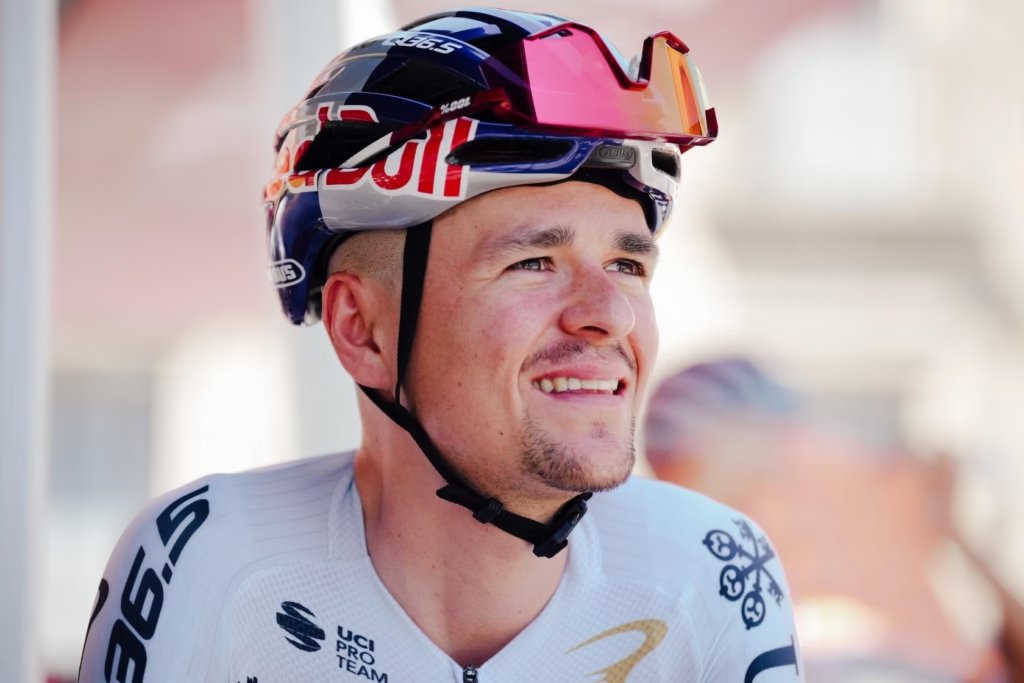 Photo Credit: A.S.O./Thomas Maheux
Tom Pidcock arrives with immediate evidence of form
Pidcock could hardly have produced a better final preparation race.
He returned to road competition at Sunday’s GP Industria & Artigianato in Larciano and won alone after attacking on the final climb with around 12 kilometres remaining. Christian Scaroni led the chase home 12 seconds later.
That came only a week after Pidcock won the elite cross-country mountain bike world title at Val di Sole.
The significance for Québec is not simply that he has won twice. It is the manner of those performances. Pidcock has already shown that his acceleration is there, that he can commit to a move before a finish and that he can hold a small gap once the road becomes quicker.
Friday’s finale suits those qualities.
Waiting beside Matthews until the final few hundred metres makes little sense, but Pidcock does not have to attack from 50 kilometres out either. The final two passages of the Côte de la Montagne provide obvious opportunities to force a small selection and then use his descending, positioning and acceleration to make that advantage stick.
He may also be one of the riders least inconvenienced by an untidy race. Evenepoel generally benefits from creating separation and sustaining it. Matthews wants the right group brought to the finish. Pidcock can operate between those two scenarios.
That versatility makes him one of the strongest candidates for Friday.
Isaac del Toro needs the repeated climbs to remove the faster riders
Del Toro’s 2026 season has moved him well beyond promising-young-rider status.
He won the UAE Tour, Tirreno-Adriatico, Tour Auvergne-Rhône-Alpes and Deutschland Tour before completing his debut Tour de France in third overall and taking the white jersey.
Québec is a more awkward race for him because none of the climbs is long enough for sustained climbing ability alone to decide the result.
His opportunity comes from accumulation.
Twenty passages of the Côte de la Montagne allow UAE Team Emirates-XRG to keep increasing the cost of remaining near the front. Del Toro does not need Matthews or the other quicker finishers to be dropped the first time the favourites race the climb properly. He needs them to spend more with every repetition until their sprint is either gone or they lose contact completely.
UAE also have Brandon McNulty in their Canadian programme after his victory at GP Montréal last year. That gives the team another rider comfortable attacking before the final lap rather than placing every responsibility on Del Toro.
The tactical danger is doing too much. If UAE spend the final hour driving the race only for Evenepoel or Pidcock to attack over the top of their work, Del Toro could find himself creating the perfect race for somebody else.
Michael Matthews is still the rider the attackers need to eliminate
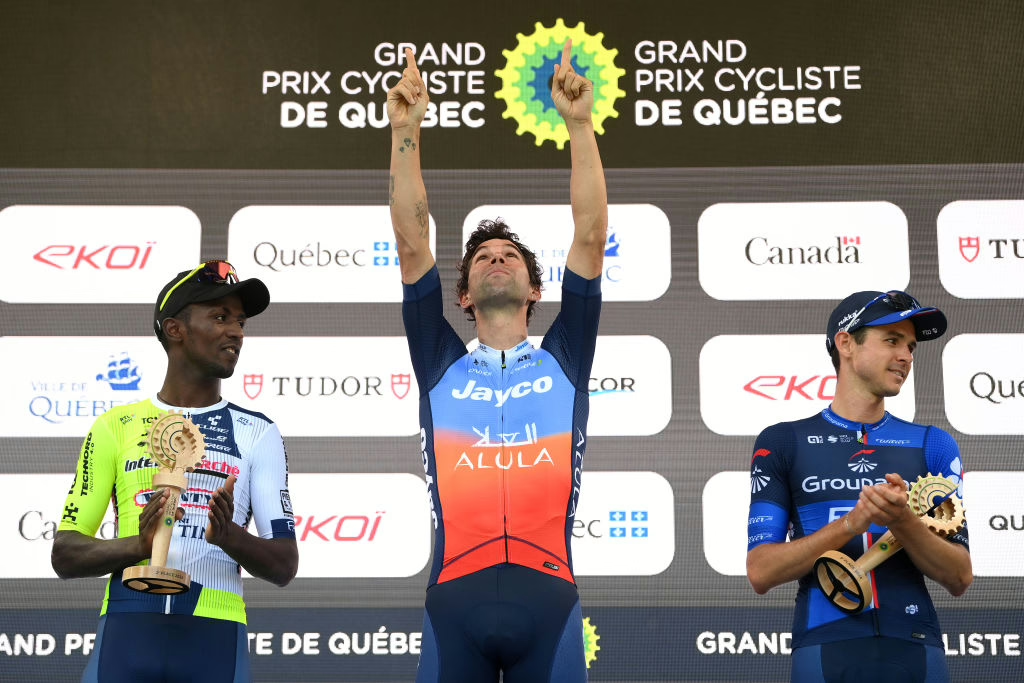
Matthews is 35 and facing a field containing several of the best younger riders in the sport. None of that changes what he has repeatedly done in Québec.
He won in 2018, 2019 and 2024. He has also finished second twice and third twice. His record is not based on one particular version of the circuit or one exceptional season. He has remained competitive here across different course configurations and different generations of rivals.
That makes Matthews the obvious reference whenever the front group remains substantial.
Nobody needs to wonder what Jayco AlUla want. Keep Matthews protected, survive the repeated attacks and deliver him towards the final uphill kilometre with enough riders around him to discourage late moves.
The difficulty is that the 2026 circuit gives rival teams 20 opportunities to undermine that plan.
Mauro Schmid is important because he gives Jayco an option away from Matthews. Schmid can follow attacks during the final laps and is quick enough that rivals cannot give him much freedom. If he is present in a dangerous move, Jayco can stop chasing and leave somebody else to solve the problem.
For Matthews, every lap completed without being isolated improves the equation.
If 20 or 25 riders enter the final kilometre together, he may still be the man to beat.
Paul Seixas has already earned a place among the favourites
There is very little point continuing to treat Seixas as an outsider because he is 19.
He has won Itzulia Basque Country and La Flèche Wallonne this season and finished fourth overall at the Tour de France. Those results establish his level without any need to project what he might become.
Québec should suit him, although Montréal’s heavier climbing is probably an even cleaner fit.
The Côte de la Montagne provides the explosive effort Seixas wants, while repeating it 20 times should progressively favour the strongest riders. The complication is the road after it. Creating five seconds over the steep section does not automatically translate into five seconds at the finish.
Decathlon CMA CGM have enough alternatives to avoid making Seixas chase every move himself. Tiesj Benoot can work deep into a hard one-day race, while Lapeira gives the team a faster option if a larger group survives.
That should allow Seixas to be selective with his attacks.
He is most dangerous if somebody else has already made the race difficult.
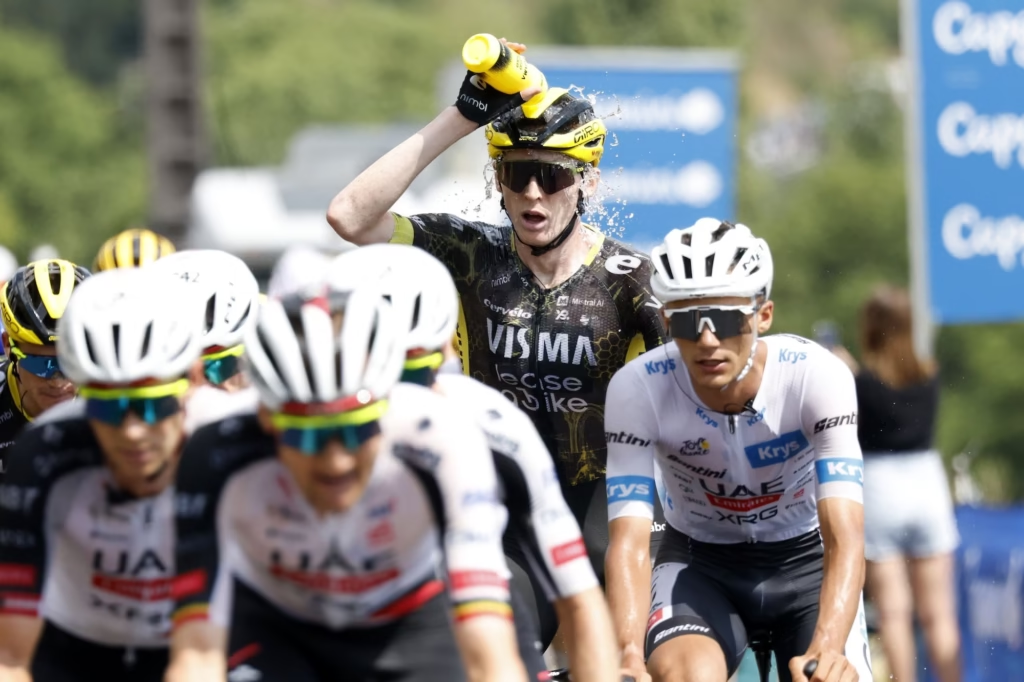
Matteo Jorgenson gives Visma a strong option in an aggressive race
Matteo Jorgenson deserves more attention than he sometimes receives in a field dominated by Evenepoel, Pidcock and the young Tour performers.
Visma | Lease a Bike have several cards, with Louis Barré, Bart Lemmen and Wilco Kelderman also listed for Québec, but Jorgenson is the rider most capable of converting a hard final hour into a major result.
A conventional reduced sprint is not ideal for him. A race where groups are continually forming and reforming is much better.
Jorgenson has the engine to attack from further out and enough climbing ability to remain relevant when the repeated Côte de la Montagne ascents begin removing riders. He can also afford to make a move before the recognised favourites because his team does not have Matthews waiting behind demanding a controlled finish.
Barré may be equally useful tactically. His recent Deutschland Tour performances showed improved form, and his more explosive profile gives Visma a second rider capable of following the sharpest accelerations.
The team have little reason to ride conservatively.
Maxim Van Gils can benefit from everyone watching Evenepoel
Van Gils is one of the most useful second leaders in the race.
If Evenepoel attacks, Van Gils does not have to contribute to the chase. If another favourite moves, he can follow without immediately becoming responsible for making it work. If the front comes back together, his finishing speed still gives Red Bull another option.
That combination can become particularly important on a circuit race.
The final three laps are likely to contain repeated short-lived moves rather than one clean selection. Every time Evenepoel forces another team to chase, Van Gils saves energy. Every time Van Gils gets into a move, rival teams have to decide whether they can risk allowing an accomplished hilly Classics rider to stay there.
Red Bull’s strongest tactic may therefore be refusing to reduce Québec to an Evenepoel-versus-everyone contest.
Lidl-Trek have too many options to ride passively
Quinn Simmons, Juan Ayuso and Giulio Ciccone give Lidl-Trek three very different ways to influence the finale.
Simmons is perhaps the most naturally suited to attacking before the favourites expect the race to be decided. He finished third at GP Montréal last season and rarely needs an invitation to move from distance.
Québec rewards that willingness.
An attack with 20 or 30 kilometres remaining does not have to contain the strongest rider in the race. It needs enough team representation behind that nobody wants to chase immediately.
Ayuso and Ciccone strengthen that possibility because Lidl-Trek can place one rider ahead without abandoning the finale. If Simmons goes, other teams carry the responsibility. If everything returns, Ayuso and Ciccone still have the climbing ability to remain involved.
The one scenario Lidl-Trek should want to avoid is simply escorting Evenepoel and Pidcock towards the final Côte de la Montagne.
Their strength lies in making those riders respond earlier.
 Photo Credit: Getty
Ben Healy and Alberto Bettiol need the race to break before the final climb
Ben Healy is another rider whose prospects improve when the finale becomes disorganised.
He does not want Matthews in the group and he probably does not want to wait for a final explosive acceleration against Pidcock or Evenepoel either. His best opportunity is to become part of the move that forces everybody else to make difficult decisions.
The same applies to Alberto Bettiol, although the Italian has particularly useful evidence from this race.
Bettiol finished third in 2025 after being part of the late selection with Alaphilippe and Pavel Sivakov. He already knows how quickly a small advantage can become decisive once the strongest teams hesitate behind.
The 2026 circuit provides even more opportunities for that sort of attack.
Neither Healy nor Bettiol should be judged solely by whether they can follow the final acceleration. If they are still sitting anonymously in the main group at the foot of the twentieth Côte de la Montagne, they have probably waited too long.
Mauro Schmid could become Jayco’s attacking option
Schmid should not be viewed simply as support for Matthews.
His finishing speed makes him dangerous from a reduced group and his strength over repeated short climbs gives him scope to follow attacks that Matthews may prefer to let go.
That places rivals in an awkward position.
If Schmid joins Pidcock, Van Gils or Simmons late in the race, Jayco have no reason to chase. If another team retrieves the move, Matthews returns to contention without his own team having spent the energy.
Schmid was second on Stage 18 of this year’s Tour de France behind Richard Carapaz, another reminder that he can remain effective deep into demanding races.
Québec may require exactly that balance between aggression and endurance.
The faster outsiders need Evenepoel and Del Toro to leave something behind
Paul Lapeira, Corbin Strong and Jenno Berckmoes become increasingly relevant if the strongest attackers fail to produce a small final group.
All have more interest in arriving at the finish with numbers than joining a long-range contest against Evenepoel.
Lapeira has the added advantage that Decathlon’s principal attention will fall on Seixas. If Seixas attacks and forces rivals to chase, Lapeira can conserve himself for a finish.
Strong has already demonstrated that Québec suits him, finishing second behind De Lie in 2023, while Berckmoes occupies a similar space between puncheur and sprinter that has traditionally worked well here.
Lennert Van Eetvelt, Dorian Godon, Anthon Charmig and Michael Woods add still more possible attackers to a race where team control could disappear quickly during the closing laps.
Woods is a particularly unusual presence. He has come out of road retirement temporarily as part of his build towards the Montréal World Championships, giving the Canadian crowd a familiar home rider even if the steeper Montréal circuit should suit him considerably better.
-
 Photo Credit: Getty
 -
 Photo Credit: Getty

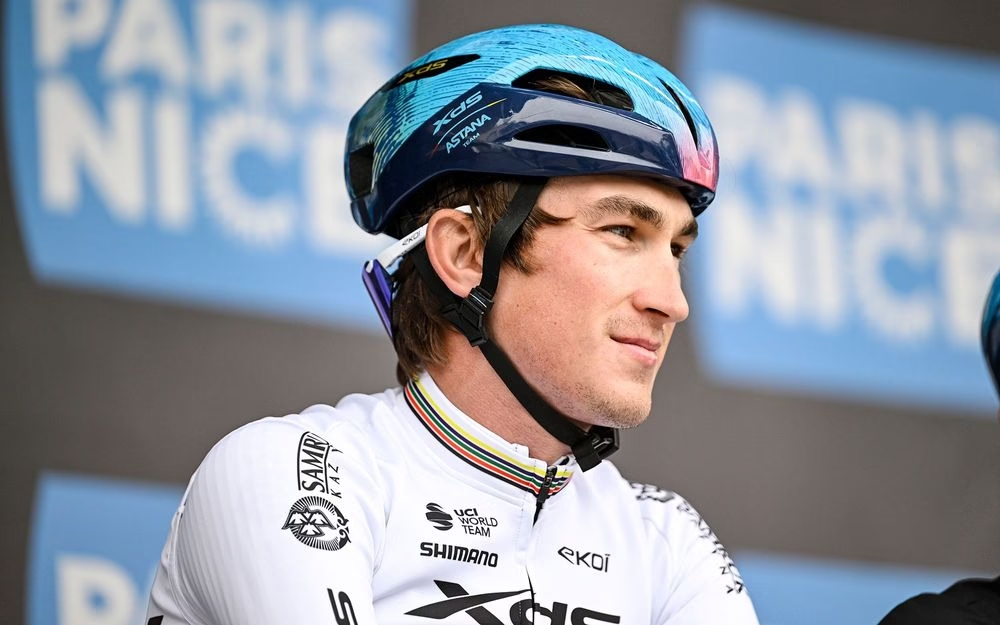
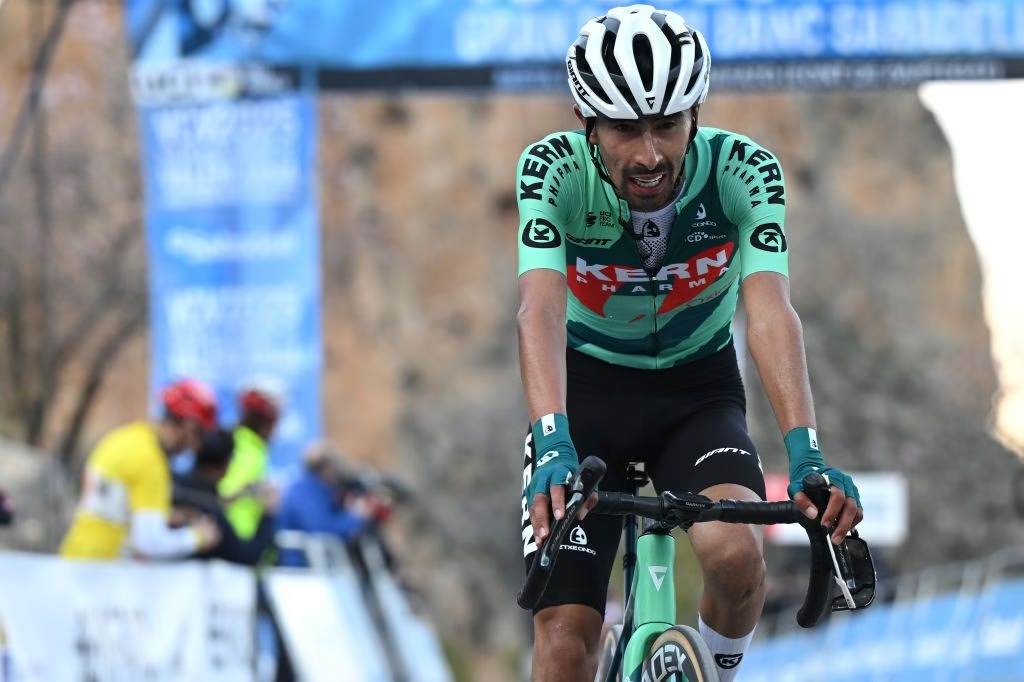
Why Matthews may benefit from the missing favourites
The absence of De Lie is especially significant.
At full fitness, the 2023 winner would have given the fastest finishers another team willing to help control late attacks. Instead, Lotto-Intermarché arrive without the rider best suited to carrying that responsibility.
Van der Poel’s absence removes another competitor who could both attack and win from a fast finish. Pogačar would almost certainly have increased the pressure much earlier.
Their removal does not simply weaken the field. It changes who has an incentive to work.
If Pidcock attacks with Simmons and Van Gils during the penultimate lap, who chases?
Jayco may have to because of Matthews. Decathlon may refuse if Seixas or Benoot is present. UAE may sit behind if Del Toro has made the selection. Red Bull certainly will not help if Van Gils is ahead.
Those decisions are where Québec can escape from the strongest rider on paper.
GP Québec 2026 prediction
Evenepoel deserves favourite status. He has the power to turn a moment of hesitation into a decisive gap and enough finishing speed that rivals cannot assume simply following him will solve the problem.
Del Toro and Seixas benefit if the repeated climbing makes the race relentlessly hard, while Matthews remains the clearest winner if a sizeable group survives.
Pidcock has the most attractive balance between those scenarios.
He arrives immediately after winning alone at Larciano, has the acceleration to respond on the Côte de la Montagne and does not need a completely fractured race to remain competitive at the finish. He can attack before Matthews becomes dangerous without being forced to race from the same distance as Evenepoel.
Prediction: Tom Pidcock
Evenepoel is the biggest threat, with Matthews the rider most capable of punishing everyone if the attacks fail. Del Toro and Seixas complete the main group of favourites, while Van Gils, Jorgenson, Simmons and Schmid are the riders most likely to take advantage if the expected contest becomes tactical.
For viewers in the UK, the race begins at 16:00 BST on Friday 11 September, with the decisive final laps expected later in the evening. The broadcast details and expected viewing window are in our GP Québec 2026 TV and live stream guide.

